
YOU CAN ALWAYS BE SAFER

The archetype of a prudent man … he wears both a belt and suspenders.
No matter how safe you try to be, there is always something else you could have done to be safer. We all make compromises when the utility of what we are doing to be safer becomes more burdensome than the incremental increase in safety our actions attain. On one hand, it’s safer to wear seat belts than not to wear them, and the cost of wearing them is exceedingly slight compared to the benefit derived. On the other hand, while it would be a lot safer for all traffic not to exceed 15 mph, the cost of such a rule far outweighs the benefits derived from enforcing it.
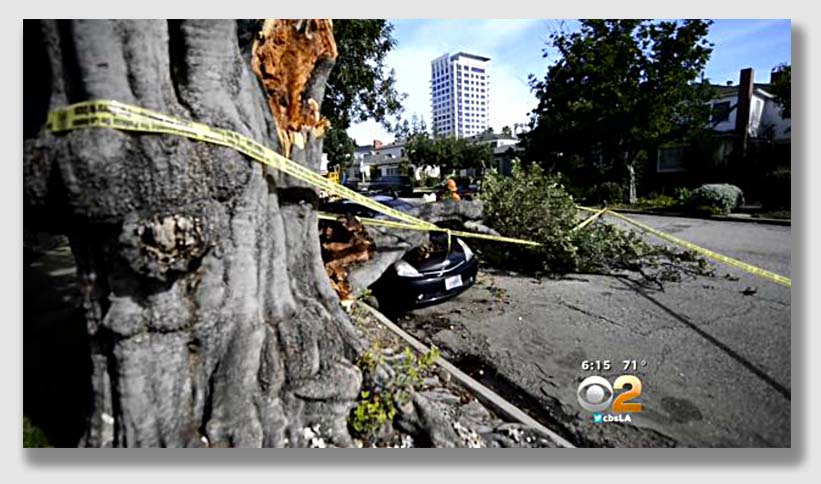
A similar situation applied in this landmark municipal liability case from Omaha. During a windstorm, a motorist pulled over because he couldn’t see to drive. A tree belonging to the City fell, hitting his car and paralyzing him. The tree, a silver maple, was badly decayed. The motorist sued the City, arguing that for a tree owner to permit a danger tree to stand violated the City’s own ordinances. At trial, the disabled plaintiff was awarded $5 million.
On appeal, however, the Supreme Court of Nebraska was more persuaded by the City’s argument that if every person in its arborist crew spent an entire work year inspecting silver maple trees, each tree would only receive a 12-minute inspection. The City had a tree inspection program in place, and the Court found it reasonably conceived and discharged. Could the City have done more? Certainly. Had it done more, would the damaged tree have been found? No one could say.
The City’s tree inspection program was reasonable, and that was all that was required. The verdict was reversed.
 McGinn v. City of Omaha, 217 Neb. 579, 352 N.W.2d 545 (S.Ct. Neb., 1984). Mr. McGinn was driving in the City of Omaha on a rainy, blustery afternoon when the inclement weather made him pull over to park. As he was doing so, a silver maple tree fell in front of him, and a branch struck his car, rendering him a quadriplegic.
Photographs taken after the accident revealed that the trunk of the tree was extensively decayed. McGinn sued the City, arguing it was negligent in failing to inspect the tree for disease, decay, and structural defects, and in violating a city ordinance making it unlawful for a landowner to permit a dangerous tree to stand. The City countered that McGinn was contributorily negligent and that the storm, which could not have been reasonably anticipated, caused the tree to fall. The trial court rendered judgment in favor of McGinn and awarded $5 million in damages.
The City appealed.
Held: The judgment was reversed. The Nebraska Supreme Court held that city was not negligent for having failed to remove the tree where there was no evidence that the inspection program conducted by the city was negligently designed or carried out, or that the tree had been found to be hazardous as a result of any inspection made by the city.
Normally, governmental units are liable under ordinary negligence principles for injuries or damages resulting from a tree falling onto a public road from land in the governmental unit’s possession. In this case, while McGinn was correct that the City had violated an ordinance that rendered it unlawful for any property owner to permit a diseased or structurally weak tree to stand on his property, the violation was at most evidence of negligence and did not impose strict liability on the City. Rather, negligence must be measured against a particular set of facts and circumstances present in each case, and the utility of the City’s conduct must be measured against the magnitude of the risk.
 Here, the City had established an annual inspection program to check for hazardous trees. The program was neither negligently designed nor negligently carried out. Alternatives might have reduced the risk, such as cutting down any silver maple older than a certain age or conducting lengthy, individual tree inspections, but these remedies were expensive and unreasonable. There was no indication that the tree that fell on McGinn’s car during the severe storm had been found to be hazardous during any prior city inspection.
Thus, the Court said the city was not negligent for failing to have the tree removed and was not liable for personal injuries sustained by McGinn.
The takeaway here is that, in assessing the reasonableness of a defendant’s actions, courts traditionally consider the magnitude of the task. A homeowner with ten trees cannot reasonably fail to ascertain the condition of his or her trees. A municipality with 10,000 trees can get away with failing to ascertain the condition of any particular tree if it has an inspection program that strikes a reasonable balance between cost and efficacy.
– Tom Root


