

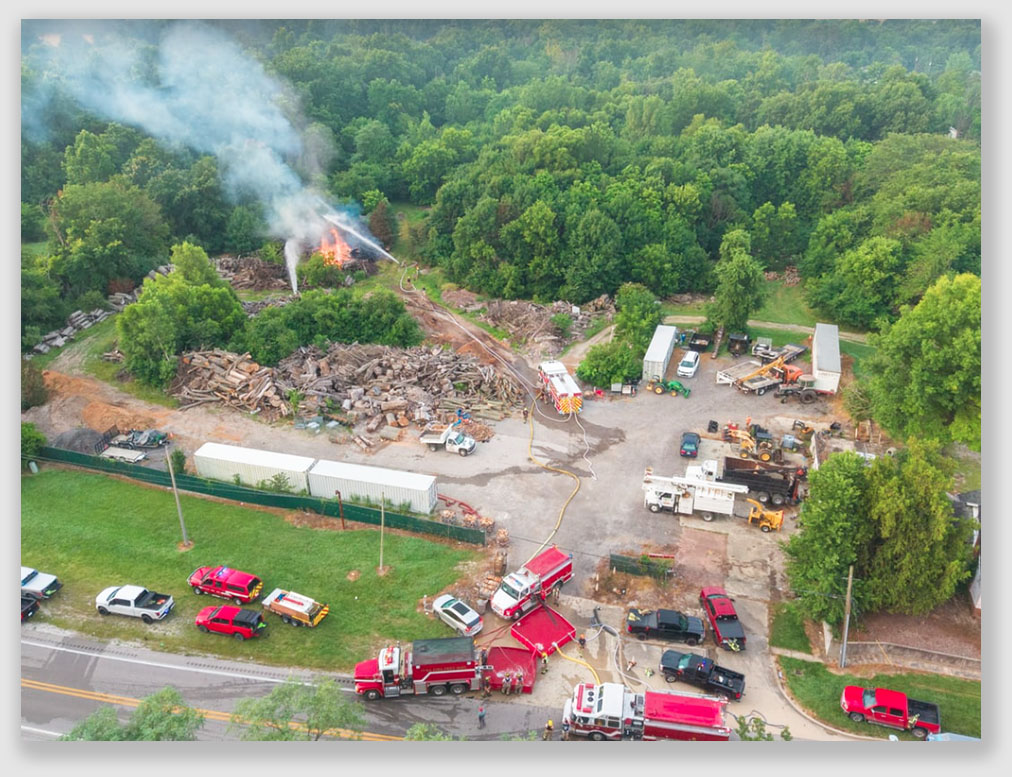
A fire that is believed to have started from spontaneous combustion in large logs stored outside Top Notch Tree Service on East Main Street in Salem is under control, but is expected to burn out over the next few days. Salem Assistant Fire Chief Bill Fulton says the city used a track hoe to split the burning trees from those not on fire to keep the fire from spreading. He says flames were shooting from the trees upon their arrival. “Found was part of the pile of debris that they bring in form the tree service was on fire towards the very south end. It’s all interconnected, so what we tried to do is put a stop between it and the major part of the pile. It would be hard to get the whole pile completely disposed of and put out.” The fire department was later assisted by Salem Public Works who brought an end loader to the scene to cut a bigger gap between the burning and non-burning trees. The city then pushed together the burning trees so they could be allowed to burn themselves out. Fulton believes he knows the cause of the fire…
Boston, Massachusetts, Globe, July 7, 2026: In the woods of Maine, searching for an answer to a ticking climate bomb
Scientist Kathleen Savage leaned out from the basket of a boom lift, a red safety helmet perched on her head. She sealed a few needle-covered stalks from an Eastern Hemlock tree inside a clear plastic cylinder and pulled out her phone. On the screen, a meter rose and fell as the level of gases inside the cylinder fluctuated. The question she was asking: What were the microscopic bugs on the stalks and leaves doing in there? The answer would provide limited data — just one point, from one portion of a tree in one forest. But looked at another way, it could also buy the planet critical time as the world races to address the climate crisis… Science Daily, July 8, 2026: Trees keep absorbing carbon long after they stop growing
Trees do not necessarily keep growing for as long as they keep photosynthesizing, according to a new study published in Science Advances. Researchers found that oak trees continue absorbing carbon dioxide well after their annual growth has ended, suggesting forests may store less carbon in wood than many climate models currently predict.
The discovery challenges a long-standing assumption that higher rates of photosynthesis naturally lead to greater tree growth. If trees continue taking in carbon without turning much of it into new wood, less carbon may remain locked away over the long term. Forests play a major role in slowing climate change because trees remove carbon dioxide (CO2) from the atmosphere and store much of it in their trunks, branches, and roots. Scientists have generally expected that rising atmospheric CO2 levels would boost photosynthesis, leading to faster growth and increased long-term carbon storage…
Las Vegas, Nevada, KLAS-TV, July 8, 2026: Summerlin neighbors say officials know why hundreds of mature trees are dead, missing
The bark of the ash tree in front of a Las Vegas post office is unseasonably dry and waning. It’s barely budding, and Summerlin neighbors said elected officials know why, but they want you to see that not much is being done to change the situation. Approximately 200 mature ash trees are dead or missing in the North Summerlin area and many more in Hills Park, after the early implementation of Nevada Assembly Bill 356, passed in 2025, which imposes restrictions on most grass across the valley. The January 2027 deadline is spurring the removal of “nonfunctional grass.” However, it appears that miles of grass removed was essential to the life of hundreds of over 20-year-old trees throughout the Summerlin area. Once the grass was removed around the summer of last year, some in other phases, the trees appeared to decline rapidly…
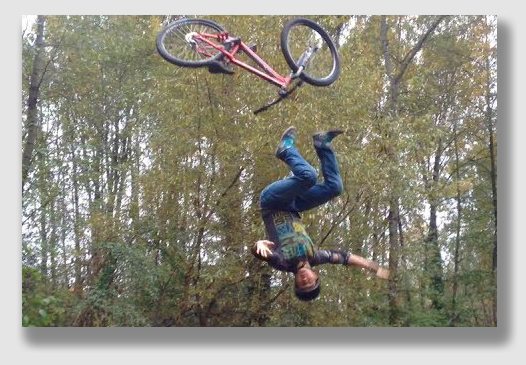
Two Vermont men have agreed to pay $35,000 and remove unauthorized trail features after state officials alleged they illegally built mountain bike trails in Mt. Mansfield State Forest, the Vermont Attorney General’s Office announced. Attorney General Charity Clark said Cyril Brunner and Aaron Rice settled allegations that they unlawfully constructed approximately 8,000 feet of mountain bike trails in the state forest in Stowe between 2016 and 2021. “No one should be treating state land and state forests like their backyard,” the attorney general said Wednesday. An investigation by the Vermont Agency of Natural Resources found the men cut down about 327 trees and permanently altered rocks by drilling holes to anchor wooden trail crossings, according to the settlement. “The investigation was probably done by the Agency of Natural Resources and they referred the case to us,” said Clark. “We get this information about what had happened and then take the steps we need to hold the bad actors accountable for the timber trespass…”
The Economist, July 8, 2026: How the biggest trees survive droughts
Towering over 100 metres above the forest floor, the dipterocarp—named after its winged seeds, which spiral away in the wind—is the tallest tropical tree in the world. For a plant, being tall is an advantage: if your neighbours cannot overshadow you, that leaves you with the lion’s share of the sunlight. But trees need water as well as light, and here being tall presents a problem. The physics of moving liquid through thin channels means that the taller a tree gets, the harder it is to pump water from the soil to the leaves in the crown. Scientists had assumed that would leave big trees, like dipterocarps, more vulnerable than their more diminutive competitors when water was scarce. But in a paper published on July 2nd in Science, a team led by Paulo Bittencourt of Cardiff University have shown that, thanks to some clever evolutionary engineering, that is not true. A tree’s trunk contains a network of tubes known as xylem whose job is to ferry water from the roots to leaves. While many animals pump fluid around their bodies with a heart, trees rely on evaporation to keep the liquids flowing. As water in the leaves escapes into the air, it creates suction in the xylem. That draws more water up to fill the space. That process is aided by the properties of water itself. Water molecules tend to cling to their neighbours, so that as one is drawn up, others follow. The molecules also adhere to the walls of the xylem, helping to counteract the downward pull of gravity…

A controversial transmission project that would cut hundreds of mature trees on about 5 acres of Portland’s beloved Forest Park is likely to move forward under a new agreement between Portland General Electric and the city of Portland. Opponents say the deal could set a precedent for additional utility projects and more environmental damage in the park. The project would require PGE to fell more than 370 of the nearly 700 trees assessed within the project area, primarily Douglas firs. Many Oregon white oaks, bigleaf maples and lower-growing vegetation would remain, the utility said, because they are less likely to conflict with the transmission lines…
Deutsche Welle, July 8, 2026: The Australian tree reshaping the world’s wildfires
Each year, more than 400,000 hikers descend on Galicia for the Camino de Santiago pilgrim walk, crossing misty hills and dense green woodland. But much of the forest surrounding the route is no longer native. Instead of indigenous oak and chestnut, large parts of northwestern Spain are now dominated by eucalyptus. That transformation is not unique to Galicia. Prized by the pulp and timber industries for its rapid growth and profitability, vast monocultures of the Australian tree have been planted in places such as Brazil, Chile, California, India and South Africa. Globally, eucalyptus plantations now cover 22 million hectares across more than 90 countries, and in many regions, they have become a cornerstone of rural economies. But hiding beneath the seemingly tranquil canopies are landscapes vulnerable to extreme wildfires because scientists regard the trees as highly flammable…
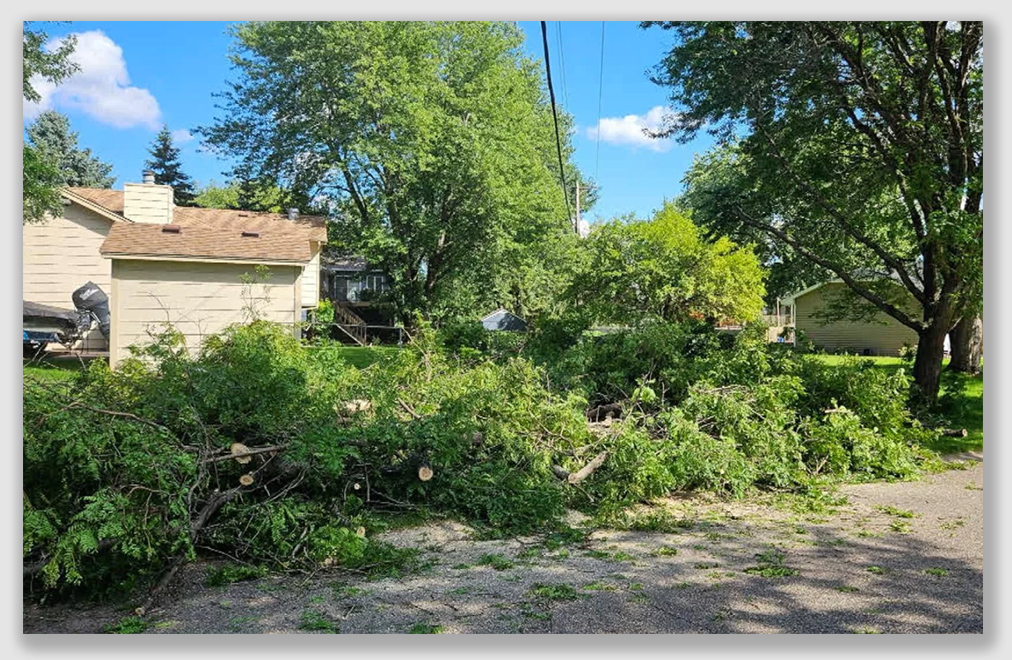
The city of Wichita is warning residents to not trim or cut trees on city property after video began circulating of a partygoer trimming tree branches at Sunday’s World Cup watch party. Monday morning, a Wichita Eagle reporter verified the video by going to the downtown park and noticed branches that had been recently cut and a pile of small limbs set aside on a nearby sidewalk. The video in question said the branches were in the way of the screen at the park showing the Mexico v. England game. “Trees in our parks are public assets that enhance the park experience for all visitors, and any pruning or maintenance is performed by authorized City staff,” city spokesperson Tyler Schiffelbein said. City ordinance strictly prohibits unauthorized cutting or alteration of trees on city property…
A Palm Springs-based nonprofit organization focused on protecting local wildlife and wildlife habitats urged the city today to reject a proposal to remove more than 2,000 dry fronds from city-owned palm trees. According to a proposal going before the Palm Springs City Council on Wednesday, city staffers are calling for the removal of dry fronds, otherwise known as skirts, from California fan palms located in pedestrian areas to eliminate potential risks to the community. A skirt can potentially injure pedestrians or arborists when they fall, since skirts can weigh more than 1,000 pounds, according to the staff report. Additionally, roof rats and cockroaches are known to nest in palm tree skirts throughout Southern California, posing health risks since they both can carry serious diseases, according to the report. If the proposed resolution moves forward, the city’s roughly 2,150 California Fan Palms — under the classification of Washingtonia filifera and Washingtonia robusta — will be removed of skirts, fruit pods and trunks over the next four years at a cost of $300,000…

 Tree and Neighbor Law For Homeowners and Professionals