

 CNN, June 17, 2026: Ancient Sherwood Forest oak tree reputed to have sheltered Robin Hood has died
When knights of old went looking for Robin Hood, they knew where to find him. The legendary outlaw has been associated with England’s Sherwood Forest for centuries, and one tree in particular has traditionally been cited as his hideout: the Major Oak. Scientists now believe this 1,200-year-old oak tree has died after it failed to produce any new leaves this spring, British conservation body the Royal Society for the Protection of Birds said in a news release. With a canopy spread of 28 meters (92 feet) and a trunk circumference of 11 meters (36 feet), the Major Oak was one of the biggest trees in Britain. Supports for some of the branches were put in place in the early 20th century, and the tree was fenced off in the 1970s…
Ottawa, Ontario, CTV News, June 16, 2026: A tree in this Ottawa homeowner’s yard is destroying her home, but she can’t cut it down
By looking at the damage, it appears as if an earthquake hit Nicole Robert’s house. But the root cause of all the damage to her home in Ottawa’s Copeland Park neighbourhood is a maple tree in her front yard. Specifically, the tree’s roots. “The front of my house sank, and the brick became separated from my foundation. The house is cracked. There is enough force to crack through my brick, which I guess when that happens, it’s a substantial force,” Robert said. Robert noticed last summer that her house started shifting when doors wouldn’t stay closed and windows could not open. Upon further inspection, she found major cracking and separation along her foundation and brick siding. She brought in three different engineers to assess why it was happening. “They determined that the cause of the movement was trees. The tree roots sucking the moisture out of the ground,” said Robert. “[The roots] can’t go that way because of the street, there’s no water. So where are they getting pushed to? Well, they’re getting pushed back to my home…” New York City, The Wall Street Journal, June 16, 2026: Vultures Are Stinking Up This North Carolina Town. Locals Want Justice.
These days, you have to watch where you step in parts of this picturesque hamlet. Those white splashes on the sidewalk aren’t fresh paint. They’re vulture poop. Lots of it. Large groups of black vultures have taken up residence in town, covering the quaint historic district in feathers and foul-smelling excrement. Poop was so thick beneath one tree that people slipped on the sidewalk when it rained. When public-works crews went to hose down the area, they couldn’t complete the job. The smell was so overwhelming that workers started retching. Now, the malodorous mess has led to legal squawking between the town and two of its residents. In March, the Town of Hillsborough sued Kenneth and Linda Ostrand, demanding they stop feeding a large group of the black vultures roosting on their property…
Real Simple, June 16, 2026: 6 Trees You Should Never Plant in Your Yard, According to the Experts
Outfitting your yard with beautiful flowers, shrubs, and trees comes down to far more than aesthetics alone. Often, the best choices are low-maintenance plants that are native to the environment, thrive brilliantly on their own, and (as a nice bonus) show off with some pretty foliage. This is true of anything you add to your landscaping, but trees require an extra level of scrutiny to ensure they pass the backyard vibe check. Once established, they’re far more difficult to remove, and their larger canopies can lead to a lot more maintenance compared to, say, a knee-high shrub. We spoke with arborists and landscapers about which trees are bad choices for your yard so you can spare yourself the headache. Despite its name, the Tree of Heaven isn’t exactly a homeowner’s delight. Not only is it intrusive both by seed and sucker, but it can become unwieldy and very difficult to control, warns Tammy Sons, landscaping expert and founder of TN Nursery. But wait, it gets worse…
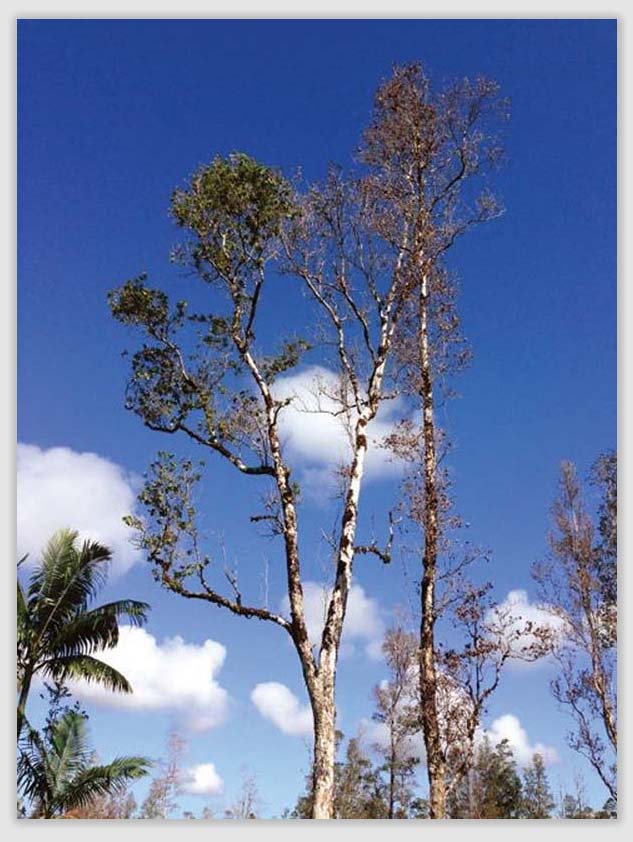
Forestry officials are pinning their hopes for containing the spread of rapid ohia death on a newly developed beetle repellent known as SPLAT Verb. ROD is a fungal disease that has killed upwards of a million ohia trees on Hawaii Island since it was first detected in Puna over 15 years ago. The disease has also appeared on Kauai, killing about 1,000 trees there. SPLAT Verb, developed over five years by forest entomologist Kylle Roy with the U.S. Forestry Service Health Protection Branch, works by repelling ambrosia beetles, which burrow into diseased trees and spread ROD through their frass (chewed, undigested wood and excrement). Specifically, the repellent emits a pheromone that discourages the beetles from burrowing into the trees, ultimately preventing the release of active fungal pathogens into the environment. Personnel from the Department of Land and Natural Resources’ Division of Forestry and Wildlife and the USFS have applied SPLAT Verb to ohia trees killed by ROD as well as healthy ohia in the Kokee State Park area over the last few months…
Florida International University researchers found that some of the most common trees in Florida can significantly shield homes from extreme wind, decreasing suction forces applied to critical regions of the roof by as much as 50%. The findings were recently published in the Journal of Wind Engineering and Industrial Aerodynamics. The urbanized part of Miami-Dade County is home to an estimated 36 million trees, and city planners want even more in the years to come. About 20% of Miami-Dade County is covered by the branches and leaves of trees, known collectively as the urban tree canopy. For homeowners, the canopy can provide shade and protection, but during hurricanes trees can also become hazards. So, what exactly are all these trees doing during storms? Which trees are more likely to become hazards, and which help shield homes from wind? To answer these questions, Amal Elawady, an associate professor in the Civil and Environmental Engineering Department, Haitham Ibrahim, a postdoctoral associate, and Fouad Elazaka, a Ph.D. candidate, gathered data on more than 40,000 trees across Florida. They then tested how a set of the most common trees in Florida interact with extreme wind and nearby homes at FIU’s Wall of Wind, a world-leading facility capable of simulating a Category 5 hurricane and conducting full-scale testing…
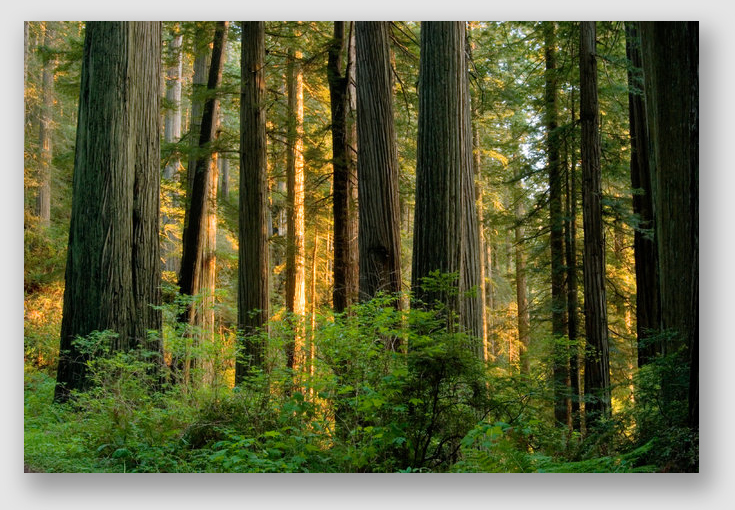
Trees may not be able to store as much planet-heating carbon as hoped, a study suggests, with researchers finding photosynthesis does not always lead to wood growth. Scientists studied 137 sites across the US and found trees stopped growing months before the point in the year at which photosynthesis stopped. Forests are a vital defence against climate breakdown but their power depends in part on how much carbon dioxide they can convert into wood, which keeps the planet-heating molecule out of the atmosphere for decades and centuries. Other uses of carbon are typically shorter lasting…
Severe storms on Thursday irreparably damaged what is believed to be the last remaining “witness” tree at a home in Springfield, Ill., dating back to the time that Abraham Lincoln lived there. According to a National Park Service employee, the tree, an American linden, was damaged by winds, which gusted to at least 60 miles per hour. Pictures posted to social media show the tree with its upper half toppled over. Lincoln bought the home in January 1844 and lived there for 17 years. During that time, he set up his own law practice, welcomed and buried his second child, was elected to the House of Representatives and eventually to the White House in 1860. He left the home for the White House early in 1861…
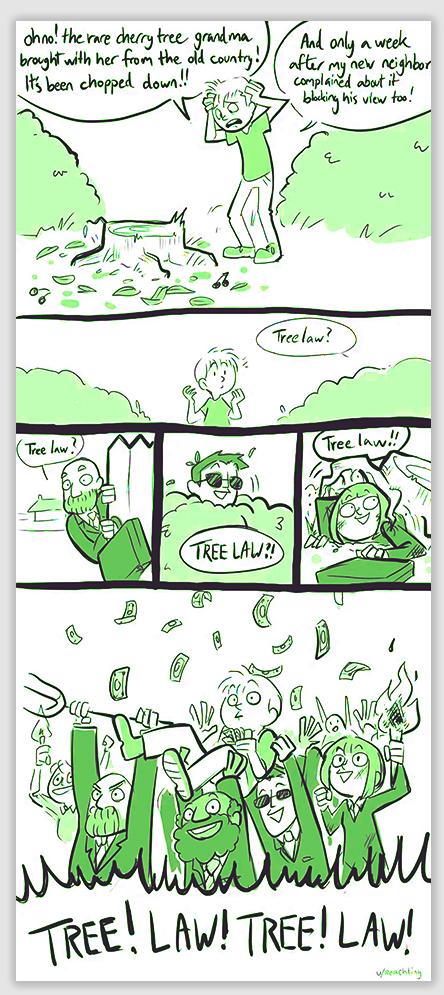
An intriguing question: What do Chris Pine, William H. Macy and a suburban librarian have in common? Answer: They’ve all been entangled in messy, costly disputes over … trees. Each of these three people have been involved in lawsuits over, you guessed it, the finer points of foliage — to the tune of tens of thousands to tens of millions of dollars. It turns out that the leafy corner of the yard is often the most contentious spot in the neighborhood, with people passionately sparring over property lines, esoteric regulations and who’s blocking the view. There are plenty of spectators too, with strong opinions — the subreddit r/treelaw has more than 175,000 weekly visitors who come to ask their questions, make tree puns and, virtually, chant “TREE! LAW! TREE! LAW!…”
Tree deaths tripled in New Mexico during the second warmest year on record, according to new analysis of the state’s forest health from the U.S. Forest Service and New Mexico Forestry Division. 2025 saw a rapid expansion of bark beetle-caused deaths with 209,000 acres of conifers now dead — up from 67,000 acres in 2024 — mostly on national forest land managed by the USFS. “Fall and winter temperatures remained warmer and drier, allowing bark beetles to remain active late in the season,” the report concluded. “Large areas of ponderosa and piñon forests saw significant mortality from bark beetles, especially in the southern part of the state. Areas near burn scars from large wildfires continue to experience bark beetle attack on residual trees. If there is good news in the report, it is that a virus infecting some of the most common insects causing defoliation greatly reduced the number of acres showing a loss of leaf or needle coverings. Insect infestations of the western spruce budworm, Douglas-fir tussock moth, western tent caterpillar, needleminers and scale insects was down 51% from 327,000 acres in 2024 to 160,000 acres in 2025…”
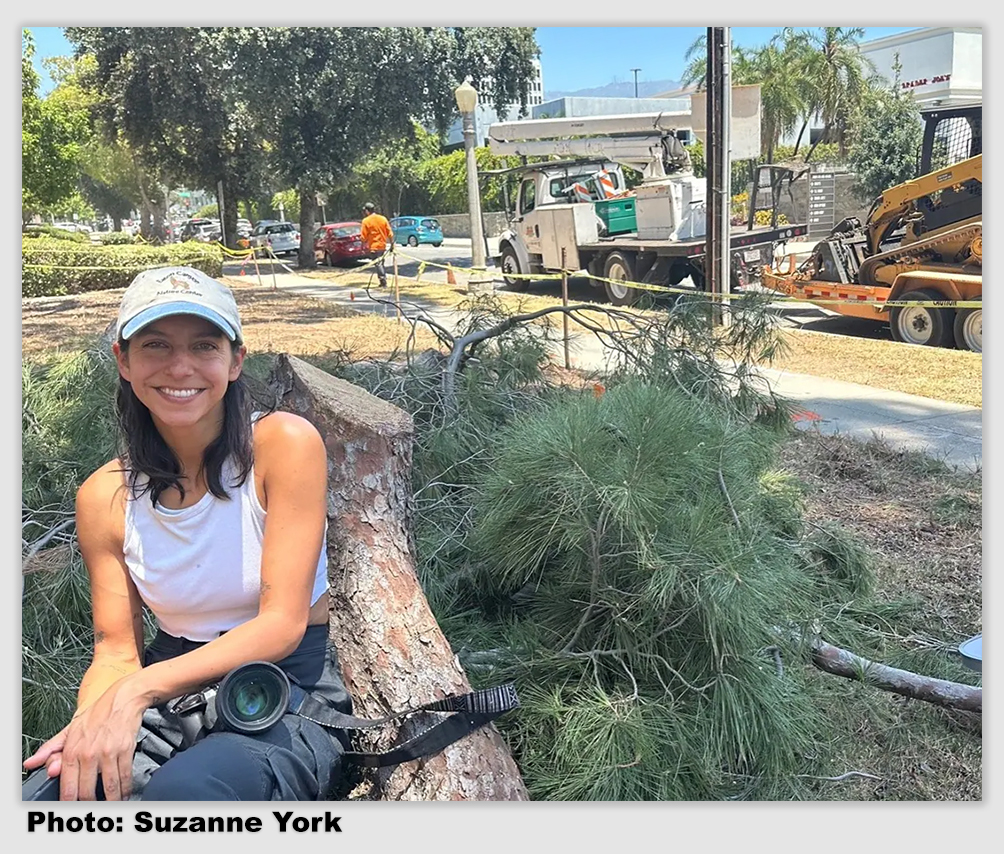
Pasadena holds a long-standing designation as a Tree City. Administered by the Department of Public Works, the city actively manages a diverse urban forest comprising more than 60,000 public trees spanning dozens of species. The city uses a Master Street Tree Plan to carefully select which tree types are planted on specific parkways and tracks and to closely monitor tree care. For generations, Pasadena has been a community defined not only by its historic architecture and beautiful neighborhoods, but by the towering canopy of mature trees that line its streets, parks, and school campuses. That is why many residents were stunned last Wednesday to find construction crews preparing to remove what appeared to be healthy, mature trees from the campus at San Rafael Elementary School. The Pasadena Unified School District (PUSD) has instituted a plan to remove approximately 193 trees across 11 school campuses as part of a soil remediation project tied to post-Eaton Fire environmental cleanup efforts…
Beneath the Blue Mountains of eastern Oregon, in the Malheur National Forest, a single honey fungus has been spreading through the roots of the forest for thousands of years. It now covers nearly ten square kilometres. Most of it is invisible. What you see at the surface is indirect: clusters of trees dying in the same way, and, for a few weeks in autumn, honey-coloured mushrooms pushing up through the soil. The organism itself is the network underneath. It is one of the strongest contenders for the largest living thing on Earth. That phrasing is deliberate, and we will come back to it, because the title is more contested than the headlines suggest. The fungus is Armillaria ostoyae, a honey fungus and a root pathogen, the kind of organism a forester first meets as a disease rather than a wonder. It was spotted in the Malheur in 1988 by a Forest Service worker, Greg Whipple, who put its extent at about 400 acres. That turned out to be a large underestimate…

 Tree and Neighbor Law For Homeowners and Professionals