Case of the Day – Tuesday, June 24, 2025

WE’RE FROM THE GOVERNMENT, HERE TO HELP OURSELVES

Marlborough should have heeded Marlboro's advice -

Marlborough should have heeded Marlboro’s advice – “better makin’s” … as in “we’d better be makins sure we own the land befores we go diggin’ it up.”

Some time years ago, Marlborough (the City, not the cigarette) abandoned a seldom-used city street, even noting in the land record the misspelled sentiment that it “hearby abandon[ed] and discontinu[ed] any and all rights …” in the street.

Well, time passed. While much improved in the world, the competence of decision-by-committee did not.

When the Marlborough powers that be decided that a new water main had to be installed, they concluded they should go right down the right-of-way they had abandoned. “What, we abandoned it? Well,” the city fathers and mothers chuckled, “we’ll just take it back!”

And they did, too, going right up the center of the abandoned street, tearing up the place and downing a number of trees (which is how we ended up writing about this, to begin with). America’s a relatively civilized place (albeit one with a lot of lawyers), so the landowners sued.

Obtaining a judgment that the City had trespassed was easy: after all, the land records themselves revealed the City had no rights in the street. But figuring the damages was tricky, especially because the landowners wanted treble damages. In Massachusetts, a trespasser to trees is liable for treble damages unless he or she had “good cause to believe” that he or she had a right to cut down the trees. The City argued it had relied on one of its attorney-employees, who opined that the street remained a public thoroughfare despite the unambiguous and misspelled language of the recordation and Massachusetts law. The City said it took “extensive steps” to determine its rights.  Sure, and COVID-19 came from Australia, the 2020 election was rigged, and Ukraine invaded Russia.

The Court said “nonsense” to Marlborough (and probably would have said the same to that other stuff).  It seemed the plans for the water main construction themselves carried the notation “Ownership to be determined,” and the trial judge warned the City at the temporary restraining order stage that its rights were pretty shaky. But the City dug and cut on. Sow the wind, reap the whirlwind.

An interesting damages note to the case: the City offered “expert” testimony from a real estate professional as to the loss of value of the property because of the trespass, calling this a “common sense” approach to valuation. The Court rejected the expert and the approach because the loss calculation necessarily must include the value of the trees that had been cut down. Besides, the Court said, a real estate expert — no matter how good in his or her area of expertise — knew diddly-squat about trees.

street150615The damage approach approved by the Court – the “cost of cure” method – took into account the cost of replacing the trees that had been cut, as well as the removal of the larger stumps.

Smith v. City of Marlborough, 67 Mass.App.Ct. 1104, 852 N.E.2d 137, (Mass.Ct.App., 2006). Abutting landowners brought an action against the City of Marlborough, alleging that the city had trespassed, destroyed trees, and removed soil and gravel during the installation of a water main through their properties along an allegedly abandoned lane. The Superior Court entered judgment for landowners and awarded treble damages, and the City appealed.

Held: The award of treble damages was upheld. The Court agreed that the City of Marlborough had abandoned the street, and it thus committed trespass when it destroyed trees while installing a water main along the abandoned street. A recorded order stated that the city “hereby abandons and discontinues any and all rights that it now has or ever had” in the lane. The Court held that the City did not have a good reason to believe that it owned land which it had previously abandoned, and thus the landowners abutting the street — who received the property following abandonment — were entitled to treble damages due to the city’s removal of trees while installing the water main.

Marlborough tried to make Sandy Posey's 1967 country-pop song into the city anthem ...

Marlborough tried to make Sandy Posey’s 1967 country-pop song into the city anthem …

The evidence showed that the survey “was performed without the benefit of the determination of the status” of the lane and that the landowners raised questions about the ownership of the land with city personnel immediately after receiving notice of blasting near the lane, but the city continued its work nonetheless.

No one disputed the amount of damages determined under the “cost of cure” method on appeal. The damages included the cost of replacing trees, as well as the removal of stumps of larger trees that had been cut. Marlborough complained that it was deprived of an opportunity to present its own “common sense and expert approach” when its expert, a real estate appraiser, was not allowed to testify because he was not an arborist and did not determine the value of the trees.

Marlborough offered no specific allegations of errors in procedure or in the jury instructions and merely concluded that “according to common sense,” the loss of trees could not be worth more than the damages awarded for the land taking. The Court rejected this argument, too.

– Tom Root

TNLBGray140407

Case of the Day – Wednesday, February 26, 2025

SHOWING UP

Denise Pevarnek’s agent chopped down her neighbors’ trees so she’d have a better view of the river. The neighbors complained (surprisingly enough), but Denise steadfastly ignored their remonstrances. The neighbors then sued, but Denise ignored the summons. She finally decided to start paying attention after a default was entered against her and the trial court intended to assess treble damages against her in the amount of $77,000.

YouSnoozeYouLoseDenise tried futilely to undo the consequences of her earlier indolence. Alas, a stitch in time saves nine. The Court ruled that she had had plenty of notice, but her decision to ignore the lawsuit was her problem, and undoing the default she so richly deserved would have turned her problem into her neighbors’ problem. And they were already smarting from the loss of their trees.

Of interest in the case — one argument Denise included in her scattershot but untimely defense — was her contention that the cost to replace the trees wasn’t the right measure of damages and that the trial court was wrong to rely on an affidavit of an arborist that didn’t explain in detail how he had arrived at the damage costs. The Court rejected this, saying that in the case of trespass, the measure of damages is either the reduction in the value of the property or — where the property can be repaired — the cost to fix things. The goal of the damage award, according to the Court, is to come as close as possible to compensating the owner for the damages, and trial courts have a lot of latitude to choose the method that seemed more reasonably calculated to do so.

The affidavit, the Court noted, laid out the expert’s education and experience, showed that he had inspected the damaged real estate, and proposed a reasonable strategy for repairing the harm. The arborist listed what had to be done and how much he’d charge to do it. It might not be perfect, but perfection is often the enemy of “good enough.” The affidavit, the Court ruled, was “good enough.”

Stitch2The Court reminded the defendant that if she really had found the damage showing to be flawed and superficial, she could have come to the hearing and contested it. Snooze and lose, indeed.

Bologna v. Pevarnek, 2007 Mich. App. LEXIS 2689, 2007 WL 4207801 (Mich.App., Nov. 29, 2007). Denise Pevarnek hired Chester Damiani to clean up her property. He was zealous to a fault, deciding to improve the view of the Detroit River from her adjacent lot by cutting down trees belonging to her neighbors, the Bolognas. Believing that Denise and Chester’s conduct was baloney, the Bolognas sued for trespass, alleging that the destruction reduced the value of their property and exposed a view to Pevarnek’s unsightly neighboring property and asking for $28,000, trebled by Michigan’s wrongful cutting statute to $84,000.

Denise Pevarnek was served with the lawsuit, but she didn’t answer. As is customary when that happens, the Bolognas got a default judgment. Thereafter, they presented the affidavit of a certified arborist who opined that the cost of landscape restoration was $24,050. At this point, Denise took notice, and began taking action to defend, seeking to have the default undone. The trial court refused, and it entered judgment against her for $77,730. Pevarnek appealed.

Held: The judgment was upheld. Much of the case revolves around whether Denise should be relieved from her default judgment. The Court of Appeals ruled, in essence, that she knew about the suit and did nothing. In other words, “you snooze, you lose.” But of interest in the area of tree law was Denise’s claim that the trial court was wrong in using the cost of replacing the trees as a measure of the damages the Bolognas suffered. The Court of Appeals said where the wrong consists of a trespass to property resulting in an injury to the land that is permanent and irreparable, the general measure of damages is the diminution in value of the property. If the injury is reparable or temporary, however, the measure of damages is the cost of restoration of the property to its original condition (if less than the value of the property before the injury).

perfectThe rule is, however, flexible in its application. The ultimate goal is compensation for the harm or damage done. Thus, a court may apply whatever method is most appropriate to compensate a plaintiff for his or her loss. Here, the Court said, given the fact that the Bolognas’ trees could be restored, it was proper for the trial court to use the cost-of-restoration method.

Pevarnek argued that the trial court erred by adopting without question the assertion of alleged damages without sufficient foundation. The plaintiff had filed an affidavit of arborist Steve McCollum, who swore that – in order to return the property to its pre-trespass condition, that is, with no view of Pevarnek’s property – 12 new trees had to be planted, some existing trees had to be replanted, the over-pruned trees had to be removed, and the lawn had to be repaired. He stated that the total cost of this work was $24,050. The trial court awarded plaintiffs damages of $77,730, equal to three times the sum of the cost of work proposed by McCollum and $1,860 for the cost of a privacy fence. Although McCollum’s affidavit didn’t explain how he calculated the damages, he stated his qualifications and education, he said he had personally inspected the Bologna property, assessed their needs, specifically listed the work to be done, and listed the cost for his business was to complete it. The Court said the expert affidavit put forth a reasonable basis for the damage computation, and that was enough.

– Tom Root
TNLBGray

Case of the Day – Monday, February 10, 2025

HERE WE CUT DOWN THE MULBERRY BUSH…

When Mamie’s lights went out, she called the electric company to fix them. The linemen tracked down the problem and fixed it while Mamie was off at Wal-Mart. But while they were there and Mamie wasn’t, the electric workers saw an excellent opportunity to saw… and to get rid of some trees in the utility’s easement across Mamie’s yard that they thought were in the way of the distribution line to Mamie’s house.

Mamie returned, shopping bags in hand, to find her mulberry tree had been cut down and cherry tree topped. Naturally, she sued. After all, her trees had not caused the power outage. Nevertheless, the electric company said the tree could have caused the power loss, but for the grace of God, and it relied on its easement to support its right to remove the one tree and permanently stunt the other out of concern that someday they might pose a hazard.

I would have bet a new chainsaw that the electric company was going to win this one, and I can only conclude that it may have been “homered” by the local judge. After all, Mamie was a neighbor, and the big, bad electric co-op was just some faceless out-of-towner. I know of no other way (than possibly an inability to read precedent and engage in reasoned thought) to justify a holding that while the utility had an easement, as well as the duty to maintain the reliability of its lines, it nonetheless could not merely be liable for overzealous trimming but even be socked with treble damages.

Treble damages are only appropriate in Missouri if the malefactor lacks probable cause to believe it owned the land the tree stood on. That test should have been modified to comport with the facts. Consolidated had an easement for the electric lines to cross Mamie’s property, and whether its decision to trim or remove the trees near its lines was correct or not, the decision should have been accorded deference.

Tomorrow, we’ll look at a subsequent Missouri electric company case, where we will see the utility get clobbered despite its desperate reliance on today’s holding.

Segraves v. Consolidated Elec. Coop., 891 S.W.2d 168 (Ct.App. Missouri, 1995). Mamie Segraves sued Consolidated Electric Co-op – her electricity provider – after one of its linemen cut down her mulberry tree and “topped off” her cherry tree.

One summer day, Mamie awoke to find that her electricity was off. She left to go shopping at 9 a.m., and when she returned two hours later, the lights were back on. However, the mulberry and cherry trees in her front yard had been cut down and one branch of her elm tree had been cut off.

Mamie testified these trees had never interfered with her electrical service before. In the past, Consolidated had asked to trim the trees around her electric lines, and she had always agreed, but it had not done so in the past six years. Mamie estimated the value of the mulberry tree was $2,000.00, and the value of the cherry tree was $500.00.

Mitch Hurt, a senior lineman with Consolidated, testified he was called to handle an electrical outage. He tracked the outage to a problem with one of the lines near Mamie’s home, but he could not pinpoint the problem. He had to drive down the road and look at the individual lines to try to find the problem. When he passed the line leading up to her house, he could not see the transformer pole. He stopped and went to inspect her service. He noticed her mulberry tree was very close to the transformer, and so he cut it down “to get it away from the transformer pole.” He also cut off the entire top of a nearby cherry tree because its branches had all grown towards the line. He felt these branches presented a safety hazard because children could easily climb them and reach the power lines. Mitch admitted it may not have been necessary to cut down either of these trees to reinstate electrical service.

Bob Pogue, Jr., Mitch’s boss, testified he told Mitch to trim as much of the trees as he thought was necessary. Bob Jahn, Consolidated’s general manager, testified Mamie knew about the location of the electric lines when she bought the place.

The trial court found in Mamie’s favor and assessed treble damages. Consolidated appealed.

Held: The Co-op had no right to cut the trees, and treble damages were proper.

The trial court did not find Consolidated to be a trespasser because it had the right to enter onto Mamie’s premises to maintain the electric lines. The right to remove limbs that have fallen onto the lines, however, “does not extend to cutting down trees or ‘topping’ trees that are not presently interfering with electrical service without prior consultation with the property owner.” While the mulberry and the cherry trees probably needed to be trimmed, the trial court said, there was no evidence that the mulberry “needed to be cut to a stump and that the cherry needed to be cut back to its major trunks, eliminating all of the fruit-bearing branches.”

Section 537.340 of the Revised Statutes of Missouri allowing for treble damages for the destruction of trees, does not require that a party wrongfully enter upon the property. In fact, the Court of Appeals said, Mamie can recover for wrongfully cutting down trees if she can establish either that Consolidated wrongfully entered her land and cut down the trees, or Consolidated entered her land with consent but exceeded the scope of the consent by cutting down the trees without permission.

While it is true, as Consolidated argued, that a license may be converted into an easement by estoppel if the license holder can establish it spends a great deal of time and money to secure enjoyment of its use, the scope of such an easement nevertheless will be determined by the meaning and intent that the parties give to it. The Court found no history between the parties of cutting down trees, and nothing from which such a right to cut down trees can be implied. Thus, even if Consolidated did acquire an easement by estoppel, it exceeded the scope of the easement by cutting down Mamie’s mulberry and cherry trees.

The utility also argued it was required by law to trim or remove the trees to ensure safety. Under the National Electrical Safety Code, Consolidated argued, it was required to trim or remove trees that may interfere with ungrounded supply conductors should be trimmed or removed, and where that was not practical, the conductor should be separated from the tree with proper materials to avoid damage by abrasion and grounding of the circuit through the tree. Consolidated maintained it had the authority to remove Mamie’s trees according to the Code because there was substantial evidence showing limbs of both trees had been burned by electricity, the mulberry tree was blocking the transformer pole, and the children living nearby could have easily climbed either tree and reached the live electric wires.

The Court rejected that, holding that Consolidated failed to show that the Code applied here because it failed to present evidence that the electrical wires leading to Mamie’s home were “ungrounded supply conductors.” Further, even if the Code applied, it gives electric companies two options, to trim or to remove the trees. The trial court found it was unnecessary to remove the trees in this case.

Not to be deterred, Consolidated also argued it was obligated to remove the trees because it had a non-delegable duty to maintain a safe clearance around its electrical lines. “Although Consolidated was required to exercise the highest degree of care in maintaining its electrical wires,” the Court said, “it was not required to remove the trees surrounding them, and it exceeded its authority by doing so.”

Section 537.340 of Missouri Revised Statutes holds that if any person shall cut down, injure, or destroy or carry away any tree placed or growing for use, shade, or ornament, or any timber, rails, or wood standing, being or growing on the land of any other person, the person so offending shall pay to the party injured treble the value of the things so injured, broken, destroyed, or carried away, with costs.

The Court noted that a person can only fell trees wrongfully in one of two ways: he can enter the land wrongfully and fell the trees, or he can enter with the landowner’s consent and then exceed the scope of that consent by felling trees without permission. While the statute limits damages recoverable to single damages in certain cases, such as where it appears the defendant has probable cause to believe that the land on which the trespass is alleged to be committed, or that the thing so taken, carried away, injured, or destroyed, is his own. It was up to Consolidated to prove it had such probable cause.

The determination of whether the defendant proved probable cause existed rests with the trial judge. Here, the Court said, “the trial judge did not abuse his discretion in finding Consolidated did not have probable cause” to believe it had the right to cut down Mamie’s trees.

– Tom Root

TNLBGray140407

Case of the Day – Tuesday, November 19, 2024

WOODMAN, SPARE THAT TREE!

woodman150203“… touch not a single bough …”, Mrs. Chinn, the plaintiff, cried in this California case on wrongful tree cutting.

The plaintiff, Mrs. Chinn, agreed with her neighbor, Ms. Hess, to build a common fence. The worker hired to construct it found he had to trim the branches of one of Mrs. Chinn’s plum trees to make the fence fit. And that’s where the problems arose.

Mrs. Chinn’s tenants, the Schmidts, told the worker to go ahead and cut down the tree. Of course, they denied this, but the trial court found the testimony of the worker and four neighbors who watched the timber harvest unfold. Mrs. Chinn sued Forrest and Hess for trespass and for treble damages for wrongful tree cutting under California statute.

The issue was whether Forrest and Hess reasonably believed the Schmidts had the authority to speak for Mrs. Chinn. The trial court found that the authority Mrs. Chinn had given them, coupled with her own ignoring of the goings-on in the fence and tree project, gave the defendants a reasonable basis to believe that the Schmidts could give Forrest the right to cut down the tree.

Thus, there was no trespass. And, of course, no trees left standing, either.

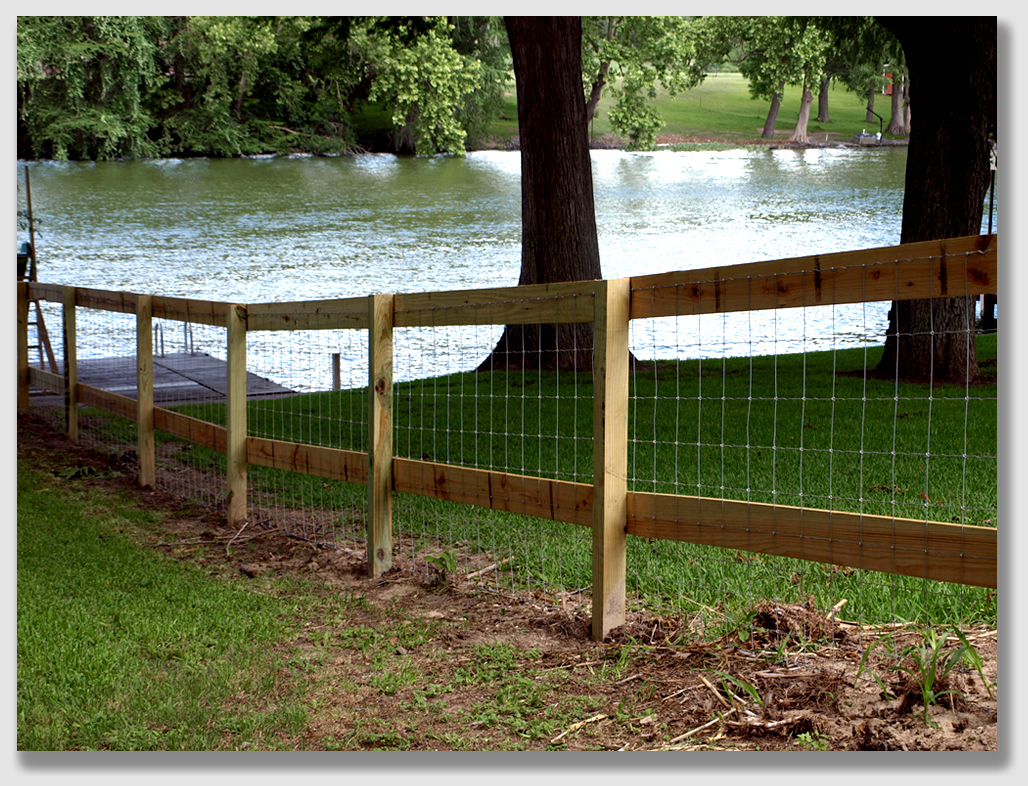
A common fence

     A common fence

Chinn v. Hess, 2007 Cal. App. Unpub. LEXIS 3942, 2007 WL 1430192 (Cal.App. 1 Dist., May 16, 2007). Chinn and Hess owned adjoining properties. Chinn rented her place to the Schmidts. Chinn and Hess had agreed to build a new fence, which they had hired Forrest to complete. While he was building it, he cut down a plum tree on Chinn’s land that obstructed the planned fence.

Chinn sued Hess and Forrest for trespass and wrongful tree cutting under California Code of Civil Procedure § 733. Forrest claimed he had begun merely by trimming the tree, but the Schmidts came outside and agreed the tree should come down. The Schmidts denied this, but the weight of the evidence caused the trial court to believe Mr. Forrest.

The trial court found for Hess and Forrest. Chinn appealed.

Held: The plum tree remained cut down (of course, it would have at any rate), but Mrs. Chinn was not entitled to treble damages under California Code of Civil Procedure 733. The trial court had found that Mrs. Chinn hadn’t proved that Forrest had proceeded without consent, but Mrs. Chinn complained that it wasn’t her obligation to prove lack of consent, it was Forrest’s and Hess’s duty to prove they had consent.

The plum tree was very severely pruned.

The plum tree was very severely pruned.

The Court of Appeals held that lack of consent is an element of the tort of trespass, meaning that it was one of the issues Mrs. Chinn had to prove in order to establish a trespass. Still, whether she carried her burden of proof wasn’t important here, the Court said, because the trial court had concluded that Forrest and Hess had proven that the defendants reasonably believed the Schmidts were Mrs. Chinn’s agents. Mrs. Chinn had given the Schmidts authority to speak to Ms. Hess about the tree and the fence. Once the Schmidts were empowered to speak for Plaintiff, Plaintiff chose not to communicate with Defendant Marilyn Hess, and when the issue of the plum tree arose, Mrs. Chinn did not respond to messages and did not drive two miles to see the fence. Rather, Mrs. Chinn relied solely on the Schmidts to represent her regarding the fence and tree issue, just as she relied upon them to take care of the garden on the property they were renting.

The combination of her intentional conduct and her want of ordinary care, Mrs. Chinn caused Forrest and Hess to believe reasonably that the Schmidts had the authority to consent to the removal of the tree. Ostensible authority in an agent is established by showing that the principal, intentionally or by want of ordinary care has caused or allowed a third person to believe the agent possesses such authority. Such authority must be established through the acts or declarations of the principal and not the acts or declarations of the agent. Where the principal, like Mrs. Chinn, knows that the agent holds himself out as clothed with a certain authority, and remains silent, such conduct on the part of the principal may give rise to liability.

– Tom Root

TNLBGray140407

Case of the Day – Thursday, July 25, 2024

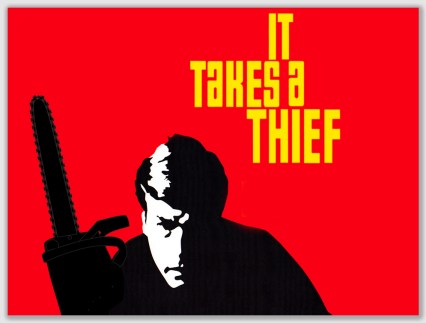
IT TAKES A THIEF

It was perhaps the last of the 60s-era TV spy genre series: It Takes a Thief featured the adventures of cat burglar, pickpocket, and thief Alexander Mundy, suavely played by Robert Wagner, who stole to finance his life as a polished playboy and sophisticate. He ends up in prison, which is where the story begins. A U.S. spy agency proposes a deal to Mundy: steal for the government in exchange for his freedom.

Real life thieves are not so accomplished, and seldom so handsome and cosmopolitan. Which brings us to Logan County, Ohio, and Lowman Lumber Company.

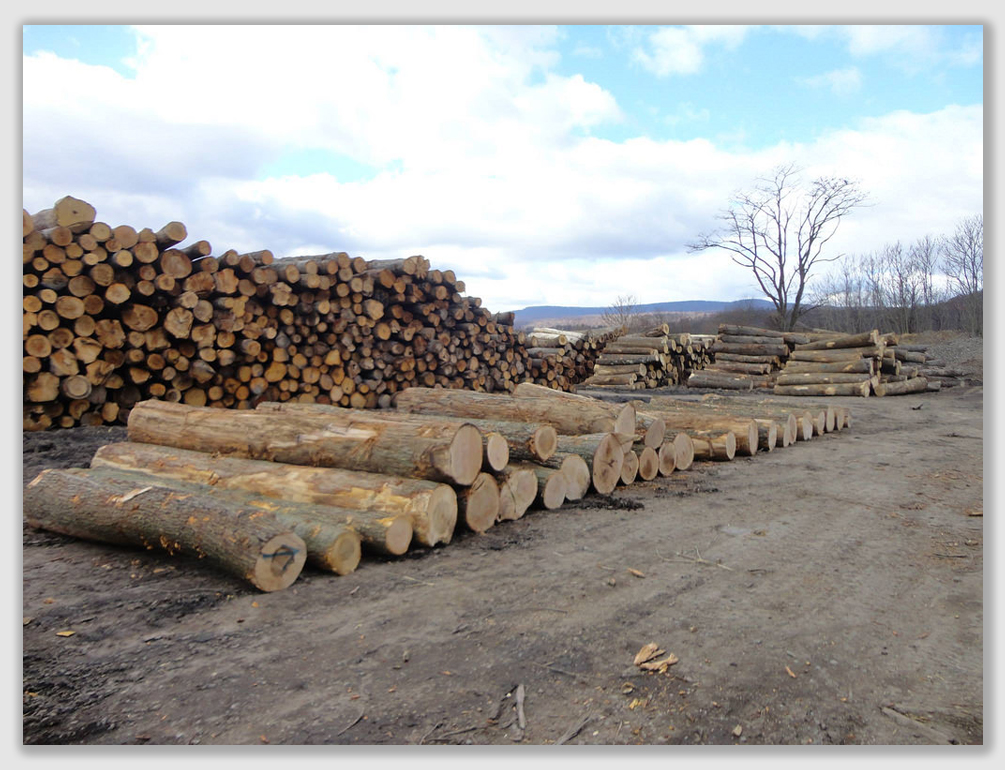
We’re not calling company owner Sturgil Lowman a thief. The courts of Logan County have already done that for us. Sturgil was in the timber harvesting business. Over 40 years, he seems to have developed what the criminal justice people call a modus operandi: Cut a few corners, cross a few boundary lines, and wherever possible, take some timber from the neighbor’s land as well as the tract you’ve bought the right to harvest.

Sometimes you get caught. Then, you affect your most self-deprecating head shake and chuckle, admit you made a dumb mistake, and compensate the victim for the trees you unlawfully took. When you balance the books at the end of the year, the timber you got away with is enough to make the timber you got caught taking worthwhile. Cost-benefit, baby.

The problem is that word spreads – especially at the courthouse, where every lawsuit record is preserved. After awhile, the “oops, I goofed” schtick gets old. That’s what happened to Sturgil.

He finally crossed someone who filed a criminal complaint, and he was convicted of receiving stolen property (the trees). He paid restitution and did a little probation for the misdemeanor. But at the same time, another timber trespass case was playing out across the hall in a different courtroom.

Sturgil was logging Dale’s place under contract. While doing so, he busted the boundaries with the Shanklin’s wooded tract, and proceeded to butcher 15 of the prettiest acres in Logan County (which is a rather pretty place to begin with). This time, the owners pursued him with a vengeance, and Sturgil’s history of being private property-challenged – as well as the grossness of his violation of the Shanklin land – was enough for the jury to inflict real pain on him. Sturgil was ordered to not just pay for the damage to the Shanklins, but to pay treble damages for recklessness and punitive damages on top of that for malice.

Sturgil especially contested the trial court’s award of punitive damages on top of treble damages, and frankly, it is rare for a Court to approve both. But this case, if any, proves the old maxim that “hard cases make bad law.” The jury and the courts knew a bad actor when they saw one, and they used the tools at hand to dissuade him from continuing his malefaction. The final ticket was $45,000 in compensatory damages, increased by another $90,000 under ORC § 901.51, and an additional $33,500 in punitive damages, and $35,600 in the Shanklins’ attorney fees. A bill of $204,100 for $30,600 in stolen timber.

How’s that cost-benefit analysis looking now, Sturgil?

Shanklin v. Lowman, 2011-Ohio-255 (Ct.App. Logan Co., Jan. 24, 2011). Sturgil Lowman, a lumber company owner, harvested some timber for landowner Dale Kauffman. Dale identified the fence line that marked the boundary between his land and that of the Shanklin family, next door.

The Shanklins were retirees living in Florida, who used the wooded tract they owned solely for recreational purposes. The man who looked after the land for them, Tom Stacey, said that it was an “old growth area” with a beautiful high canopy, completely shading when leaves were present, and with tall, straight trees. He described it as having “the most lush undergrowth” he had seen anywhere in Ohio, and that the east edge of the back parcel had a dramatic, deep, narrow ravine that was about forty or fifty feet deep, with rich wildlife.
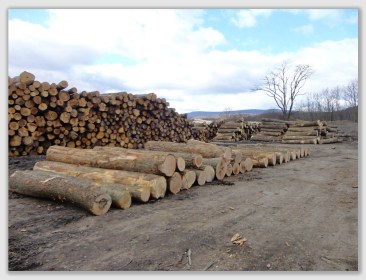
In the spring of 2006, Tom was cleaning up the Shanklin property due to an ice storm. As he walked the back of the property near the ravine, he discovered a road and bulldozer tracks. About twelve to fifteen acres of the property had been clear-cut, except for some stumps, and a logging road had been cut nearly a quarter mile into the property from the Kauffman property line. There two points of entry into the property, with the main logging road going through the fence line, with the fence cut off and rolled up. In addition to the removed trees, Tom found damage to trees that were not taken, including scars and “chunks” resulting from equipment being moved through the area.

It did not take long to connect it to Sturgil. Sheepishly, he admitted that Dale had shown him the property line, that he never hired a surveyor to confirm the property lines, that he never consulted any maps or real estate records to determine the property lines, but instead had an employee “mark the lines with ribbons,” and that neither he nor his employees kept any documentation about how many trees or what types of trees were cut.

This was not Sturgil’s first rodeo. He had been sued perhaps five times in his 40 years of operation for trespass to timber, and he was convicted of the felony of receiving stolen timber, for which he paid restitution and was sentenced to probation. Even more troubling, Tom reported that a Lowman employee had approached him a year earlier to learn who owned the Shanklin land. Tom walked the man through the property, whereupon the man offered him $10,000 if he could convince the Shanklins to let Lowman cut the timber. Tom refused and told the man that if the Shanklins were interested, they would contact Sturgil’s company directly.

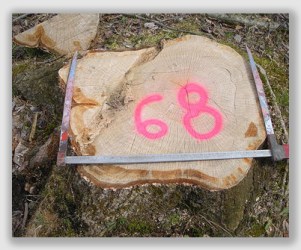
James Bartlett, a consulting forester, performed a stump count for the Shanklins, identifying species and estimating the value of the wrongfully cut trees at the time they were cut. He found 282 stumps, and – using a United States Forest Service formula – found the aggregate value of the timber to be at least $30,671. He said he could not put a value on the “loss of beauty” to the property or the loss of enjoyment of the property.

A professional registered surveyor testified that he had examined the property line, and it “seemed very straightforward to him where the property line was.” He said that if Sturgil had hired a surveyor prior to the cutting, the line between the properties would have been easily determined.
A licensed realtor who had lived in Logan County his entire life testified that the property was unique because it was directly across from the highest point of Ohio, and was the most scenic ground in Logan County. He estimated that the value of the area that had been harvested, prior to the cut, would have been about $6,000 an acre, or $90,000 for the 15 acres affected. He estimated the value after cutting was about $3,300 an acre.

The jury returned a verdict awarding the Shanklins compensatory damages of $45,000, resulting in trebled damages of $135,000, and punitive damages of $33,750.

Sturgil appealed.

Held: The $168,750 damages award was upheld.

The Court found that the compensatory damages were amply justified by the testimony that the 15 acres fell in value from $90,000 to about $49,000. Additionally, the evidence showed that the timber was worth at least $30,671, but possibly more, because the Shanklins could have put the timber out for competitive bidding. Thus, the Court ruled, the record contained “competent, credible evidence supporting the jury award of compensatory damages.”

Sturgil complained that the evidence did not show that the timber trespass had been reckless, which is necessary under ORC § 901.51 in order for treble damages to be assessed. The Court of Appeals made mincemeat of this argument:

Evidence showed that a man identifying himself as representing Lowman Lumber approached Tom Stacey and inquired about harvesting the timber on the Shanklin property. The man offered Tom $10,000 if he could convince the Shanklins to let his company harvest the timber, but Tom declined the offer and gave no indication that the Shanklins were willing to sell timber to Lowman. Tom eventually discovered that twelve to fifteen acres of the Shanklin property had been cut, that a logging road had been cut nearly a quarter of a mile into the Shanklin property from Dale Kauffman’s property line, and that there were two points of entry into the Shanklin property with about twenty branches off the main logging road. A fence marked the property line between the Shanklin property and Dale’s property, but the main logging road went through the fence line, with the fence itself cut off and rolled up.

A professional surveyor identified the property line between the Kauffman and Shanklin properties and observed that cutting had taken place across the line onto the Shanklin property. The cutting extended five or six hundred feet across the property line.  Lowman did not hire a surveyor before cutting on the property, but Dale had showed him the corners of the property. Sturgil Lowman admitted he had previously been convicted of receiving stolen property and criminal damaging involving tree trespass in August 2007, and that there had been several judgments in civil cases against him for cutting onto neighboring property without authorization.

The foregoing litany, the Court ruled, was “credible evidence that Lowman perversely disregarded a known risk with heedless indifference to the consequences.”

Sturgil argued that the trial court should not have awarded both punitive damages and treble damages.

The Court disagreed. “An award of punitive damages in a tort case may be made only upon a finding of actual malice on the part of the defendant,” the Court said. “‘Actual malice’ for these purposes is ‘(1) that state of mind under which a person’s conduct is characterized by causing substantial harm’… When ordering punitive damages, the trier of fact is to make a “reasoned  determination… of an amount that fairly punishes the tortfeasor for his malicious or malevolent acts and that will deter others from similar conduct.”
The Court held that an award of punitive damages “will not be overturned unless it bears no rational relationship or is grossly disproportionate to the award of compensatory damages.”

The Court easily found that the long list of horribles that supported a finding of recklessness also rose “to the level required to demonstrate ‘a conscious disregard for the rights… of other persons that has a great probability of causing substantial harm’.” There can be little doubt that the jury, and later the Court of Appeals, saw Sturgil as a serial trespasser who had long ago concluded that the cost-benefit analysis of stealing timber was such that it was worth getting caught now and then, passing it off as a “mistake,” given all the times he could get away with it.

– Tom Root

TNLBGray140407

Case of the Day -Wednesday, July 24, 2024

ACT IN HASTE, REPENT IN LEISURE

Many years later, we can still see Mom shaking her head at us kids over some blunder or another, asking us, “What were you thinking?”

The answer, of course, is that we were kids, so of course, we weren’t thinking at all.

But you wonder how a guy who has been in the timber business for 30 years, has been shown the property boundaries and has a clear visual cue – a line of trees – to remind him, can nonetheless overshoot by three acres, and commit an expensive timber trespass on someone else’s land. So what was he thinking?

The issue was whether Cameron Klinck (no known relation to Colonel Wilhelm Klinck) was merely negligent or instead forged on heedless of the consequences (which is the very essence of recklessness). The difference is crucial because mere negligence would cost Klinck about what he sold the Shanghai’ed trees for, and thus leave his wallet smarting only a bit. Recklessness, on the other hand, will trigger ORC § 901.51, and entitle aggrieved tree owner Ishan Judeh to three times the compensatory damages – in this case, the stumpage value of the trees – what we call “treble damages.”

Judeh v. Mahoning Valley Timber & Land Co., Case No. 03-MA-138, 2004-Ohio-4819 (Ct. App. Mahoning Co., Aug. 31, 2004), 2004 Ohio App. LEXIS 4353, 2004 WL 2029136 (2004). Ishan Judeh owned land next to acreage owned by Gene Pyle, portions of which were wooded. Cameron Klinck, a logger who owned Mahoning Valley Timber & Land Co., contracted to remove timber from Pyles’ land. Pyles described the location of the boundary dividing his and Judeh’s property.

Klinck removed trees from Pyles’s land as arranged, but also removed trees from about three acres of Judeh’s land. Judeh sued Mahoning Valley Timber for trespass, conversion, and wrongful taking of timber from his land. The trial court awarded Judeh $6,000, representing the stumpage value of the wrongfully cut trees, and trebled the damage to $18,000 under ORC § 901.51, finding that Klinck had been reckless in harvesting the trees from Judeh’s property.

Klinck appealed.

Held: The record showed Klinck had been reckless.

The Court of Appeals reviewed the decision with a deferential standard. It “indulge[d] every reasonable presumption in favor of the lower court’s judgment and finding of facts” and “[i]n the event the evidence is susceptible to more than one interpretation, [the court] construe[d] it consistently with the lower court’s judgment.”

In this case, evidence showed that Klinck knew where the property boundaries lay. The line was clearly visible by virtue of a tree line that extended 416 feet from south to north between the two parcels. Klinck admitted he knew where the boundary line was located, had maps and had walked the boundary line. Although he did not have the land surveyed, Klinck admitted that it was good business to survey the area of the property to be logged and that he used a surveyor 98% of the time. He had been in the timber business for over thirty years and was aware of the risks of failing to survey the property. In addition, the Court said, the magnitude of the trespass – being two to three acres – suggested recklessness.

– Tom Root

TNLBGray140407

Case of the Day – Wednesday, May 1, 2024

MEASURING HARM

oopsMr. Harper accidentally cut down 70 trees on Ms. Dumas’ property, thus markedly improving his view. Oops! 

The more skeptical among us think that cutting one Dumas tree would have been an accident, and cutting down a few would be a tragedy. But cutting down 70 of ‘em, and coincidentally achieving the better view Mr. Harper coveted… well, that sounds like enemy action.

The Connecticut court is considerably more credulous than are we. The judge bought the notion that Mr. Harper and his woodsmen goofed, but pondered long and hard about how to figure the damages. In a weird inversion of schadenfreude, Ms. Dumas argued her damages should be measured by the value that Mr. Harper derived from his better view. The Court rejected that.

Instead, it held that the measure of damages is either the value of the timber or the diminution in value of Ms. Dumas’ place. Harper said that the trees he accidentally lopped weren’t ornamental, so the only damage is about $1,000 worth of debris (thus proving that while he couldn’t identify a property line, old Mr. Harper didn’t lack for chutzpah).

schaden141031The Court disagreed. The trees weren’t strictly ornamental, but that was their purpose, regardless of Mr. Harper’s sad attempt at botanical speciesism. The damages should be measured by the cost of repair, the Court said, and the repair will cost $16,000.

Careful testimony by Ms. Dumas’ expert was crucial to establishing her damages, and arborists and landscape professionals should consider how plenty of detail can persuade a court to side with an expert’s report. For the same reason that play-by-play people keep a color commentator near at hand, an expert should tell a story that’s not only accurate and complete, but interesting as well.

Dumas v. Harper, 2008 Conn. Super. LEXIS 264, 2008 WL 496558 (Conn. Super.Ct., Feb. 6, 2008). Yvon Dumas claims that Emery Harper and his agents entered her land without permission and cut down about 70 trees. Dumas claimed trespass and sought compensatory and treble damages under Connecticut law, and other equitable relief. The matter was tried to the judge instead of a jury.

Based on the evidence, including a site inspection, the court found that Harper and his minions had indeed cut down about 70 trees, making the area unsightly with tree stumps, branches and debris strewn about. The Court found that Harper’s trespass was the result of a mistake.

Nothing left but a stump field ...

Nothing left but a stump field …

Dumas introduced evidence of the value of the “view” to Harper with the trees on her property cut down. But the Court ruled that the value of any view to Harper was not the measure of damages, but rather the damages were either the market value of the tree once cut down, or the diminution in the market value of Dumas’ property caused by the cutting. Harper argued that the only measure of damages the court was permitted to award under Connecticut General Statute § 52-560 was the market value of the 70 trees as severed from the soil, because the trees in question were neither ornamental nor shade trees. The Court disagreed, holding that while the trees were not ornamental trees as such, the evidence was that they had ornamental value insofar as their removal rendered that portion of Dumas’ property unsightly. It would make no sense, the Court said, for the damages to be limited to the value of the trees as severed from the real estate. The damages to be awarded to Dumas should be based on the reduction in the pecuniary value of the land because of the cutting.

The Court found that the decrease in value of the Dumas property should be measured by the cost of cleanup and screening the area with new trees. The Court accepted the expert opinion of Dumas’ landscape consultant, who testified that the work would take a week or more and would cost $9,180 for labor and $6,000 for new trees.

– Tom Root

TNLBGray140407