Case of the Day – Thursday, February 26, 2026

THE GRASSHOPPER AND THE ANT

grasshopper140314Perhaps the problem with America these days is that too many people want something for nothing. Former President Biden waned to give people who understood that they were borrowing money for college a free pass. President Trump wants people to believe the 2020 election was stolen, affordability is a hoax, and that the government owes him billions. And we all want the people we disagree with – and face it, they’re all wrong – to shut the hell up.

Here’s a Vermont case about someone else who wanted something for nothing, a modern take on the grasshopper and the ant. About 50 years ago, the brothers Stanley partnered up to buy some woodland. But only industrious brother George, a busy little worker ant, ponied up the cash for the place, paid the taxes, paid the rent, and managed the affairs of the woodland. Grasshopper John was too busy doing whatever grasshoppers do.

After about 45 years of this, ant George started getting tired of grasshopper John never paying his fair share. Ant George was out a lot of investment, and he decided it was time to pay it back. So he sold the timber on the land for about $46,000.

Suddenly, grasshopper John was very interested in the goings-on, and he sued ant George. But he didn’t just want half of the proceeds. Surely that would be unfair. Instead grasshopper John hires three wise old owls as expert witnesses, and they opine that the timber was really worth anywhere from $60,000 to $80,000. Plus, he retained the services of a foxy old lawyer, who told him he could get treble damages for ant George’s wrongful cutting of the timber (plus a legal fee for the fox).

foxylawyer140314The trial court suspected that John was more snake than grasshopper, but it nevertheless didn’t have much choice but to award him half the value of the timber. The court selected the lowest of the various estimates given by the several owls who testified as experts, still awarding the grasshopper one-half of the $61,785 value of the timber. The court refused treble damages.

The grasshopper was furious! He had been denied what was fair, namely all of it! He wanted the timber valued at $80,000, with his one-half share trebled to $120,000. Fortunately, the wise Supreme Court upheld the trial court, finding that treble damages for wrongful cutting don’t apply where one owner of the land — even if he’s an industrious ant — gives permission. Still, the ant lost $31,000 of his $46,000 to his brother, the grasshopper, whose investment had never amounted to a farthing.

grasshopperb140314The moral, boys and girls, is that a slothful existence and a good lawyer beats hard work and careful investment any day.

Stanley v. Stanley, 928 A.2d 1194 (Sup.Ct. Vt., 2007). Some 50 years ago, brothers John and George Stanley bought a perpetual lease of a 100-acre wooded lot in Victory, Vermont. Defendant George paid the entire purchase price, but the brothers owned the lot as tenants-in-common. From the beginning of their ownership, George paid the annual rent as well as property taxes when they were assessed.

In 1965, he received money from Portland Pipe Company for the right to lay pipe across the property. In the spring of 2002, he hired a logging contractor to harvest and sell the trees from the lot. The logging operations were completed that summer. George didn’t discuss the logging operation with plaintiff John until after it was completed. George figured that “since he had been paying all the expenses relating to the property, he should be able to make the decisions relating to the land.” George got $45,803.32 for the timber removed from the lot. When John learned that timber was being cut, he took pictures of the operation and tried to reach George — who had neither an iPhone nor broadband — without success.

John didn’t try to stop the logging, but after it was over, he sued his brother, seeking an accounting, partition, treble damages under 13 V.S.A. §3606, costs of the action, and attorney’s fees. While he couldn’t afford to share the expense of the land with his brother, John apparently found his checkbook when it came time to hire expert witnesses. He presented testimony from three experts on the value of the timber cut. Thomas Hahn, a private consulting forester, presented two different methods of determining the value of the timber cut from the property, the prevailing market price of a unit of wood in the summer of 2002 based on trade publications (using which he concluded that the value of the timber was $61,785.79), and the “timber cruising” or “sampling” method that would support a finding that the fair market value of the timber was $82,000. Stanley Robinson reviewed the logging contractor’s summary of mill slips and trip tickets, and Alan Bouthelier on his observations from visiting the property prior to the logging. The testimony of these two experts supported a finding that the fair market value of the timber cut was approximately $80,000.

woodpile140314The trial court refused to rely on Hahn’s “sampling” method, dismissing it as too speculative. Instead, it found that the fair market value of the timber cut was $61,785.79, and that plaintiff was entitled to half of this amount. It also ruled that the treble damage statute does not apply to actions between tenants-in-common for the sale of common property, and granted a request for partition. Following the hearing, George gave John $22,901.66, half of what he had been paid for the timber.

None of this was good enough for the rapacious John. So he appealed.

Held: The trial court was affirmed. The Supreme Court held that Vermont’s timber trespass statute — which reads in part that if a person cuts down trees belonging to another person “without leave from the owner,” the injured party can recover treble damages — is plain and unambiguous. The Court said that the statute’s language presupposed that the injured party had ownership rights to the exclusion of the party from whom treble damages are being sought.

The statute is a punitive one, intending to deter intentional trespass and wrongful taking of another’s timber. Because George had an undivided ownership interest in the trees at the time of the logging, the treble damages statute simply does not apply. He simply was not among the intended targets of the statute, those “‘tree pirates’ and ‘arboreal rustlers’ who trespass on another’s property and remove timber to which they have no right.”

John also argued that the trial court erred when it held that the “timber cruising” or “sampling” method of determining the quality and quantity was too speculative. The Supreme Court held that because the trial court, after evaluating several different methods, relied on the testimony of the expert as to one of the methods to determine the fair market value of the timber cut and sold, the Supreme Court would not second-guess it on whether it could have used an alternative method.

– Tom Root
TNLBGray140407

Case of the Day – Tuesday, November 18, 2025

A FISH STORY

A longtime supporter of ours from New Hampshire wrote to us recently to recount the travails of his friends, Larry and Laura Littoral. They keep a cottage on one of New Hampshire’s many delightful ponds. Unfortunately for the Littorals, they have a neighbor, Wally Angler, who is both an avid fisherman and a pain in the fundament.

(These are pseudonyms, of course, and we hope you admire our creativity).

Dead trees are not always eyesores...

Dead trees are not always eyesores…

Wally has been badgering the Littorals to cut down several dead trees on their land. It’s not that the trees pose a threat to life and limb (they don’t), but rather Wally believes that if the dead timber falls into the pond, it will provide an excellent habitat for trout (and, in the process, benefit Wally’s favorite pastime). Larry and Laura like their property the way it is, believing that dead but standing timber is an important part of the ecology of the place, providing sustenance for woodpeckers, shelter for martens, snow fences in the winter, and beauty for nature lovers.

There are two observations worth making here. The first is that, although this may seem counterintuitive, abundant evidence suggests that standing dead timber, which otherwise does not pose a hazard to people or property, has considerable value to the ecosystem. The second is that even if the standing dead trees are of no value to the woods, the Littorals are creating no risk to anyone by keeping the trees standing on their property, and if they like the denuded trunks where they are, the couple should be entitled to letting the dead trees stand.

Recently, the Littorals enjoyed a weekend getaway. At least, they enjoyed it until they returned to their cottage to find the dead trees mysteriously cut down and lying in the pond. Had Horatio been there, he might have said, “O day and night, but this is wondrous strange!” But to the Littorals, unhappy as they were, it didn’t seem strange at all. And they didn’t have to look far for a suspect.

Is that the "Bart Simpson defense" we're hearing?

   The”Bart Simpson defense”clashes with Occam’s Razor.

They complained to the local constabulary, who spoke to Wally. He, of course, denied it, but the Littorals have figured out who Wally hired to cut down the trees, and even deduced that Wally moved the boundary line iron pins to trick the tree service into believing that the trees were Wally’s.

The Littorals are hopping mad, but they don’t want to hang an unsuspecting tree service out to dry. They wonder what action they might have against Wally, and whether the tree service will get nicked in the crossfire. Finally, they note that the local ordinance requires a permit to cut trees within 50 feet of a shoreline, grant of which depends on vegetation remaining or being added to maintain a measured level of trees and ground cover in the area. Unsurprisingly, no one bothered to apply for a permit.

Whew! It’s a veritable tree law final exam. Today, we’ll tackle the first (and easy) question: what kind of lawsuit do New Hampshire statutes permit the Littorals to bring?

At common law, what we’re looking at here is garden-variety trespass, often called in cases like this “trespass to trees” or “trespass to timber.” It appears, however, that New Hampshire has helpfully reduced the action to statute. Section 227-J:8 of the New Hampshire revised statutes provides that

I.      No person shall negligently cut, fell, destroy, injure, or carry away any tree, timber, log, wood, pole, underwood, or bark which is on the land of another person, or aid in such actions without the permission of that person or the person’s agent.

II.   In addition to any other civil or criminal penalty allowed by law, any person who violates the provisions in paragraph I shall forfeit to the person injured no less than 3 and not more than 10 times the market value of every such tree, timber, log, lumber, wood, pole, underwood, or bark cut, felled, destroyed, injured, or carried away.

Simply put, the Littorals have a nice statutory remedy here. Where most state law wrongful cutting statutes provide for treble damages, New Hampshire courts can hammer unlucky defendants for up to 10 times the value of the timber.

What’s more, while the statute on its face seemingly applies only to negligent cutting – not to intentional pure-d mean cutting like what occurred here – New Hampshire appears to apply the statute to any wrongful cutting, employing the 3-10x scale provided by RSA 227-J:8 as an analog punishment gauge, with higher multipliers reserved for more egregious conduct.

whodunnit161004The case we examine below involves a New Hampshire timber trespass that exhibits some of the same kind of chutzpah shown by Wally Angler (assuming the Littorals can prove he’s the culprit, which we believe is likely). The brazen willfulness shown by the defendant below – which was not much different from Wally’s intentional trespass – clearly influenced the damages awarded.

Tomorrow, we’ll explore whether the Littorals can bring a common law trespass action in lieu of proceeding under the statute. Then, of course, we’ll have to grapple with the thorny damages question: exactly how much is dead standing timber worth, anyway?

Today’s case:

McNamara v. Moses, 146 N.H. 729 (Supreme Ct. N.H. 2001). Marilyn McNamara lived in Eagle Rock Estates, a residential subdivision in Amherst. The subdivision plans show an easement for access to the lot of her neighbor, attorney Bob Moses, as a shared driveway connecting the lot with the street. The driveway is steep, winding, and tough to use during the winter. As a result, since 1977, Bob and other residents have used an unpaved roadway behind the lots that they call Eagle Rock Drive, for easier access to their lots. Until 1998, everyone believed Eagle Rock Drive was on common land owned by the Eagle Rock Estates Association.

Marilyn bought her place in 1997. Even she believed Eagle Rock Drive was on common land that abutted the rear of her property. However, after someone proposed paving Eagle Rock Drive, Marilyn researched the matter and found Eagle Rock Drive actually traversed her lot. She announced this at an Association meeting, whereupon Bob Moses told her the Association members had adverse possession of the roadway.

Marilyn tried to get along, giving Bob written permission to use Eagle Rock Drive for the time being but urging him to upgrade his driveway soon and begin using it instead. She warned him that she would not agree “to pave the roadway under any conditions.”

In December 1998, Marilyn found one of Bob’s workmen cutting trees along the roadway on her property. The workman said he was preparing the road for further work at Bob’s request. Marilyn told him the property was hers, she had not given permission to cut the trees, and he should stop cutting and leave. When Marilyn’s joint owner, Bill Vargas, met with Moses later that day, Moses said that “he owned the road,” and asked, “What are you going to do about it?” Marilyn quickly lawyered up and told Bob as much in a letter.

The following Sunday, Marilyn and her beau returned from a weekend away (as did Larry and Laura Littoral), to discover that Bob Moses’ contractor had regraded the roadway and widened it by 5 feet. In so doing, Bob’s people cut down at least 12 of Marilyn’s birch and pine trees that did not interfere with passage over the roadway.

The dead trees are now "in" Golden Pond.

The dead trees are now “in” Golden Pond.

Marilyn sued to enjoin Bob from using Eagle Rock Drive and for damages and penalties for unlawfully cutting her trees. The trial court concluded Bob had a prescriptive easement to use the roadway to access his lot, but held that cutting Marilyn’s trees to widen the roadway had been an unreasonable use of the easement. The court awarded Marilyn compensatory damages of $1,200 – the market value of the trees cut in the widening – and penalties of five times that amount ($6,000) under RSA 227-J:8.

Bob appealed.

Held: The Supreme Court upheld the damages and penalties.

Bob argued the trial court erred in awarding damages based on speculation or approximation of the value of the trees. The Court rejected the argument, noting that the “speculative” nature in this case was not the prohibited kind, that is, whether a particular loss has been or will be incurred. Instead, the only speculation was how much damage had been caused, that is, the possible valuation of an actual loss.

The trial court awarded compensatory damages of $1,200 for the 12 lost trees, specifically finding that Marilyn’s estimated value of $100 per tree was “reasonable and, if anything, conservative.” The fact that McNamara did not identify each tree by species when testifying as to the average value of the felled trees may have made her showing kind of light, but that “does not render the court’s finding erroneous, particularly in light of the defendants’ decision neither to cross-examine her nor to offer contrary testimony. Finally, the mere fact that the plaintiffs’ estimate of the value of the trees was an approximation is not fatal.”

Bob also contended that the trial court abused its discretion by awarding five times the value of the felled trees as the penalty for violating RSA 227-J:8. The Court suggested that Bob’s own arrogance was an appropriate factor in setting the multiplier:

The record supports the court’s finding that the defendants willfully caused the cutting of trees on the plaintiffs’ property, thereby amply justifying a multiplier at the low end of the range specified in the statute. In particular, in addition to being informed at the May 1998 association meeting that the land in question was owned by the plaintiffs, when questioned as to whose land he thought he had been driving across prior to the meeting, Mr. Moses responded, ‘I didn’t know, other than I knew it wasn’t mine.’ The court’s assessment that the cutting on the plaintiffs’ land was intentional was also supported by testimony that, when [Marilyn’s joint owner] Vargas confronted the defendants on the afternoon of the cutting, their responses were, respectively: ‘what are you going to do about it?’ and a statement that Mrs. Moses would ‘continue the rest of the clearing herself with her own chainsaw.’ Moreover, after having been informed that they did not have permission to clear the land further, the defendants continued the clearing three days later when the plaintiffs were out of town.

The Court also noted that while maintaining the easement by keeping the road free of brush and overhanging limbs was within Bob’s rights, expanding the roadway by five feet was not.

– Tom Root

TNLBGray140407

Case of the day – Monday, November 10, 2025

GOOD DRAFTING DOESN’T ALWAYS PREVENT LITIGATION

A little more today on independent contractors:  I have often noted that inexact lawyering can lead to needless litigation. That’s not to say that good draftsmanship will necessarily avoid litigation, but — as we see in today’s case — it always helps.

Dogger got the logs - Worley was left with the stumps

Dugger got the logs – Worley was left with the stumps

Mrs. Dugger hired a Kentucky-certified master logger, Tommy Thomas, to log her land. She signed a contract with him which specified, among other things, that ol’ Tom-Tom was an independent contractor. Well, master logger or not, Tommy Boy wasn’t a master listener. Although Mrs. Dugger told him she didn’t own the land across the crick and he shouldn’t log it.

Of course, he logged it anyway. Predictably, the woman who owned the land on the other side of the watercourse sued, naming both Tommy T. and Mrs. Dugger as defendants.

Mrs. Dugger’s lawyer had her dismissed from the lawsuit on summary judgment, because Kentucky law was clear that an owner wasn’t liable for the errors of an independent contractor, and Tommy Thomas was clearly an independent contractor. The written agreement between the two of them was a great help in establishing this, as well as proving that Mrs. Dugger had told her contractor where her property boundaries lay.

The appeals court agreed, holding that Thomas’s master logger certification meant he should have known better. The contract helped demonstrate that the parties consistently intended for him to be an independent contractor, and he, in fact, controlled the manner of the work and how it was accomplished. Mrs. Dugger might have been liable anyway if the cutting was “work involving a special danger.” But in Kentucky, the Court said, it’s not.

She had a good lawyer - but it didn't keep her out of the courtroom

She had a good lawyer – but it didn’t keep her out of the courtroom

Worley v. Dugger, Not Reported in S.W.3d, 2007 WL 4373120 (Ky.App., Dec. 14, 2007). Mrs. Dugger entered into a logging contract in May 2003 with Tommy Thomas to cut timber from part of her property. During Thomas’ cutting, he crossed onto Worley’s land and took trees valued at over $1,300. Worley sued Thomas and Dugger, seeking damages for the wrongful taking of timber pursuant to KRS § 364.130.

Just prior to trial, Mrs. Dugger won summary judgment on the basis that Thomas was acting as an independent contractor at the time he wrongfully took timber from Worley’s property. Later, a default judgment was entered against Thomas on the issue of liability. Worley moved to vacate the summary judgment and reinstate Mrs. Dugger in the lawsuit. When the court refused to vacate, Worley appealed.

Held: Summary judgment in favor of Mrs. Dugger was appropriate. The trial court found Thomas was acting as an independent contractor at the time when he wrongfully took timber from the plaintiff. Thomas was told not to log beyond the borders of Dugger’s property, something he admitted under oath. What’s more, Mrs. Dugger was not vicariously liable for Thomas’s wrongful timber harvest because she failed to adequately instruct him. Although landowners had been found liable in other cases where independent contractors had cut trees from neighboring land, that was because the landowners had allowed their contractors to cut trees without knowing the exact location of the boundary lines.

Here, the Court said, Mrs. Dugger explicitly instructed Thomas to not exceed the boundaries of her property beyond the creek. Thomas, on his own initiative and contrary to Mrs. Dugger’s instructions, crossed the creek onto Worley’s land. Thomas was a “Kentucky Certified Master Logger,” and the Court held that this certification meant that Thomas should have been familiar with his duty to observe boundary lines to avoid the possibility of liability.

Lucky thing Mrs. Dugger had it in writing

Lucky thing Mrs. Dugger had it in writing …

Plus, Thomas’s contract with Mrs. Dugger clearly identified him as a “contractor.” In Kentucky, as a general rule, employers are not vicariously liable for the acts of independent contractors. The right to control the work and the methods of its performance is determinative on the question of whether one is a servant or an independent contractor. If the employer retains the right to control the work and the manner in which it is done, those doing the work are servants. On the other hand, if an employee has the right to control the manner of work and the right to determine the means by which results are accomplished, he is deemed an independent contractor and the employer is not responsible for his negligence.

The exception to the general rule is that if the work to be performed is either a nuisance or is inherently dangerous, the employer will not be absolved from liability. The Court ruled that tree cutting is not “work involving a special danger” as contemplated by the law. Here, the Court held, Thomas was an independent contractor because he controlled the manner of the timber cutting as well as the means he would use to complete the job.

Under the facts of this case, the work of cutting timber upon Mrs. Dugger’s land was neither a nuisance nor inherently dangerous. Thus, Mrs. Dugger could not be held liable for Thomas’s negligent work.

– Tom Root

TNLBGray

Case of the Day – Thursday, October 23, 2025

THAT EQUITY MAY PREVAIL

A barricuda in one of its habitats - the other is a courtroom.

A barracuda in one of its habitats – the other is a courtroom.

Sometimes you really wish you knew the back story of a lawsuit. Merely reading the recitation of facts and the application of the law in some cases leaves you wondering – why is this case even in the courtroom?

Today’s case is a perfect example. The Mannings lived in a housing development. Behind their well-manicured lawn lay some scrubby, undeveloped woods. Their neighbors had a back lawn that was about 30 feet deeper, and the Manning family mistakenly thought that their own lawn must be that long, too. So they cleaned and chopped weeds, took down some saplings, and installed a park bench and baseball batting cage.

But it turned out that the land wasn’t theirs. Presently, they got a letter from some limited liability company’s lawyer, telling them to cease and desist forthwith, govern their actions accordingly, and all of that legal mumbo-jumbo. Chastened, the Mannings withdrew to their own boundary.

End of story? Nope. The owner of the land, CUDA Associates, LLC — “CUDA” undoubtedly being short for “barracuda” — sued the Mannings for the grievous harm they obviously had done to its rather decrepit piece of real estate. The ‘Cuda sued for trespass, for intentional and wrongful cutting of timber in violation of Connecticut law, and for “unjust enrichment.”

OK, fo technically, the Mannings did commit a trespass ... but they left the land in better shape than they found it.

OK, so technically, the Mannings did commit a trespass … but they left the land in better shape than they found it.

And exactly who was unjustly enriched? You have to wonder why CUDA would have sued at all. After all, there was no damage to the CUDA land. In fact, the Court suggested the Mannings had improved it. What’s more, the trespass was an honest mistake, and the trespassers withdrew as soon as their attention was called to the error. We’ll never know the whys. But the trial court pretty clearly agreed with us that the whole thing was a tempest in a teapot: the judge dryly observed that “[t]he equities in this claim clearly rest with the defendants, and as such must be balanced with the nominal losses that the plaintiff has suffered.” In other words, the Mannings’ trespass was pretty minor and done honestly enough, and CUDA didn’t really suffer for it. In fact, it was better off for the trespass, because its property was left in better shape than it would have been in had the Mannings stayed home. The whole case seemed like a monumental waste of the court’s time.

However – and we should all know this by now – litigants are allowed to waste the court’s time, and they do so daily. As maligned as lawyers are, sometimes the fees they charge are the only brakes ever applied to the wacky legal claims their clients want to press in the courtroom. Unfortunately for the Mannings, no cooler heads prevailed in the offices of CUDA’s counsel, so the suit was litigated to judgment.

The court recognized that Connecticut law dictated that damages had to be awarded, even where the trespass was trifling. So it awarded CUDA $1,500, an amount which (we hope) was probably much less than its attorney’s fee. So some justice prevailed in the end, even if it was only found in a lawyer’s pocket.

CUDA Associates, LLC v. Manning, 2008 Conn. Super. LEXIS 93, 2008 WL 249974 (Conn.Super., Jan. 8, 2008). CUDA Associates owned 3,000 square feet from which the Mannings cleared trees, removed underbrush and in effect extended the back boundary of their property line by approximately 30 feet along the entire easterly line of their backyard. All of the surrounding land owned by CUDA or its successor was undeveloped. The Mannings’ house was located in a developed residential area with housing on both sides of White Avenue, and abutting the plaintiff’s property to the east and south. The Mannings installed a park bench, a baseball practice apparatus and the cutting of certain trees and undergrowth, an intrusion into the CUDA’s property that ended when CUDA wrote to them. The Mannings were operating under a mistaken belief that the property that they had encroached upon was theirs and roughly matched the back property line of their neighbor. This mistaken belief led them to do certain clearing and cutting of trees and underbrush and to use the property for their own benefit. CUDA sued for trespass, removal of timber in violation of statute and unjust enrichment.

CUDA could have erected a sign that warned against trespassing and spouted a lot of legal nonsense, like this one ...

CUDA could have erected a sign that warned against trespassing and spouted a lot of legal nonsense, like this one …

Held: The Court found that the Mannings committed a trespass upon a portion of CUDA’s property for their own use and benefit, but any loss of use for CUDA was not measurable. The trespass was negligent and not intentional and, therefore, only minimal damages were awarded. As for the cutting of trees, timber or shrubbery in violation of Connecticut General Statute §52-560, while the Mannings did cut trees, CUDA failed to establish the quantity or the value of any of the trees that had been removed. In fact, the Court said, the cutting may have actually improved the overall site appearance for CUDA’s benefit. Nothing more than reasonable and ascertainable value under the statute can be awarded.

As for unjust enrichment, the Court held that the non-permanent intrusion by the Mannings was unintentional. What’s more, any benefit derived by them from the CUDA land was coincidental to the use of their own backyard property and was of a de minimis nature. The Court said that equities in this claim clearly rested with the Mannings and had to be balanced against the nominal losses that CUDA suffered. The Court awarded CUDA $400 for the common-law trespass, $600 for the timber statute violation, and $500 for unjust enrichment.

– Tom Root
tnlbgray140407

Case of the Day – Tuesday, August 5, 2025

IF A TREE FALLS IN THE FOREST …

venezuelastore160816

Island Realty’s coffers were as empty as a Venezuela grocery store’s shelves.

Taking a philosophical bend, a New York trial court asked “[i]f trees are cut in a forest that were going to be removed anyway does the owner have compensable damages?”

The Mottas couldn’t stand the overgrown and scrubby condition of unimproved land next door to their place, property owned by Island Realty. When another neighbor took matters into his own hands and cut back some of the offending saplings on the vacant land, the Mottas — bothered by falling leaves and insects, not to mention fears of West Nile virus — hired their own landscaper to cut back some other trees and vegetation on the Island Realty property.

The landscaper attacked the job with enthusiasm, and a neighbor — worried about the cutting because the Mottas weren’t home — called the cops. The police came and — this being New York City — everyone got a ticket because no permits to cut trees or park dumpsters had been obtained. One of the police officers reported the matter to Island Realty, too.

Island Realty had a case of the “shorts.” It wanted to develop the lot for housing, but its bank account was emptier than a beer cooler in CaracasSo it sued the Mottas for treble damages under New York law and brought in an expert who tried to sell the Court the amazing woof story that the one-third acre of cut saplings would cost $190,000 to replace.

The Mottas’ expert pointed out that the Island Realty development plan called for the removal of the trees that the Mottas had cut. In other words, far from damaging Island Realty, the Mottas had saved the developer a few bucks by doing what the developer would have had to have paid to have done.

The Court was a bit vexed. It didn’t much cotton to the Mottas’ form of self-help in clear-cutting the neighboring land, but it couldn’t really find any damage, either. It ruled that under New York law, the lesser of the diminution of value of the land or restoration costs was used to set damages. The Mottas had pretty well shown that the land wasn’t worth a dime less with the scrub cut. In fact, an aerial picture taken during the litigation (three years after the cutting) showed that the scrub was nearly all back.

show150714The Court held that because Island Realty intended to cut the trees itself, damages were nominal, and it ordered the Mottas to pay $100, trebled to $300. In fact, the Court gave credence to the Mottas’ suggestion that the whole reason Island Realty sued to begin with was to raise a pot of money to start the development that it was too cash-starved to pull off by itself.

333, Island Realty Assoc., LLC v. Motta, 21 Misc.3d 554, 863 N.Y.S.2d 866 (Sup.Ct., Aug. 22, 2008). Island Realty was a land developer that owned a large tract of unimproved wooded land along the south shore of Staten Island. Joseph and Joan Motta owned a house next door. The Mottas had often complained that the unattended trees on the Island Realty land had created a nuisance because some of the trees hung over their property, and falling leaves had clogged their pool drains.

Motta’s neighbor – whose property also abutted the Island Realty land – exercised a little self-help by cutting a swath of Island Realty trees to create a 100-foot buffer zone between his backyard and the tree line. He did so without any permission or objection from the real estate firm. Seeking to create a similar buffer zone to safeguard his own property, Joseph Motta had a landscaper cut the trees that overhung his land and create a buffer zone away from the unattended trees for fear of insects and West Nile Virus, which was prevalent in Staten Island around that time.

While the Mottas were not home, the landscaper and his crew went to work but became overzealous, cutting down various trees without Island Realty’s consent and without any supervision from the Mottas. A nosy neighbor called the police to inform them that trees were being cut while the Mottas were not home. Because the complaint involved tree cutting, police officers from the New York City Department of Environmental Protection responded to the premises and observed a wood chipper feeding into an open container. Upon confronting the landscaper, the police officers learned that Joseph Motta authorized him to clear out some trees. The police officers originally estimated that 100 to 200 trees were cut in an area about half the size of a football field, but later admitted they were not certain how many trees were cut down. The police issued Motta five summonses for cutting down trees without permission and for placing a container on the street without a permit. All of those charges were dismissed by the criminal court, except for the container charge, for which the defendants paid a $250 fine.

Officer Friendly responded to a call from a nosy neighbor ... and stopped by the Mottas for a chat.

Officer Friendly responded to a call from a nosy neighbor … and stopped by the Mottas for a chat.

Island Realty was not immediately aware of the felling of the trees but soon learned of it from the police. The company had planned to develop the wooded tract into a large development of houses, and in order to do so, it would have had to clear large sections of trees to comply with an approved plan. Ironically the Mottas argued that they rendered a benefit to Island Realty in removing trees at no expense to the company that ultimately would have to have been removed in order to complete the building project.

Nevertheless, Island Realty sued Motta under New York Real Property Actions and Proceedings Law § 861, which authorizes treble damages for the wrongful cutting of trees.

Held: Motta was liable for damages, but the damages awarded were nominal, $100 trebled to $300. The Island Realty expert estimated that 483 saplings would have to be planted to replace what was cut, at a price of $190,000. The trial court rejected the estimate as “incredible” and “preposterous.” Motta’s expert, on the other hand, testified that Island Realty was under no legal requirement to replace the trees, which it was going to cut down itself anyway. The Court accepted this opinion.

The Court followed the New York law principle that the measure of damages for permanent injury to real property is the lesser of the decline in market value or the cost of restoration. A plaintiff may demonstrate the costs of restoration, but then it becomes the defendant’s burden to prove that a lesser amount than that claimed by the plaintiff will compensate for the loss.

Here, the Court said, Island Realty only presented speculative testimony of the value of the restoration and disregarded balancing that testimony with the other evidence in this case, namely, that there was no decrease in the value of the land, especially when it was to be cleared for development anyway.

The Court warned that it did not condone the Mottas’ actions in cutting down Island Realty’s trees without permission. However, applying the rule of taking the lesser of the values between restoration —which was most speculative — and no diminution of the value of the land, the Court held it was clear that there was no diminution in the value of the land.

It was noteworthy, the Court said, that Mottas tried to buy the land from Island Realty after the cutting, and Island Realty wouldn’t adjust the price downward because the trees were gone. This suggested, the Court said, that even Island Realty didn’t think the land was worth less with the trees gone. Rather, it suggested that Island Realty’s lawsuit was only about getting startup capital for a building project from the Mottas instead of being about the value of the lost trees that would never be replanted.

– Tom Root

TNLBGray140407

Case of the Day – Thursday, July 17, 2025

SUDOKU, ANYONE?

sudoku150624The story’s not new, but it’s new to us … four jurors playing sudoku during a drug conspiracy trial in Sydney, Australia, caused a mistrial to be declared after three months and 100 witnesses. We feel for them – a lot of what goes on in the courtroom is deadly dull, and occasionally, rather foolish as well.

This is one of those cases that makes our point. The Wisemans had an access easement along the boundary of their property and their neighbor, Mr. Greenfield. They sold some land to a developer, and part of the deal was that the developer would install a driveway. The developer hired a company to do it. After the job was done — and the driveway was indeed properly within the access easement — Mr. Greenfield said that some branches had been cut from a pine tree of his that stood along the drive.

This being America, he sued his new neighbors.

Mr. Greenfield had no witness that his neighbor-or anyone else, for that matter—had cut off the branches. He had no evidence that the tree’s value had been lessened (except for his own claim that his property was worth $25,000 less, pretty steep for a couple of pine boughs). But the lack of evidence didn’t bother him that much.

It did, however, bother the Court. First, the Court noted, the fact that the branches were missing didn’t mean the Wisemans had cut them. Second, the subcontractor for the developer wasn’t the Wisemans’ agent, even if he had cut the branches (and Greenfield had no evidence he had done so). Third, there was no unbiased evidence as to the extent of damage, and the Court wasn’t going to sit still to hear Mr. Greenfield speculate as to how much he ought to get in damages.

Most important for us students of the Massachusetts and Hawaii rules, the Court said even if the Wisemans had trimmed the branches back to the limits of the easement, they had the right to do so, and any damages Greenfield could recover were only for any extra branch that might have been taken beyond the property line.

This action was truly a waste of everyone’s time… Ready for a hand of Old Maid?

Sometimes, trimming trees next to driveways is a darn good idea ...

Sometimes, trimming trees next to driveways is a darn good idea …

Greenfield v. Wiseman, 2008 Conn. Super. LEXIS 198, 2008 WL 344606 (Conn.Super., Jan. 17, 2008). David Greenfield owned property next to that belonging to Carter and Eileen Wiseman. The Wisemans had access to a portion of their land only by means of a 20-foot-wide corridor running across the Greenfield land. When the Wisemans sold some of their land to a development company, part of the deal was that the developer would build a gravel driveway along the access corridor. The company hired a subcontractor to perform the task.

Shortly after the driveway was built, Greenfield sued, claiming breach of covenants and trespass. He abandoned all claims except the trespass claim, arguing that the development company and the Wisemans trespassed while the driveway was being built, by cutting some limbs off a large pine tree on the corner of his land. No one witnessed the actual cutting of the trees, nor was any testimony presented from those who actually cut the limbs. The uncontradicted testimony was that neither of Wisemans personally cut any of the branches or witnessed the actions of those responsible. Nevertheless, Greenfield claimed damages under a Connecticut treble damage statute.

Held: Greenfield’s case was thrown out. The Court observed that the essential elements which must be proven to sustain an action for trespass were ownership or possession of an interest in land by the plaintiff, an invasion, intrusion or entry by the defendant affecting the plaintiff’s exclusive possessory interest, done intentionally, and causing direct injury. Here, the Court said, the evidence failed to show any intentional intrusion or invasion of Greenfield’s possessory interest by either of the Wisemans. The treble damage statute does not provide a new or independent cause of action. Instead, it merely provides a measure of damages applicable in situations where compensatory damages, absent the statute, would be recoverable.

This was just a stupid case to bring in the first place ...

This was just a stupid case to bring in the first place … That’s why Greenfield lost. Because he was a knucklehead, and his lawyer wasn’t any better …

But Greenfield said that the Wisemans were liable because the subcontractor was their agent. In order to demonstrate the existence of an agency relationship between the defendants and the unknown individual or individuals who cut the limbs from the plaintiff’s pine tree, the Court held, the evidence must establish a manifest action by the principal that the agent will act for him, an acceptance by the agent of the undertaking, and an understanding between the parties that the principal will be in control of the undertaking. Here, neither of the Wisemans controlled the means by which the driveway would be installed, and both were unaware of the name of the person or entity engaged by the development company to perform the actual installation work. There was no agency relationship.

Finally, Greenfield produced no evidence concerning the value of the cut branches, and all of the photographs revealed a healthy pine tree that did not have to be cut down as a result of the branches being removed. Besides, the Court said, the Wisemans or anyone acting as their agent would be fully justified in cutting any portion of the branches which extended beyond the stake onto their property.

– Tom Root
TNLBGray140407

Case of the Day – Tuesday, July 15, 2025

AND DON’T FORGET THE LITTLE WOMAN …

I got a call last week from a friend – I’ll call him Arnie Acme – who wanted me to look at a contract he was signing for office space. As a favor, Arnie said. “You know,” Arnie said, “just a quick read-through. After all, I know it’s OK.”

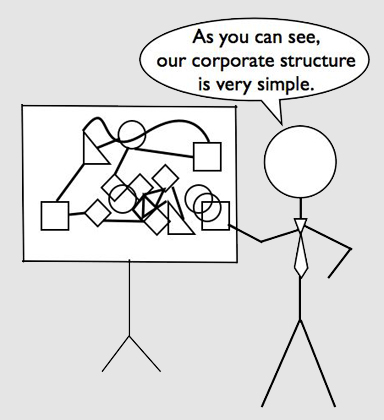
Enamored with the gravitas of a corporate structure, Arnie owns probably a dozen or more corporations or limited liability companies, all organized (I use that word very loosely) in a maze of affiliates, subsidiaries, parents, and joint ventures that would confuse a lab rat.  He forms them online, leaving the tedious work of writing bylaws, naming officers, and drafting minutes of corporate meetings until “later.” You can guess when “later” finally arrives… the day after he discovers he really needs them.

The contract he emailed me was between Office Megapark Corporation and “Acme.” I asked him which “Acme” he had in mind as the contracting party, given that he had “Acme Enterprises, Inc.,” “Acme Management, LLC,” “Acme Services Corporation,” “Acme Systems Limited Liability Company,” “Acme Interplanatery, Inc.” and a gaggle of other Acme variations of entities. He said he was not sure, and he would just put “Acme” in as the leasing party, so he could decide later which company he wanted to be the leaseholder. He planned to have his newly-hired office manager sign the lease, because her name had not yet appeared in any business records, and he could write her name and purported office into whatever corporate or LLC minutes he might need later. 

Arnie’s devil-may-care attitude toward contract and business association law reminded me of a sad fact. Small business owners sometimes (in Arnie’s case, always) skimp on the legal niceties. After all, they reason, paying out $500 to some lawyer for a bunch of forms and a vinyl corporate book doesn’t really “grow the business,” as the buzz phrase puts it. And who wants to squander money on a lawyer? Not Arnie. He just wanted a free and “quick read-through.”

Oops!

Oops! Sometimes, misteaks happen.

That’s rather false economy. In today’s case, a mom-and-pop timber harvesting business was hired to take down trees on one owner’s land, and — predictably enough — the chainsaws wandered onto Mr. Follender’s land, to the tune of 439 commercial-quality trees cut down and removed without permission. Follender lost trees worth $54,500. After trebling and some discounts, he ended up with a $120,000 judgment against Bert Maxim, the defendant.

Unfortunately, the timber harvester had involved his wife in the business, and she did enough of the business paperwork that she had signed the contract for the timber operation that had gone awry. Oh, if they had only incorporated, formed an LLC, done something! And if only Mrs. Maxim hadn’t signed that agreement! But hubby was out cutting down trees, and they were in a hurry …

The Court ruled that her involvement in the unincorporated business was enough to make her liable for the $120,000 judgment as well.

Sure, LegalZippy.com or Lawforms-R-Us can sell you some boilerplate-laden forms over the Internet that’ll purportedly set you right up. However, the best structure for a small business to protect its principals from liability varies from state to state. The legal niceties of the business organization — not just in the formation of the company but in day-to-day management — are best addressed by your local attorney or a specialist to whom he or she might refer you.

corporate_structureBut get the advice now. Usually, by the time you realize you should have spent the money on the legalities of business formation and protection, it’s too late.

Follender v. Maxim, 845 N.Y.S.2d 484, 44 A.D.3d 1227, 2007 WL 3101953 (N.Y.A.D., Oct. 25, 2007). Follender sued Berton Maxim and his wife for “wrongful and/or cutting down/taking of timber” from the purchased property. The Maxims, doing business as Prime Hardwood, had entered into a contract with Follender’s adjacent landowners, Valentine Riedman and Christl Riedman, to log their property. In the process, they inadvertently trespassed on Follender’s property and removed trees. Follender alleged negligence and conversion, with a request for treble damages, against the Riedmans and Maxim. They named his wife as a defendant, too, calling her “Jane Doe Maxim.”

Follender dropped the Riedmans from the suit, but the Maxims failed to answer or defend. After learning that Maxim’s wife’s name was Eileen Tine, Follender filed an amended verified complaint against them both individually and doing business as Prime Hardwood.

hook140806Again, they failed to answer or appear. After Follender got a default judgment against them, the court ordered an inquest. When the Maxims again failed to appear, Follender offered extensive proof which included, among other things, the contract between the Riedmans and Tine (signing on behalf of Prime Hardwood), an affidavit from Valentine Riedman which explained that when Maxim came to log his property, he was given a survey map which showed the Riedmans’ boundary line. Valentine Riedman was unaware that Maxim would remove timber outside of those boundaries. Michael Greason, a professional forester, testified that 439 commercial species trees were cut from Follender’s property, 386 of which had a value of $54,506.68. The Court trebled the damages and assessed damages of $120,000 against Maxim but never mentioned his wife, Eileen. Follender appealed, contending that the failure to include Eileen in the order awarding damages was a mistake.

Held: The judgment was modified, and the order of the trial court awarding treble damages of $120,000 against logger Maxim for negligence and conversion was rewritten to include the logger’s wife in the award of damages. She had signed the contract between Maxim’s business and the landowner’s adjoining property owners, in connection with which the logger had trespassed onto Follender’s property and from which he unlawfully removed trees.

Generally, appellate courts may correct any mistake, defect, or irregularity in a judgment, provided that the correction does not affect a substantial right of a party.

– Tom Root
TNLBGray140407