
HAWAII SINGS HAWAII
 Regular readers know that I often write about the Hawaii Rule, easily the second most cited rule in arboriculture law. But for all of that, the great State of Hawaii has not expounded on the seminal holding in Whitesell v. Houlton, the decision that most famously rejected the second prong of the Massachusetts Rule by holding that when a landowner’s tree became a nuisance to his or her neighbor, the neighbor could compel the landowner to abate the nuisance – that’s legalese for remove the tree or at least the part of the tree that was bedeviling the adjoining property owner – at the landowner’s expense.
Whitesell, which adopted a rule from an old Virginia case, Smith v. Holt, held that a tree was a nuisance if it was “noxious” or if there was an imminent danger of it causing “sensible harm” to property (besides plant life) other than by “casting shade or dropping leaves, flowers, or fruit.” “Sensible harm” is a standard not causing much confusion: tree roots heaving basement walls, danger trees about to fall on nearby cars and structures – it has always been reasonably obvious what “sensible harm” might be. But what might Whitesell’s reference to “noxious” trees be all about?
About 35 years after Whitesell, a Hawaii court has finally tackled the question, interpreting Whitesell and providing a rare glimpse at a court admitting that its own precedent, if not wrong, at least was a bit too frisky. Not that I am surprised, it turns out that Whitesell’s reference to noxious trees” was meaningless surplusage, language borrowed without much consideration from a since-discredited Virginia decision.
 No one ever expected a litigant to latch on to the “noxious” half of Whitesell’s disjunctive definition in order to make his case. When the plaintiff in today’s case did just that, the appellate court was compelled to admit that Whitesell’s inclusion of ‘noxious’ was “superfluous.” Translation: Whitesell said ‘noxious’, but it did not mean it.
The appellate court in today’s case did the only thing it could: it decided to “modify [the] holding in Whitesell for when a plant can be considered a nuisance. Plants whose overhanging branches cast shade or drop leaves, flowers, or fruit, or whose roots interfere only with other plant life, are not nuisances. Overhanging branches or protruding roots constitute a nuisance when they actually cause, or there is imminent danger of them causing, material harm to a person or to property other than plant life.”
Good idea, even if it’s 35 years late. Get rid of the ‘noxious’ language. If the tree is noxious, it probably already poses an imminent danger to people or property. And that is exactly what a non-noxious tree does when it has become a nuisance.
For heaven’s sake, simply define the tree by the imminent threat it represents, not with some squishy term like ‘noxious’.
Spittler v. Charbonneau, 145 Haw. 204, 449 P.3d 1202 (Ct. App. 2019). Scott Spittler sued his neighbors, Paul and Janice Charbonneau, raising all sorts of trespass, nuisance and related claims. The claims relevant here is his claim that the Charbonneaus’ ironwood trees, planted in 1983 as windbreaks under a U.S. Dept. of Agriculture program, were dropping leaves and branches on his property, and had “an extensive root system, have created a poor growing environment, and continue to present danger to person, real property, and agricultural products of [Spittler].” For good measure, he also claimed that the trees were ‘noxious,’ based upon a “high risk” rating of “12” set out on the Hawaii Pacific Weed Risk Assessment website. He demanded that the Charbonneaus remove the trees at their expense.
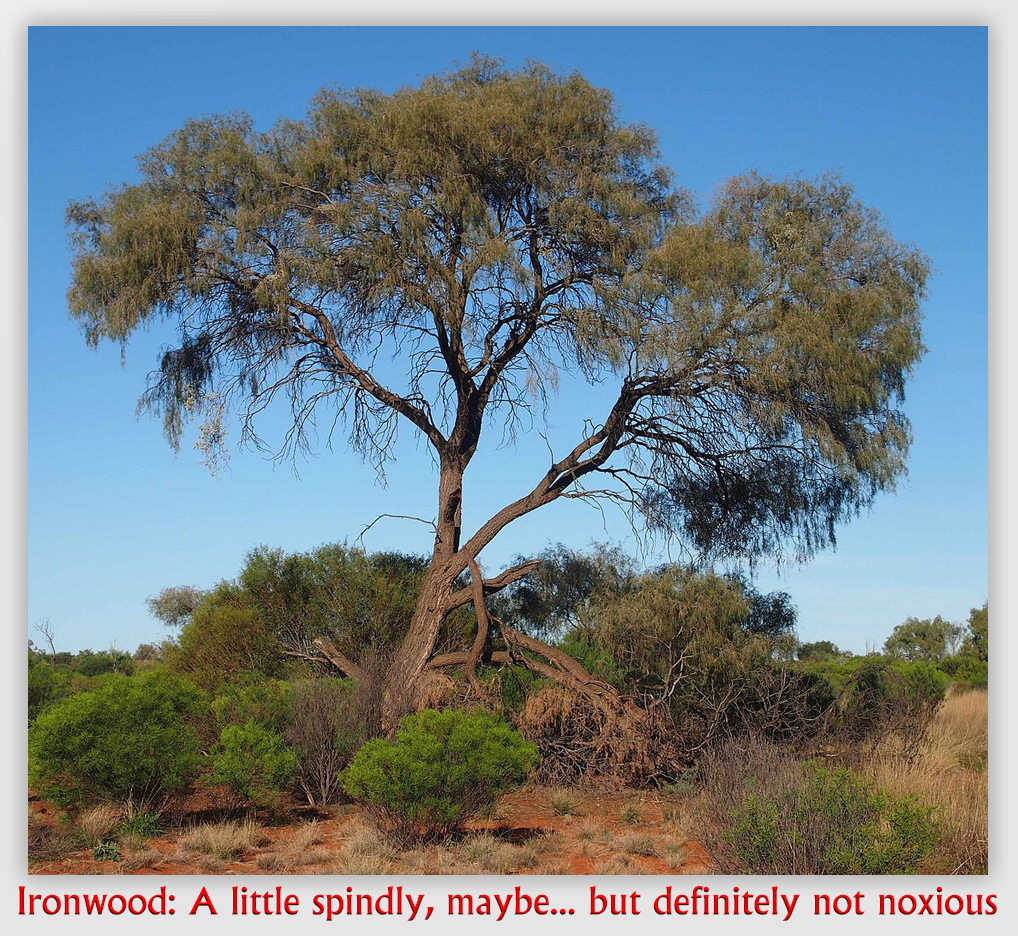 The trial court held for the Charbonneaus, finding that “the intrusion by way of overhanging branches, leaves and roots into Scott’s property that results in damage to plant life is not a nuisance and not compensable.”
Scott appealed.
Held: The trees were neither noxious nor nuisances. What’s more, Whitesell’s reference to noxious trees being nuisances is surplusage that should be stricken from the decision.
The Court observed with some surprise that “in a state known for its lush foliage, there appears to be only one reported appellate decision, Whitesell v. Houlton, addressing when a plant that naturally encroaches upon a neighboring property can constitute a nuisance. Whitesell adopted a modified version of the Virginia rule set forth in Smith v. Holt, which was later overruled in part by Fancher v. Fagella. Borrowing from Smith v. Holt, Whitesell held that “non-noxious plants ordinarily are not nuisances… Overhanging branches or protruding roots constitute a nuisance only when they actually cause, or there is imminent danger of them causing, sensible harm to property other than plant life, in ways other than by casting shade or dropping leaves, flowers, or fruit. When overhanging branches or protruding roots actually cause, or there is imminent danger of them causing, sensible harm to property other than plant life, in ways other than by casting shade or dropping leaves, flowers, or fruit, the damaged or imminently endangered neighbor may require the owner of the tree to pay for the damages and to cut back the endangering branches or roots and, if such is not done within a reasonable time, the damaged or imminently endangered neighbor may cause the cutback to be done at the tree owner’s expense.”
Thus, according to Whitesell, the Charbonneaus’ trees could be considered a nuisance if: (1) they were “noxious”; or (2) they caused, or there was an imminent danger of them causing, “sensible harm” to property other than plant life other than by “casting shade or dropping leaves, flowers, or fruit.”
“In Whitesell,” the Court said, “we did not define the word ‘noxious’ or formulate a test to determine when a plant could be considered ‘noxious.’ The difficulty inherent in characterizing a plant as ‘noxious’ is illustrated by this case. Scott argues that ironwood trees are “noxious” based upon a “high risk” rating of “12” on the Hawaii Pacific Weed Risk Assessment website. That website does not use the word “noxious” and states only that the “small-cone ironwood” is “[u]sed in [Hawai’i] for windbreaks at higher elevations. Wood used for fuel.” It does not indicate that the ironwood is “physically harmful or destructive to living beings,” which is the definition of “noxious” contained in the Merriam-Webster dictionary.” The Court noted that some Hawaii cases had characterized some other flora as being noxious, but ironwood trees weren’t on anyone’s list except for Scott’s.
 The Court sheepishly admitted that “[o]ur use of the word “non-noxious” in Whitesell was superfluous. A noxious plant — i.e., one that is “physically harmful or destructive to living beings” — is one that actually causes, or that could pose an imminent danger of causing, material harm to persons or to property other than plant life; conversely, a plant that actually causes, or that poses an imminent danger of causing, material harm to persons or property other than plant life may be considered noxious. We note that certain plants, such as coconut palms, are capable of causing material injury to persons or to property other than plant life just by dropping fronds or nuts. We also note that tree roots can, under some circumstances, pose imminent trip[ping] hazards without damaging property other than plant life. We therefore modify our holding in Whitesell for when a plant can be considered a nuisance. Plants whose overhanging branches cast shade or drop leaves, flowers, or fruit, or whose roots interfere only with other plant life, are not nuisances. Overhanging branches or protruding roots constitute a nuisance when they actually cause, or there is imminent danger of them causing, material harm to a person or to property other than plant life. When overhanging branches or protruding roots actually cause, or there is imminent danger of them causing, harm to a person or to property other than plant life, the damaged or imminently endangered neighbor may require the tree’s owner to pay for the damage and cut back the endangering branches or roots and, if that is not done within a reasonable time, the damaged or imminently endangered neighbor may cause the cutback to be done at the tree owner’s expense.”
The only dispute before the court alleged the ironwoods dropped “overhanging branches which merely cast shade or drop leaves, flowers, or fruit,” and “roots which interfere only with other plant life.” Under those facts, the Charbonneaus’ trees were not a nuisance…
– Tom Root


 Tree and Neighbor Law For Homeowners and Professionals