Case of the Day – Tuesday, April 28, 2026

IF I OWE HIM, YOU OWE ME, AND SOMEONE ELSE PROBABLY OWES YOU…

One of the beauties of American tort law (if we’re even allowed to use that phrase, which is doubtful) is that if you’re a defendant, you often can daisy-chain as many other people or entities to share your pain as your creative lawyer can find.

The tragic death of young but substantial teenager Tyre Sampson at a cut-rate Florida amusement park provides a case in point. Tyre, only 14 years old but already a sought-after football lineman (at 6’2″ and 300 lbs) fell to his death from a “Free Fall” ride, billed as the world’s tallest free-standing drop tower. When the tower brakes engaged, Tyre – who exceeded the maximum size for the ride – slipped out of his seat and fell 100 feet.

Tire’s parents sued the park, which in turn will no doubt sue the owners of the ride (who lease the contraption to the park).  They will sue the ride’s installers, who will sue the ride’s builders, who will sue the designers.  At some point, Sir Isaac Newton may become a third-party defendant: if not for him, there’d be no gravity. It’s a tort lawyer’s dream: a daisy chain of defendants, all with deep pockets.

Another example arose several years ago when a mid-air explosion of a Southwest Airlines 737 engine killed one passenger and – but for some serious flying by an unflappable Navy fighter pilot turned airline captain – could have killed hundreds. Let’s say Joe Doaks, a passenger on board who had the scare of his life, sues Southwest for negligence in maintaining the airplane. Southwest could be both the defendant and a third-party plaintiff, in turn suing the maintenance company that inspected the engine last without finding a crack in a turbine blade. The maintenance company could then bring in the engine maker for selling a defective engine, and the engine maker could sue the company that made the blade for defective manufacture, and the blade maker could sue the metal supply company for selling a nickel-based high-performance alloy that did not meet specifications, and the metal supply company can, in turn, sue the company making the test equipment that gave faulty readings that the metal was within limits… Before you know it, Joe Doaks has a chain of six defendants, each pointing the finger at the next guy and claiming that any liability they may have is shared among all of them.

This is generally a good thing for the plaintiff, because the more defendants, the deeper the collective pocket from which to collect. But the daisy-chained defendant has to have a duty to the injured party before it is liable, and the lure of finding someone else with a checkbook to stand in the defendant’s dock with you can lead to some fairly strained interpretations of “duty.”

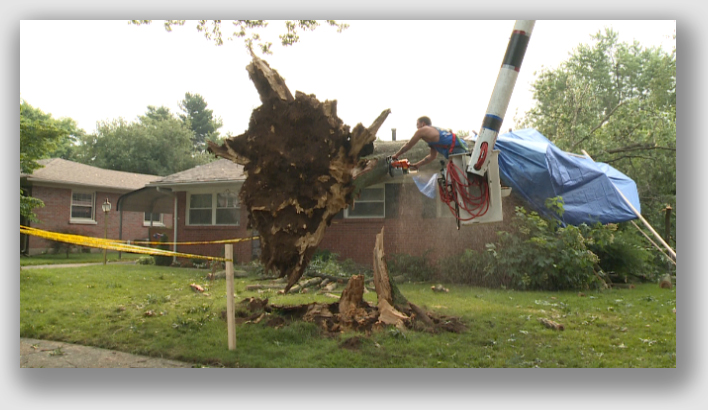
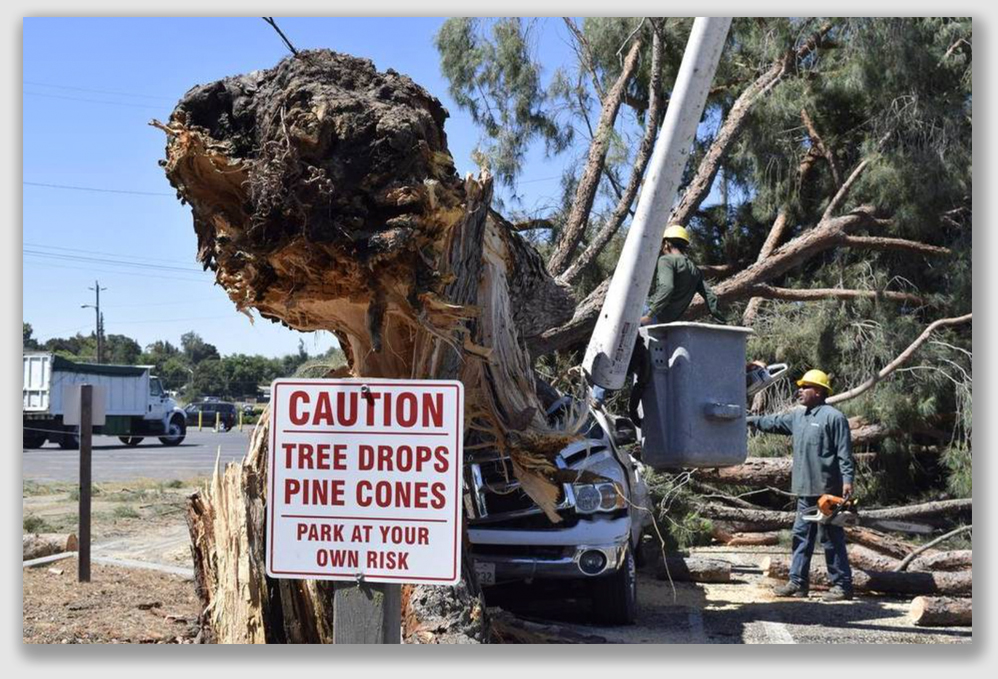
In today’s case, a landlord’s tree dropped a limb onto the heads of two of his tenants. They sued, complaining that the landlord company failed to fulfill its duty to maintain the tree. No argument there – of course it did. But the landlord, looking for someone to share its pain, went after the electric company. Dominion Virginia Power had an easement across the property, the landlord argued, and the defective tree stood within it. The power people, the landlord claimed,  had a duty to keep the trees in the easement trimmed, and thus shared any liability the landlord had to the injured tenants.

Well, yes, the court said, there is a duty there, but there is also some fine print regarding the extent of that duty. And, as the lawyers like to say, the details are where the devil resides…

Vaughan v. S.L. Nusbaum Realty Co., Case No. CL15-5895-00/012016 (Virginia Circuit Ct., Nov. 30, 2016), Va. Cir. LEXIS 183. Travis Vaughan and Alexander Goldenberg were injured when the “wind picked up” and they were struck by a falling limb from a tree located at an apartment complex owned and managed by S.L. Nusbaum Realty Co. Travis and Alex sued Nusbaum, who in turn sued Dominion Virginia Power, the electric company. It seems the tree that dropped the limb was located on a utility easement held by Dominion, and Nusbaum argued Dominion had a duty to maintain the tree.
The easement granted Dominion “the right, privilege and easement of right of way, to construct, operate and maintain a pole line for the transmission and distribution of electricity,” and, with respect to the issue before the Court, “the right to trim, cut and keep clear all trees, limbs and undergrowth and other obstructions along the lines or adjacent thereto that may in any way endanger or interfere with the proper and efficient operation of the same.” Nusbaum argued that as holder of the easement, Dominion had the same rights and responsibilities that Nusbaum did, and had “the duty to maintain the easement, including by maintaining any trees growing on the easement.”

Dominion argued it owed no contractual duty to Travis and Alexander to maintain trees located within the easement.

Held: The Court held that Dominion had no duty toward Travis and Alex.

The trial court said the relevant question was whether the duty to maintain the easement right of way imposes a concomitant duty upon Dominion — as the owner of the dominant estate—to maintain all aspects of the tree.

The right to use an easement comes with a duty to maintain it in a manner consistent with the allowed use. Although Virginia courts have apparently not articulated the extent of a power company’s duty under an easement, at least one other jurisdiction has. In a case stemming from a property owner’s personal injury when his heel struck a metal shield on a guy wire supporting a pole bearing equipment of defendants, a New Jersey court held that, as owners of the dominant estate, “defendants were under an affirmative duty to make reasonable inspections of their easement upon plaintiff’s property and to use due care to keep the guy wires and metal shield in good repair.”
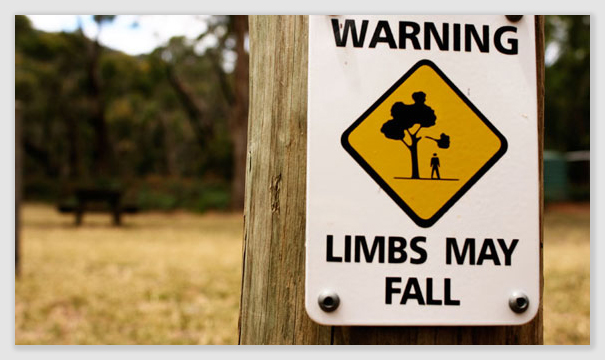
Here, the trial court said, the easement does not impose an affirmative duty on Dominion, as owner of the dominant estate, to tend to the tree beyond those actions necessary to maintain the easement in a manner consistent with the use allowed. Dominion has the duty to inspect the easement and make repairs as necessary, including trimming, cutting, and clearing trees, but only to the extent that such trees, or parts thereof, “endanger or interfere with the proper and efficient operation” of the “wires, poles, attachments, equipment and accessories.”

The court said Dominion nevertheless could be liable if Travis’s and Alex’s injuries were caused by its improper maintenance of the easement consistent with its use by, for example, failing to clear portions of the tree from the vicinity of power lines when necessary, trimming the tree in a way that the public was placed in danger, or compromising the health of the tree through improper trimming. Stated differently, the court said, Dominion “must take necessary actions to properly maintain the pole line and its accessories and, if Dominion exercises its right to ‘trim, cut and keep clear all trees, limbs and undergrowth and other obstructions along said lines or adjacent thereto that may in any way endanger or interfere with the proper and efficient operation of the same’ [which is what the easement specified], it must exercise reasonable care in doing so.”

The duty arises from the easement, so the complaint must allege facts to support a breach of that duty. It was not enough for the landlord to say the tree was on the easement and a limb fell to justify bringing the electric company into the lawsuit.

– Tom Root

TNLBGray140407

Case of the Day – Monday, March 16, 2026

THINK DIFFERENT

different151009The late Steve Jobs — whose equipment we use in running treeandneighborlawblog.com — exhorted us all to “think different,” by which he meant “buy Apple products.” Since his death, Steve’s life became a best-seller and a major motion picture a decade ago… but like its competitors, Samsung, Google, and Microsoft, Apple’s brand has tarnished a bit as of late. 

Notwithstanding Steve’s Einsteinian advice, my late mother – a retired English teacher – used to lecture me that Apple really meant “think differently.” No matter.

Today, we’re taking a fresh look at the Virginia Supreme Court’s decision in Fancher v. Fagella, the seminal 21st-century case on tree encroachment. In so doing, we re-read the old Smith v. Holt decision credited with first adopting the old Virginia Rule 85 years ago. And we’re “thinking different” about it. Sorry, Ma.

Initially, we confess, we joined with the Virginia Supreme Court and commentators in ridiculing Smith v. Holt’s focus on whether a tree was “noxious” or not. We liked the newer Fancher approach, which the Washington Post, after all, hailed as breaking new ground. But now, after revisiting Smith v. Holt and considering the 19th-century cases on which it was based, we’re wondering why Virginia ever thought the Fancher decision was necessary at all. Thinking different … can a set of Apple Vision Pro goggles be in our future?

Over the years, the law on what a neighbor may do with encroaching trees branched into three or four divisions. The flinty, self-reliant New Englanders have followed the Massachusetts Rule, a holding that landowners may resort to self-help to stop encroaching trees and roots by trimming them back to the property line, but courts are not available to hear encroachment disputes if self-help is not adequate. At the other end of the United States (and 50 years later), Hawaii adopted what is unimaginatively known as the Hawaii Rule, a holding that while Massachusetts Rule-style self-help was always available to a landowner, so were the courts: landowners could sue to collect damages and to force a neighbor to trim or remove a tree when that tree was causing actual harm or was an imminent danger to his or her property.

The disrespected Virginia case on the issue, Smith v. Holt, was in fact forward-looking and logical: in essence, Smith v. Holt adopted the Hawaii Rule years ahead of the Ahola State, and did so with law which — had the Virginia courts not acted so precipitously in Fancher v. Fagella — would still be the law in the Old Dominion.

Smith v. Holt was the 1939 decision — handed down only eight years after the Massachusetts Rule was adopted in the Bay State — that the Virginia Supreme Court repudiated in its 2007 Fancher opinion. In Smith v. Holt, the Virginia Supreme Court reviewed a dispute in which a neighbor’s private hedge had grown over the years to the point that it was growing on the complaining neighbor’s lawn and shading a large portion of it. The Court held that the Massachusetts Rule should apply unless the hedge in question was (1) causing actual harm or was an imminent danger to the neighbor; and (2) was “noxious.” Because Mrs. Smith had not shown that actual harm was being caused, the Supreme Court declined to order Mr. Holt to remove the hedge. The Smith v. Holt holding was seen at the time as a variation on the Massachusetts Rule — although we doubt that it was any real departure from the implied limits of that rule — and became known as the Virginia Rule.

In Fancher v. Fagella, the Supreme Court abandoned the Virginia Rule it adopted in Smith v. Holt. We think this abandonment was unnecessary, premised on a misunderstanding of its own holding 68 years earlier. The adoption of the Hawaii Rule is happening increasingly throughout the United States, and it is probably as inevitable as urban growth. However, the Virginia Supreme Court’s overturning of Smith v. Holt was an overreaction predicated on its own misunderstanding of what is meant by a “noxious” tree. Even in the Massachusetts Rule decision eight years before, the court had cited a 19th-century New York decision that held “[i]t would be intolerable to give an action in the case of an innoxious tree whenever its growing branches extend so far as to pass beyond the boundary line and overhang a neighbor’s soil.” The Massachusetts Rule was never intended to extend noxious trees. And what the Smith v. Holt court meant by “noxious” was clear in the context of that case. The court relied on an 1884 Mississippi case in which a mulberry tree was held to be “noxious” because its roots had penetrated and contaminated a neighbor’s well. There was nothing inherently poisonous about the tree: it was just growing in such a way as to cause real harm to the neighbor, beyond mere shade and encroachment. In fact, in the only Virginia case ever to rely on Smith v. Holt -— the case we’re reviewing today — a trial court found in 1990 that “under the circumstances of this case, the “mock” or “osage” orange trees are noxious.”

So it’s clear that whether a tree is “noxious” has nothing to do with the inherent characteristics of the tree or hedge, but has everything to do with where the tree or hedge is located and what it is doing to the neighbor. And that is the classic definition of a nuisance given by the U.S. Supreme Court in a 1926 case: “merely a right thing in the wrong place, like a pig in the parlor instead of the barnyard.” A noxious tree is a perfectly good tree, but one in the wrong place causing actual, substantial harm, or threatening the same.

But the Fancher Virginia Supreme Court ran off on a tangent, talking about kudzu and poison ivy when it is clear that the courts that first enunciated the “noxious” standard meant nothing more than a tree that was causing or threatening real harm. Ironically, under the Hawaii Rule adopted in Fancher, the plaintiff would have done no better than she did in Smith v. Holt. The hedge she complained about in 1939 wasn’t causing her any harm other than shade and encroachment on her property. That’s not actionable under the Hawaii Rule. If it had been destroying her foundation or choking her sewer, the Smith v. Holt court would have declared it “noxious” and thus a nuisance.

Likewise, Smith v. Holt was all Mr. and Ms. Fancher needed to carry the day. In fact, their arborist understood: he testified that the sweetgum “tree was ‘noxious’ because of its location …” (emphasis added). The arborist and the Fanchers both understood Smith v. Holt. Why the trial court could not, and why the Virginia Supreme Court found it necessary to overrule a perfectly serviceable decision — something courts are traditionally loathe to do — we don’t know. But contrary to the hand-wringing and the editorializing, no new day has dawned on Virginia encroachment law. Under Smith v. Holt, a tree causing actual or imminent sensible harm to a complaining neighbor was a “pig in a parlor.” Under Fancher v. Fagella, it still is.

nuisance151009Arrington v. Jenkins, Chancery 89-173, 1990 WL 751069 (Cir.Ct.Va. Feb. 20, 1990) (unreported). This decision, which relied on Smith v. Holt, a landmark Virginia case which was overruled in September 2007 by Fancher v. Fagella, appears to have concerned a suit by one urban neighbor against another because her Osage orange tree had limbs that were overhanging his yard. The Osage orange, of course, drops round fruit of about 5 inches in diameter, which are green and lumpy and inedible to humans. They are known as “hedge apples.”

Arrington sued for an injunction, asking the Court to order Jenkins to trim the branches that were overhanging the Arrington yard, apparently because of the 5” inedible “hedge apples” the tree dropped on his lawn every fall.

Held: The trial court held that “under the circumstances of this case, the ‘mock’ or ‘osage’ orange trees are ‘noxious’” within the meaning of Smith v. Holt. Because of that fact, the trial court said, the responsibility for the trimming of the trees to avoid the fruit from falling upon Arringtons’ property must rest with Jenkins. The court issued an injunction that restrained Jenkins from allowing the limbs of the Osage orange trees to grow over and above the Arringtons’ land.

– Tom Root

TNLBGray140407

Case of the Day – Wednesday, September 24, 2025

LOSERS WEEPERS

A few days ago, I wrote about a neighbor boy’s remarkable good fortune in finding a Wham-O Superball, and the law that governed whether he could keep it or had to return it to another claimant. All of that turned out to be moot, as he promptly lost it in a cornfield. But I had so much fun writing about finding lost property that I thought I’d take up the obverse of that coin today – what happens when the lost property was stolen to begin with.

The objet d'art that started it all

The objet d’art that started it all

Now, ripped from the headlines… and based on a true story… I present the tale of poor driving instructor Martha Fuqua, whose purported avocation of haunting flea markets and garage sales brought her a brief shining moment of wealth and fame.

Martha dropped $7.00 on a dusty and faded old painting in a dilapidated frame. Or so her story goes. She says it sat around her place for a few years before she decided to get it appraised at her late mother’s urging. Lo and behold, the painting turned out to be by the French impressionist Pierre Auguste Renoir. What a lucky break for Martha! And it seemed to be worth somewhere north of what Martha had paid for it, about 15,000 times her initial investment.

Everyone loves a story like this, an everyday Joe or Jane unexpectedly becoming rich because of serendipity. Like the German teen who happed across a 1-lb. gold bar while swimming on vacation. Martha’s story was equally compelling – maybe even more so, because she had just lost her teaching position and was training to be a casino blackjack dealer. No question, Martha sure could stand to be Queen for a Day, and maybe stub her toe on a windfall herself right about now.

But alas, nothing ruins a good story like an eyewitness. Or two.

When Martha sought to auction the piece of art in 2012, the word quickly spread that the piece was Renoir’s On the Shore of the Seine, a 5½ x 9-inch landscape. Martha, who began calling herself “Renoir Girl,” was basking in the publicity. Reporters and art enthusiasts tried without success to establish the provenance of the work. Someone eventually tracked it back to the Baltimore Museum of Art. Officials there denied ever having had it hanging on their walls. But shortly before the auction – which was expected to bring Martha over $100,000 – the Washington Post found documents showing that the May family, a prominent patron of the BMA, had loaned the work to the museum in 1937. Museum officials checked again, and this time found records showing the landscape had been reported stolen in 1951.

Enter Renoir Girl’s brother, Matt, who said that he had seen the painting among his late mother’s possessions several years before his sister said she had bought it for the price of a Subway foot-long and a medium drink. A mother who happened to have been an art student in Baltimore in the early 1950s, right when the diminutive painting was plucked from the  museum wall. Other family acquaintances recalled seeing the painting at the Fuqua family’s home in Virginia in the 80s and 90s. Oh, those pesky eyewitnesses!

No impressionist paintings were harmed during this raid.

No impressionist paintings were harmed during this raid.

The BMA complained that it didn’t really care how Martha Fuqua came to possess the work, because regardless, it belonged to the museum. The FBI bravely swept in, shot an unarmed civilian or two, wrestled the painting to the floor, probably tased the frame once or twice, and took possession of the work. Then the courts took over.

The government filed what is known as an interpleader action in Federal court. An interpleader action states in essence that the filer is in possession of some property to which there are competing claims for ownership. It asks the Court to separate the wheat from the chaff and sort out the claims. Ms. Fuqua said that she found the Renoir fair and square… and anyway, she possessed it and possession is nine-tenths of the law. The BMA said that the law doesn’t let anyone, even an innocent purchaser, take title to stolen goods.

United States v. Baltimore Museum of Art, 991 F. Supp. 2d 740 (E.D.Va. 2014): Only two parties remained of the four claimants named by the plaintiff United States of America, Martha Fuqua – who claimed she bought the artwork at a flea market – and the Baltimore Museum of Art. The BMA claimed the Renoir landscape had been reported stolen from its walls 60 years before.

Surprisingly enough to people who follow this kind of thing, the Court actually observed that “the Fourth Circuit has endorsed the truism ‘[t]hat possession is nine-tenths of the law’.” Virginia common law presumes that the person in possession of a piece of property has a superior claim to it, although the presumption can be rebutted by sufficient evidence. The Court noted that one way of rebutting the presumption was by proving the property was stolen because the law was clear that “even a good-faith purchaser for value cannot acquire title to stolen goods.”

Interestingly enough, Pierre

Interestingly enough, Pierre “Pete” Renoir, pictured here, was one of the few interested parties not to make a claim in the case for the landscape at issue.

BMA essentially was bringing a detinue action, a common law action to obtain an order from the court that its property be returned to it from another person – not necessarily a wrongdoer – who for whatever reason is in possession of it. In order to prevail, BMA had to prove (1) a property interest in the item; (2) the right to immediate possession; (3) that the property is capable of identification; (4) that the property is of some value; and (5) that it possessed the property at some time in the past.

The parties didn’t dispute that the property – a painting – could be identified and that it had considerable value. Ms. Fuqua, however, claimed that the museum couldn’t prove it had ever possessed the painting. The BMA produced copies of the 1951 police report, copies of its records showing that the painting had been loaned to it, and copies of board minutes from the early 1950s citing the theft and an insurance claim. (In case anyone wonders, the May family descendants had been named in the suit as potential claimants, but they waived any claim to the Renoir).

Martha Fuqua - the

Martha Fuqua – the “Renoir Girl” herself – argued that possession was nine-tenths of the law. It’s that other 10% that’ll get you, however, as it did in this case …

Martha Fuqua argued that the BMA records weren’t reliable evidence, but the District Court found the internal records showing the painting was loaned to it, that it cataloged it and exhibited it in due course, were convincing. Even more persuasive was the official copy of the police report, proving that the BMA had reported the painting had been purloined. Ms. Fuqua complained that the police report was hearsay, but the Court correctly pointed out that the report wasn’t intended to prove that the painting had been stolen, but rather to prove that it had been reported stolen. Too fine a point for you? Such is the nature of the law of evidence.

The Court concluded that Ms. Fuqua hadn’t offered any evidence that the painting had not been stolen, and the BMA had provided plenty of proof that it had been. As a final “hail Mary,” the Renoir Girl speculated that maybe Saidie May ­– who had loaned the painting to the museum – hadn’t had her husband’s permission to do so. Like that mattered. The Court dismissed this canard as rank speculation.

The painting was ordered back to the museum. And by her reckoning, Martha Fuqua is out the price of a King’s Hawaiian® Pork & Slaw Sandwich from Firehouse Subs… and a Coke.

Martha later said she’d like to put the kerfuffle behind her. One can hardly blame her. As for Marcia “Light Fingers” Fouquet, Martha’s deceased mother, the Romans had a phrase for it: De mortuis nil nisi bonum dicendum est (“Of the dead nothing but good is to be said.”) So we won’t talk about her at all.

–Tom Root

TNLBGray140407

Case of the Day – Monday, March 24, 2025

IF A TREE FALLS ON A CAR, AND THERE’S NOBODY TO SUE, DOES IT STILL MAKE A NOISE?

After the Virginia Supreme Court decided in Fancher v. Fagella that Linda Landowner has a duty to ensure her trees don’t become a nuisance to her neighbor Arnie Adjacency, you could be forgiven for reasoning that she also has a duty to be sure that her trees don’t fall on Mortimer and Mildred Motorist. After all, a duty to protect others from physical harm ought to rank higher on the hierarchy of social good than keeping Arnie’s retaining wall from collapsing.
Retain_wall

One of the beauties of the law, however, is that it often does not make sense. The Virginia Supreme Court had an opportunity to underscore that unsurprising phenomenon when it ruled that Fancher’s departure from the old Virginia Rule of Smith v. Holt didn’t extend to a landowner’s duty to the passing public. When a tree in the front yard dies, decays, and falls on the road, let the driver beware …

Cline v. Dunlora South, LLC, 726 S.E.2d 14 (Supreme Ct. Virginia, 2012). Cline was driving on a public road when a tree fell and crushed the roof of his car. Cline suffered severe and permanent injuries, including fractures of his cervical spine.

The tree was located about 16 feet from the edge of the road, on land owned by Dunlora South. At the time of the mishap, the road was traveled by about 25,000 vehicles per day. The tree, about 25 inches wide, was “dying, dead, and/or rotten” at the time it fell. It had been in this condition for “many years,” the Court said, “and exhibited visible signs of decay, which were open, visible and/or obvious.” According to Cline, the tree’s condition was or should have been known by Dunlora, just as the company should have been aware of the hazards presented by trees being next to the public highway. Cline sued, but the trial court held that Virginia law did not provide for recovery of personal injury damages caused by a private tree falling on a public highway. Cline appealed, and the case reached the Virginia Supreme Court.

Another Latin phrase ... this one more familiar ...

Another Latin phrase … this one more familiar ...

Held: The Court held that, even after Fancher v. Fagella, a private landowner was not responsible for damages to a person using a public highway, when that damage was caused by a tree located on the landowner’s property. At common law – that is, the law imposed and changed incrementally by judicial decisions handed down over the years – a landowner owed no duty to those outside the land with respect to natural conditions existing on the land, regardless of the danger posed by such dangerous conditions. Although Virginia courts had never recognized that principles of ordinary negligence apply to natural conditions on land, in Smith v. Holt, an adjoining landowner was held to have a nuisance cause of action if an injury was inflicted by the protrusion of roots from a noxious tree or plant on the property of such adjoining landowner. The Court observed that the duty it recognized in Smith v. Holt was “in accord with the broad common law maxim: ‘sic utere tuo ut alienum non laedas’ – one must so use his own rights as not to infringe upon the rights of another … The principle of sic utere precludes use of land so as to injure the property of another.”

It was this principle that gave birth to the “Virginia Rule,” a splitting of the difference between the Massachusetts Rule and the Hawaii Rule.

Fancher changed a lot, the Court admitted. It modified Smith’s “Virginia rule” by discarding the subjective requirement of “noxious” nature and imposing a limited duty on owners of adjoining residential lots to protect against actual or imminent injury to property caused by intruding branches and roots. Fancher established a rule allowing relief where trees encroaching onto the land of another begin to constitute a nuisance, that is, when they encroach upon the property of another such that they cause actual harm or the imminent danger of actual harm. Fancher recognized that a trial court must determine whether circumstances are sufficient to impose a duty on the owner of a tree to protect a neighbor’s land from damage caused by its intruding branches and roots.

We bet the driver heard this one ...

We bet the driver heard this one …

The Court held here that the Fancher rule imposing a duty on a tree owner to protect a neighbor’s land from damage caused by the tree, only “addresses a narrow category of actions arising from nuisance caused by the encroachment of vegetation onto adjoining improved lands.” The Fancher and Smith duties are dramatically different than imposing a duty on a landowner to monitor the natural decline of his or her trees adjacent to a roadway. Fancher does not impose a duty on a landowner to inspect and cut down sickly trees that have the possibility of falling on a public roadway and inflicting injury.

Instead, the duty owed by adjoining property owners is to not do anything to make the highway more dangerous than it would be in its natural state. In this case, no one suggested that Dunlora engaged in any affirmative act that made its property adjoining the highway different than it had been in its natural state. Cline’s complaint was that Dunlora failed to act, and Virginia common law tort principles do not hold that a landowner owes a duty to take affirmative acts to protect travelers on an adjoining public roadway from natural conditions on his or her land.

– Tom Root


TNLBGray140407

Case of the Day – Thursday, February 6, 2025

ENCROACHMENT, NUISANCE … AND THE MARCH OF TIME

camelhorse140429Encroachment – not the football kind, the tree kind. Encroachment governs the rights of adjoining property owners when the trees on one of the properties encroach on the property of the other. Overhanging branches, invasive root systems, falling debris … those kinds of problems.

Monday, we explored one of the two different approaches to encroachment under American law, the “Massachusetts Rule” that landowners are limited to self-help – but not lawsuits – to stop encroaching trees and roots. Yesterday, we looked at the other end of these 50 United States, and the “Hawaii Rule,” a holding that a landowner could sue for damages and injunctive relief when a neighbor’s tree was causing actual harm or was an imminent danger to his or her property.

Between the two competing rules, Virginia found herself firmly straddling the line. The fair Commonwealth may be for lovers but it is also for equivocators. The landmark Old Dominion case on the issue, Smith v. Holt, hailed from the 1930s, holding that the Massachusetts Rule applied unless the tree in question was (1) causing actual harm or was an imminent danger; and (2) “noxious.” This holding brings to mind the maxim, “A camel looks like a horse designed by a committee.” Frankly, Smith v. Holt had “committee’ written all over it. It seemed to hold that the Massachusetts Rule applied except where it didn’t. And what did “noxious” have to do with anything?

hoist140715The Virginia Supreme Court finally addressed the confusing situation in Fancher v. Fagella. There the Court found itself hoisted on its own “noxious” petard. Everyone could agree that poison ivy was noxious, and most people could agree kudzu was noxious. But how about a cute little shade tree? Shade trees are definitely not in the same league with poisonous or entangling pests, but yet, a cute little shade tree can come out of the ground harder and do more damage than poison ivy or kudzu ever could.

Take the tree in Fancher. It was a sweet gum, a favored landscaping tree as well as a valuable hardwood. But for poor Mr. Fancher, it was Hydra covered in bark. Only halfway grown, Fagella’s sweet gum’s roots were already knocking over a retaining wall, kicking up patio stones, breaking up a house foundation and growing into sewers and even the house’s electrical system. Fancher sued for an injunction, but the trial court felt obligated to follow Smith v. Holt. There was just no way that a sweet gum tree could be noxious, the local court held, and thus, it would not help the frustrated Mr. Fancher. But the Virginia Supreme Court, wisely seeing that the “noxious” standard was of no help in these cases, abandoned the hybrid rule of Smith v. Holt, an unwieldy compromise that had already become known as the “Virginia Rule.” The Court – noting that the “Massachusetts Rule” was a relic of a more rural, bucolic age – decided that the “Hawaii Rule” was the better fit for modern, crowded, helter-skelter suburban life. It sent the case back to the trial court, instructing the judge that the court should consider whether an injunction should issue.

This decision fits neatly into what we have been considering for the past week on negligence and nuisance. Here, the tree had become a nuisance, possibly because Fagella had not cared for the tree before it began damaging the neighbor’s property. All the tree had ever done is what trees do – it grew. And grew and grew. It was healthy, perhaps amazingly so, but Fagella was ordered to shoulder the cost of damages caused not because it was dangerous or dead or anything other than an inconvenience.

Like the decision or hate it, you could see this coming. From an age in which trees grew and lived and died, and effects of the life cycle were not chargeable against the landowner, we may be arriving at a point where trees aren’t much more than big, woody pets, with their owners responsible for whatever the tree may naturally do.

Fancher v. Fagella, 650 S.E.2d 519, 274 Va. 549 (2007). Fancher and Fagella were the owners of adjoining townhouses in Fairfax County, Virginia (a largely urban or suburban county west of Washington, D.C., and part of the Washington metropolitan area). Fagella’s property is higher in elevation than Fancher’s, and a masonry retaining wall runs along the property line to support the grade separation. Fancher has a sunken patio behind his home, covered by masonry pavers.

treeonhouse160322Fagella had a sweet gum tree located a few feet from the retaining wall, about 60 feet high with a 2-foot diameter trunk at its base. Sweet gums are native to the area and grow to 120 to 140 feet in height at maturity, with a trunk diameter of 4 to 6 feet. The tree was deciduous, dropping spiky gumballs and having a heavy pollen load. It also has an invasive root system and a high demand for water.

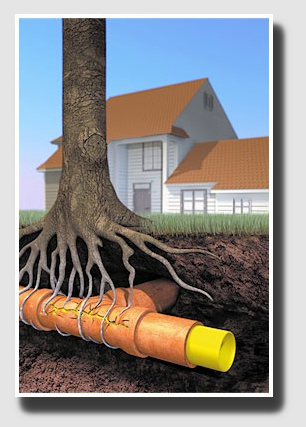
In the case of Fagella’s tree, the root system had displaced the retaining wall between the properties, displaced the pavers on Fancher’s patio, caused blockage of his sewer and water pipes and had begun to buckle the foundation of his house. The tree’s overhanging branches grew onto his roof, depositing leaves and other debris in his rain gutters. Fancher attempted self-help, trying to repair the damage to the retaining wall and the rear foundation himself, and cutting back the overhanging branches, but he was ineffective in the face of the continuing expansion of the root system and branches. Fancher’s arborist believed the sweet gum tree was only at mid-maturity, that it would continue to grow, and that “[n]o amount of concrete would hold the root system back.” The arborist labeled the tree “noxious” because of its location, and said that the only way to stop the continuing damage being done by the root system was to remove the tree entirely.

Fancher sued for an injunction compelling Fagella to remove the tree and its invading root system entirely and asked for damages to cover the cost of restoring the property to its former condition. Fagella moved to strike the prayer for injunctive relief. The trial court, relying on Virginia law set down in Smith v. Holt, denied injunctive relief. Fancher appealed.

Held: The Supreme Court abandoned the “Virginia Rule,” adopting instead the “Hawaii Rule” that while trees and plants are ordinarily not nuisances, they can become so when they cause actual harm or pose an imminent danger of actual harm to adjoining property. Then, injunctive relief and damages will lie. The Court traced the history of the encroachment rule from the “Massachusetts Rule” — which holds that a landowner’s right to protect his property from the encroaching boughs and roots of a neighbor’s tree is limited to self-help, i.e., cutting off the branches and roots at the point they invade his property — through the modern “Hawaii Rule.” The Court noted that Virginia had tried to strike a compromise between the two positions with the “Virginia Rule” set out in Smith v. Holt, which held that the intrusion of roots and branches from a neighbor’s plantings which were “not noxious in [their] nature” and had caused no “sensible injury” was not actionable at law, the plaintiff being limited to his right of self-help.

Invasive_rootsThe Court found the “Massachusetts Rule” rather unsuited to modern urban and suburban life, although it may still work well in many rural conditions. It admitted that the “Virginia Rule” was justly criticized because the classification of a plant as “noxious” depends upon the viewpoint of the beholder. Just about everyone would agree that poison ivy is noxious. Many would agree that kudzu is, too, because of its tendency toward rampant growth, smothering other vegetation. But few would declare healthy shade trees to be noxious, although they may cause more damage and be more expensive to remove, than poison ivy or kudzu. The Court decided that continued reliance on the distinction between plants that are noxious and those that are not imposed an unworkable and futile standard for determining the rights of neighboring landowners.

Therefore, the Court overruled Smith v. Holt, insofar as it conditions a right of action upon the “noxious” nature of a plant that sends forth invading roots or branches into a neighbor’s property. Instead, it adopted the Hawaii Rule, finding that encroaching trees and plants are not nuisances merely because they cast shade, drop leaves, flowers, or fruit, or just because they happen to encroach upon adjoining property either above or below the ground. However, encroaching trees and plants may be regarded as a nuisance when they cause actual harm or pose an imminent danger of actual harm to adjoining property. If so, the owner of the tree or plant may be held responsible for harm caused to adjoining property, and may also be required to cut back the encroaching branches or roots, assuming the encroaching vegetation constitutes a nuisance. The Court was careful to note that it wasn’t altering existing law that the adjoining landowner may, at his own expense, cut away the encroaching vegetation to the property line whether or not the encroaching vegetation constitutes a nuisance or is otherwise causing harm or possible harm to the adjoining property.

The Court warned that not every case of nuisance or continuing trespass may be enjoined, but it could be considered here. The decision whether to grant an injunction, the Court held, always rests in the sound discretion of the chancellor and depends on the relative benefit an injunction would confer upon the plaintiff in contrast to the injury it would impose on the defendant. In weighing the equities in a case of this kind, the chancellor must necessarily first consider whether the conditions existing on the adjoining lands are such that it is reasonable to impose a duty on the owner of a tree to protect a neighbor’s land from damage caused by its intruding branches and roots. In the absence of such a duty, the traditional right of self-help is an adequate remedy. It would be clearly unreasonable to impose such a duty upon the owner of historically forested or agricultural land, but entirely appropriate to do so in the case of parties, like those in the present case, who dwell on adjoining residential lots.

– Tom Root

TNLBGray140407

Case of the Day – Wednesday, January 15, 2025

THERE ARE LEGAL COSTS, AND THEN THERE ARE LEGAL COSTS

fees160104Let nothing come between a lawyer and his fee.

You might be cynical, and see today’s case as nothing more than a lawyer worried about collecting a large and unwarranted fee. But the case is much more than that.

The facts are rather prosaic. Some landowners failed to carefully mark the common boundary with their neighbor before setting a timber company loose on the property. Sure enough, the cutters harvested some of the neighbor’s trees. That much wasn’t an issue.

When Valarie Garvey sued the Chaceys for timber trespass, property damage and a collection of related causes of action, the Chaceys hired some aggressive litigators. Their lawyers knew that the best trial defense often is a good pretrial offense. They fought tooth and nail before trial, gaining their best tactical high ground when Valerie’s lawyer inexplicably didn’t identify the plaintiff’s timber expert by the pretrial deadlines.

The expert was crucial because he was going to testify as to the value of the timber that had been wrongfully cut. But once the expert established the value of the missing trees, Section 55-332 of the Virginia Code would let Valerie Garvey collect three times the value of the wrongly-cut timber, plus reforestation costs, plus other damages to the property (such as the private road the timber harvesters ripped up) plus “legal costs directly related to the trespass.” In short, it looked like a big payday for Valerie Garvey. She just had to do one thing. She had to prove the value of the stolen timber.

Alas, she screwed it up. Perhaps it would be more appropriate to say her lawyer screwed it up. Without the expert, Valerie had no way to get the value of the timber into evidence. When the jury decided the case, it was able to award her the princely sum of $15,135.00 (only a fraction of the reforestation costs she estimated to be $78,000.)

expert160104Valerie’s lawyer, trying to save a case that was going south pretty fast, successfully convinced the trial court that the “directly associated legal costs incurred by the owner of the timber as a result of the trespass” included attorneys’ fees. Valerie claimed she had spent over $135,000 in legal fees, and the trial court awarded even more than that – $165,000 – in fees.

I doubt that Valerie’s lawyer was going to get all of that pile of cash. In fact, Val had every right to be as mad as a wet hen over counsel’s missing the expert witness deadline. I suspect that the lawyer and client had made a deal to salvage something out of the case, a deal that would have counsel ending up with little more than cab fare (but no malpractice claims). Unfortunately, we’ll never know, because, on appeal, the Chaceys convinced the Virginia Supreme Court that whatever “directly associated legal costs” might be, they are not “attorneys fees.” The Supreme Court was impressed that wherever the legislature intended to authorize the award of attorneys fees – in over 200 statutes in the Code – it was able to clearly say so.

The Chaceys – not satisfied with hitting a triple – swung for the fence. They asked the Supreme Court to rule that where a plaintiff claiming timber trespass did not prove the value of the missing timber, the case should be thrown out. The Supreme Court disagreed. Proving a timber trespass does not require that one prove the value of the purloined pines. Of course, not doing so cuts the plaintiff out of a lot of damages, but the offense does not depend on proven damages. It just requires that a trespass to timber occur, whether the tree is worth anything or not.

As for Valerie’s attorney, I suspect he marched straight from the courtroom to his malpractice carrier’s office.

reforest160104Chacey v. Garvey, 295 Va. 1, 781 S.E.2d 357 (Supreme Court of Virginia, 2015). In 1995, Valerie Garvey bought 50 acres of land from Allan and Susan Chacey. The Chaceys retained ownership of adjacent property, and they reserved to themselves an easement over Garvey’s property as a means for ingress and egress to their property.

At the end of 2012, Garvey sued the Chaceys and Blue Ridge Forestry Consultants, Inc., alleging timber theft and trespass. Garvey said the Chaceys had hired a logging company a few years previously to remove some timber located on their property, and that the company had trespassed on her property and removed timber without her permission. She alleged that she was entitled to damages for timber theft at three times the value of the timber on the stump, as well as reforestation costs not to exceed $450 an acre, the costs of ascertaining the value of the timber, and her attorney’s fees. She also asked for $30,000 for damages to her property caused by the trespass, including damage to the road, fencing, and the stone bridge.

Prior to trial, Garvey attempted to designate an expert witness for the purpose of establishing the monetary value of the timber on the stump at issue in the complaint. However, she did so too late and the trial court refused to let her expert testify during the three-day jury trial.

While she was testifying at trial, Garvey was asked by her attorney whether she had incurred legal costs in connection with the trespass. The Chaceys objected, but the trial court ruled that legal costs included attorney’s fees. Garvey told the jury that she had incurred more than $135,000 in legal costs, including attorney’s fees, which she claimed were all directly associated with the trespass. She also testified that she had negotiated with Bartlett Tree Services for the restoration of the trees, and she had paid a deposit of $440 towards that work, against a total price of $78,000.

The trial court ruled that Garvey could not recover treble damages since her expert evidence regarding the value of the timber on the stump had been excluded. However, the case could still go to the jury for consideration of damages for reforestation and legal costs.

The Chaceys argued that attorneys’ fees are not recoverable by a prevailing party in an action for timber theft pursuant to the Virginia Code § 55-331. They also contended that Garvey’s timber trespass claim should not have been submitted to the jury, because she had failed to provide any evidence related to the value of the alleged damaged timber. However, the jury found for Garvey on her claims of timber theft, trespass, and property damage. On the timber theft claim, the jury awarded Garvey $135.00 in reforestation costs. The jury also awarded her legal costs. On the trespass count, the jury awarded Garvey $15,000 in damages. The trial court held that Garvey was entitled to $165,135 in “directly associated legal costs incurred by Plaintiff as a result of the trespass, including attorney’s fees, in the amount of $150,000 …”

The Chaceys appealed.

needlawyer160104Held: The Virginia Supreme Court split the ticket. It observed that although Virginia Code § 55-331 permits any victim of timber trespass to collect “directly associated legal costs incurred by the owner of the timber as a result of the trespass,” whether Garvey was entitled to attorney’s fees depends upon the meaning of “costs.” Garvey argued that her attorney’s fees are legal costs directly associated with the trespass. The Chaceys argued that Garvey is merely entitled to the costs necessary for the prosecution of her suit.

Tracing the definition of “costs” in other proceedings, the Court held that “the term ‘costs’ is limited to the costs necessary for the prosecution of a suit, and does not include attorney’s fees. The Code of Virginia contains more than 200 instances where the General Assembly has determined a successful litigant is entitled to ‘attorney’s fees and costs’ or ‘costs and attorney’s fees’ … However, the General Assembly did not include the right to recover attorney’s fees in this statute, something it has done in more than 200 other separate instances.”

The Court disagreed with the Chaceys, however, about the timber trespass claim. The Chaceys, no doubt wanting to capitalize on their pretrial success in keeping Garvey’s expert off the stand, argued that the trial court erred in permitting Garvey’s timber trespass claim to proceed to the jury because Garvey failed to provide any evidence related to the value of the alleged damaged timber. Essentially, the Chaceys were contending that evidence related to the value of the damaged timber is a prerequisite to awarding any of the additional damages provided for under Code § 55-332(B).

Virginia Code § 55-332(B) holds that any person who removes timber from the land of another without permission is liable to the rightful owner for “three times the value of the timber on the stump and shall pay to the rightful owner of the property the reforestation costs incurred not to exceed $450 per acre, the costs of ascertaining the value of the timber, and any directly associated legal costs incurred by the owner of the timber as a result of the trespass.” The Court held that there was nothing in the statute that stated that an owner is only entitled to reforestation costs, legal costs, or the costs of ascertaining the value of the timber after he or she had first established the value of the timber that was improperly taken. Instead, the Court said, the statute made clear that the person who removed the timber “shall be liable to pay” all of these damages to the owner. The fact that Garvey was unable to prove the value of the timber on the stump in this case did not preclude her from being able to recover the other damages she was entitled to under Code § 55-332(B).

– Tom Root

TNLBGray

Case of the Day – Monday, August 19, 2024

THERE ARE LEGAL COSTS, AND THEN THERE ARE LEGAL COSTS

fees160104Let nothing come between a lawyer and his or her fee.

You might be cynical, and imagine that today’s case is nothing more than a lawyer worried about collecting a large and unwarranted fee. But the case is much more than that.

The facts are rather prosaic. Some landowners failed to carefully mark the common boundary with their neighbor before setting a timber company loose on the property. Sure enough, the cutters harvested some of the neighbor’s trees. That much wasn’t an issue.

When Valarie Garvey sued the Chaceys for timber tress, property damage and a collection of related causes of action, the Chaceys hired some aggressive litigators. Their lawyers knew that the best trial defense often is a good pretrial offense. They fought tooth-and-nail before trial, gaining their best tactical high ground when Valerie’s lawyer inexplicably didn’t identify the plaintiff’s timber expert by the pretrial deadlines.

The expert was crucial because he was going to testify as to the value of the timber that had been wrongfully cut. But once the expert established the value of the missing trees, Section 55-332 of the Virginia Code would let Valerie Garvey collect three times the value of the wrongly-cut timber, plus reforestation costs, plus other damages to the property (such as the private road the timber harvesters ripped up) plus “legal costs directly related to the trespass.” In short, it looked like a big payday for Valerie Garvey. She just had to do one thing. She had to prove the value of the stolen timber.

Alas, she screwed it up. Perhaps it would be more appropriate to say her lawyer screwed it up. Without the expert, Valerie had no way to get the value of the timber into evidence. When the jury decided the case, it was able to award her the princely sum of $15,135.00 (only a fraction of the reforestation costs she estimated to be $78,000.)

expert160104Valerie’s lawyer, trying to save a case that was going south pretty fast, successfully convinced the trial court that the “directly associated legal costs incurred by the owner of the timber as a result of the trespass” included attorneys’ fees. Valerie claimed she had spent over $135,000 in legal fees, and the trial court awarded even more than that – $165,000 – in fees.

We doubt that Valerie’s lawyer was going to get all of that. In fact, Val had every right to be as mad as a wet hen over counsel’s missing the expert witness deadline. We suspect that the lawyer and client had made a deal to salvage something out of the case, and counsel would have ended up with little more than cab fare (but no malpractice claims). Unfortunately, we’ll never know because on appeal the Chaceys convinced the Virginia Supreme Court that whatever “directly associated legal costs” might be, they are not “attorneys fees.” The Supreme Court was impressed that wherever the legislature intended to authorize the award of attorneys fees – in over 200 statutes in the Code – it was able to clearly say so.

The Chaceys – not satisfied with hitting a triple – swung for the fence. They asked the Supreme Court to rule that where a plaintiff claiming timber trespass did not prove the value of the missing timber, the case should be thrown out. The Supreme Court disagreed. Proving a timber trespass does not require that one prove the value of the purloined pines. Of course, not doing so cuts the plaintiff out of a lot of damages, but the offense does not depend on proven damages. It just requires that a trespass to timber occur, whether the tree is worth anything or not.

As for Valerie’s attorney, we suspect he was on the phone pretty quickly, calling his malpractice carrier.

reforest160104Chacey v. Garvey, 291 Va. 1, 781 S.E.2d 357, 358 (2015). In 1995, Valerie Garvey bought 50 acres of land from Allan and Susan Chacey. The Chaceys retained ownership of adjacent property, and they reserved to themselves an easement over Garvey’s property as a means for ingress and egress to their property.

At the end of 2012, Garvey sued the Chaceys and Blue Ridge Forestry Consultants, Inc., alleging timber theft and trespass. Garvey said the Chaceys had hired a logging company a few years previously to remove some timber located on their property, and that the company had trespassed on her property and removed timber without her permission. She alleged that she was entitled to damages for timber theft at three times the value of the timber on the stump, as well as reforestation costs not to exceed $450 an acre, the costs of ascertaining the value of the timber, and her attorney’s fees. She also asked for $30,000 for damages to her property caused by the trespass, including damage to the road, fencing, and the stone bridge.

Prior to trial, Garvey attempted to designate an expert witness for the purpose of establishing the monetary value of the timber on the stump at issue in the complaint. However, she did so too late, and the trial court refused to let her expert testify during the three-day jury trial.

While she was testifying at trial, Garvey was asked by her attorney whether she had incurred legal costs in connection with the trespass. The Chaceys objected, but the trial court ruled that legal costs included attorney’s fees. Garvey told the jury that she had incurred more than $135,000 in legal costs, including attorney’s fees, which she claimed were all directly associated with the trespass. She also testified that she had negotiated with Bartlett Tree Services for the restoration of the trees, and she had paid a deposit of $440 towards that work, against a total price of $78,000.

The trial court ruled that Garvey could not recover treble damages since her expert evidence regarding the value of the timber on the stump had been excluded. However, the case could still go to the jury for consideration of damages for reforestation and legal costs.

The Chaceys argued that attorneys’ fees are not recoverable by a prevailing party in an action for timber theft pursuant to the Virginia Code § 55-331. They also contended that Garvey’s timber trespass claim should not have been submitted to the jury, because she had failed to provide any evidence related to the value of the alleged damaged timber. However, the jury found for Garvey on her claims of timber theft, trespass, and property damage. On the timber theft claim, the jury awarded Garvey $135.00 in reforestation costs. The jury also awarded her legal costs. On the trespass count, the jury awarded Garvey $15,000 in damages. The trial court held that Garvey was entitled to $165,135 in “directly associated legal costs incurred by Plaintiff as a result of the trespass, including attorney’s fees, in the amount of $150,000 …”

The Chaceys appealed.

needlawyer160104Held: The Virginia Supreme Court split the ticket. It observed that although Virginia Code § 55-331 permits any victim of timber trespass to collect “directly associated legal costs incurred by the owner of the timber as a result of the trespass,” whether Garvey was entitled to attorney’s fees depends upon the meaning of “costs.” Garvey argued that her attorney’s fees are legal costs directly associated with the trespass. The Chaceys argued that Garvey is merely entitled to the costs necessary for the prosecution of her suit.

Tracing the definition of “costs” in other proceedings, the Court held that “the term ‘costs’ is limited to the costs necessary for the prosecution of a suit, and does not include attorney’s fees. The Code of Virginia contains more than 200 instances where the General Assembly has determined a successful litigant is entitled to ‘attorney’s fees and costs’ or ‘costs and attorney’s fees’ … However, the General Assembly did not include the right to recover attorney’s fees in this statute, something it has done in more than 200 other separate instances.”

The Court disagreed with the Chaceys, however, about the timber trespass claim. The Chaceys, no doubt wanting to capitalize on their pretrial success in keeping Garvey’s expert off the stand, argued that the trial court erred in permitting Garvey’s timber trespass claim to proceed to the jury because Garvey failed to provide any evidence related to the value of the alleged damaged timber. Essentially, the Chaceys were contending that evidence related to the value of the damaged timber is a prerequisite to awarding any of the additional damages provided for under Code § 55-332(B).

Virginia Code § 55-332(B) holds that any person who removes timber from the land of another without permission is liable to the rightful owner for “three times the value of the timber on the stump and shall pay to the rightful owner of the property the reforestation costs incurred not to exceed $450 per acre, the costs of ascertaining the value of the timber, and any directly associated legal costs incurred by the owner of the timber as a result of the trespass.” The Court held that there was nothing in the statute that stated that an owner is only entitled to reforestation costs, legal costs, or the costs of ascertaining the value of the timber after he or she had first established the value of the timber that was improperly taken. Instead, the Court said, the statute made clear that the person who removed the timber “shall be liable to pay” all of these damages to the owner. The fact that Garvey was unable to prove the value of the timber on the stump, in this case, did not preclude her from being able to recover the other damages she was entitled to under Code § 55-332(B).

– Tom Root

TNLBGray