Case of the Day – Friday, November 7, 2025

ODDJOB

We suspect that imagining a world without frivolous lawsuits would be an impossible dream.

We suspect that imagining a world without frivolous lawsuits would be an impossible dream.

We suspect neighborhood grocer Jerald Walker won’t try to save a few bucks like this anymore. When he had odd jobs to be done around the store, he generally would offer the work to casual laborer Gene Moser and his sometimes-sidekick Paul McCubbin. Gene and Paul (think “Stan and Ollie,” if you like), would paint walls, repair doors, rake leaves or perform other menial tasks, and Jerald would pay them an agreed-upon price for the work.

As lawyers like to say, there came a time when Jerald needed some trees trimmed. He called Gene and offered $30.00 for the project. Gene, apparently daunted by the scope of work to be performed, recruited his swamper Paul, agreeing to split the fee 50-50. Instead, the only thing that was split was Paul’s noggin.

Gene and Paul finally showed up to do the job, and Jerald provided them with the saws they needed. They had only trimmed a couple of branches when a limb being cut by Gene fell and hit Paul.

Would Pancho sue the Cisco Kid? Tonto file against the Lone Ranger? Sancho allege a tort against Don Quixote? Such weighty questions may never be answered, but we do know that Paul would sue Gene. And he did.

For good measure, Paul McCubbin also went after Jerald Walker, arguing that he deserved workers’ compensation because he had been the store’s employee and, in the alternative, contending that the tree-trimming work was inherently dangerous. An “inherently dangerous” occupation provides an exception to the rule that an independent contractor cannot collect against a hiring party.

The Workers’ Compensation hearing officer ruled that Paul McCubbin was not an employee of the store, a position agreed with by the trial. For good measure, the trial court also held that tree trimming was not an inherently dangerous occupation. Paul McCubbin’s guardian – necessary because his head injuries were severe and permanent – had more luck in the Court of Appeals. That tribunal ruled that material questions of fact had been raised regarding both whether McCubbin was an employee and whether the work he was hired to do was inherently dangerous. The parties appealed to the Kansas Supreme Court.

The Supreme Court ruled that nothing in the record permitted a holding that McCubbin was Jerald Walker’s employee. The fact that Walker provided the tools and pointed out the trees to be trimmed was not determinative, because the price was set for a complete job, Walker had no control over when the job was done or how it was done, or even over how McCubbin and Moser would split the payment for the work. Thus, Paul McCubbin was the grocery store’s independent contractor, and Walker was not liable for the accident.
Sure you do ... but does that make you a tree trimmer?

Sure you do … but does that make you a tree trimmer?

What’s more, the Court said, no work is “inherently dangerous” if it can be performed safely. Tree trimming can be done safely and without accident (although maybe not by McCubbin and Moser). Thus, the “inherently dangerous” exception to nonliability did not apply here.

McCubbin v. Walker, 256 Kan. 276, 886 P.2d 790 (S.Ct. Kan. 1994). Jerald and Carol Walker own Valley Market, a small, neighborhood grocery store in Kansas City, Kansas. Jerald often hired Gene Moser and Paul McCubbin, two local men, to perform odd jobs at the market, such as painting, light carpentry, and other general maintenance duties. Walker viewed the two as ‘contract labor’ rather than as traditional employees. Walker would decide on whatever job he needed to be done and then negotiate with them about the cost of performance.

In April 1989, Walker contacted Moser about trimming dead tree branches from some trees in front of the market. Moser agreed to do the job for $30.00. Moser contacted McCubbin to help him trim the trees, and the two agreed to split the money, with Moser providing all of the equipment. The two trimmed two branches from one tree and had moved onto a second tree, when a trimmed branch struck McCubbin as it fell, causing him severe and permanent injuries.

McCubbin’s guardian filed a workers’ compensation claim, arguing that McCubbin was Walker’s employee. The Worker’s Compensation administrative law judge held that the parties did not come under the Kansas Workers’ Compensation Act, as Walker did not meet the statutory definition of an employer and McCubbin did not meet the statutory definition of an employee. The ALJ found instead that both Moser and McCubbin were independent contractors.

McCubbin’s guardian next sued Walker and Moser, alleging that McCubbin’s injuries were the direct and proximate result of their negligence. Walker moved for summary judgment, arguing that McCubbin was an independent contractor and that tree trimming was not an inherently dangerous activity that would require Walker to equip, supervise, or warn McCubbin of the obvious dangers involved in the trimming of trees. The trial court held that even assuming the greatest possible duty that could be owed by Walker to McCubbin, there was no breach. The court found that McCubbin was an independent contractor, and his injuries were caused by his own and Moser’s actions, not by a condition of the premises.

The Court of Appeals reversed, holding that whether McCubbin was an employee or an independent contractor, and whether tree trimming was an inherently dangerous activity, should be determined by a jury.

Walker appealed to the Kansas Supreme Court.
He performed odd jobs, too ... did that make him Auric Goldfinger's independent contractor?

He performed odd jobs, too … did that make him Auric Goldfinger’s independent contractor?

Held: Moser was an independent contractor, and the work he had undertaken was not inherently dangerous so as to impose any special duty on Walker. The Court observed that an independent contractor is someone who contracts to do certain work according to his or her own methods, without being subject to the control of the employer, except as to the results or product of the work. The single most important factor in determining a worker’s status as an employee or independent contractor, the Court said, is whether the employer controls – or has the right to control – the manner and methods of the worker in doing the particular task. As a general rule, when a person lets out work to another and reserves no control over the work or workers, the relation of contractee and independent contractor exists, and not that of employer and employee, and the contractee is not liable for the negligence or improper execution of the work by the independent contractor.

The Supreme Court agreed that an exception to the general rule of nonliability of an employer for the negligence of an independent contractor is the “inherently dangerous activity” doctrine. Under that doctrine, one who employs an independent contractor to do work involving a special danger to others that the employer knows or has reason to know to be inherent in or normal to the work, or which the employer contemplates or has reason to contemplate when making the contract, is subject to liability for physical harm caused to such others by the independent contractor’s failure to take reasonable precautions against such dangers. However, an activity cannot be termed inherently dangerous merely because it may possibly produce injury; instead, the intrinsic danger of the work on which the doctrine is based must result from the performance of the work, and not from the collateral negligence of the contractor.

Here, the Court said, Moser and McCubbin were independent contractors. Walker hired Moser to produce a result and did not recruit McCubbin. Walker did not provide the equipment, and – although he specified which trees he wanted to be trimmed – did not direct how the work was to be performed. Furthermore, payment was based on the completed task and was a single sum regardless of the time and effort expended. Finally, it was relevant that Moser and McCubbin provided general maintenance and odd job services for a number of people, not just Walker.

As for the work itself, the Court held, tree trimming is an everyday activity that can be accomplished safely and, when done so, is an activity in which danger is not inherent in the activity itself. Tree trimming generally does not constitute an inherently dangerous activity.

Thus, McCubbin was not entitled to recover damages from the Walkers.

– Tom Root

TNLBGray

Case of the Day – Monday, October 27, 2025

STUPID LAWSUITS, TREE-TRIMMING DIVISION

The Internet, repository of wisdom that it is, features several videos of people leaning a ladder against a tree branch, climbing the ladder, and then cutting off the branch against which the ladder was leaning.

It is this kind of advance planning (along with every cellphone serving double duty as a video camera) that assures that America’s Funniest Videos will never run out of new material.

The Keystone Cops could not have done it better than the mook named Mook in today’s case. After being told not to trim his friend’s tree, he does it anyway, with a Rube Goldberg ladder, wearing dress shoes and sawing off the branch against which his ladder was leaning. Later, he told the paramedics he had no idea what had happened. That’s not surprising… it appears that his brain wasn’t functioning well even before the accident.

Kun Mook (Kun being his last name) did, however, have the presence of mind to hire a lawyer who was unafraid to bring such a nothingburger of a case. And, amazingly enough, it sort of paid off. Mook sued the landowner, Young Rok Lee, and his minister, Pastor Jang (who was a confederate in the tree-trimming misadventure). The Pastor had insurance, which paid the $100,000 policy limit as a settlement before Rok walked away with the win.

So who was the real mook, Mook or the lawyer who advised the insurance company to part with 100-large?

Kun Mook Lee v. Young Rok Lee, Case No. 2-18-0923 (Ct.App. Ill., Sept. 3, 2019), 2019 IL App (2d) 180923; 2019 Ill.App. LEXIS 732. Kun Mook and Young Rok were members of the same church, pastored by Rev. Jang. One day, Kun Mook and Pastor Jang showed up at Young Rok’s house, despite Rok’s request that they not come. Rok did not provide, maintain, or otherwise supply any of the equipment used in the subsequent tree-trimming efforts.

Upon looking at the tree limb, Mook said the work should be left to professionals because it was too large and too high, and the work would be dangerous. Not taking his own good advice, Mook and Pastor Jang unloaded their gear and attached two ladders with wire to reach the required height. Rok, who had been mowing his lawn in the back, came to the front yard and saw what Pastor Jang and Mook were up to, he immediately told the men to stop their efforts, because it was too high and too dangerous. The two men ignored Rok and continued to try to cut the limb off the tree. Rok eventually gave in and assisted them in their efforts.

Mook thought that the tree limb might damage the roof when it fell after being cut, so Rok tied one end of a rope around the limb being cut and the other end to another limb. The wired-together ladders were placed against the limb to be cut. Mook volunteered to climb the wired-up ladders to a height of 25 feet while wearing dress shoes and carrying an electric chainsaw. He sawed through the limb with predictable effect. The limb swung free, the ladder fell, and Mook was seriously injured.

Mook sued Rok and Pastor Jang for negligence, arguing that Rok failed to provide appropriate tools, safe instruction, a safe place to perform the work, and appropriate safety equipment, and failed to adequately supervise the work and secure the debris. Mook then filed a motion for a good-faith finding, noting that Pastor Jang had insurance coverage for the incident under his homeowner’s insurance policy and that the insurance company had tendered the limits of Pastor Jang’s policy, $100,000, to Mook. The trial court confirmed the settlement between Mook and Pastor Jang.

Rok stood as firm as his granite namesake, arguing Mook was more than 50% comparatively negligent and that, even if he had not been, Rok was not liable under the open-and-obvious rule. Specifically, Rok alleged that, at the time Mook fell, he had a duty to exercise ordinary care for his own safety, including the duty to avoid open and obvious dangers. Despite this, Rok argued, Mook “breached his duty by carelessly and negligently failing to appreciate and avoid a danger so open and obvious, specifically, two ladders affixed together reaching considerable heights leaned against a tree limb to be cut with an electric chainsaw, that any person would reasonably be expected to see it.”

Held: Mook would collect nothing from Rok.

A plaintiff alleging negligence must show that the defendant owed a duty to the plaintiff, that the duty was breached, and that the breach proximately caused the injuries that the plaintiff sustained. Relationship-induced duty can be inferred if the plaintiff can show that the injury is reasonably foreseeable, the injury is likely, the burden on the defendant of guarding the plaintiff against the injury is slight, and the consequences of placing that burden on the defendant.

A possessor of land is subject to liability for physical harm caused to his invitees by a condition on the land, the Court ruled, if but he knows or should know of the condition and should realize that it involves an unreasonable risk of harm to his invitees, and should expect that they either will not realize the danger or will fail to protect themselves against it. If he knows that or reasonably should be expected to know that, and he yet fails to exercise reasonable care to protect them against the danger, he is liable.

However, a possessor of land is not liable to his invitees for physical harm they suffer due to any activity or condition on the land whose danger is known or obvious to them unless the possessor should anticipate the harm despite such knowledge or obviousness. This is known as the “open-and-obvious” rule.

Here, the Court said, Rok, as a landowner, has a general duty to protect an invitee like Mook, his invitee, from dangerous conditions on his property. Nevertheless, the open-and-obvious rule applies, providing an exception to that duty. This is so, the Court said, because “we fail to understand how any reasonable person could not have appreciated the open-and-obvious danger of tying two ladders together and placing those ladders against a tree limb 20 to 25 feet above the ground, the very limb that he was attempting to cut down. We also find that no exception to the open-and-obvious rule applies here. Kun Mook was certainly not distracted from noticing that he was climbing the two ladders with a chainsaw in his hand. We also find that the deliberate-encounter exception does not apply. No reasonable person would expect that Kun Mook would climb the ladders and cut down the limb — with the top ladder leaning against the limb to be cut — because the advantage of getting rid of the limb outweighed the incredible risk of doing so.”

Besides, the Court said, Mook’s injuries were not foreseeable. “An injury is not reasonably foreseeable,” the Court ruled, “when it results from freakish, bizarre, or fantastic circumstances… The conduct that Kun Mook engaged in here—tying two ladders together, placing the top ladder against the very limb that was to be cut, climbing the ladders with dress shoes on and a chainsaw in his hand, and, finally, cutting the limb that led to his fall constitute, as a matter of law, freakish, bizarre, and fantastic circumstances.”

After initially looking at the tree limb, the Court found, Mook said that the work should be left to professionals because the tree limb was too large and too high and the work would be dangerous. “Nevertheless, he marched on in the face of that danger, climbing the ladders while wearing dress shoes and carrying a chainsaw. Then he proceeded to cut the limb, against which the top ladder was leaning. As a matter of law, we find that these actions go well beyond a showing of more than 50% liability.”

– Tom Root

tnlbgray140407

Case of the Day – Tuesday, October 21, 2025

A MATTER OF LAW

Relatively few lawsuits ever make it to trial. Most often, they are resolved by motions to dismiss – the plaintiff has made some wacky claim that, even if fully believed, would not lead to a judgment – or the undisputed evidence shows that the plaintiff cannot possibly win.

Example 1: My neighbor to the southwest has some very tall oak trees. I sue her because the leaves are falling and the wind is carrying some of them (it seems like all of them) into my yard. She would file a motion to dismiss, arguing that even if everything I say in the lawsuit is true, I am entitled to no damages, because the law does not make her liable for where the wind may carry her falling leaves.

Example 2: I sue my neighbor, claiming that she has used her Turboblast 3000 blower to push all of her leaves into my yard. If that is true, the law would call it a trespass and I could recover the cost of hauling the leaves away. But she provides affidavits of various nosy neighbors and members of her garden club, who state they watched her pile her leaves in the street (where the city wants them put), and the wind later blew the piles into my yard. All I have is my assertion that she owns a Turboblast 3000 blower, and the leaves are in my yard. In that case, the court would grant her summary judgment because no reasonable jury could find any evidence that she, and not the wind, was the culprit.

As Mark Twain was reputed to have once said, nothing spoils a good story like the arrival of an eyewitness.

When no reasonable jury could find evidence enough to believe one side of a lawsuit, we say the other side is entitled to judgment in its favor “as a matter of law.”

In today’s case, the federal district court has to pick through a motion for partial summary judgment – where the plaintiff asks for judgment that resolves some (but not everything) of what it would have to prove at trial. The court splits the baby down the middle, finding the tree trimming company had a duty to little Jimmy, who was burned by a live wire while he was playing on a swing set, but leaving for a jury the question of whether the duty was breached.

Marland v. Asplundh Tree Expert Co., Case No. 1:14-cv-40 (D.Utah, Dec. 14, 2016), 2016 U.S. Dist. LEXIS 173156, 2016 WL 7240139. Since 1997, Asplundh Tree Expert Co. has contracted with Bountiful City Light and Power to provide power line clearance services. Under that contract, Asplundh’s responsibility is limited to providing line clearance so as to prevent interruption of service by trees or tree limbs coming into contact with the lines or other electrical equipment.”

Under the agreement, Asplundh had the right and duty to remove dead, defective or fast-growing trees located so as to be a hazard to BCLP’s lines whenever “practical and permissible.” Any removal required written permission from the property owner and BCLP. Under the agreement, BCLP would provide Asplundh with an area in which to work, called a feeder. Asplundh was then responsible for clearing the lines along that feeder. This would include determining what trees needed to be trimmed or removed, obtaining the necessary approvals, then doing the actual trimming or removing.

On an early fall day in 2005, Asplundh trimmed a large Siberian Elm at Lyle Henderson’s home in Bountiful. Asplundh trimmed the tree but did not remove it and did not recommend to BCLP that it be removed. About 21 months later, a limb from the tree fell onto a power line, knocking the line into a neighboring backyard and onto a swing set where a child, Jimmy Marland (not his real name) was playing. Jimmy was seriously burned. After that mishap, BCLP got Lyle’s permission to remove the tree.

Jimmy’s parents sued on the child’s behalf, claiming Asplundh was negligent in not removing the tree. They asked for summary judgment in their favor on the issues of whether Asplundh owed Jimmy a duty, and whether he breached the duty.

Held: Scott and Jennifer were granted summary judgment on whether the duty, but not on the breach.

Summary judgment is appropriate if there is no genuine dispute as to any material fact and the party asking for summary judgment is entitled to judgment as a matter of law. In considering whether a genuine dispute of material fact exists, a court must determine whether a reasonable jury could return a verdict for the nonmoving party in the face of all the evidence presented.

To establish a claim of negligence, the Marlands had to show that Asplundh owed Jimmy a duty, (2) that Asplundh breached that duty, (3) that the breach of duty was the proximate cause of Jimmy’s injury, and (4) that Jimmy in fact suffered injuries. Here, the Marlands sought partial summary judgment, focused on the first two elements only, duty and breach.

Whether Asplundh owed Jimmy a duty of care is a legal issue for the court to decide, but if there is a duty, whether Asplundh breached it is a question of fact for the jury to decide. “Accordingly,” the court said, “summary judgment is inappropriate unless the applicable standard of care is fixed by law and reasonable minds could reach but one conclusion as to the defendant’s negligence under the circumstances.”

The Marlands argued that Asplundh’s duty arose under the Restatement (Second) of Torts § 324A, which had been adopted by the Utah Supreme Court. Section 324A holds that when someone agrees to render services for someone else, and when he or she should recognize the service is necessary for the protection of a third person, he or she is liable to the third person for physical harm resulting from his failure to exercise reasonable care in performing the service, if (a) his or her failure to exercise reasonable care increases the risk of such harm, or (b) he or she has agreed to perform a duty owed to the third person, or (c) the harm is suffered because of reliance of the other party or the third person upon the services being performed.

Here, the Court held, there was evidence that Asplundh has agreed to provide services to BCLP which Asplundh should have recognized was necessary to protect third parties like Jimmy. Utah law imposes on utility companies like BCLP the highest degree of care to prevent people from coming in contact with high-voltage electricity. Line clearance is necessary, not only to prevent interruption of service but also to prevent injuries that might result if tree limbs come into contact with electrical wires. Therefore, the court said, Asplundh would be liable to Jimmy for physical harm resulting from its failure to exercise reasonable care if at least one of three subsections in the Restatement are met:

The Court found evidence that subsections (b) and (c) applied. BCLP had a duty to prevent harm to others from its power lines and it delegated part of that duty — line clearance — to Asplundh. Because Asplundh was performing line clearance on the particular feeder, BCLP did not do so itself. Therefore, BCLP relied upon Asplundh to conduct line maintenance so it would not have to. Based upon these facts, the Court said, “There is evidence that Asplundh owed Plaintiffs a duty of care.”

The Marlands argued that “Asplundh breached its duty of care by not removing or recommending to have removed the subject tree in 2005.” Their expert witness provided an affidavit contending that Asplundh had a duty to suggest the removal of the Siberian Elm if the tree was accessible and posed a hazard based on its type, size, and proximity to the power lines. The court agreed that the affidavit stated an applicable standard of care, but even so, summary judgment was not appropriate.

The problem was that before Asplundh could remove a tree, it was required to seek BCLP’s and the homeowner’s permission. The Court agreed that the undisputed evidence showed that BCLP would have given permission to remove the tree because BCLP always gave permission when removal was recommended. But while Lyle Henderson, the homeowner, testified that on other occasions he gave “carte blanche permission” to the utility to trim the tree, there was evidence that he had refused permission to remove or even trim the subject tree in the past and was reluctant to remove the tree even after this accident. Based upon these disputed facts, the court said, the Marlands could not show, “as a matter of law, that removal of the tree would have been permitted by Mr. Henderson.”

Based on the conflicting evidence, the court said, the Marlands had failed to show “as a matter of law” that Asplundh would have received permission from the homeowner to remove the tree “and, therefore, have failed to demonstrate as a matter of law that Asplundh breached its duty of care.” Additionally, the court hints without elaboration, “even if Plaintiffs could demonstrate permissibility, various disputes exist concerning whether removal was required under the relevant standard of care.”

Note: The case went to trial. On February 21, 2017, a jury found Asplundh at fault and awarded Jimmy $3.4 million in damages.

– Tom Root

TNLBGray

Case of the Day – Wednesday, August 6, 2025

BUYER’S REMORSE

What do you get when you cross a lousy businessman with a careless homeowner? In today’s case, you get a whopper of a lawsuit.

The job's not finished until the paperwork's done.

The job’s not finished until the paperwork’s done.

The lousy businessman was Jeff Davis, who may well be a very good arborist but clearly was lacking in paperwork and billing skills. The shocked homeowner was Ron Sexton, who — to put it charitably — was woefully (and conveniently) forgetful, not to mention rather unforgiving.

Ron had hired Jeff to trim trees in 2002, and he paid the invoice, which had been figured at $1,200 (although he couldn’t remember ever seeing the bill he paid). He hired Jeff again the following year, but Jeff not only didn’t prepare a written proposal or estimate, he couldn’t even be sure he had told Ron the price would be the same as the year before.

For his part, Ron kept expanding the scope of the work, appearing frequently as the crews worked to suggest additional trimming. By the time Ron was done changing the job to encompass all 60 trees on his land, Jeff’s crews had 14-1⁄2 days of work in, presenting Ron with a bill for $17,400.

You’d think that Jeff would have said something to Ron about how the bill was mounting up. For that matter, you’d think Ron might wonder at some time during the two weeks of tree work how much it was all costing him. But neither Dumb nor Dumber questioned anything until the bill arrived in the mailbox. And then, Ron refused to pay.

Like every state, Kansas has a consumer practices act, intended to protect consumers from unscrupulous businesses that prohibit unconscionable acts and deceptive practices. And even if Dorothy isn’t in Kansas anymore, that doesn’t mean that the state’s restrictions are over the rainbow: just about all states have unfair or deceptive acts and practices statutes, consumer protection statutes, consumer fraud statutes, or the like. The laws are well-intended, but as our homeowner hero proves today, the likelihood that they can be used for mischief is high.

Here, we suspect that Ron didn’t feel like a defrauded consumer until some lawyer suggested that some KCPA claims would be a dandy way to beat paying Jeff. So Ron claimed Jeff had violated the KCPA by deceptive practices (not telling him how much it would cost and trimming well beyond the scope of the work in order to jack up the price) and unconscionable acts (performing unnecessary work and not giving Ron his money’s worth). The jury didn’t buy it — especially the whopper that he didn’t know it was $1,200 a day because he hadn’t gotten last year’s bill, a bill which he had managed to pay without seeing at the rate of (guess it) $1,200 a day — but the jury did apparently find that the value of Jeff’s work fell somewhat short of $17,400, because it awarded Mr. Davis only $6,500.

    Does this look like a Mensa convention?

And here, we encounter a popular fiction: juries are wise and Solomonic. They’re not, often hurried, bored, a collection of weak-willed people bullied by one or two strong ones, even just plain stupid. But juries as fact-finders are the foundation of our legal system, and appellate courts protect that foundation with a most deferential standard of review. Typically, an appeals court won’t overturn a jury’s findings of fact unless no rational juror — even taking the evidence in a light most favorable to the winner — could have made the decision the jury handed down.

Here, just about everything in the record was contradicted. But assuming the jury believed evidence in favor of Davis Tree — and the appeals court made that assumption — it could have come to the conclusion it reached. Interestingly, the Court of Appeals seems to have been less than thrilled with the jury’s verdict even while showing it deference, asking cryptically, “Would the evidence also support contrary inferences? Yes, but that is simply not the question which we are called upon to decide.”

Everyone was a loser here, especially because all of this could have been avoided with a written estimate from the arborist and a careful written record of change orders maintained throughout the job. The homeowner was negligent to the point of recklessness as well, but… well, he was the customer. Expect customers to be foolish or to try to beat the contractor out of a fair price. The tree professional has to prepare for the naïve and the cunning customer alike.

Davis Tree Care v. Sexton, 197 P.3d 904 (Ct.App. Kan., 2008). In 2003, Ron Sexton hired Jeff Davis, doing business as Davis Tree Care, to trim the trees at his house. It was a big job, with over 60 trees trimmed and a final bill of $17,400. When Sexton refused to pay, Davis sued him for breach of contract and unjust enrichment. Sexton counterclaimed under the Kansas Consumer Protection Act (KCPA), alleging deceptive practices and unconscionable acts. Sexton had used Davis Tree the year before, for which he was billed $1,200 per day. He denied having seen the 2002 invoice and denied the 2002 job was priced on a per-day basis, but he admitted he had paid the same amount as was shown on the invoice. He maintained that Davis had never told him the 2003 job would cost the same as the 2002 work, and that was “willful misrepresentation of a material fact” under the KCPA.

Sexton and Davis Tree agreed that the work was intended to include removing two trees and removing an oak tree branch, but Sexton said he didn’t ask for anything else. Davis testified that Sexton also wanted some general trimming and that he came out from time to time and pointed out additional work he wanted done. Sexton argued there was no need for general trimming because that was what Davis Tree had done the year before. The trial court found against Davis Tree on the contract claim, but it awarded Davis Tree $6,500 on the unjust enrichment claim. As for Sexton’s creative KCPA claims, the court found that Davis Tree had committed neither deceptive practices nor unconscionable acts.

Sexton didn’t appeal the $6,500 he was found to owe Davis Tree on the unjust enrichment claim, but he did challenge the findings that Davis Tree had not violated the Kansas Consumer Practices Act.

ToocloseHeld: Davis Tree had not violated the law. Because the trial court jury had found for Davis Tree, the appellate court had to consider the evidence in a light most favorable to the tree trimmer. If the evidence so viewed supports the verdict, the appellate court will not intervene to disturb the verdict. The question on appeal, the Court said, was whether there was evidence to support the jury’s findings against Sexton’s claims.

The issue was whether Jeff Davis believed Ron Sexton knew the price and requested added tree trimming services. There was ample evidence that he knew what he had paid the year before, and that Davis believed he knew the price would be the same in 2003. Likewise, there was plenty of evidence that Sexton had asked for extra services. Based on that, a rational jury could have found from the record that Davis Tree did not willfully conceal or misrepresent the price or scope of the work.

Under the KCPA, a supplier shall not engage in deceptive acts or practices, including the willful use in a misrepresentation of “exaggeration, falsehood, innuendo or ambiguity as to a material fact,” the willful failure to state a material fact or the willful concealment of a material fact. Such practices are violations regardless of whether the consumer has, in fact, been misled. Here, the evidence supported that Jeff Davis of Davis Tree believed he and Sexton had discussed the price and that Davis believed Sexton knew the price for the 2003 job would be the same as the prior year — $1,200 per day. Likewise, the evidence supported the inference that Sexton requested additional trimming services. That, the Court said, was sufficient to find Davis Tree did not willfully conceal or misrepresent the price or scope of the work.

Sexton also claims the trial court erred in finding Davis Tree did not commit unconscionable acts in violation of the KCPA. He argued that because KCPA cases were so “fact-sensitive,” the appellate court had to conduct an “unlimited review” of findings that certain conduct was not unconscionable. But the Court disagreed, holding that the standard is “abuse of discretion,” that is, when no reasonable person would take the view adopted by the trial court. This is especially true where the credibility of witnesses is central to the resolution of the case. Credibility determinations will not be reweighed on appeal.

The KCPA prohibits a supplier from engaging in an unconscionable act in connection with a consumer transaction. In determining whether an act is unconscionable, a court considers a nonexclusive list of circumstances “which the supplier knew or had reason to know,” including whether when the consumer transaction was entered into, the price grossly exceeded the price at which similar property or services were readily obtainable in similar transactions by similar consumers, and whether the consumer was able to receive a material benefit from the subject of the transaction.

Sexton argued that the Davis Tree invoice lacked documentation, and compared it to invoices for other Davis Tree customers that differed both in amounts charged and in how specifically the tasks were described. Davis Tree cited the extensive equipment and complex procedures required to trim the large number of trees on the Sexton property over the claimed 14-plus days of work. The trial court found that “just looking at $1200 a day for three people and the equipment, the Court … does find that it has not been established by a preponderance of the evidence that the price was grossly exceeding the value of what was being provided.”

Davis Tree Service learned a costly lesson

Davis Tree Service learned a costly lesson

The Court of Appeals found essentially that Sexton had not sustained his burden of proof. The trial court found there were three people working on the project, using a number of machines, and at least two of the people climbing trees with their gear. Even Sexton admitted to seeing the equipment and work being done. However, the trial court noted, Davis Tree’s failure to prepare specific proposals was “a bad way to run a business,” and “more of a poor business that was run by Mr. Davis and not an unconscionable act or an intentional misleading business. Just bad business practices.”

At trial, in support of the claim that he did not receive a material benefit under the KCPA, Sexton argued the work Davis Tree claimed to have done was the same as done the previous year and, therefore, unnecessary, or that Davis Tree charged for work not done, and that Sexton did not receive the benefit of the full $17,400 charged. But as the Court noted, the jury did not order Sexton to pay the full $17,400 charged. The jury’s verdict against Sexton was for $6,500, and that was not challenged on appeal.

The trial court found there was little evidence to show what the value of the work actually should be, but it considered the evidence of the number of people and amount of equipment involved to conclude $1,200 a day was not excessive and, therefore, not unconscionable. The Court of Appeals couldn’t say that no reasonable person would agree with that ruling. Thus, the trial court’s ruling that Sexton received a material benefit would not be disturbed.

-Tom Root

TNLBGray140407

Case of the Day – Tuesday, April 15, 2025

STICK IT TO THE MAN …

Tal Mims owned a rental house. He also owned a landscaping company. So when Rosemary Stills, his tenant, called to say a tree had fallen on the house, who better to come over to clean up the mess that Tal’s landscaping crew? It seemed like perfect synergy. It also was a bit redolent of the ’60s mantra,stick it to the man.” That is, if the “man” in question is a State Farm agent.

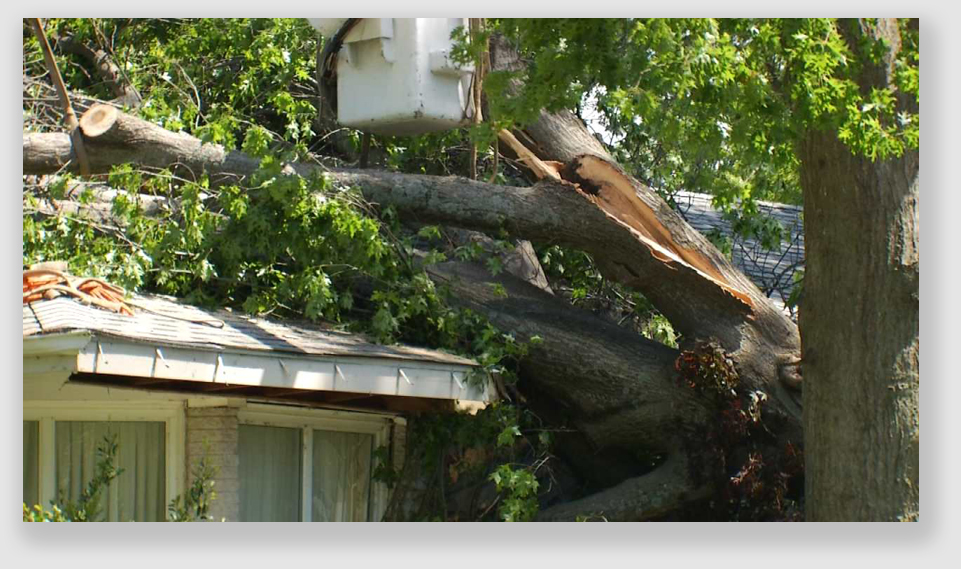
Some would say "disaster." Tal Mims said "opportunity."

     Some would say “disaster.” Tal Mims said “opportunity.”

But things got worse. While the tree was being cut up, a large branch fell on the tenant’s son, breaking his leg. The tenant sued Tal, and then she added his homeowner’s insurance carrier as a defendant. Then both the plaintiff and defendant Tal ganged up on the insurance company.

The policy pretty plainly excluded bodily injury and property damage “arising out of the rental or holding for rental of any part of any premises by any insured” and “arising out of premises owned or rented to any insured, which is not an insured location.” But Tal and Rosemary argued that while the falling tree related to the rental property, the accident — which occurred while it was being cut up — did not. Tal Mims argued rather disingenuously that he was acting on his own behalf at the time of the accident and that he was not engaged in any business pursuit or employment.

Here’s the problem, the Court said. While throttling insurance companies is something courts do fairly often, the companies still are free to limit coverage so long as the limitations do not conflict with statutory provisions or public policy. The business pursuits exclusion in a homeowner’s policy is intended to exclude risks that should be covered under different policies. Here, the Court said, the property on which the accident occurred was never listed in his homeowner’s policy, but instead happened on another piece of property that should have been covered by its own policy. Besides, the accident happened because Tal was removing a tree from the roof of the rental house. The Court guessed that if Tal had left the tree on the roof, it would have badly affected the value of the house.

That being true, the Court said, this was pretty clearly a project related to a rental property and thus pretty clearly excluded from Tal’s insurance policy, a happy ending for common sense. It was not so happy for Tal and Rosemary, both of whom hoped State Farm’s deep pocket would solve their problems.

Stills v. Mims, 973 So.2d 118 (La.App., 2007). Stills rented her home from Tal and Tommie Lee Mims. Tal operated a business named Tal’s Custom Landscaping, Inc. When a storm caused a tree to fall on the roof of the home. Stills informed Tal of the damage, and he came to remove the tree. In doing so, a limb fell from the roof onto the ground and injured Stills’ son, LeWilliam. stickit150427Stills sued Tal and Tommie Lee Mims, and he added State Farm as a defendant. She alleged State Farm had in effect at the time of the accident a policy covering the Mims’ actions.

State Farm filed a motion for summary judgment asserting that the homeowner’s policy issued to Tal Mims was for his personal residence at 2508 Lindholm Street and that State Farm never issued a policy for 604 Central Avenue, where the accident occurred. State Farm asserted that the liability and medical payments coverages provided in the policy excluded bodily injury and property damage “arising out of the rental or holding for rental of any part of any premises by any insured” and “arising out of premises owned or rented to any insured, which is not an insured location.” The trial court granted summary judgment in favor of State Farm, finding no coverage under the Mims’ homeowner’s policy. Both Stills and the Mims appealed.

Held: The trial court’s dismissal of State Farm Insurance was upheld. Stills argued that her claim was based on the Mims’ negligence in cutting the tree down, and not on any property defect, making the insured location issue irrelevant. Both Stills and the Mims asserted that the business pursuit exclusion did not apply, because the Mims’ actions fell under the exception for activities ordinarily incident to non-business pursuits.

Mims denied being in the business of renting homes. He claimed that he was acting on his own behalf at the time of the accident and that he was not engaged in any business pursuit or employment. The Court noted that insurance companies are free to limit coverage so long as the limitations do not conflict with statutory provisions or public policy. Exclusions must be strictly construed against the insurer with any ambiguities construed in favor of the insured. The insurer bears the burden of proving the applicability of an exclusion to a claimed loss.

The Court said that the business pursuits exclusion in a homeowner’s policy is intended to exclude risks that should be covered under different policies. For example, the commercial risks of a business would typically be covered by a commercial liability policy, whereas the risks associated with a rental dwelling would typically be insured by rental property insurance. The removal of the risks associated with business enterprises or rental properties helps to lower the rates of homeowner’s insurance by eliminating non-essential coverages.

Stills and the Mims argued that her claim did not arise from any business pursuit by the Mims, but rather, the claim was based on the Mims’ personal liability and involved activities that were ordinarily incident to non-business pursuits. They cited Blue Ridge Insurance Co. v. Newman — where the Court found that such a tree mishap was covered by a homeowners’ policy – in support of their position. But the Court said Blue Ridge was different. First, plaintiff Newman’s property on which the tree was located was insured under his homeowner’s policy. Here, the house leased by Stills was not insured under the Mims’ State Farm policy. The Mims were not seeking coverage for an accident that occurred on Tal’s insured residence, but instead, the Court held, Tal sought to have his homeowner’s insurance cover an incident that occurred on an unrelated rental location that should have been insured by some other policy. The very purpose behind the business pursuits exclusion, the Court said, supported a finding of no coverage.

scamSecond, in Newmanthe defendant’s property had been his family’s home since 1965 and had only been rented to a friend for less than a year prior to when the accident occurred. In Tal Mims’ case, there was no indication that the Stills residence was anything other than a rental property.

Third, Newman’s house was vacant when the tree fell, whereas Stills and her son were residing in the Central Avenue home when the tree fell on it. Fourth, the damage in Blue Ridge arose when the tree from Newman’s property fell on a neighboring property. Here, the existence of the tree on the property and its falling during the storm did not cause the damage. Instead, young LeWilliam’s injury arose from Mims’ removal of the tree from the roof of the rental dwelling.

Finally, the Blue Ridge court’s major consideration was that the mere existence of the tree on the property had no bearing on the use of the property- as a rental. The fact that a tree fell on the roof of the rental home in this case, particularly if left there, would likely affect the suitability of Stills’ rental dwelling. While the existence or maintenance of a tree on Newman’s family property was an activity usually incident to non-business pursuits, Tal Mims’ removal of a fallen tree from the roof of a rental dwelling by Stills was clearly not.

Pretty clever argument, the Court conceded – but State Farm was not liable.

– Tom Root

TNLBGray

Case of the Day – Monday, April 14, 2025

MURRELL II – WINNING THE BATTLE BUT LOSING THE WAR …

So many say. But it's their clients who are driving the train ...

So many say. But it’s the clients who are driving the train …

Here we are, the start of Tax Week. That is, if any IRS employees are left in the office to review what we file…

Meanwhile, those fun-loving Murrells of Rolling Hills, California, are back for an encore performance! The couple’s quixotic effort to hold their condo association liable for all sorts of alleged backroom dealing and breach of trust in cutting down their trees to improve the view of their neighbors, the Fullers, was covered in the Case of the Day for Friday, April 11, 2025 (funny, it seems like only last week). Lest you think that decision was the end of the saga, I now bring you Murrell II, the Very Expensive Sequel.

If you’re the kind of person who remembers what kind of mayo you had on your sandwich at lunch a week ago last Thursday (Duke’s), you’ll recall that the Rolling Hills Community Association held an easement across the Murrell’s’ property for “[r]oads, streets, or bridle trails, parkways and park areas[, p]oles, wires and conduits for the transmission of electricity…; [p]ublic and private sewers, stormwater drains, land drains, and pipes, water systems, water, heating and gas mains or pipes; and … [a]ny other method of conducting and performing any public or quasi-public utility service or function on, over and under the surface of the ground.” The easement gave the Association the right to trim or cut trees within its limits. The Fullers, whose view of the ocean was obscured by the Murrells’ trees, convinced the RHCA to trim back some of the Murrells’ trees and whack down a few others, so that they could enjoy the million-dollar vista they had paid for when they bought their place.

That’s “long story short.” The actual history of the tortured litigation and thundering herd of parties is byzantine with a small “b”, and is amply (if not completely) recounted in the full opinion. The Murrells ended up suing the Fullers, the RHCA, and an individual member of the RHCA board (who was seemingly picked at random). There were counterclaims and crossclaims. When the 2007 dust settled, the board member was dismissed, and judgments or pieces of judgments were rendered against the RHCA and the Murrells. Board member Donald Crocker was held not to have breached any duty. And a judge ordered the Murrells to pay more than $700,000 in legal fees for the Fullers and RHCA.

Complex. And you were confused by White Lotus

Naturally, everyone appealed. And that brings us to today’s 2011 decision.

Recollect that the Murrells argued the RHCA had no right to cut down trees to improve someone else’s view. In today’s case, they added the argument that the community association should have been equitably estopped from cutting down the trees because it had approved the Murrells’ construction of an addition to their home with a wall of windows, and the Fullers had not objected. Both parties, the Murrells contended, had lulled them into building something that depended on their trees for privacy, and the defendants could not fairly be allowed to strip their privacy away by cutting down those trees, even if it otherwise had the legal right to do so.

The Court of Appeals made short work of the Murrells’ latest lament. First, it concluded that the easement let the RHCA cut down trees for any reason it liked. As for the “equitable estoppel” argument, the judges held that “[t]he Murrells fail to cite pertinent authority that RHCA should be estopped from removing a tree on its easement because of the Murrells’ addition plans.” The decision was not elegant, but then, the Court pretty clearly thought the argument was so foolish as to not deserve much analysis.

Much of the remainder of the decision is dedicated to the Murrells’ complaints about how much they were forced to pay for the RHCA’s and Fullers’ attorneys. The lengthy recitation is mind-numbing (unless you happen to be a lawyer, in which case $1,500 an hour is a “feel good” story). The Murrells ended up winning $30,000 from RHCA and nothing from the Fullers. It cost them $500,000 in legal fees for themselves and another $492,000 in the defendants’ legal fees, all to fight for their recently departed Aleppo pine tree.

pyrric140710“Another such victory and I am undone!” King Pyrrhus is reputed to have said. So could the Merrills. At the same time, most of us find it difficult to imagine being able to drop $1.6 million on a legal battle over some trimmed trees.

Oh, to live in Rancho Palos Verde Estates. Or at least to be able to afford to do so …

Murrell v. Rolling Hills Community Association, Case No. B202019, 2011 Cal. App. Unpub. LEXIS 772 (Ct.App. Cal., Jan. 31, 2011). A contentious and costly feud over trees and a neighbor’s view has spawned multiple legal actions, cross-actions, five appeals, and two cross-appeals. To obtain an unobstructed ocean view, the Fullers wanted certain trees on “the Murrell property” trimmed or removed. The Murrells, who sought to preserve privacy, resisted. So began a decade-plus dispute.

After many attempts to mediate, the case went to trial in 2007. The Fullers obtained judgment in full against the Murrells in the amount of $10,000, and the Murrells obtained judgment in the amount of $30,000 against RHCA on RHCA’s breach of its covenants, conditions and restrictions (CC&Rs) and breach of fiduciary duty.

The Murrells incurred $892,000 in attorney fees. They were awarded $400,000 as attorney fees against RHCA but were ordered to pay $159,000 as attorney fees to RHCA on a separate claim and $334,000 as attorney fees to the Fullers.

The Murrells claimed the CC&Rs did not authorize RHCA to “trim, top and/or remove trees and foliage on the Murrell property” for the purpose of providing the Fullers with an ocean view. The Fullers sued in turn for injunctive and declaratory relief that they had the right to have the trees cut or trimmed. The Murrells also sued RHCA for breach of the CC&Rs, breach of fiduciary duty, trespass, and conversion, alleging that by going onto the Murrell property and removing a pine tree in order to benefit the Fullers’ view at the expense of the Murrells’ privacy, RHCA acted contrary to the CC&Rs and its fiduciary duty to act in good faith and fair dealing.

In so doing, the Murrells claimed RHCA violated the CC&Rs because they did not empower RHCA “to remove trees in the easement on the Murrell property for any reason unrelated to the express and implied purposes of the easement, which are the creation of and maintenance of roads, bridle trails, utilities, parkways, park areas, above-ground poles, wires, and conduits as well as sewers, drains, pipes and below ground conduits.” denied the complaint’s material allegations and pleaded 17 affirmative defenses.

The trial court granted summary judgment to the RHCA. The Murrells contended summary judgment was improper on the grounds that neither RHCA nor the trial court addressed their equitable estoppel claim. The Murrells argued the CC&Rs cannot be interpreted to authorize RHCA to remove the pine tree, which was on RHCA’s easement, for the purpose of enhancing the Fullers’ view. They further argued that even if such authority existed, questions of fact existed regarding whether RHCA complied with its fiduciary duty to the Murrells in light of expert evidence that removal of the pine tree was unnecessary to improve the Fullers’ view.

Stormy Daniels probably wasn’t smiling when she was told to pay the Trump’s legal fees – reportedly $840 an hour for one attorney – and it’s a cinch the Murrells weren’t grinning at what they owed for the Association’s lawyer’s bill, either.

The Murrells argued RHCA was estopped from asserting any right to remove the pine tree for the reason RHCA and the Fullers did not complain to the Murrells about their plans to construct an addition to their residence involving floor-to-ceiling windows, and in reliance on this “silence, ” the Murrells constructed this addition with the expectation that their “foliage and mature trees[, including the pine tree ]” would preserve their privacy.” The Court held that the Murrells failed to cite pertinent authority that RHCA should be estopped from removing a tree on its easement because of the plans for their addition. The estoppel argument failed.

The Murrells also contended that RHCA was not authorized to remove the tree to enhance the Fullers’ view, which was not a reason recognized as an easement use under section 2(b) of article V under the CC&Rs. The Court held that the “fallacy of their position lies in their misinterpretation of the pertinent provisions of the CC&Rs. When viewed in context, these provisions reveal RHCA has the right to remove trees located in its easement, without regard to purpose.”

The Court said that the “language of the CC&Rs governs if it is clear and explicit, and we interpret the words in their ordinary and popular sense unless a contrary intent is shown.” The Court interpreted the CC&Rs “to make them lawful, operative, definite, reasonable and capable of being carried into effect, and [to] avoid an interpretation that would make them harsh, unjust or inequitable.” Here, it was uncontroverted that the Murrell property is burdened by an easement in favor of RHCA and that the pine tree was located on this easement portion of that property. RHCA had the right to remove trees located on that portion of the Murrell property burdened by its easement. The Court said that the unambiguous language of the CC&Rs in the phrase “in or along any easements” referred to the physical location of the tree which RHCA is authorized to remove rather than to any particular qualifying reason for its removal, for example, solely for an easement use or purpose. Thus, the fact that enhancing a member’s view is not an enumerated easement use is inconsequential.

– Tom Root

TNLBGray140407

Case of the Day – Tuesday, December 17, 2024

DUMB AND DUMBER

What do you call a guy who volunteered to help his father-in-law cut down a tree and who witnessed first-hand the risk that a branch would bounce back and endanger the workers, but then went ahead and clobbered himself by – guess what – letting a branch bounce back and hit him?

So what do you call a guy who breaks both wrists doing that, and then sues his father-in-law?

This case illustrates the various rungs of the guest ladder that a person standing in your front yard might occupy. The bottom rung, of course, is a slimy trespasser. The top would be the owner. In between are a business invitee, a social invitee and a licensee.

Dumber thought he could promote himself to the status of licensee as though he were an employee of his father-in-law (who must have been a tolerant soul to let his daughter marry this guy). The Arkansas Supreme Court knocked him down a few rungs but undoubtedly made him feel better by explaining that the rung did not matter. The very patient father-in-law had not just warned him of the danger, but he had shown him the danger and how to ensure it did not come to pass.

Some people simply won’t learn.

Young v. Paxton, 316 Ark. 655, 873 S.W.2d 546 (Supreme Court of Arkansas, 1994). Don Young brought a negligence action against his father-in-law, Gerald Paxton, for injuries that he sustained on Gerald’s land as a result of trimming limbs from a tree. Gerald successfully moved for summary judgment. Don appealed, arguing that material issues of fact remained to be decided, including whether he held the status of a licensee or invitee on Gerald’s property, and whether Gerald’s negligence was the proximate cause of his injuries.

On a fine June Saturday, Don walked over to his father-in-law’s house in Saline County. There he found Gerald trimming the limb of a hardwood tree with a chainsaw while standing on a 20-foot extension ladder. The tree was over 15 feet tall with limbs drooping to the ground. Gerald had previously cut three or four limbs down.

The ladder Gerald was using rested against the limb which he was attempting to trim. As he began to cut the limb which the ladder was leaning against, the limb began to rise as the weight from the severed part fell away. Gerald asked Don to get a rope from his shop. Don located a rope and returned to the tree, and at Gerald’s request, he threw him the rope.

Gerald then wrapped the rope around the limb. Don held the rope while standing on the ground to prevent it from “bucking” and dislodging the ladder when the cut part of the limb fell away. As Don held the limb securely with the rope, Gerald cut the end of the limb and climbed down the ladder.

Gerald then showed Don where to place the ladder in order to cut another limb. The ladder was placed against the designated limb, and Don climbed up with the chainsaw and proceeded to cut it. This occurred five minutes after Gerald cut the limb with Don’s help. When the weight of the cut part fell away, the limb rose and the ladder lost its support, causing Don to fall. Because of the fall, Don badly hurt both wrists.

Don sued Gerald for $25,000 in damages, alleging that Don was a licensee on Gerald’s property and that his injuries were proximately caused by Gerald’s failure to supply proper tools to use to perform the task that he asked Don to perform; failure to properly supervise the cutting; and failure to secure the limb.

Gerald filed for summary judgment, arguing that Don had admitted that he was a licensee on Gerald’s property and that there was no proof that Gerald had violated any duty owed Don by acting willfully or wantonly towards him. Gerald argued that Don knew or should have known the dangers posed by cutting branches from the tree. In the alternative, the motion stated that as a matter of law, Don had failed to present any proof that Gerald’s conduct proximately caused his injury.

Don then filed an amended complaint, alleging that Don came onto Gerald’s property at Gerald’s express or implied invitation and acted for the parties’ mutual benefit by cutting the branches. Don further alleged that as an invitee Gerald failed to use ordinary care to avoid injury to him because Gerald knew or reasonably should have known that danger existed.

The trial court granted Gerald’s motion for summary judgment, and Don appealed.

Held: Don will collect not a dime.

The Court noted that an invitee may be a public invitee or a business invitee. A business visitor is one who enters or remains on land for a purpose connected with the business dealings of the owner. A public invitee is invited to enter or remain on land as a member of the public for a purpose for which the land is held open to the public.

However, one who goes upon the premises of another with the consent of the owner for his own purposes and not for the mutual benefit of himself and the owner is not an invitee but a licensee. The Supreme Court declined to extend the invitee status to persons on the premises of another primarily for social reasons.

The law of negligence requires as essential elements that a plaintiff show that a duty was owed and that the duty was breached. A property owner owes his or her licensee the duty to refrain from causing the licensee injury by willful or wanton conduct, and as well owes a duty to warn of hidden dangers or risks. To constitute willful or wanton conduct, there must be a deliberate intention to harm or utter indifference to, or conscious disregard of, the safety of others.

But, the Court ruled, the duty to warn does not extend to obvious dangers or risks that the licensee should have been expected to recognize. Indeed, there is no obligation to protect the invitee against dangers that are known to him, or which are so apparent that he may reasonably be expected to discover them and be fully able to look out for himself.

The Court said an invitee may be a public invitee or a business invitee; a business visitor is one who enters or remains on land for a purpose connected with the business dealings of the owner, while a public invitee is invited to enter or remain on land as a member of the public for a purpose for which the land is held open to the public. However, one who goes upon the premises of another with the consent of the owner for his own purposes and not for the mutual benefit of himself and the owner is not an invitee but a licensee; invitee status has not been extended to persons on the premises of another primarily for social reasons.

Where there was no evidence that Don was invited onto the property, he was not visiting his father-in-law for any stated business purpose and expected no pay for his assistance, no reasonable jury could have found otherwise, and, thus, no material issue of fact existed on this point. What’s more, the Court found, there was no evidence that Gerald acted willfully or wantonly to cause Don any injury. In fact, the evidence showed that Gerald advised Don that the limb would have a tendency to rise as the weight from a severed branch fell away, and Don had even seen it happen a few minutes before when he helped Gerald when faced with the same risk. Even if Don had not known of the risk when he arrived, the court said, that risk was brought to his full attention before the accident.

It is a landowner’s duty to use ordinary care to maintain the premises in a reasonably safe condition for an invitee, the Court said, but that duty usually is satisfied when the danger is either known or obvious to the invitee. There is no obligation to protect an invitee against dangers that are known to him, or which are so apparent that he may reasonably be expected to discover them and be fully able to look out for himself.

So, the Court concluded that regardless of Don’s status as a licensee or invitee, Gerald did not breach the duty of care owed. He perpetrated no willful or wanton injuries on Don, who was well aware of the danger involved in the limb cutting.

Because breach of a duty owed is an essential element in a cause of action for negligence, and that element was lacking, Gerald was fully entitled to summary judgment.

– Tom Root

TNLBGray140407