CONNECT THE DOTS
 A negligence action is a lot like a child’s “connect-the-dots” game. If you want to win, you have to connect the dots of “duty” to “breach of duty” to “proximate cause of damages” to “amount of loss.”
Skip a step, and you can walk away empty-handed, or – like the couple in today’s case – with a lot less.
We find it a bit unsettling that a tree service was not alerted to a bigger problem by the 100-lb. concrete plug stuck in the bottom of a tree it was to trim, and that the trimming crew proceeded to “top” the tree in order to make it healthier. Perhaps using animal magnetism on the tree or dousing the roots in snake oil might have helped.
This case has cautionary tales aplenty. First, with digital film as cheap as it is (as in, 80% of Americans have smartphones), take pictures of the trees before and right after trimming. This is true whether you’re Harry and Harriet Homeowner or whether you run Paul Bunyan’s Tree Service.
Second, do not ignore warning signs that a tree has significant problems. Pretending that a concrete plug was not poured into a tree by a former owner and that some simple shaping will keep it strong and healthy, is confusing a dangerous conflation of wishes and facts.
Third, both the homeowners and the tree service should insist on a detailed contract, one that spells out the obligations and expectations of both parties.
Finally, if litigation ensues, take a serious look at your expert’s analysis. Try to poke holes in the expert’s report. Be your own “tiger team.” When you read in the decision that the expert was unable to testify to a crucial element, it’s already too late.
Sandblom v. Timber Tree Service, Inc., 2009 R.I. Super. LEXIS 126, (Super. Ct. Rhode Island, Oct. 27, 2009). Steve and Terri Sandblom hired Timber Tree Services, Inc., to provide tree services to five trees located on their Arlington Street property. Steve told Timber Tree that he and his wife wanted one tree removed and the other four trimmed – two in the backyard and two in the front yard, one of which was a mature silver maple tree.

A concrete patch in a tree… never a good idea.
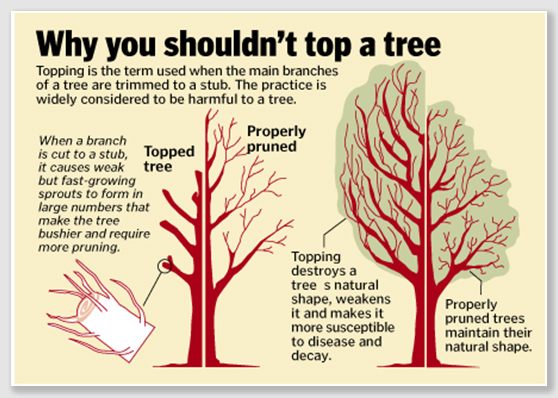
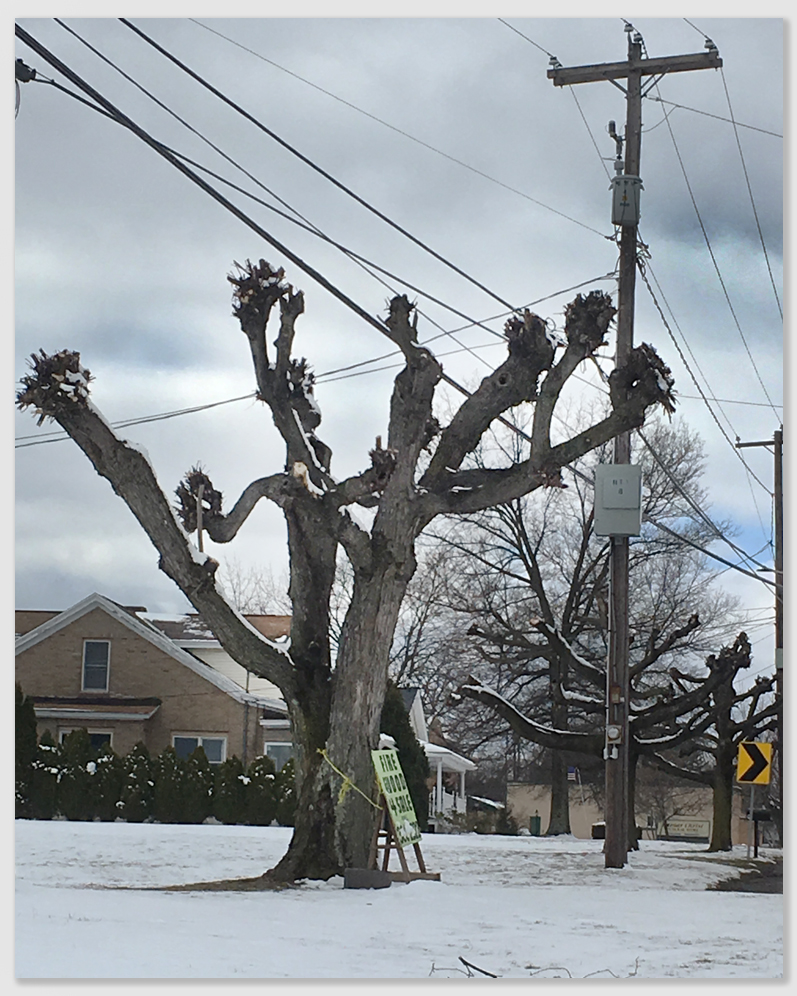
Even before work commenced, Timber Tree told Steve that total removal of the silver maple tree was an option, due to the fact that the tree appeared to be damaged, with a basketball-sized cement plug in the base of the tree. The concrete suggested rot, which was later confirmed by Timber Tree workers. The plug had been in the tree when the Sandbloms bought the property in 2004. Steve elected to have the tree “topped” instead because Timber Tree’s owner told Steve that after “topping off,” the tree would be healthy and regain a healthy condition similar to a neighbor’s fully-grown silver maple.
Timber Tree gave the Sandbloms a written estimate of the charges for the work to be performed, a total charge of $1,400.00 without itemization. Work began in April 2005.
Late in the day, a Timber Tree worker asked Steve whether he wanted the silver maple tree cut down entirely. Steve examined the tree, and testified later that so much growth had been cut from the silver maple that it only could be described immediately after the work as two bare trunks, totally denuded of any vegetation.
The Sandbloms sued, claiming that as a result of Timber Tree’s negligent services, the silver maple tree in the front yard suffered permanent and irreversible damage, thereby reducing the value of their property as a whole. Pursuant to G.L. 1956 § 34-20-1, they sought twice the value of the tree and three times the value of the wood. Timber Tree counterclaimed for the outstanding balance due for services rendered.
Held: The Court, rejecting Steve’s testimony that the tree was healthy, found that the silver maple was already a diseased tree when it was topped. Steve’s expert was unable to quantify how much of the tree’s condition was caused by existing rot or prior improper pruning. The expert’s damage calculation thus was rejected.
Steve testified that before Timber Tree’s work, the silver maple was “overgrown” with vegetation and needed trimming, but was otherwise healthy. The Court found the testimony not credible in light of the observations of rot made by Timber Tree’s owner and workers. The placement of a cement plug sometime before suggested that rot may have been present for a considerable period of time.
 Despite Timber Tree’s suggestion that perhaps the tree was not worth further substantial investment, Steve chose to proceed with the request to “top off” the maple. Steve said he expected the silver maple would be “topped” to get tree growth away from electrical wires. Timber Tree’s owner described the work to be performed as the removal of “sucker growth.”
Instead, Timber Tree trimmed so much growth from the silver maple that was nothing but two bare trunks. However, because there was no photographic evidence of the condition of the silver maple prior to the trimming, the Court could only conclude from the evidence that the silver maple was not healthy before it was topped.
Steve’s expert, John Campanini, testified that Timber Tree’s work was contrary to industry standards in that its workers removed more than 20% of the live wood from the tree. He also testified that Timber Tree failed to adhere to industry standards by pruning or cutting known nodes of the tree, which he found by observing the “cuts” made to the tree.
As for Timber Tree’s other work, John Campanini said some of the work appeared improper in that Timber Tree failed to remove all of the dead wood on one of the trees. On a second tree in the backyard, Timber Tree did not complete the job of thinning out the crown of the tree, in that many branches on the lower canopy were not removed. This, John Campanini described, was “sub-par performance.” John Campanini supplied no testimony to quantify the damage caused by Timber Tree’s errors and omissions.
Mr. Campanini used a formula called the “trunk formula,” whereby the calculation of loss starts with the circumference of the trunk near the ground and continues based on certain objective and subjective factors relative to the tree’s location and condition. According to Mr. Campanini, this mode of calculation is approved by the International Society of Arboriculture. The result of the calculation is to determine an “appraised” value of the tree before Timber Tree’s work, which he concluded to be $5,100.00.
Although it found his testimony credible, the Court declined to rely on Mr. Campanini’s analysis. It noted that, for example, the formula failed to account for the apparent rot of the tree, as evidenced by the concrete plug. Also, the photographic evidence of the current condition of the tree undercut any claim that the silver maple was “totally lost” as a result of Timber Tree’s work. On the contrary, the evidence of the tree’s current condition showed that the silver maple had returned to a tree lush with foliage; indeed, even Mr. Campanini testified that the Silver Maple was not dead and did not need to be replaced.
 Mr. Campanini said that damage to the silver maple could be cured by four or five subsequent remedial prunings at $750.00 apiece, to select branches that may develop good supporting unions and help regain the form and shape of a natural silver maple. The tree was about 80 years old, making replacement almost impossible. Such a mature tree would not be available from a nursery for transplantation, leaving the only replacement alternative as a young sapling that would take many years to develop into the stature of the silver maple prior to Timber Tree’s work.
In order to establish a negligence claim against Timber Tree, the Sandbloms had to prove by a preponderance of the credible evidence that Timber Tree was negligent, by showing that Timber Tree owed the Sandbloms a legally cognizable duty, a breach of that duty, proximate causation between the conduct and the resulting injury, and the actual loss or damage. Then, the Sandbloms had to prove that Timber Tree’s negligence caused loss or damage to their property and demonstrate the value of those damages as determined by the reasonable value of the loss or damage. Although mathematical exactitude is not required, the damages must be based on reasonable and probable estimates.
The Rhode Island Supreme Court has held that “the general rule is that where the damage to realty is temporary, the cost of repair measure is proper, and where the damage is permanent, the diminution in value measure is most appropriate.”
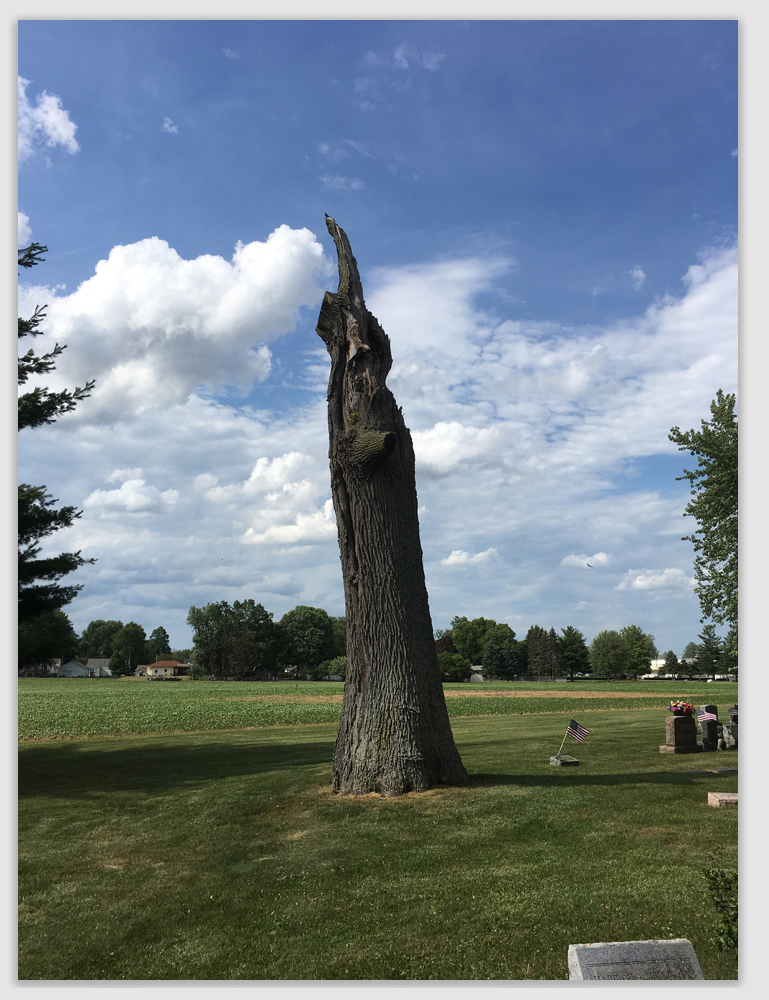
Looks good to me…
Although the Court found that Steve proved negligence by Mr. Campanini’s testimony, his evidence on the issues of whether the negligence caused damage and how much those damages were was “somewhat shaky.” The evidence showed that the silver maple was not healthy when it was pruned, meaning that the evidence did not show that Timber Tree’s negligence damaged the tree beyond where it was before the topping. What’s more, the evidence did not show that the silver maple was completely destroyed, such that replacement would be the proper measure of damages. Good thing, too, because an actual replacement cost would be very difficult to calculate, “due to the fact that a similar mature maple would not be available at a nursery for transplantation.”
Because the evidence showed that the tree had made a considerable recovery since it was pruned, the damage it suffered was temporary and the cost of repair would be the appropriate measure of the damages. The only credible testimony concerning the cost remedial measures was Mr. Campanini’s testimony that the silver maple could be restored with four to five remedial prunings, at a cost of $ 750.00 per pruning. The Court awarded the Sandbloms $ 3,750.00 in damages.
The Sandbloms asked for double damages under § 34-20-1. But that section only provides such damages where the cutting or destruction of a tree occurred “without leave of the owner thereof.” Here, Timber Tree performed its services with Steve’s permission. “While the services may not have been to Mr. Sandblom’s satisfaction, “ the Court said, “the Legislature did not intend double damages for negligent services that were performed at Plaintiffs’ request.”
– Tom Root


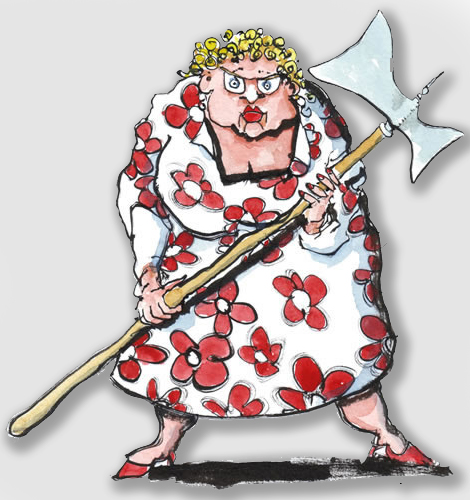 Years ago, our neighbor Olwen – who, if she had not passed away (meaning, of course, that we cannot speak ill of her), we would have described as a battleaxe – surrounded two sides of her property with 2-3’ arborvitae. It didn’t really look that bad, but… well, they grew.
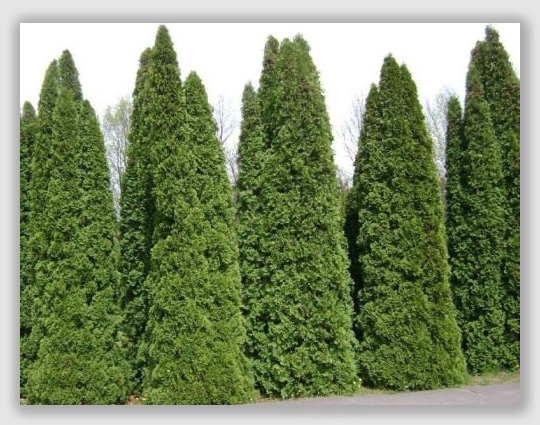 Joseph v. Nathanson, 87 Mass. App. Ct. 1102, 23 N.E.3d 151, 2015 Mass. App. Unpub. LEXIS 37 (Ct.App. Mass. Jan. 16, 2015). Pnina Joseph and Nancy Ellen Nathanson owned abutting properties and shared a property line. Pnina planted thirty-five arborvitae trees on her property close to the property line to serve as a privacy screen. In October 2012, Nancy directed her landscaper to go onto Pnina’s property and “prune” the trees. The landscaper “topped” the trees by cutting about five to six feet from the tops.
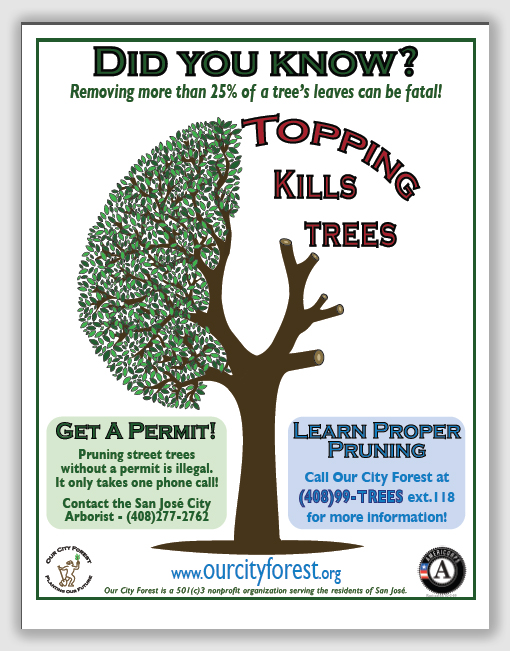 The Court said it would interpret a statute to give effect “to all its provisions, so that no part will be inoperative or superfluous.” The statute here requires that the trees be “cut down, carried away, girdled or otherwise destroyed.” G. L. c. 242, § 7. “The phrase “otherwise destroyed” includes,” the Court said, “but is not limited to, the preceding phrases including ‘cut down’.” In other words, “cut down, carried away,” and “girdled” are examples of how a tree may be destroyed; they are not exclusive.

 Tree and Neighbor Law For Homeowners and Professionals