Case of the Day – Thursday, January 16, 2025

SITTING ON YOUR RIGHTS

Equity is a beautiful thing.

There was a time, back in merry olde England, went the courts of law had gotten so hidebound and formalistic that your average aggrieved peasant couldn’t catch a break. So people who needed something more than what the law could provide would petition the Lord Chancellor.

Thus began the courts of chancery, known more commonly as courts of equity. A court of equity is authorized to apply principles of equity, as opposed to those of law, to cases brought before it.

Equity courts hear lawsuits and petitions requesting remedies other than damages, such as writs, injunctions, and specific performance. Most equity courts were eventually merged with courts of law, but some American states, including Delaware, Mississippi, New Jersey, South Carolina, and Tennessee, preserve the distinctions between law and equity and between courts of law and courts of equity.

Today’s case, being from Tennessee, started with a Chancellor (something like this fellow), because what the plaintiffs really wanted was an injunction, a court order that the owner of the hedge trim it. But it ended up in the Tennessee Supreme Court.

At its root, equity is nothing more than fairness. Note how equity creeps into this case, not only in the application of the Massachusetts Rule – and how much a creature of equity is that? – but in the observation at the end of the decision that laches should prevent Bill Granberry from getting any relief from his claim.

Bill sat on his rights. If he had sued Penelope when the hedge was still short and young, the outcome might have been different.

Granberry v. Jones, 188 Tenn. 51, 216 S.W.2d 721 (Supreme Ct. Tenn. 1949): Bill Granberry and Penelope Jones each owned a residence on adjoining lots in Tullahoma. Due to the narrow frontage, Bill’s residence is a little less than five feet from the boundary line between the properties.

Penny planted an evergreen shrubbery hedge entirely on her side and within a few inches of the boundary line. The hedge has grown to a height of about twenty feet and its branches and foliage have grown over the boundary line and over Bill’s property to the extent that they rub the side of his house and enter his open windows.

Bill sued for an injunction that would require Penny to trim the hedge back to the boundary line. For good measure, he also asked for a decree requiring her to move the hedge entirely or at least to cut it down to a height of not more than 24 inches and to keep it that way, and for damages.

Penny demurred (which is legalese for saying to the court, “Even if everything he says is true, Bill’s got nothing coming). Penny argued that she had the legal right to grow the shrubbery on her own property to any height she desired, and if any of the branches or foliage protruded onto Bill’s land, his remedy was only to cut the hedge to the extent of the protrusion. The trial court overruled her demurrer, and Penny appealed.
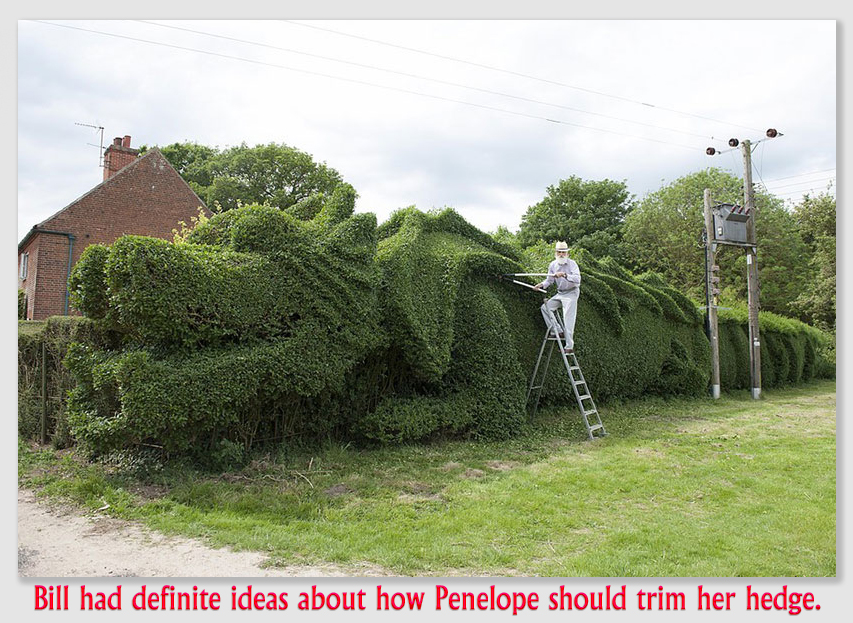
Held: Penny’s demurrer was correct: Bill’s remedy was limited to self-help.

The court reversed the lower court’s decree which had overruled the defendants’ demurrer to the complainant’s bill, seeking inter alia to enjoin the defendants from permitting their hedge to extend onto his land. The court dismissed the bill.

Noting that it could “find no Tennessee case where resort to a Court of equity has been attempted on the facts alleged by this bill,” the Supremes ruled that every owner of land has dominion of the soil, and above and below to any extent he or she may choose to occupy it. As against adjoining property owners, the owner of a lot may plant shade trees or cover the grounds with a thick forest, and the injury done to them by the mere shade of the trees is damnum absque injuria.

No landowner has a cause of action from the mere fact that the branches of an innocuous tree belonging to an adjoining landowner overhang his or her premises. The afflicted owner’s right to cut off the overhanging branches back to the property line is considered a sufficient remedy, the Court said, citing the Massachusetts Rule.

The principle, the Court said, is that an owner of land is at liberty to use his land, and all of it, to grow trees. Their growth naturally and reasonably will be accompanied by the extension of boughs and the penetration of roots over and into the adjoining property of others.
Bill argued that the overhanging branches and foliage had caused the outside wall of his home to rot and decay, and the sills and woodwork have been caused to rot to such an extent that they will have to be replaced by reason of the constant leaning against them of the hedge.

The Court was a mite troubled that it obviously had taken many years for the hedge had grown to its current size. Bill could have taken action when the hedge was much smaller, and the damage to him and burden to Penny – were she to be required to cut the hedge – would have been much less. “The long acquiescence and laches upon the part of [Bill] without any notice to [Penny] and with no attempt to aid himself,” the Court wrote, “is clearly the cause of the damage for which he seeks equitable relief. Of course, the Courts are open to [Bill] if, in legally aiding himself, he is improperly interfered with by [Penny] or her brother. Our conclusion, also, is without prejudice to whatever rights, if any, [Bill] may have for recovery of the expense to which he may be put now or hereafter in cutting the overhanging branches or foliage.”

– Tom Root

TNLBGray

Case of the Day – Thursday, April 4, 2024

COULDA, SHOULDA, WOULDA

Trials are much more of an art than a science. Trial attorneys walk a fine line between not putting enough evidence on to support their case and dumping so much data into the record that the factfinder cannot dig its way out of the pit of minutiae to reach the right conclusion. I once had an old law professor who cautioned us not to tell him more about the elephant than he ever wanted to know. It’s sort of like that.

Still, the sense that you should never leave any fish in the pond when you’re done angling is not the worst instinct to act upon.

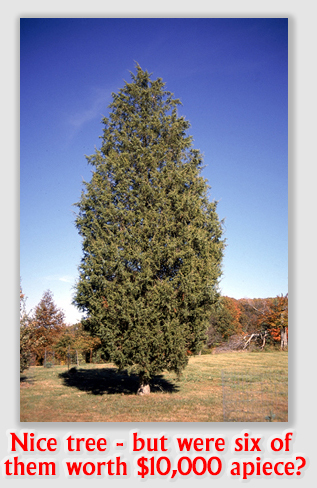
Take the Wolfenbargers, people who probably should have read their property deed a little more carefully when they bought their property next to the Woods’ place. If they had, they probably would not have mistakenly thought they owned the common driveway and thus could cut down the six Eastern Red Cedars that flanked the gravel strip. It’s a bad idea to cut down the neighbors’ trees, even when you think they’re yours. It’s a worse idea to try to defend a tree case against plaintiffs whose surname is “Wood.”

But it’s a worse idea still for your lawyer to figure he or she can rely on rapier-like cross-examination of the plaintiffs’ experts to make your valuation case. The Wolfenbargers’ mouthpiece may have saved them a few bucks on an expert, but he was “pennywise and pound foolish,” as they say. An old lawyer would have told him that “hope is not a strategy.” Neither is complaining to the court that the plaintiffs did not make the kind of damages showing you think they should have. Do you want a damages showing you can argue to the judge or jury? If so, you had better put the evidence on yourself.

The Wolfenbargers coulda, shoulda, woulda put some diminution of value evidence on, expert testimony that showed the Woods’ place did not lose a third of its value because six lousy trees were cut down. But they didn’t…

Wood v. Wolfenbarger, Case No. E2011-01953-COA-R3-CV (Ct.App. Tenn. Aug. 15, 2012), 2012 Tenn. App. LEXIS 563, 2012 WL 3329525. The Woods owned property next to that of the Wolfenbargers. The two parcels share a gravel road, which the Wolfenbargers mistakenly believed they owned. They did not.

In the spring of 2009, the Wolfenbargers cut down trees on both sides of the road. The trees, Eastern Red Cedars, belonged to the Woods and were healthy mature trees when they were cut down. The Woods sued.

The only issue to be decided at trial was the amount of damages. The Woods offered testimony from Jim Cortese, a certified master arborist. He testified that there were varying approaches to figuring the value of the trees. First is the cost approach. One subset of the cost approach is repair cost, which measures the cost to repair broken branches and other less-than-fatal damage to the tree. There is also replacement cost, a method used when the trees are a total loss, but are of the size that can be replaced with the same species of roughly the same size and quality.

Then, there is the “trunk formula method.” Jim testified that the trunk formula method is to be used when the tree is too large to be replaced. The value calculated by that method is the cost of replacing the tree with the largest locally available plant and adjusting for the size difference, species classification, condition classification, and location classification of the appraised tree.

Jim also described a timber value method to be used for trees grown as commercial lumber, employed to determine the value for a stand of timber in a woodland setting where the trees are of sufficient size and character to be harvested. Here, Jim said, the timber value was not the appropriate method for determining the value of the Woods’ trees. He explained: “It was my opinion that there were not enough trees to justify a timber sale. It was – the trees were not really – they just wouldn’t be suitable for a timber sale.” He also explained that “a timber sale is always between a willing buyer and a willing seller. It is not a forced upon somebody valuation that they have to accept what the value of the trees [is].”

Jim calculated that if the timber value of the trees was considered, it would be just $840.00. However, he opined that the timber value should not be used here, because this was no commercial timber stand. Instead, Jim testified that the replacement cost method should be used to value the six trees cut in this case. testified that he has successfully transplanted trees as large as the ones at issue in this case. He figured the replacement cost for the trees at $161,300.

He also used the trunk formula method to value the damages. He testified in detail about this method, and  valued the first tree at $14,700; the second at $5,400; the third at $19,000; the fourth at $10,600; the fifth at $5,800; and the sixth at $6,600, for total damages of $62,100.

The trial court said that because the Woods had not offered any evidence of the value of their land or how the aesthetics of the property had been damaged, it would not entertain any damages other than the timber value of the cut trees, citing Tenn. Code Ann. § 43-28-312. Because the cutting was negligent, the trial court said, the statute authorized doubling the damages. The trial judge awarded the Woods  $1,680.00.

The Woods appealed.

Held: The statute did not limit the Woods to the mere value of the wood. Instead, they were entitled to damages calculated by the trunk formula method, raising their take to $62,100.

The Wolfenbargers argued that because no evidence of diminution of value was presented, the timber value was the only appropriate measure of damages under Tenn. Code Ann. § 43-28-312. The Woods responded that they had presented three estimates of damages, and if the Wolfenbargers wanted the trial court to apply a different measure of damages than the Woods’ showing, they should have put on their own evidence. The Court of Appeals agreed. “Plaintiffs presented no evidence with regard to diminution of value. Neither, however, did Defendants. Neither the Trial Court nor this Court may award damages based upon a measure of damages when there is no evidence in the record regarding that measure of damages.”

The Court said, however, that the statute “clearly and unambiguously provided that ‘nothing in this section precludes an owner of the property on which timber has been cut by another from recovering damages for loss of value other than commercial timber value, if any, of the timber negligently or intentionally cut’.” Thus, the Woods were free to produce evidence of the measure of damages other than the timber value, which is what they did.

The Court of Appeals found that using timber value was inappropriate, observing that Jim Cortese specifically testified that timber value should not be used. No evidence in the record rebutted this testimony, the Court said, and the trial judge found Jim to be a credible witness. On the other hand, the Court of Appeals rejected the Woods’ contention that replacement cost should be used, noting that the Woods had bought their place in 2006 for $185,000. It was “unreasonable to argue that the proper measure of damages for the wrongful cutting of these six trees is the replacement value of $161,300,” the Court said, which was “an amount almost equal to the price… paid for the entire 38 acres only a couple of years earlier.”

However, the Court ruled the Woods’ trunk formula evidence did make sense. The evidence showed that the six lost trees were too large to be replaced for a reasonable cost. Jim’s trunk formula method provided a value for each tree, evidence that the Wolfenbargers did not challenge. “Given all this,” the Court said, “we find and hold that Plaintiffs proved that the trunk formula method was the appropriate method of valuing the damages in this case. We note that Tenn. Code Ann. § 43-28-312 provides for doubling or tripling, when appropriate, of the current market value of the timber only. As Plaintiffs are not awarded the current market value of the timber, they are not entitled to an award of double the amount of their damages. We modify the Trial Court’s judgment to award damages to Plaintiffs in the amount of $62,100…”

– Tom Root

TNLBGray140407