Case of the Day – Wednesday, April 1, 2026

I CAN SEE FOR MILES

In the land of pleasant living, we can and often do sue for almost anything. Even so, today’s case is especially egregious.

Today’s plaintiff, Betsy Stibler may be hypersensitive (as the Court of Appeals hinted. She clearly is an April Fool, a suitable icon for today.

Whatever else, she certainly had gotten used to seeing for miles and miles from her kitchen window. Or at least to the 18th hole of the golf course next door. When the owner of the country club next door planted a number of additional trees on its golf course – trees that neither hung over nor grew under Betsy’s property – she sued. Sued for no better reason than the trees interfered with her seeing goings-on on the golf course.

OK, the world is full of people like Betsy (who should be named Karen). Not only do such people claim a right to the air they breathe, but they also claim the air we’re breathing, too. And everything is personal. Note that Betsy did not just sue because the golf course’s trees accidentally or even negligently blocked her view of its property; she claimed the trees were planted maliciously for the purpose of annoying her.

There are a lot of Betsys in this world who think it’s all about them. But most of those other Betsys don’t have the spare change to hire a lawyer to sue the offending tree planters. Those who do have the money usually have better sense than to fritter it away in a foolish lawsuit, and even then, those who don’t have that good sense usually cannot find a lawyer with the same reckless approach to litigation as they do. They enter their attorney’s office full of rage, and then he or she patiently talks them off the ledge.

As my famed relative (so we Roots like to think he’s our relative, at least) Elihu Root once said, “About half the practice of a decent lawyer is telling would-be clients that they are damned fools and should shut up.”

But occasionally we hit the frivolous litigation trifecta, and that happened here. Betsy convinced herself that God, the subdivision or someone had decreed that she should always be able to see the golf course (although why she wanted to see it puzzles us), and she apparently had the extra money to pay a lawyer to tilt at her windmill for her. Unsurprisingly, the magic combination of wealth, entitlement and stupidity enabled Betsy to find a lawyer hungry or foolish enough to take the case.

Now, all that was missing was a compliant judge. Fortunately for the defendants, Betsy could not find one of those. It turns out that for trees to be declared a nuisance in Tennessee requires a less sensible judge than the one she found, not to mention more sensible harm than some cranky lady who does not like the neighbors’ new landscaping is able to claim.

Stibler v. The Country Club, Inc., Case No. E2014-00743-COA-R3-CV (Ct.App. Tenn., Mar. 9, 2015). Betsy Stibler owned a residence next door to The Country Club’s eponymous golf course. In 2013, The Club planted trees all over its golf course, including Green Giant and Skip Laurel trees planted on the portion of the course that lies behind Betsy’s house. The trees do not encroach on Betsy’s land and cause no physical damage to her place. But what they do do is obstruct Betsy’s view of the course.

Betsy sued, claiming The Club had created a nuisance by planting the trees and thereby obstructing her view of the golf course. In fact, she claimed the trees were planted “for the purpose of annoying Plaintiff and decreasing the property value of Plaintiff,” and that she was “being deprived of her right/easement appurtenance of enjoyment of all persons owning lots in said sub-division of the park space (i.e. [sic] golf course) as provided by the [subdivision restrictions].” 

The applicable subdivision restrictions state that “no noxious or offensive trade or activity shall be carried on upon any lot nor shall anything be done thereon which may be or may become an annoyance or nuisance to the neighborhood,” and “any park spaces as shown upon the plat, will not be built upon but preserved as ornamental park spaces for the enjoyment of all persons owning lots in said sub-division.”

The Club filed a motion for summary judgment, which the trial court granted on the grounds that Betsy could not prove that the trees constituted a nuisance.

Betsy appealed.

Held: The trees are not a nuisance.

Betsy argued that the subdivision restrictions meant that The Club should be prohibited from interfering with her enjoyment of her property “by changing the very character and nature of her home as a golf course view property.” Betsy asserted that because the trees are a nuisance, they are prohibited by the subdivision restrictions. She also contended that the requirement that park spaces, which Betsy asserted included the golf course, must be preserved for the “enjoyment of all persons owning lots in said subdivision” meant her view of the course had to be maintained.

The Court disagreed with Betsy’s premise. The subdivision plat designated park spaces as “park spaces.” The golf course was labeled “golf course.” The Court said that Betsy’s “desire that the golf course be treated as a park space even though it is not designated as such on the plat is contrary to the very paragraph 7 that Plaintiff relies upon. Further, nothing within the subdivision restrictions guarantees Plaintiff an unobstructed view of the golf course. Nor is there any provision within the subdivision restrictions that prohibits Defendant from planting trees on its own property. This issue is without merit.”  

The Court observed that under Tennessee law, a nuisance is anything that annoys or disturbs the free use of one’s property or renders the property’s ordinary use or physical occupation uncomfortable. “It extends to everything that endangers life or health, gives offense to the senses, violates the laws of decency, or obstructs the reasonable and comfortable use of the property… As long as an interference with the use or enjoyment of property is substantial and unreasonable enough to be offensive or inconvenient, virtually any disturbance of the use or enjoyment of the property may amount to a nuisance.”
However, a use of property that constitutes a nuisance in one context does not necessarily constitute a nuisance in another context. Whether an activity or use of property amounts to an unreasonable invasion of another’s legally protected interests depends on the circumstances of each case, including “the character of the surroundings, the nature, utility, and social value of the use, and the nature and extent of the harm involved.” Whether a particular activity or use of property is a nuisance is measured by its effect on a normal person, not by its effect on the “hypersensitive.” The standard for determining whether a particular activity or use of property is a nuisance is “its effect upon persons of ordinary health and sensibilities, and ordinary modes of living, and not upon those who, on the one hand, are morbid or fastidious or peculiarly susceptible to the thing complained of, or, on the other hand, are unusually insensible thereto.”

When trees are involved, Tennessee law holds that “encroaching trees and plants may be regarded as a nuisance when they cause actual harm or pose an imminent danger of actual harm to adjoining property.”

Here, the only damage Betsy can cite is that she thinks her property is worth less because she can no longer see the golf course. The Court held that her claims “are simply insufficient to give rise to a claim for nuisance. Plaintiff has directed us to nothing which would give her a protected legal right entitling her to a view of Defendant’s property.”

The Court cautions that it was not suggesting that trees could never constitute a nuisance, but just that “given all of the facts and circumstances in the case now before us at this time, Defendant has shown that Plaintiff cannot prove that the trees at issue in this case constitute a nuisance.”

– Tom RootTNLBGray140407

Case of the Day – Tuesday, March 24, 2026

THE MASSACHUSETTS RULE GETS FLUSHED

Greed may be good ... but it doesn't get a lot of love from the court.

Greed may be good … but it doesn’t get a lot of love from the court.

Gloria Lane was a down-on-her-luck middle-aged woman who managed to just eke out an existence with her disabled brother in an old house. Their place was next to a rental property, a house equally as old, but owned by a corporate slumlord, W.J. Curry & Sons.

Do you see where this one is going? Hard cases can make bad law. Even where the result isn’t necessarily wrong — and we’re not hard-hearted enough to criticize people who were too poor to afford to fix the bathroom — cases are fact-driven.

We can imagine the scenario: a faceless corporation rolling in dough, too chary to keep up its properties and too avaricious to pay damages inflicted on the impoverished neighbors. That, at least, is the innuendo.

The Curry property included three large, healthy oak trees near the boundary with the Lane homestead. The trees are much taller than either of the houses, and those towering oaks featured limbs that protruded over Gloria Lane’s house and caused manifold problems. First, the court said, she had to replace her roof 15 years before the lawsuit “because the overhanging branches did not allow the roof to ever dry, causing it to rot.” She complained that prior to replacing the roof, “[e]very roof and wall in [her] house had turned brown and the ceiling was just falling down. We would be in bed at nighttime, and the ceiling would just fall down and hit the floor.”

In 1997, one of the oaks shed a large limb, which fell through the Lanes’ roof, attic, and kitchen ceiling. Rain then ruined her ceilings, floor, and the stove in her kitchen. The Lanes were physically unable to cut back the limbs hanging over the house, and they couldn’t afford to hire it done. For that matter, Gloria couldn’t even afford to fix the hole in her roof.

flush151015If that weren’t enough, the oaks’ roots clogged the Lane’s sewer line, causing severe plumbing problems. Gloria tried to chop the encroaching roots away from the sewer over the years, but they kept growing back and causing more plumbing problems. At the time of the lawsuit, she hadn’t been able to use her toilet, bathtub, or sink in two years because of the clogs. Instead, she went to the neighbors’ house (presumably not the Curry rental) to use the toilet. Meanwhile, raw sewage was bubbling into her bathtub, and the bathroom floor had to be replaced due to toilet backups and water spills.

Gloria told the trial court that “everything is all messed up. I can’t bathe. I can’t cook. I don’t want people coming to my house because it has odors in it, fleas, flies, bugs. It’s just been awful for me.” Ms. Lane, already under a psychiatrist’s care, said she “just can’t take too much more.”

After the branch punched a hole in her roof, Gloria asked the owner of W.J. Curry – one Judith Harris, a corporate minion who was neither W.J. nor any of his sons – to do something. She had a tree service trim the lower branches, but not the ones that would have been more expensive to reach. This didn’t solve the problems. When Gloria complained again, Ms. Harris told Gloria that she was on her own.

Now, boys and girls, these are hard facts. We aren’t dealing with the Schwalbachs, who were perfectly fit and reasonably flush, complaining to an underfunded cemetery association about a few twigs and leaves. Here, we have a dramatis personae that includes – as protagonist – a pathos-inducing poor woman caring for an invalid sibling, and – as antagonist – a soulless corporation destroying her happy home, one dropped limb by one dropped limb by one rotten roof by one clogged sewer at a time. And we’ve got some real damage, too. You try knocking on the neighbor’s door eight times a day and night to use the ‘loo, and see how you feel. Did the Massachusetts Rule have any chance of survival in the face of this heart-wrenching tale?

punch151015Of course not. The evil slumlord defendant (and we don’t know that he was evil or even a slumlord, but the story has a life of its own) argued that Tennessee followed the Massachusetts Rule. After all, it pointed out, Gloria was free to fire up her Husqvarna and clamber out onto her roof to cut down the offending limbs herself. Tennessee law firmly established that her remedies were limited to Massachusetts-style “self-help.” That means Gloria should get nothing for the hole in her roof, nothing for her falling plaster, nothing for her waterlogged stove, and nothing for the sewage bubbling in her bathtub.

The trial court agreed with W.J. Curry. It held that while it was “certainly a serious situation that the plaintiff has not been able to use her bathroom for two years … these three trees are alive and living and they do what trees normally do. They produce branches and grow, and they produce a root system. And even though you trim the branches back or you trim the roots back, they are going to produce more branches and more roots.”

Spoken like a judge whose own toilet flushes just fine. The three-judge appellate panel – a trio of jurists who were also not worried about the efficacy of their respective commodes – agreed. They observed that, after all, the trees were not “noxious” (which was a quaint notion championed by Smith v. Holt but since abandoned in Fancher v. Fagella).

The Tennessee Supreme Court reversed, adopting the Hawaii Rule, holding that living trees and plants are ordinarily not nuisances, but can become so when they cause actual harm or pose an imminent danger of actual harm to adjoining property. When that happens, the Court said, the owner of the tree had some responsibility to clean up the mess. No doubt swayed by the extensive record of travail propounded by Ms. Lane, the Court held that W.J. Curry’s trees clearly satisfied the definition of a “private nuisance.” It sent the case back to the trial court for a remedy to be crafted, one that no doubt included money damages and probably an order that the landlord cut down the oversized trees.

Sure, Gloria ... get up there and trim those branches yourself.

Sure, Gloria … get up there and trim those branches yourself.

Lane v. W.J. Curry & Sons, 92 S.W.3d 355 (Tenn. 2002). The long-suffering Gloria Lane sued W.J. Curry and Sons, Inc. a landlord owning a rental property next to her house. Over the years, her roof was damaged by branches overhanging from oaks growing on the Curry property, a branch fell, smashing into the home and causing extensive damage, and the root system substantially damaged her sewer system, rendering her home almost uninhabitable.

Gloria sued, asserting that encroaching branches and roots from the Curry trees constituted a nuisance for which she was entitled to seek damages. W.J. Curry responded that Ms. Lane’s sole remedy was Massachusetts Rule-style self-help, and she could not recover for any harm caused by the trees.

The trial court and Court of Appeals agreed with W.J. Curry and Sons, holding that an adjoining landowner’s only remedy in a case like this one was self-help, and that a nuisance action could not be brought to recover for harm caused by encroaching tree branches and roots.

Ms. Lane appealed to the Tennessee Supreme Court.

Held: Self-help is not an adjoining landowner’s sole remedy when tree branches and roots encroach. A nuisance action may be brought when the encroaching branches and roots damage the neighboring landowner’s property.

The Supreme Court held that although encroaching trees and plants are not nuisances merely because they cast shade, drop leaves, flowers, or fruit, or just because they encroach upon adjoining property either above or below the ground, they may be regarded as a nuisance when they cause actual harm or pose an imminent danger of actual harm to adjoining property. If so, the owner of the tree or plant may be held responsible for harm caused by it and may also be required to cut back the encroaching branches or roots, assuming the encroaching vegetation constitutes a nuisance.

Thumb's down to the Massachusetts Rule.

Thumbs down to the Massachusetts Rule.

The Court engaged in a lengthy discussion of the various theories of liability adopted in various states, including the Massachusetts Rule, the Hawaii Rule, and the old, pre-Fancher Virginia Rule. The Court decided that the Hawaii Rule should be followed, because it “voices a rational and fair solution, permitting a landowner to grow and nurture trees and other plants on his land, balanced against the correlative duty of a landowner to ensure that the use of his property does not materially harm his neighbor,” while being “stringent enough to discourage trivial suits, but not so restrictive that it precludes a recovery where one is warranted.” The Court criticized the Massachusetts Rule, agreeing with the notion that limiting a plaintiff’s remedy to self-help encourages a “law of the jungle” mentality by replacing the law of orderly judicial process with the doctrine of “self-help.” Yet, the Court said, the Hawaii Rule was consistent with the principle of self-help that Tennessee courts had previously enunciated.

The Court was careful to note that it was not altering existing Tennessee law that the adjoining landowner may, at his own expense, cut away the encroaching vegetation to the property line – whether or not the encroaching vegetation constitutes a nuisance or is otherwise causing harm or potential harm to the adjoining property.

– Tom Root

TNLBGray140407

Case of the Day – Wednesday, November 5, 2025

DOING IT ON THE CHEAP

Fred Flintstone's boss dictated the hours, methods and conditions of work. Hence, Fred was an employee.

Fred Flintstone’s boss dictated the hours, methods and conditions of work. Hence, Fred was pretty clearly an employee.

Over the next few days, we’re going to talk about independent contractors in the legal sense. With Uber, Lyft and a host of other “gig” companies around, all of which save money by calling their workers “independent contractors,” the topic is timely. The tree business worries (or should worry) a lot about the status of a worker. A lot of bad things can happen when a worker is misclassified as an independent contractor when he or she is an employee. In the next five days, we’ll try to look at a lot of the pitfalls.

You’d think that determining whether a worker is an employee or independent contractor ought to be pretty cut-and-dried. Fred Flintstone at the Bedrock quarry? Well, he used his employer’s equipment, he did what he was told, he punched a time clock… clearly an employee. On the other extreme, we have the A-Team. They came to you, brought their own weapons (and usually a homemade armored vehicle or two), and included a helicopter. They came to do a job and then left (usually just a step ahead of the Army authorities). No question, they were independent contractors. Very independent contractors.

They brought their own guns - clearly independent contractors.

They brought their own gun, transportation, and – in the case of B.A. Baracas – high-class bling. Clearly, the A-Teamers were independent contractors.

The difference between B.A. Baracas and Fred Flintstone is significant and obvious. But that hardly prevents people from calling one the other when the mood strikes them. Some employers think it’s crafty to label their employees as “independent contractors.” It’s irresistible: no tax withholding, no pesky employer matching of social security payments, no unemployment insurance, and no time-and-a-half for overtime. The IRS fights a never-ending battle against this dodge, even providing a convenient form to help you determine whether your worker is a Fred or a B.A.

There are reasons beside taxation for a principal to try to pound a square employee into a round independent contractor hole. Liability and workers’ compensation are two of those. Over the next few days, we’re going to examine the problem of worker classification as it relates to the arboriculture industry. Today, we’re looking in on a real cheapskate and how his tightfistedness nearly killed a teenage girl.

Penny-pincher Sulcer had a tenant named Quimby. No, not the Mayor of Springfield, but instead a long-haul trucker. The landlord ignored his tenant’s pleas to trim a dangerous tree until the tree got in the way of the landlord’s plans. Then he told his tenant — a tree-trimming tyro — to trim it for him, for free, of course.

For some unfathomable reason, Quimby did so. Unfortunately, in so doing, Quimby dropped a limb in a freak accident that struck his high school senior daughter Leslie’s chest, requiring emergency open heart surgery to fix. She survived (even marrying lucky young Mr. Allen during the pendency of the litigation). Sulcer argued that he wasn’t at fault because Quimby was really just an independent contractor, and it was Leslie’s and Quimby’s fault that she stood too close to the tree while Quimby was cutting limbs.

The trial court bought it, but the Court of Appeals — offended, we hope, that the landlord was getting off scot-free — looked at the issue differently. The question, the appellate judges properly held, was what Sulcer owed Leslie as a tenant, not as a volunteer worker for her volunteer-worker-tenant-Dad. And clearly, he had breached his duty to keep young Leslie safe from the perils of an unskilled tree-cutter. Of course, the Court couldn’t help but notice the report of Leslie’s arborist: he said a professional trimming job would have cost ol’ tightwad Sulcer $300 to $500. The Court didn’t say it, but we think it was a bit disgusted that the landlord was willing to jeopardize the life and health of his tenants for $500.00.

No, not this Quimby – Leslie Quimby ...

No, not this Quimby – Leslie Quimby …

Allen v. Sulcer, 255 S.W.3d 51 (Tenn. Ct.App., 2007). A landlord told his tenant, Mr. Quimby, to prune large limbs from a tree on the rental property with a chainsaw. The tenant’s 18-year-old daughter, Leslie Quimby (now Leslie Allen), was assisting by clearing the limb debris and suffered an aortic valve rupture and other internal injuries that required emergency open-heart surgery, resulting from the impact of a tree limb that had fallen and ricocheted off the ground, striking her in the chest and chin. At the time of the incident, her father was in an ash tree (about 15 to 20 feet off the ground) in front of his rental house, pruning overgrown limbs with a chainsaw. Ms. Allen was standing in front of the house and assisting her father by clearing the limb debris.

The tenant had previously requested more than once that William E. Sulcer, his landlord, who lived 100 yards from the rental house, have the tree pruned. Quimby had voiced his concern that the overgrown limbs hanging over the house and driveway would hurt someone. Even though Sulcer had used professional tree services on his farm in the past, he asked Quimby to perform the work because he was tired of the limbs hanging over the house and driveway. Sulcer did not offer to compensate Quimby for his services. Quimby had no training or expertise in pruning or felling trees or in operating chainsaws, even though he owned one and used it on the limb in question. Sulcer knew Quimby didn’t have experience pruning trees, but he relied on the fact that Quimby had cut limbs on the property before with no problems. Even so, Quimby had never before trimmed large limbs or climbed into a tree to do so. Other than selecting the limbs, Sulcer provided no other instruction, provided no equipment, and was not present at the time of the injury.

Ms. Allen sued Sulcer, alleging he was negligent both as landlord and as the principal of the negligent agent, Quimby. She asserted that Sulcer was negligent in instructing her father to undertake such a task, in failing to supervise his activities, and in failing to maintain the leased premises in a safe condition. She argued that the negligence of her father should be imputed to Mr. Sulcer under the principles of vicarious liability. Sulcer responded that if there was any relationship between Quimby and himself, it was that of employer and independent contractor. He contended he did not create the alleged dangerous condition and that, if it existed, he had no duty to Ms. Allen because the dangerous condition was known (or should have been known) to her. He argued that, as an employer of an independent contractor, he was not liable for the negligent acts of the contractor or for injury to the contractor’s helpers.

The trial court found Quimby to be an independent contractor, and it was a well-settled principle of law that employers of an independent contractor owe no duty to the employees or “helper” of the independent contractor engaged in an inherently dangerous activity. The trial court granted judgment for the defendant, and Ms. Allen appealed.

tightwad-1-140213Held: The summary judgment for Sulcer was reversed. The Court observed that a successful negligence claim requires the plaintiff to establish a duty of care owed by the defendant to the plaintiff; conduct by the defendant falling below the applicable standard of care that amounts to a breach of that duty; an injury or loss; causation in fact; and proximate cause. The Court said that, although the parties agreed that Quimby acted as an independent contractor on behalf of Sulcer, the facts of the case more directly implicated landlord/tenant law. The trial court had overlooked the fact that Ms. Allen was a tenant of Sulcer and failed to account for the possibility of Sulcer’s negligence as a landlord. Thus, the Court held, the dispositive question was whether Ms. Allen encountered a harm whose foreseeability gave rise to a duty of reasonable care on the part of Mr. Sulcer, the landlord, to protect her from the danger of falling limbs.

This is not amateur hour ... as the penny-pinching landlord found out.

This should not be amateur hour … as the penny-pinching landlord found out.

In general, landlords owe a duty of reasonable care to their tenants. When a landlord undertakes to repair or maintain some part of the premises, he owes his tenants a duty to exercise ordinary and reasonable care in seeing that the repairs are properly made. In other cases, landlords were held liable for injuries to tenants when they sent unskilled employees to repair units. Here, Sulcer knew that Quimby was unskilled in tree trimming, that he did not want to perform this work, and was afraid of heights. Sulcer didn’t even offer to pay Quimby. He didn’t inquire into safety precautions or any other methods Quimby might use. Sulcer argued he had no duty to Ms. Allen because the danger of falling limbs was open and obvious, and, because the danger was so open and obvious, it was not foreseeable that Quimby would allow her to collect the limbs or be anywhere near the work site. But Tennessee courts have concluded that an open and obvious danger does not automatically result in a finding of no duty and therefore no landowner liability. As in any negligence action, a risk is unreasonable and gives rise to a duty to act with due care if the foreseeable probability and gravity of harm posed by a defendant’s conduct outweigh the burden upon the defendant to engage in alternative conduct that would prevent the harm.

Here, limbs falling from a tree are not so obvious a danger as to relieve Sulcer of his duty to hire a competent tree trimmer. Sulcer created an unreasonable risk of harm when he asked an unskilled tenant to conduct work that was dangerous. While the force of a falling limb is predictable, its trajectory while falling and after striking the ground is not. This unpredictability makes the risk of injury from a falling limb more salient when unskilled hands attempt the task. The alternatives available to Sulcer, the Court said, ranged from discussing pruning methods to offering assistance to hiring a professional tree trimmer, all of which, to varying degrees, would have materially lowered or eliminated the probability of such harm with very little burden to the defendant.

The Court found that Sulcer had a duty to select someone who would know how to minimize the risk of trimming such large branches.

– Tom Root

TNLBGray140407

Case of the Day – Monday, September 29, 2025

DON’T BET AGAINST THE HOUSE

As I have noted many times before, the ancient doctrine of sovereign immunity (you can’t sue the king) remains alive and well in this country. You cannot sue the federal government, a state government, or even a city or county, unless the same government you intend to sue has passed a law saying you may do so.

And face it, who is daft enough to give you advance permission to sue them?

That’s why tort claim statutes are written so narrowly. Many of the rights they purport to give are illusory. Today’s case is a great example.

At first blush, the Tennessee Governmental Tort Liability Act seems expansive, letting a private party sue the government for negligence, or even – without negligence – where the roadway is controlled by the government and is dangerous, provided the government has notice of the dangerous condition.

Ah, but the proof of the pudding is in the tasting. Today’s case recites a lot of facts necessary to establish the mood. The facts seem to me (and, I bet, to most fair-minded people) to easily push the plaintiffs over the finish line, making the County liable. However, in the end, the court decided that the evidence was insufficient to even reach a jury.

Getting a court to declare the very government of which it is likely a part to be liable to pay out big bucks is like asking the casino house to even up the odds – not very likely to happen.

Graham v. Bradley County, 2013 Tenn. App. LEXIS 611, 2013 WL 5234240 (Ct. Appeals Tenn. 2013). On July 21, 2008, Ronald Graham, M.D., and his wife, Winifred, were driving their VW convertible past property owned by Henry and Gayle Evans on Tunnel Hill Road. The top portion of a sugar maple tree fell onto the car, seriously injuring them.

It turned out that 25 years before, the tree had been damaged so badly that it had decayed, losing about 85% percent of its strength. Believing that the tree was defective, unsafe and dangerous, the Grahams sued the Evanses and Bradley County. The County asserted that it was immune from suit pursuant to the Tennessee Governmental Tort Liability Act. The Grahams argued that TGTLA immunity should be denied because the County had actual or constructive notice of the tree’s condition. The Grahams eventually settled with the Evanses, but after they did, the County amended its answer to allege comparative fault of the Evanses.

At trial, the County’s road superintendent admitted the County was specifically responsible for maintaining the road and was required to inspect and repair any unsafe conditions. He agreed that the County had taken action to remove other hazards that were above the roads. He said that when conditions on private property affected the roads, he either asked the property owner to remedy the condition or obtained an entrance permit to enter the property and remedy the condition. If the condition presented an emergency situation, the County did not wait for permission. The county did not hire professionals to ascertain whether trees posed an emergent situation, but the employees notified the road superintendent of dangerous conditions. County paved the road, patched potholes, mowed county property near the road, removed litter, and trimmed trees, brush, and bushes near the road.

The road superintendent acknowledged that the tree was visible from the road and that county workers had likely passed by the tree as they responded to complaints and performed general maintenance nearby. He admitted that the tree had been trimmed in 2006 but did not have any record of whether the County trimmed that particular tree even though the County was trimming other trees in the area.

The County was responsible for maintaining about 750 miles of county roads, with “countless” trees alongside the roadways. The County had neither a budget nor the manpower to inspect each tree to determine whether it was in a weakened condition.

The road on which the accident occurred, Tunnel Hill Road, was about 7.4 miles long, passing through pastures and wooded areas. The road superintendent said the County did not touch the trees unless a specific tree posed a hazard. He claimed that he had neither noticed nor received a specific complaint about the tree in question. There had been no other falling-tree accidents along Tunnel Hill Road, but on the day of the accident, the County experienced a severe storm, and the superintendent received about ten reports concerning fallen trees or tree limbs.

Mr. Evans, the owner of the tree, acknowledged that an oak tree had fallen onto the tree. He and his son had once attempted to remove the oak tree but were unsuccessful. He said that anyone walking on the roadway would have noticed the Tree’s limb that extended over the roadway, that the Tree and its limbs appeared to be alive, and that the Tree was as “green as every other tree down there.” He did not notice that the tree had decayed and did not believe it posed a danger. He claimed that there had been a severe thunderstorm the night of the accident, with thunder, lightning, and strong winds. Mr. Evans acknowledged that the tree appeared to have been trimmed at some point but asserted that he had never trimmed the tree.

A board-certified master arborist found that an older oak tree had fallen onto the tree and split the tree, causing one portion to lean over the road. He explained that a casual observer might think that two trees were simply growing side by side. He stated that in reality, the tree had lost about 85% of its strength and had suffered extensive decay. He said that the portion of the tree that was “leaning over the road was damaged” and “badly decayed.” He believed that the tree’s defects were visible from the road. He said that the top of the tree was “too heavy” for the “decayed trunk to support” and that it fell onto the car from a height of about 25 feet. He believed that the wind from the thunderstorm was the “final straw” that caused the tree to fall but asserted that a healthy tree would not have been affected by the storm.

The arborist conceded that despite the tree’s defective state, it yielded green foliage and was positioned among other trees. He asserted that the tree was the largest one in the row and was noticeable because of its size and because of the position of the oak tree. He admitted that one would have to be “looking up in the trees” to see the scar caused by the oak tree. He acknowledged that someone simply walking alongside the road would not notice the tree’s defects, and that even if an untrained observer did notice the defects, they would probably not realize that the tree needed to be removed.

Another decayed limb from the tree had been trimmed in the summer of 2006. The arborist testified that the limb was at a height of 20 to 25 feet and that he had to use a lift to inspect it. He observed no reason for any entity other than the County to have trimmed the tree, and that the person who cut the limb would have had to see the tree’s defects. He believed that county workers performing maintenance on the road would have viewed the tree’s condition and would have been prompted to investigate the condition of the tree if they had been exercising reasonable diligence. If he had been asked, the arborist would have recommended that it “either be pruned or removed.”

Based on all the evidence, the trial court held that the County was immune from liability. The court found no proof that the roadway was unsafe as a result of the presence of the tree, or that the County had constructive or actual notice concerning the tree’s condition.

The Grahams appealed.

Held: The County is immune from liability.

In 1973, the General Assembly enacted the TGTLA (Tenn. Code Ann. § 29-20-201(a)) to codify the general common law rule that all governmental entities shall be immune from suit for any which may result from the activities of such governmental entities.

Passage of the TGTLA constituted “an act of grace through which the legislature provided general immunity to governmental entities from tort liability but removed it in certain limited and specified instances.” The Grahams maintained their claim skirted municipal immunity, based on a simple negligence claim for failure to maintain the county roadways and Tennessee Code Annotated § 29-20-203.

The elements of a negligence claim include (1) a duty of care owed by the defendant to the plaintiff; (2) conduct by the defendant falling below the standard of care amounting to a breach of that duty; (3) an injury or loss; (4) causation in fact; and (5) proximate or legal cause. Tennessee Code Annotated § 29-20-205 removes governmental immunity for injuries caused by negligent acts or omissions of county employees. The legislature provided in § 29-20-205(4) that governmental immunity shall not be removed for failure to inspect property not owned by the County.

All parties admit, however, that immunity may be waived for the negligent failure to maintain county roadways. The Grahams argued that the County’s duty to maintain its roadways included a duty to inspect for unsafe conditions that may exist along the roadway and that extend beyond the roadway. The County denied having such a duty.

Here, the County had a duty to maintain its roadways and that the duty likely extended to maintaining obstructions located above the roadway. Duty is defined as “the legal obligation owed by the defendant to the plaintiff to conform to a reasonable person standard of care for the protection against unreasonable risks of harm,” and a duty exists “if the defendant’s conduct poses an unreasonable and foreseeable risk of harm.” A risk is unreasonable where the foreseeable probability and gravity of harm posed by the defendant’s conduct outweigh the burden upon the defendant to engage in alternative conduct that would have prevented the harm. The question of whether a duty exists requires consideration of whether ‘such a relation exists between the parties that the community will impose a legal obligation upon one for the benefit of others — or, more simply, whether the interest of the plaintiff which has suffered invasion was entitled to legal protection at the hands of the defendant.

Here, the Court refused to impose upon the County a duty to inspect every tree that “leaned” over the roadway. Imposing such a duty, the Court ruled, would place an insurmountable burden upon the County and detract from its ability to maintain the roadways. The County maintained its roadways by trimming trees that posed obvious issues and by responding to complaints concerning specific trees, brush, and bushes. The evidence reflects that the tree in question continued to sprout green leaves, was located among other healthy trees, and did not appear to be decayed or damaged to the extent that was discovered after the accident. The County had never received a specific complaint about the tree, and the only evidence offered concerning the County’s interaction with the tree was conjecture at best.

The Grahams also based their claim on Tenn. Code Ann. § 29-20-203(a), which removed “immunity from suit of a governmental entity… for any injury caused by a defective, unsafe, or dangerous condition of any street, alley, sidewalk or highway, owned and controlled by such governmental entity.”

Suits brought pursuant to § 29-20-203 must show three elements: “The local government must own and control the location or instrumentality alleged to have caused the injury;” The location or instrumentality must be “defective, unsafe, or dangerous;” and the local government entity must have “constructive and/or actual notice” of the condition.

The Tennessee Supreme Court has defined actual notice as “knowledge of facts and circumstances sufficiently pertinent in character to enable reasonably cautious and prudent persons to investigate and ascertain as to the ultimate facts.” “Constructive notice” is defined as information or knowledge of a fact imputed by law to a person (although he may not actually have it) because he could have discovered the fact by proper diligence, and his situation was such as to cause upon him the duty of inquiring into it.

Here, the Court said, the County never received a specific complaint about the tree. While the tree had been trimmed in 2006, and the Grahams argued that the County was the only entity that would have had reason to trim the tree, there was no actual evidence that it was the County that did so. Based on the witnesses’ testimony that the tree did not appear to be damaged or decayed, and the arborist’s testimony that one would have to look up into the trees to see the damage caused by the oak tree, the Court concluded that the County did not have sufficient knowledge of facts that would have required it to investigate the tree’s condition.

– Tom Root

TNLBGray

Case of the Day – Wednesday, July 23, 2025

GIVE ‘EM AN INCH, THEY’LL TAKE A MILE

outhouse141229Seems like it was only 80 years ago or so when Grandpaw emerged from his outhouse one day to find a couple of duded-up flatlanders standing on his little piece of Tennessee hillside. They had some kind of deed full of fancy writin’, and they told him if he signed it, they’d string some wires on poles across the place, and he’d have electric lights just like the big city folks.

That sounded like a pretty good deal to Grandmaw, who was good and tired of hand-pumping well water, cooking on a wood stove, and buying ice whenever the iceman decided to come. She made Grandpaw put his ‘x’ on the dotted line.

The flatlanders were as good as their word. They ran some wooden poles and a couple of wires over the homestead, and pretty soon, Grandmaw had her Frigidaire and electric stove, Grandpaw had an electric light in the privy, and life was grand. The flatlanders from the Tennessee Valley Authority sold Gramp power at dirt-cheap rates, and only appeared once every couple of years or so and trimmed back a few trees under the wires.

Much later, in the 1960s, crews came in and replaced the poles with gigantic steel truss transmission towers on concrete pads. They cut a bigger swath of timber, removing trees under the towers and a few feet to either side. Grandpa and Grandma were pretty unhappy about it, but they were quite old and didn’t know what to do. You checked things with a lawyer, who told you that TVA had an easement from your grandparents and was within its rights.

Time marched on. Your grandparents went to their reward and you inherited the old place. You tore down the rambling farmhouse and replaced it with a beautiful log home, a rustic but modern weekend getaway. You like sitting on the porch and looking out over the hills and woods. Every so often, a TVA tree trimming crew would stop by and trim back a few trees near the power lines. You assured them that they didn’t have to worry about the mature trees beyond about 25 feet, because you’d look after them yourself.

Then, about 500 miles north-northeast of your idyllic retreat, an overtaxed transmission line sagged in the August Ohio heat and arced to a nearby tree. The cascading errors and failures that followed plunged the northeastern United States into a darkness that lasted in some places for several days.

Blackout141229Several years after the blackout, the North American Electric Reliability Corporation (NERC) – a government-certified industry organization that sets reliability standards for the transmission of electricity – established tougher rules for vegetation management around electric transmission lines.  Electric utilities faced hefty fines if they did not maintain their rights of way under transmission lines vigorously.  In 2012, you received a letter advising you, among other things, that TVA would no longer allow taller, incompatible trees within its rights-of-way even if landowners say they will control tree height, and that it would be removing – sometimes extensively – incompatible species from its rights-of-way. Any tree that could grow more than 15 feet high at maturity would have to go.
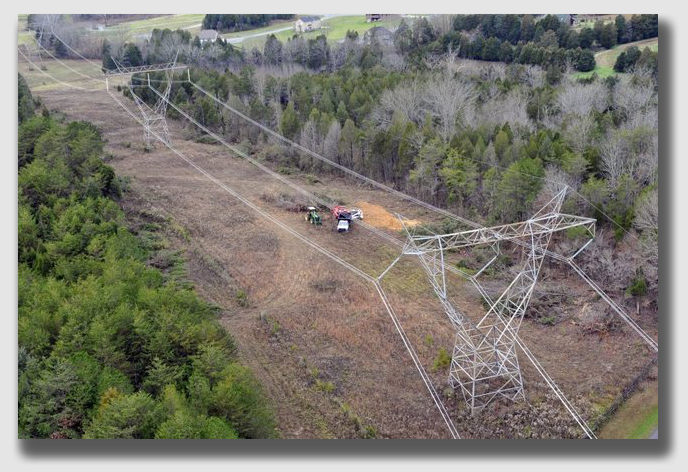
When you found out that the new vegetation management policy would result in TVA cutting down more than 200 trees, you decided to take action.

That’s what Donna Sherwood and a host of neighbors did, suing TVA in U.S. District Court. They argued that TVA had improperly classified the so-called 15-foot rule as routine maintenance which was exempt from the National Environmental Policy Act. In fact, Ms. Sherwood contended, the new 15-foot rule would essentially denude 260,000 acres, a square of land over 20 miles to a side. Besides, Ms. Sherwood argued, TVA didn’t have the right to remove trees in its right-of-way that did not interfere with or endanger the transmission lines.

The District Court threw out the case, holding that TVA had complied with the NEPA and that the easements clearly encompassed the removal of timber. The plaintiffs asked the court to submit the easement interpretation issue to the Tennessee Supreme Court, a procedure known as certifying a question. The District Court ruled that it didn’t need to certify the question because state law was well settled. The easements pretty clearly gave TVA the right to clear trees from its right-of-way.

The Court of Appeals reversed the District Court, but the decision didn’t give the neighbors much comfort. The appellate court held that the record did not demonstrate that TVA had complied with NEPA, so the case was remanded to the District Court to compile the record. But on the crucial issue, the Court held that substantial Federal interests, as well as Tennessee law, supported a reading of the old easement Grandpaw created to encompass the 15-foot rule and clear-cutting a swath as wide as the limits of the easement (in some cases, 200 feet).

The likelihood that NEPA would stop TVA is about as likely as your electric bill falling by 50%. That being the case, Ms. Sherwood is undoubtedly scratching her head with gleeful puzzlement that TVA announced, after the appellate decision , that it would abandon the 15-foot rule without further litigation.

nopruning141229

The neighbors thought they had won… but the matter wasn’t settled in court. Later this week, we’ll see what that meant when the chainsaws came out again.

Sherwood v. Tennessee Valley Authority, 590 Fed.Appx. 451 (6th Cir. 2014). The Tennessee Valley Authority (TVA) provides electric power to consumers in seven states across the Southeast. To reliably deliver that power, TVA maintains the vegetation under and around its power line structures. Historically, TVA has removed all trees directly under its power lines, but did not cut down all of the trees in what TVA called buffer or border zones, the edges of the easements TVA possesses.

Over the years, TVA acquired easements that are typically between 75 and 200 feet wide. Built within those easements are approximately 15,900 miles of power transmission lines. Those easements permit the TVA “the perpetual right to enter” and “to erect, maintain, repair, rebuild, operate, and patrol” electric power transmission lines and all necessary appurtenances. Additionally, the TVA is granted the “right to clear said right-of-way” and is allowed to maintain the right-of-way clear, including the removal of brush and trees. TVA has established a vegetation-management program for its easements. TVA maintains the easements by keeping the area beneath the transmission lines clear while leaving a narrow buffer zone on either side of the easement. The sectors are on five-year cycles for tree removal and three-year cycles for mowing or spraying the undergrowth.

Although the TVA has been maintaining the vegetation in its easements for more than seventy years, it has not removed all of the taller, mature trees located within its rights-of-way. Its right-of-way specialists have been afforded discretion in deciding which – if any – trees to remove. Budget constraints have further restricted the discretion afforded the specialists. As a result, many tall trees remain standing within TVA’s easements. TVA has also made exceptions when landowners have promised to control the height of the trees.

After the August 2003 Northeast U.S. blackout, the wisdom of allowing these taller trees to grow within electric transmission line easements was called into question. In 2007, NERC established rules for vegetation management around electric transmission lines.

TVA altered its vegetation-management practices to comply with the new NERC rules and to avoid paying fines and penalties. TVA may allow low-growing species (less than 15 feet at mature height) to be planted within the right-of-way but not directly under transmission lines, with express TVA approval required in each case. It would no longer allow taller, incompatible trees (species that exceed 15 feet mature height) within its rights-of-way, even if landowners promise to control tree height. TVA would remove all incompatible species from its rights-of-way.

A TVA spokesman said TVA would have a “zero tolerance policy,” explaining that “we’re going to remove trees that can grow 15 feet or more. We’re also going to clear the full width of the easement.”

Donna Sherwood and her neighbors sued, arguing that TVA’s new policy would result in the removal of millions of taller, older, mature trees from TVA’s rights-of-way. They argued that TVA had failed to conduct the required NEPA studies before implementing this new rule. The plaintiffs have submitted evidence showing that TVA identified more than 200 trees for removal from plaintiffs’ properties. The plaintiffs submitted evidence of the environmental consequences of removing tall, mature trees from the easements.

The district court granted TVA’s motion to dismiss the plaintiffs’ claim that TVA had exceeded the scope of the easements, denying the plaintiffs’ motion to certify a question to the Tennessee Supreme Court. After reviewing the record, the district court held that TVA had not established a new policy, instead acting consistent with the maintenance policy that had been in place for the past fifteen years. Finally, the district court held that TVA’s 2012 vegetation-maintenance policy was not arbitrary or capricious.

The plaintiffs appealed.

Held: The plaintiffs’ request that the District Court certify a question of state property law to the Tennessee Supreme Court was rejected. However, the record showed that TVA had not adequately considered the environmental consequences of its new 15-foot policy, so the case had to be sent back to the District Court.

Easement141229As for the NEPA claim, the Court of Appeals held that the administrative record submitted by TVA did not consider the environmental consequences of the 15-foot rule. The Court held that the plaintiffs were alleging that TVA’s alteration of its vegetation-maintenance practice – the removal of all trees over 15 feet, as well as those trees that will grow to a height over fifteen feet – constituted a major federal action under NEPA. The TVA must compile an administrative record for the decision it made that is being challenged by the plaintiffs, in order for the court to evaluate the decision’s propriety under NEPA.

As for the scope of the easements, the Court of Appeals agreed with the District Court that “[b]ecause federal interests are sufficiently high in this matter, the easements are governed by federal law, not state law.” When the United States is a party to a lawsuit, and the underlying activities arise from a federal program, the federal interests implicated may warrant the protection of federal law.

The Court also agreed that the unambiguous language in the easements gave TVA the perpetual right to remove trees. Although state law was not determinative when applied to a Federal easement, the Court said, under Tennessee law the scope of an easement created by a grant is determined by the language of the grant. The easements involved here unambiguously give the United States three rights: (1) the right to enter and to construct electric transmission line structures, (2) the right to clear the easements of brush, trees, and timber, and (3) the right to remove danger trees from the surrounding land. In describing the rights granted, the easements use the plural “purposes,” not the singular “purpose.”

The Court said that nothing in the language of the easements, explicitly or implicitly, limited TVA’s right to clear trees from the right-of-way.

Thus, although the NEPA issue remained to be litigated on remand, the easements were broad enough to clear-cut the full width of the easements, regardless of prior practices or the landowners’ opinions as to what was necessary to protect the transmission lines.

– Tom Root

Case of the Day – Thursday, March 27, 2025

TRESPASSERS WILLIAM

My first brush with the law of trespass came at the age of five or so, when I learned from a Bear of Little Brain that a sign in the Hundred-Acre Wood that said, “Trespassers Will-“ was really shorthand for “Trespassers William,” who had once lived there. Of course, as I now know, “Trespassers William” is/was an indie rock band. Growing up is no fun.

Since the time I was compelled to grow up, I have seen countless “no trespassing” signs on fencerows, on gates, freestanding by driveways, and tacked to front doors. The signs always sort of troubled me. As everyone knows, a trespass is an unauthorized entry upon the land of another even if no damage is done or injury is slight. To me, a sign prohibiting trespassing implied that absent the sign, trespassing was fine.

If I cut across my neighbor’s yard to get to the new Dunkin’ (formerly known as Dunkin’ Donuts back when “doughnut” was not a dirty word) before all the crullers are gone, I have trespassed whether there’s a sign or not, or whether I buy him some crullers or not. If he posts a sign along my increasingly well-worn path, does it gain him anything?

The law, as always, provides us with an answer: maybe.

Jimmy Bob Christensen, sadly enough, came up on the wrong side of that “maybe.” Being a man who liked his privacy, Jimmy Bob posted “No Trespassing” signs at the far end of the 40-foot gravel driveway leading to his rather dilapidated mobile home. He liked being alone, for reasons that will become clear.

One day, a couple of local police officers knocked on the door of Jimmy Bob’s neighbor, asking why she had bought out the local Kroger of pseudoephedrine. She said it was for Jimmy Bob, who was busy cooking it into methamphetamine. The police headed down Jimmy Bob’s driveway, past the “No Trespassing” signs, and knocked on his door.

Apparently, manufacturing meth is an odiferous business, and the smell was distinctive. Although Jimmy Bob told them to vamoose and despite lacking a search warrant, the cops entered the mobile home and they found meth and guns.

Generally, a driveway, a front sidewalk, or even a door knocker or front doorbell is enough to give any person with a legitimate reason your implied consent to walk up to the door and seek admission. If it’s someone you don’t want – an encyclopedia salesman or religious proselytizer, perhaps – you can withdraw the implied consent by telling them to leave.

Sometimes, posting a sufficient warning is enough to withdraw your implied consent ahead of time. That’s the purpose of a “No Trespassing” sign. And that was surely what Jimmy Bob intended.

If the police had heeded the sign, they never would have smelled the cooking meth. Jimmy Bob’s lawyer argued that they had trespassed and that, therefore, the search was illegal (and nothing they found could be used as evidence).

The issue got to the Tennessee Supreme Court, which held that in this case, “no” really did not mean “no.”

State v. Christensen, 517 S.W.3d 60 (Supreme Court of Tennessee, April 7, 2017): In August 2013, two law enforcement officers drove down James Christensen’s unobstructed driveway, past a “No Trespassing” sign, parked near his residence, and walked up to the front porch. After Christensen opened his door, the officers smelled the odor of methamphetamine being manufactured. They asked Christensen for consent to enter his residence, but he refused and closed the door. They forced the door. Inside the residence, they found an active methamphetamine lab and several guns.

Prior to trial, the defendant filed a motion to suppress evidence, claiming that the evidence had been seized as the result of an unlawful search because he had posted “No Trespassing” signs near his driveway. He asserted that the officers’ entry onto his property without a warrant violated the Constitution. After a hearing, the trial court denied the motion.

Held: A “No Trespassing” sign, in and of itself, is not enough to withdraw the implied invitation to anyone with a legitimate purpose to walk up to the front door and knock. The Court said, “The knocker on the front door is treated as an invitation or license to attempt an entry, justifying ingress to the home by solicitors, hawkers, and peddlers of all kinds. This implicit license typically permits the visitor to approach the home by the front path, knock promptly, wait briefly to be received, and then (absent invitation to linger longer) leave… “

Of course, the Court said, a homeowner may take actions to revoke or otherwise limit that invitation or license. The implicit license enjoyed by police and citizens alike to approach the front doors of homes may be limited or rescinded by clear demonstrations by the homeowners that are “unambiguous and obvious to the casual visitor.”

Unfortunately for Mr. Christensen, a “No Trespassing” sign is not such an “unambiguous and obvious” revocation. The Court said, “In light of the strong social presumption that a visitor to a residential neighborhood can enter the front porch curtilage to knock, we doubt a reasonable, lawful visitor would believe that ‘No Trespassing’ eliminated that presumption in every instance. Every reasonable person knows – even without seeing a “No Trespassing” sign – that one cannot trespass on private property. But that knowledge coexists with knowledge of the equally well-established principle that one may generally enter the curtilage to knock. A reasonable observer could also understand a “No Trespassing” sign as restating the “no-trespassing” principle without thinking it had any bearing on the implicit license to enter the curtilage for social reasons. In a residential context, the intention of the homeowner who posts signs, without more, seems inadequate to revoke the license.”

Of course, the right kind of sign could do the trick, the Court said. “For example, a “No Trespassing” sign posted on a fence encircling a property imparts a different message than the same sign standing alone. And a closed or locked gate, especially in the residential context, imparts more information to the reasonable observer… But nothing aside from their numerosity makes the “No Trespassing” signs in this case particularly distinctive. And numerosity alone does not eliminate the ambiguity noted above. No special facts – like a fence or other physical obstacle – clarified to the reasonable visitor that these signs revoked the license.”

The Court said, “The plain meaning of ‘No Trespassing’ is that it prohibits what people ordinarily think of as trespassing, and does not alter the character of an entry that one would not otherwise think to be a trespass, such as the implied license to approach the homeowner’s door to knock and talk.”

– Tom Root

TNLBGray140407

Case of the Day – Friday, February 28, 2025

Toga, Toga!!

AnimalHouse150306So you heard about the sweethearts of Sigma Chi? The story broke about eight years ago about how the Sigma Chi frat brothers at Southern Methodist University – who lived off-campus in an upscale place called Maison des Animauxharassed the O’Connells, their next-door neighbors, for sport. Oh, the high jinx of these fun-loving rascals! Among other pranks, they liked to urinate on the O’Connells’ fence, write obscenities in the snow in their yard, spit on the O’Connell house, and throw raw meat onto the patio (prime cuts of beef, we hope).

It all started with a noise complaint, something to do with the brothers’ 24/7 partying. As the Grinch might have said, “The noise, noise, noise, noise, noise!” Mr. O’Connell said he “brought it to their attention and said ‘you can’t do that.’ They told me they pay rent and they can do whatever they want. It’s their right.”

The O’Connells now, after a year of abuse, had the media worked into a righteous froth. So that should take care of that. But were the brothers right? Can they do whatever they want until you’re finally able to get a crew from Action News to show up with cameras and a scowling investigative reporter?

Consider the poor aggrieved neighbors, the Rileys, in today’s case. They didn’t have an Eyewitness News crew. But they did have a lawyer. The house next door to the Rileys was owned by a landlord who rented it to some dopers. But not just any dopers. This wasn’t just boom boxes blasting the Grateful Dead and the wafting smell of freshly decriminalized marijuana. Nope, the neighbors here were good capitalists, appearing to run a brisk retail operation, with traffic at all hours of the night and unsavory customers. Imagine a 24-hour McDonald’s drive-thru window, but handing out nickel bags instead of Big Macs and Eggs McMuffin. [Editor’s note – we had a lively debate over how to pluralize McDonald’s famous breakfast sandwich. The Editor won.]

The traffic was accompanied by the screeching of tires, the occasional and casual vandalism toward the Rileys’ property, cursing and shouting, and the discharge of firearms. Someone even shot the Rileys’ dog.

Now we’ll put up with a lot, but we won’t put up with that. You shouldn’t shoot a dog. (See this post for more details). The Rileys felt the same. They complained in winter 1999, but nothing changed. The police raided the place, but all they found was some personal-use marijuana. The Rileys complained to landlord Richard Whybrew again. The Attorney General complained to Mr. Whybrew. Nothing happened. Mr. Whybrew said the tenants were paying their rent, so he wasn’t going to do anything. Apparently, he believed that money talks but neighbors walk.

Riley v. Whybrew, 185 S.W.3d 393 (Ct.App.Tenn. 2005). The Rileys lived in a house in a subdivision next to a house Richard Whybrew leased to the Parkers. Problems ensued.

Shortly after the Parkers moved in, the Rileys began experiencing problems with their tenant neighbors. A high number of unknown persons would come to the Parkers’ house at all hours of the day and night, honking horns, squealing tires, and shouting people. They would drive up, engage in a brief conversation or transaction with a resident at the Parkers’ home, and leave after a few minutes. The Rileys overheard many conversations about the sale of drugs, as well as frequent profane and abusive language. On several occasions, firearms were discharged at the Parkers’ residence at various times during the day and night. Some activities were directed toward the Rileys: chemicals were put in their gas tanks, a laser pointer was aimed at Timothy Riley, personal property was stolen from the Rileys’ home, and when the Rileys were seen by the Parkers or their visitors, they were taunted, cursed at, or stared at menacingly. The Rileys’ dog was even shot by a visitor to the Parkers’ home.

Of course, sometimes your neighbor’s harassment is a little more subtle …

A month later, the police conducted a raid on the Parkers’ residence, and Marina Parker was arrested for possession of marijuana. Despite the arrest, the disturbing activities at the Parkers’ home continued. As a result, the Rileys employed an attorney to notify Whybrew of the problems. In February 2000, the attorney sent Whybrew a letter informing him that his rental property was “being used for illegal activities, in violation of the housing and zoning codes, and probably in violation of the terms of [the] lease.” Later that month, Whybrew received a letter from the director of the Narcotics Prosecution Unit of the Office of the Shelby County Attorney General about the drug trafficking. The letter noted that the amount of controlled substance found at the Parkers’ home was not enough to compel Whybrew to evict the Parkers, but stated that Carter wanted Whybrew to be aware of the situation. A year later, the Rileys again complained to Whybrew, who said the Parkers had a lease and paid their rent on time, and he did not plan to take action against them.

The Rileys sued Whybrew, the Parkers, and ten “John or Jane Doe” defendants, seeking damages for infliction of emotional distress and asking for abatement of the nuisance. Whybrew asserted that the other defendants were the sole cause of any injuries suffered by the Rileys. Whybrew maintained that the Rileys failed to state a claim upon which relief could be granted and asked the trial court to dismiss the complaint. The trial court granted summary judgment to Whybrew.

Held: The case was reinstated, and the Rileys were entitled to a trial. The Court of Appeals found that a material question of fact existed as to whether Whybrew negligently allowed the tenants’ illegal behavior to continue, and that issue precluded summary judgment against the Rileys on their nuisance claim. The Court agreed that even if Whybrew had had knowledge of his tenants’ illegal activities – including drug use, discharging firearms, and harassment – his failure to stop the Parkers’ activities could only be characterized as negligence. Thus, as a matter of law, it could not constitute the intentional infliction of emotional distress.

However, the claim of negligent infliction of emotional distress was related to the claim of negligence for landlord’s failure to abate the nuisance caused by the Parkers’ illegal activities, and as such, the Rileys’ claim for damages for emotional distress was not a stand-alone claim, and could be heard even absent expert medical testimony as to their damages. Most importantly, the Court ruled, while Whybrew argued that there was no breach of any duty to the Rileys because there was no proof that he was aware of the Parkers’ illegal activities until February 2000 (and the Parkers moved from the residence after being served with this lawsuit two months later), it disagreed and held that the Rileys had established a genuine issue of material fact on the claims of maintaining a nuisance and negligent infliction of emotional distress, sufficient to withstand a motion for summary judgment.

The case went back to trial.

– Tom Root

TNLBGray140407