Case of the Day – Monday, September 30, 2024

TREE HUGS CAR, THEN COURT HUGS TREE

What does the Amazon rainforest have to do with a ’77 Mercedes Benz?

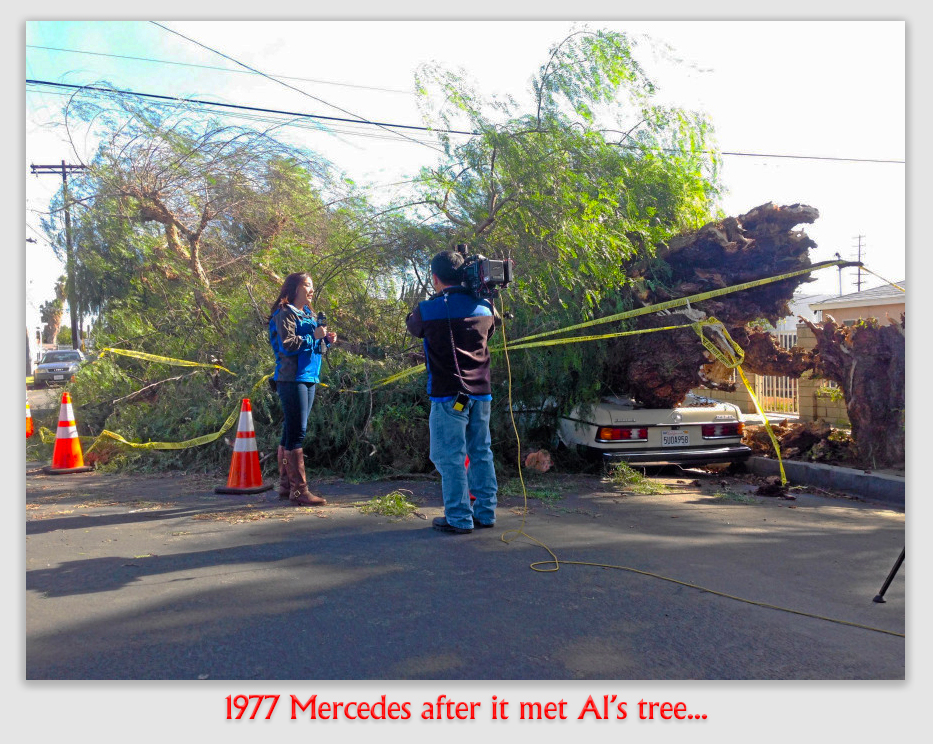
When Vic’s beautiful 1977 Benz was crushed by Al’s tree (while Vic was driving his convertible down the road), Vic knew for a fact that someone had to pay for the damage, and it wasn’t going to be him. Al should have known that the tree was going to fall down, Vic fumed in his lawsuit. That argument lasted until the neighbor, who had extricated Vic from the recently-downsized roadster, provided pictures showing the tree had decayed from the inside, and a reasonable inspection would not have caught the danger.

Never mind, Vic argued, Al should be responsible for what his trees might do regardless of whether he was negligent or not. The concept, strict liability – sometimes called liability without fault – has some utility. If you keep a couple of pet tigers in the backyard and a great white shark in the fishpond, the courts aren’t going to waste a lot wondering if you were negligent when the jungle cats maul the neighbor boy or the great white eats the president of the garden club when she leans over the water to admire the lilies. You do something that is inherently dangerous – keeping wild animals is not just a great example, but is the genesis of the notion of strict liability – was you’re going to be liable for whatever happens.

But for keeping trees? We suspect the judge was an environmentalist on the weekend, because he mused that if landowners were strictly liable for their trees falling onto the highway, then the landowners would start cutting down trees willy-nilly, and the beautiful Virgin Islands would be denuded posthaste. The Court opined that “the community, both local and global, also has a compelling interest in the protection and preservation of the environment. The same concern and sensitivity that we are just beginning to bring to the massive problem of the destruction of the Amazon rainforest, for example, should also apply to the relatively minute and particular circumstances of this case. No reasonable gain would be derived from adopting a rule of strict liability here, particularly when weighed against the potential ecological and aesthetic implications of such a decision.”

So trees would fall like dominoes, and the earth would fry like an egg. So take that, Mercedes 450 SL. You may be fine, but the Amazon is finer.
Marrero v. Gerard, 24 V.I. 275 (Territorial Ct. Virgin Islands, 1989). Victor Marrero was driving his 1977 Mercedes Benz along the East End Road in Estate St. Peters when a tree fell on his car. Before its collapse, the tree stood on Plot 5 St. Peters, owned by Alphonso Gerard.

Norman Nielsen, one of Al’s neighbors and a co-worker with Vic, quickly arrived at the scene. The base of the tree was inside Al’s fence, but the remainder was on the road. Norm described the tree as “dry” where it broke off, “kind of rotten but green on top.” The evidence, which includes Vic’s pictures of the tree (though none showing the top of the tree where there was foliage) failed to show that an external visual inspection of the tree before the fall would have disclosed that it was rotten at its base and in danger of toppling.

Held: The court ruled, therefore, that Vic had not shown Al to be negligent, because there was no evidence Al had reason to know that the tree was unstable or would fall. But Vic argued he didn’t have to show negligence, because Al should be strictly liable for the tree, that is, liable whether he was negligent or not. Vic based his argument on Restatement of Torts (Second) § 363(2), which holds that “a possessor of land in an urban area is subject to liability to persons using a public highway for physical harm resulting from his failure to exercise reasonable care to prevent an unreasonable risk of harm arising from the condition of trees on the land near the highway.” The explanation accompanying § 363 provides that “it requires no more than reasonable care on the part of the possessor of the land to prevent an unreasonable risk of harm to those in the highway, arising from the condition of the trees. In an urban area, where traffic is relatively frequent, land is less heavily wooded, and acreage is small, reasonable care for the protection of travelers on the highway may require the possessor to inspect all trees which may be in such dangerous condition as to endanger travelers. It will at least require him to take reasonable steps to prevent harm when he is in fact aware of the dangerous condition of the tree.”

The Court was unsure whether Al’s land was urban or rural, but it said that was irrelevant. Even if it had been urban, the Court said, the weakened condition of the tree was not apparent upon a visual inspection, “so that it matters not whether the area was urban or rural. Perhaps a core sampling of the tree would have disclosed the problem, but such an effort, particularly when weighed against the likely risk, is far too onerous a burden to place upon a landowner.”
Under the circumstances of this case, the Restatement simply does not impose strict liability, that is, liability without fault. While Restatement § 363(2) may apply a more specific standard of care to an urban landowner, the Court said, that standard is still “within a negligence realm.” Vic suggested the Court should “fashion a rule of strict liability” and thereby to pronounce a previously unexpressed public policy. The Court declined, holding that “Restatement § 363 is entirely consistent with sound public policy. “A landowner should have the duty to inspect for, discover and remedy patently hazardous natural conditions on his or her property which may cause harm to others outside the land,” the Court said. “But in this instance, the rotted condition of the tree was internal, not external, and therefore not discoverable upon reasonable inspection. To impose a rule of strict liability would be to declare, in effect, that any tree which is large enough to fall over the boundary of one’s land will subject its owner to liability in the event that a hidden weakness causes it to topple and cause damages off the land. Such a ruling, if widely disseminated, most likely would encourage prudent landowners to cut down large numbers of trees, thereby accelerating the already lamentable deforestation of the territory.”

No reasonable gain would be derived from adopting a rule of strict liability here, the Court held, particularly when weighed against the potential ecological and aesthetic implications of such a decision. It, therefore, dismissed Vic’s lawsuit.

– Tom Root

TNLBGray

Case of the Day – Thursday, July 11, 2024

STRICTLY SPEAKING

Strict liability statutes, also known as “liability without fault,” occupy the blameless end of the “mens rea” spectrum. Our traditional notions of fair play lead us to believe that people should not be held to blame for injury unless they are somehow at fault, either being negligent, grossly negligent, reckless, or just plain acting with intent to bring about the harm they cause.

But at common law, some acts were considered to be so inherently dangerous – the classic case was a lion that escaped from a keeper of exotic animals – that courts let the res ipse loquitur, the “thing speak for itself,” and found the owner liable for whatever mayhem ensued from a force that had once been under the owner’s control. Negligence need not be shown.

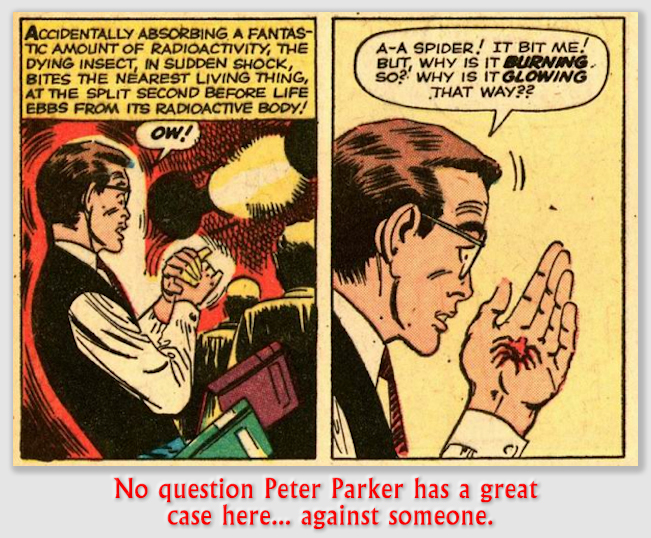
Remember the radioactive spider that bit Peter Parker and made him super-powered Spiderman? Peter (or maybe Spidey) could have sued the lab that let the spider escape. Everyone knows that a radioactive spider is an inherently dangerous instrumentality, and whoever the last guy was to have the arachnid in captivity had better be prepared to pay big, regardless of whether he was at fault or not.

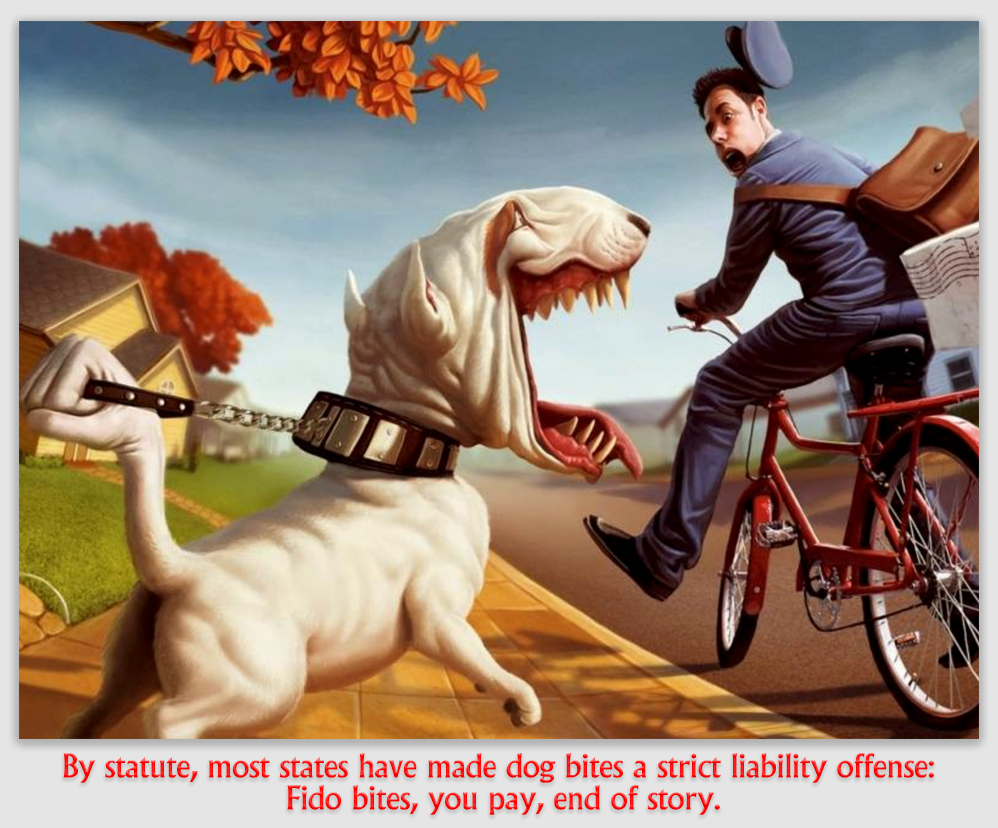
But should strict liability extend to dogs? Speaking as the owner of a 40-lb. canine who is a terror to woodchucks but a marshmallow around humans, we don’t really see why they should. Nevertheless, many states have dog bite statutes that make owners strictly liable for their canines’ misdeeds, regardless of fault. To be sure, some of the statutes are hybrids, making the owner absolutely liable except for all the cases in which he or she is not. In today’s case, the statute at issue made an owner strictly liable for his or her dog’s bite, unless the person so bitten was engaged in criminal trespass or other criminal conduct, or was tormenting or teasing or harassing the dog. So the owner is absolutely liable… sort of.

Today’s case is the kind of tree law/neighbor law mashup that you have come to rely on us to deliver. The trial court here made the tree trimmer into a trespasser, despite the obvious fact that the power company had every right to enter its easement to prune back trees. The Court of Appeals could not swallow that but instead suggested that while not a trespasser, the employee owed the dog’s owner notice that he was entering the premises, so the owner had the chance to control his dog.

With certain Supreme Court justices disappointing activists everywhere by deciding cases according to their perception of the law rather than the politics (you can tell I’m a fan of the rule of law, whether I agree with the political effects or not), there will be a lot of talk over the next few months about “judge-made law.” Do you want to see judge-made law? Just look at the gyrations of the trial and appellate court in the case below.

The judges here clearly could not accept that the dog’s owner should have to pay when the dog had been contained in a yard behind a fence and a “no trespassing” sign. A stranger—regardless of intention and right—barged in anyway and complained because the dog chased him. And they found a way to bend the law to suit their sense of propriety.

Collins v. Bergman, 2010-Ohio-6213 (Ct.App. Montgomery Co., Dec. 17, 2010), 2010 Ohio App. LEXIS 5233, 2010 WL 5274. Jason Collins worked for Nelson Tree Service, which was under contract with the power company to remove trees that were too close to utility poles and lines. Jason’s job was go from house to house inspecting all trees encroaching Dayton Power & Light utility lines and poles so any trees too close could be trimmed back at a later time.

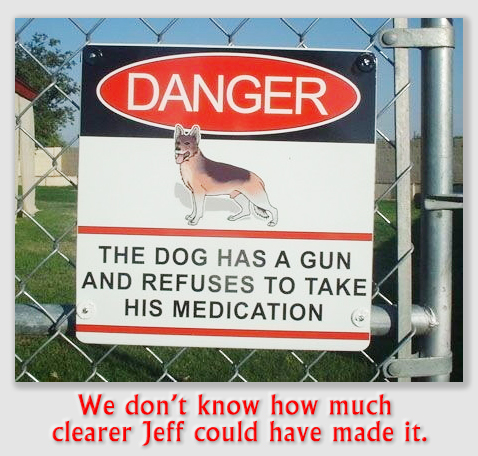
When Jason reached Jeff Bergman’s house, there was no answer when he knocked on the door. Jason left a courtesy card on the door, notifying Jeff that a tree trimming would occur in the future. Jason then went around the back of the house to count the trees. He could hear a dog barking. The dog was a Labrador-Rottweiler mix named Taz. Jason didn’t know Taz had a dog door giving him unfettered access to the back yard.

Jason could see that Jeff and his neighbor had built 6-foot privacy fences, which made it impossible for the power company to check its easement. Thinking that Taz was inside the house, Jason entered the fenced-in backyard through a gate marked “no trespassing.”

Taz was not inside. As Jason fled the barking dog, the cantankerous canine planted his fretwork in Jason’s pant leg. Jason tried to climb the privacy fence, but fell back, injuring his shoulder.

Jason sued Jeff under Ohio’s dog bite statute, O.R.C. § 955.28. Jeff filed for summary judgment. At the time, that statute provided that “the owner, keeper, or harborer of a dog is liable in damages for any injury, death, or loss to person or property that is caused by the dog, unless the injury, death, or loss was caused to the person or property of an individual who, at the time, was committing or attempting to commit a trespass or other criminal offense on the property… or was committing or attempting to commit a criminal offense against any person, or was teasing, tormenting, or abusing the dog …”

The issues in this case were whether Jason entered Jeff’s property pursuant to the utility easement and whether he was a trespasser within the meaning of the dog bite statute.

The trial court determined that Jason was injured within the easement, where he had a right to be. However, the court said, the easement did not provide a specific place for the utility to enter the property, and therefore, Jason was required to make use of the easement in a reasonable manner. The court found that Jason did not act reasonably in deciding to enter Jeff’s property without notice and through a latched gate and a fence with a posted “no trespassing” sign. The court also noted that Jason failed to follow his own company’s policy in entering a property when there is a dog barking in an enclosed area. Because Jason did not make reasonable use of the express easement granted to the utility company, he was a trespasser within the terms of O.R.C. § 955.28(B). The trial court granted Jeff’s summary judgment motion.

Jason appealed.

Held: Jason was a trespasser and not entitled to damages.

The Court of Appeals agreed with Jason that he had a right to enter the easement, and because entry to the easement was blocked, he took the only reasonable avenue open to him through the backyard fence.

However, in determining whether a person is a “harborer” under the statute, the Court said, “the focus shifts from possession or control over the dog to possession and control of the premises where the dog lives.” The hallmark of control is the ability to both prevent and exclude others from coming onto the property. Because Jason entered the property without permission, Jeff lost the ability to control his property at the time of the incident. Thus the trial court properly denied Jason’s motion for partial summary judgment and properly granted summary judgment to Jeff on the O.R.C. § 955.28 claim.

– Tom Root

TNLBGray140407