Case of the Day – Wednesday, October 29, 2025

SWEET BAMBOO

Bamboo – essentially kudzu with cellulose stalks. A report on pandas I saw on some forgettable channel last week reported, among other things, that the anthropomorphic beasts have been eating bamboo for 6 million years.

If that’s so, they certainly have done a lousy job of it.

Bamboo grows at two rates, fast and faster. It invades like the Germans into Russia, a plant so aggressive that landscapers recommend installing a concrete tank in the ground to ensure that its roots don’t go deep and spread into the neighbor’s land. It grows dense and tall, and takes no prisoners.

Florida Power & Light, the defendant in today’s case, considered bamboo a “critical removal” species. When found under FLP lines, bamboo was not to be trimmed. It was to be removed, killed dead, dead, dead.

That didn’t happen in today’s case, and the invasive plant was so high and thick that a teenager climbed it and died when the bamboo bent over and contacted a live power line.

That’s where the personal injury lawyer came in. PI attorneys are their own type of invasive species. The complaints they file spread far and wide, like bamboo, and can be as aggressive as Bambusoideae of the grass family Poaceae itself. 

A personal injury case, if successful, results in an award of damages to the plaintiff intended to make him or her whole. You would think that would be straightforward, but the amount is computed by juries, and juries can be fickle. A crying mother who lost her son versus a faceless, soulless electric utility owned by a faceless, soulless holding company sporting a made-up name, Nextera Energy, Inc. That holding company, stock symbol NEE, had net income of $6.9 billion (with a “b”) last year, on total revenues of $24.7 billion.

That’s a lot of money, and it spawns plaintiffs’ attorneys’ arguments I’ve heard many times before: Corporate greed killed the boy, and don’t you think this poor woman deserves at least one-half of one percent of FP&L’s obscene profits for her suffering? You, Mr. and Ms. Juror, need to send the defendant a message, and put the other corporate giants like it on notice that they cannot treat people this way.

In today’s case, the jury thought the loss of plaintiff Tricia Dominguez’s son was worth $12.5 million. It seems like a lot to me, but it is not my son who died. The tougher part is that the jury awarded Tricia another $15 million in punitive damages, damages awarded to punish FPL for its greedy and reckless decision to not cut the bamboo.

Punitive damages never made a lot of sense to me. Why should the plaintiff get them? If the object is to be like a fine in a criminal case, shouldn’t the punitive damages be paid to the state? And too often, the punitive damages seem to be as much a penalty imposed on a company for its size or profits as they are for truly abhorrent conduct.

Tricia’s PI attorney used a Florida doctrine known as direct liability, in which a corporation is punished for gross negligence if “there [is] willful and malicious action on the part of a managing agent of the corporation.” It worked, and FPL was socked with $15 million in punitives, despite the fact that the guy who was pilloried for gross negligence was a minor supervisor in a regional office, and despite the fact that there was no evidence he even knew about the bamboo stand where the accident occurred.

However, a court of appeals threw a healthy dose of reality on the case and undid the punitive damages.

Florida Power & Light Co. v. Dominguez, 295 So.3d 1202 (2019). In December 2011, 15-year-old Justin Dominguez was climbing a tall stalk of bamboo in his neighbor’s backyard. The stalk bent into a power line, resulting in Justin’s electrocution and death. The boy’s mother, Tricia Dominguez, filed a wrongful death action against Florida Power & Light, arguing that FPL was negligent because it ignored its own maintenance and safety standards when it failed to remove the bamboo, a fast-growing and uncontrollable plant, from the area near the line. She further alleged that FPL had been warned about the bamboo at the accident site but still failed to remove it. As a result of this negligence, she argued that FPL created a dangerous safety hazard that claimed her son’s life.

Tricia asked for punitive damages as well as compensation for her loss, complaining that the accident scene was so overgrown with trees that the power lines were not easily visible around the bamboo. She showed that FPL’s vegetation maintenance procedures explicitly recognized the risk of electrocution posed by foliage encroaching upon powerlines, including the danger to children who climb trees.

Bamboo in particular is a problem because of its aggressive growth rate. Thus, FPL designated it as a “critical removal” species that should be removed outright instead of merely trimmed in the vicinity of power lines. Tricia argued that FPL had been informed about the bamboo at the accident site by one of its contractors, who recommended it be removed. Despite the recommendation, Tricia alleged, FPL violated industry standards and its own vegetation maintenance policy by failing to do so. Tricia asserted that this failure warranted punitive damages because it was the direct result of a corporate policy that prioritized cutting costs and corporate greed over the lives and safety of the general public.

Tricia argued that due to direct liability, FPL – through the behavior of Barry Grubb, the head of vegetation management for the region in which the accident occurred and the person identified by FPL as being its vegetation management program expert – was financially responsible for the bamboo hazard. Tricia ran with that, arguing that Barry was willfully ignorant about the circumstances and hazards surrounding Justin’s death. When answering interrogatories, he claimed that no trimming or other maintenance was necessary at the accident site even though he had never visited the scene himself. At the time of his deposition years later, Grubb had still not visited the site and had no opinion on the adequacy of the maintenance there. He also testified that he was not familiar with the language in FPL’s vegetation maintenance rules about the danger of electrocution from foliage near power lines. In sum, Tricia argued, regional vegetation manager Grubb had taken a see-nothing, know-nothing approach. The jury agreed with this assessment and awarded her $15 million in punitive damages.

FPL appealed.

Held: The Court of Appeals upheld the wrongful death judgment and the $12.5 million in compensatory damages. It reversed, however, on the punitive damages.

Direct liability is one of two theories recognized in Florida through which a corporation may be liable for punitive damages. Under the direct theory, liability for gross negligence is established if the corporation itself engaged in conduct that was “so reckless or wanting in care that it constituted a conscious disregard or indifference to the life, safety, or rights of persons exposed to such conduct,” and its conduct contributed to the loss of the injured party. Because a corporation cannot act on its own, “there must be a showing of willful and malicious action on the part of a managing agent of the corporation” to establish direct punitive liability.

A “managing agent” is more than just a manager or midlevel employee. Instead, the Court held, a managing agent is an individual like a “president [or] primary owner” who holds a position with the corporation, which might result in his acts being deemed the acts of the corporation.

Here, Tricia sought punitive damages under the direct liability theory through the alleged gross negligence of a regional supervisor in FPL’s vegetation management program. At trial, supervisor Grubb was identified as the FPL employee who knew the most about this program, but he was only in charge of the program for a limited geographical area. He also testified that he has a manager himself, and thus he alone does not make policy decisions relating to the program. While his position certainly comes with significant managerial power, Grubb does not qualify as a managing agent of FPL. Overseeing only a portion of FPL’s arborist program, which is itself ancillary to FPL’s primary function of providing electric power, Grubb is at best a midlevel employee more akin to a bank vice president or hotel manager than to a corporate officer or official who could represent FPL as a whole. Because Grubb is not a managing agent for purposes of direct punitive liability, the Court said, the award of punitive damages in this case had to be reversed.

 Even if Grubb were a managing agent, punitive damages are only warranted if there is evidence he was negligent “equivalent to the conduct involved in criminal manslaughter.” To be punished by punitive damages, the Court observed, the conduct must be “so reckless or wanting in care that it constitutes a conscious disregard or indifference to the life, safety, or rights of persons exposed to such conduct.

But in this case, trial testimony established that Grubb was not directly involved with the accident and did not know about the details of Justin’s death until years after the fact. Grubb also seemed unaware of specific FPL safety standards cited by Tricia, despite being identified as the person most knowledgeable about FPL’s vegetation program. Whatever negligence a jury may infer from this evidence, the appellate panel ruled, “It certainly does not rise to the level of ‘reckless disregard of human life’ or an ‘entire want of care, which would raise the presumption of a conscious indifference to consequences’.”

– Tom Root

TNLBGray140407

Case of the Day – Friday, November 22, 2024

THOU SHALT NOT COVET THY NEIGHBOR’S TREES

Kee Nee Moo Sha, Inc., had a tract of wooded land on a lake, next to a Bible camp owned by the Baptist Church. What could be wrong with that? No loud music, no dancing all hours of the night, no boozing or riotous living… right?

The minister in charge of the Bible camp knew where the boundaries between the Baptists’ and the company’s lands lay. But he had a problem. How could he build more cabins for the pittance that had appeared in his collection plate? The Lord turned seven small loaves and a few fishes into a feast for 4,000 people. But the preacher, a lesser mortal, couldn’t stretch what little he had into more lodging.

And verily, he began to covet his neighbor’s trees.

The minister had a logger cut down about a hundred of Kee Nee Moo Sha’s pine trees. Surely this was manna from heaven — free timber! Except it wasn’t free, as the Baptists soon found out.

Kee Nee Moo Sha reacted much like a modern, more restrained version of the angry vineyard owner.  It sued. The Baptists failed to heed the Lord’s admonition to make peace with the plaintiff before you get to court.

Too bad, too. The court found that the minister’s trespass was willful, and in fact, it appeared to be rather irked with the fact that – once on the witness stand – the man of the cloth wasn’t very familiar with the 9th Commandment, you know, the one about bearing false witness and all.

Kee Nee Moo Sha wanted the Baptists to pay for the enhanced value of the timber — that is, the value of the timber after being milled — and the court agreed that the measure of damages is acceptable where the trespass is willful. But the court can’t guess what that value might be, and where Kee Nee Moo Sha failed to introduce any evidence of the enhanced value, it missed its opportunity.

The Baptists introduced evidence of the stumpage value of the timber, that is, the value at the point it had been cut down, but before it was hauled and milled. Stumpage value is always lower because the owner of the timber has to deliver it to the sawmill and pay for the milling before having a product to sell. Because the stumpage value was the best evidence of value in the record, the Baptists were charged for the lower figure.

The trial court assessed punitive damages against the church camp instead of the treble damages for wrongful cutting which the statute permits. The Court of Appeals noted that this was entirely permissible because sometimes trebling the damages just isn’t good enough to deter such conduct. Where the trespass is wanton but the damage only amounts to $100, $300 might just not get an errant preacher’s attention nearly so effectively as a whopping punitive award. The Court said that either trebling or punitive damages may be applied, at the trial court’s discretion.

covet150212And thus, the Baptists rendered unto Kee Nee Moo Sha …

Kee Nee Moo Sha, Inc., v. Baptist Missions of Minnesota-Plymouth Point Bible Camp, 1990 Minn. App. LEXIS 1305, 1990 WL 212222 (Minn.App. 1990). Kee Nee Moo Sha, Inc., is a family-owned corporation organized for the purpose of holding more than 100 acres of forested land near Hackensack, Minnesota, with a resort on the southern end of the property. The resort belongs to the Baptist Church.

In late 1976, in connection with the transfer of the Baptist’s church property to another church unit, a surveyor was hired to survey and mark the boundary between the Baptists’ land and the Kee Nee Moo Sha property. Shortly after the survey was completed, and while the brush was all cleared and orange flags marked the line, the surveyor walked the boundary line with one of the church’s pastors, pointing out in detail the location of the boundary.

About four years later, the pastor wanted to build more camp buildings as cheaply as possible. Looking for some do-it-yourself financing, he arranged for a local logger to cut about 100 pine trees in and near the main camp buildings. While most of the timber was cut on church property, 26 pines were cut on Kee Nee Moo Sha land. In addition, the pastor had the logger clear-cut nearly 100 birches and aspen from the same area of the Kee Nee Moo Sha property, along with 1,600 cubic yards of sand which were used in a drain field near the Baptist building project. Kee Nee Moo Sha was unamused.

A lawsuit inevitably followed. The trial court granted Kee Nee Moo Sha damages for trespass and an injunction against further trespass by the Baptists. Unhappy with the paltry damages awarded, Kee Nee Moo Sha appealed, seeking a higher measure of compensation, a more extensive permanent injunction, and costs, disbursements and attorney fees.

Held: The appellate court upheld the trial court decision.

The Court observed that there were several possible measures of damages that could be used when trespass to property involves the taking of timber. One of the oldest is the “enhanced value” of the timber after being sawed and transported to the place of sale or transfer, to be used when the trespass is willful. The presumption in trespass cases where timber is cut is that the trespass is willful, and the burden of proof falls to the trespasser to show otherwise.

Here, the trial court found it couldn’t use the “enhanced value” measure, because no evidence was introduced to permit the Court to determine the value of the processed lumber. Consequently, the trial court used the stumpage value presented by the Baptists to set compensatory damages, and awarded punitive damages, in addition, to arriving at a fair number. The trial court, passing up treble damages that were authorized but not required by statute, awarded punitive damages instead. The trial court found that “even an award of treble damages for that taking would not adequately punish [the Baptists] or compensate [Kee Nee Moo Sha] for the willful trespass which has occurred.”

The Court agreed that the trial judge’s approach was justifiable under Rector v. C.S. McCrossan, Inc., and the treble damage statute. It observed that Rector, while referring to various measures of damages, does not refer directly to punitive damages. Punitive damages may be awarded, however, when “the acts of the defendant show a willful indifference to the rights or safety of others.” The trial court found that the Baptists’ behavior was willful, and the evidence supported it.

ba150212Minnesota law provides that any award of punitive damages will be “measured by those factors which justly bear upon the purpose of punitive damages, including… the profitability of the misconduct to the defendant… the attitude and conduct of the defendant upon discovery of the misconduct… and the total effect of other punishment likely to be imposed upon the defendant as a result of the misconduct, including compensatory and punitive damage awards.” In this case, the Court didn’t think much of the Baptists’ attitude. First, the defendant cut the timber and removed the sand in order to line its own pocket, that is, to obtain cheap building materials for the camp. Second, the pastor continued to deny any willful misconduct throughout the trial, a denial that flew in the face of proof to the contrary and his own admission that he had been shown a clearly marked boundary prior to these takings. The appellate court dryly called the jury’s awarding of compensatory and punitive damages a “just” result.

Kee Nee Moo Sha argued for the use of the “replacement value” measure of damages also authorized by Rector, but the Court noted that in instances where the cost of replacement is unreasonable or excessive in relation to the damage to the land itself, the trial court may, in its discretion, allow the jury to consider more than one measure of damages in order to permit flexibility and achieve a just and reasonable result.

– Tom Root

TNLBGray

Case of the Day – Monday, October 7, 2024

HE SAID, SHE SAID…

This is probably the right time, what with Presidential campaign drama being played out in Washington and across the country, to run with our own “he said, she said” case, a peculiar turn-of-the-last-century trespass to timber case from New Jersey.

The defendant farmer was accused of trespassing onto the plaintiff’s land without permission and cutting down 32 trees. He said he only cut 13 trees, and anyway, he had permission from the plaintiff’s father (the plaintiff being a fair damsel who, back then, couldn’t be worrying her pretty little head about real property management).

The plaintiff’s dad, unsurprisingly, denied giving permission.

It seemed pretty clear that the jury bought the plaintiff’s version of events. The damages awarded could not have been for just 13 trees, implying the jury must have believed that Farmer Ruddy had taken all 32. The fact that the jury found a trespass meant that it necessarily disbelieved Farmer Ruddy’s story about looking at the trees with the plaintiff’s father and making a deal.

After the obligatory denial that it was not second-guessing the jury, the court of appeals held that punitive damages were not proper where the case was nothing more than “an honest dispute as to permission for the act found to be a trespass…” Sure, and Bonnie and Clyde thought they had permission to take money that wasn’t theirs from the bank. So their offense was really just “an honest dispute as to permission for the act” found to be a robbery accompanied by lots of gunfire.

If Farmer Ruddy did not have permission (as the jury found he did not), then his entire story about walking the boundary with Ms. Hollister’s father was a woof story. And necessarily, Farmer Ruddy’s conduct in trespassing and taking the trees was wanton and malicious.

The court of appeals was simply substituting its own conclusions for those of the jury, rewriting the verdict as best it could by reducing the damages by about half.

This is not only an old decision, it’s an awful one. The Court may have been swayed by George Ruddy’s motive, to remove the shade from his field and thereby make it more productive. It may have preferred George’s detailed testimony over getting permission from plaintiff Minnie Hollister’s dad, whose hot denials may have sounded hollow. It may have figured that some woods belonging to a mere girl should not be favored over a field owned by a man.

Who knows (but the Court)? The point is that those conclusions are factual, and in this country, findings of fact are made by the jury, not an appeals court. This is raw judicial encroachment on the jury function, 19th-century style.

And some think that judicial activism is a recent phenomenon.

Hollister v. Ruddy, 66 N.J.L. 68 (N.J. 1901). Farmer George Ruddy had a problem. Minnie Hollister’s trees that stood along the boundary with his field threw so much shade that a healthy part of the cropland was not healthy at all. George cut down some trees, the exact number being an issue, some of which were boundary trees.

Minnie claimed that George had no permission to remove any trees at all. George testified that he had obtained permission from Minnie’s father, who had the authority to approve tree removal. George gave convincing testimony that he had driven the elder Hollister from town to the field, that they discussed the trees and shade problems they caused, that the trees were only fit for firewood, and that George even offered to sell the wood and give all of the proceeds to Minnie (because his only interest was in making the field more productive). Farmer Ruddy said he had cut only 13 trees on the boundary, not the 32 trees Minnie claimed were gone.

No matter. The jury believed Minnie Hollister and found that George had trespassed. Miss Minnie recovered $400.00 in damages to the trees and punitive damages of $350. George appealed.

Held: Minnie was not due any punitive damages.

The trial court had instructed the jury that after it figured out the value of the timber that was improperly taken, “if you believe that the action of this defendant, in entering upon the plaintiff’s land and cutting the trees, was wanton, willful and malicious, and that he meant to take property that he knew was not his own, and cut down the trees maliciously and carried them away without the plaintiff’s knowledge or consent, you may add such damages as you think is proper punishment for a man who willfully does an illegal act of trespass of that character.”

The court of appeals agreed with the jury instruction, but it found that the clear weight of the evidence showed that Farmer Ruddy had not cut or authorized the cutting of more than the 13 trees that stood on or near the boundary line and that the trees he cut were fit only to be cut for cordwood. Their value, based on the trial court testimony, was about $20.00. But even if the jury thought that George Ruddy had cut all 32 trees, the most they could have been worth was about $400.00. So plainly, the appellate court concluded, the jury must have allowed punitive damages.

The Court ruled that the right to award punitive damages rests primarily upon a single ground – wrongful motive. But here, the Court said, there was no competent evidence that George had authorized the cutting of anything more than the trees on or along the boundary line, and he claimed that his reason for cutting those was that they shaded his field so as to prevent the raising of full crops. He also claimed that he had procured permission from the elder Hollister, who was in charge of the property, for the cutting of those trees, although Mr. Hollister hotly denied this.

The Court conceded that “the verdict determined that permission was not given, and on that point alone we would not disturb it; but it seems to us quite plain that the jury was not justified in finding the defendant’s conduct wanton or malicious. Without conceding that for a mere trespass on lands and the cutting of trees that have no special value in themselves, and the cutting of which inflicts no peculiar injury on the landowner, punitive damages can ever be properly awarded, we see no ground for their allowance on the testimony above cited.”

The Court characterized the trespass case as “an honest dispute as to permission for the act found to be a trespass. It is true that some of the trees cut were exactly on the boundary line, and it is argued that that fact gave them a peculiar value. No such value was contended for or submitted to the jury. The line was not obliterated, for the stumps of the trees remained in the earth, and the line itself was shown by a post and wire fence, which, though considerably fallen into decay, still left the boundary line between the parties clearly discernible. There was no peculiar injury or any indignity inflicted on the plaintiff. It will be enough if she gets just compensation, which, of course, may include the value, if any, of any of the trees as line trees.”

– Tom Root

TNLBGray

Case of the Day – Wednesday, October 2, 2024

HANK YANKED, JOHNSONS CRANKED, SUPREME COURT TANKED

It’s hard to muster up a lot of sympathy for hard-nosed businessman Henry Tyler. When he wanted to build a commercial building, but his neighbors rightly refused to let him cut down some of their trees, Hank just yanked the trees anyway.

But the neighbors, the Johnsons, were not a couple of patsies who would roll over and play dead. They got a lawyer, who cranked on Hank big time. By the time the dust settled, Hank owed the Johnsons for the trees he had cut down, for additional damages his trespass had caused, for treble damages under the statute, and for punitive damages. The $1,400 worth of Johnson trees that Hank butchered ended up costing him over $11,500.

But there’s truth to the maxim that little pigs go back to the trough, but big pigs get slaughtered. (Mark Cuban is credited with the most common variation on this old saw, but I recall my wonderful securities law professor, the late Morgan Shipman, using the line often back in the 70s. Like Abraham Lincoln famously said, you just can’t trust the Internet).

Treble damages are intended to punish the malefactor by providing a simple statutory punitive remedy for a wronged party. Common-law punitive damages likewise are intended to punish the malefactor but without a set formula (thereby permitting a jury to make a symbolic gesture or run wild, as it wishes).

In today’s case, the plaintiffs’ silver-tongued lawyer talked the jury into awarding both treble damages and common-law punitive damages. When the trial judge wisely struck one, reasoning that a defendant could be punished once but not twice, the plaintiffs – who were big piggies by this time – appealed.

The Johnsons should have accepted the court’s offer when it first made it. The Iowa Supreme Court tanked their punitive damage award and sent the whole case back to be retried.

Johnson v. Tyler, 277 N.W.2d 617 (Supreme Court, Iowa, 1979). The Johnsons, who bought their home in 1952, planted trees and shrubs around the premises, particularly along the west line of their property. Genco Distributors, Inc., bought the property next to the Johnsons’ land to the west, intending to put a commercial building there. Genco’s president, Henry E. Tyler, asked the Johnsons for permission to remove the trees along the west boundary in preparation for the construction work. They refused. Hank nevertheless instructed the contractor to bulldoze the trees.

The Johnsons sued under Iowa Code § 658.4 for damages resulting from Hank’s deliberate and willful removal of a number of trees and shrubs from their property. The jury found for the Johnsons, fixing the value of the destroyed trees and shrubs at $1,400.00, which were trebled to $4,200.00, adding other sundry damages of $2,100.00, and assessing punitive damages of $5,250.00. That was too much for the trial court, which set aside the verdict for punitive damages.

The Johnsons refused their adjusted judgment of $6,300.00, which still was more than double the total amount of damage they suffered. They appealed the trial court’s striking of punitive damages, and the case ended up in the Iowa Supreme Court.

Held:  Punitive damages cannot be assessed.

The Supreme Court said that the paramount issue here was the question of whether the Johnsons could have both treble damages under the statute and punitive damages at common law.

The relevant statute provides that “[f]or willfully injuring any timber, tree, or shrub on the land of another… the perpetrator shall pay treble damages at the suit of any person entitled to protect or enjoy the property.” The Court held that by bringing the action under Iowa Code § 658.4, the Johnsons chose the remedy afforded by that statute, which is itself punitive.

The Johnsons argued that the statute did not abrogate their right to punitive damages, but instead just provided an additional statutory remedy. The Court disagreed, holding that letting a plaintiff have both treble damages under the statute and punitive damages under common law “would violate the basic prohibition against double recovery.” The Supreme Court ordered that the case be retried, with the jury being instructed that it should only find compensatory damages.

Not all the news was bad for the Johnsons, however. The Supreme Court clarified one question, whether “loss of enjoyment resulting from destruction of the trees and shrubs” was part of the damages that could be tripled under the statute. The trial court said they were not.

The Supreme Court held that the treble damage statute “allows treble damages for loss resulting from willfully injuring any timber, trees, or shrubs. It does not limit recovery to damage to the trees or shrubs themselves. Loss of enjoyment resulting from such conduct is an element of damage. If properly proved, this item, too, comes within the treble damage provision of § 658.4.

Tom Root

TNLBGray

Case of the Day – Monday, May 13, 2024

MILLION-DOLLAR BABY

I’ll tell you where the real money is in litigation. It’s not the guy who walks into the lawyer’s office with a tale of woe at the hands of some big, faceless, loaded corporation. It’s not the guy who was busted for pot, and he bonded out on Friday but they didn’t release him until Monday.

It’s right here: I should have a nickel for every would-be client who ever asked me to take a case on contingent fee, because they were sure to get beaucoup bucks in the end with an outraged jury handed them millions in punitive damages for a fender-bender, or a sharp-tongued government clerk, or a badly-written newspaper story, or whatever the injury du jour might be. Total up my nickels, and I ought to be sitting on the veranda of my Caribbean beachfront mansion writing this right now.

Alas, I am at my kitchen table in Ohio. It’s not quite the same…

Few would-be litigants really appreciate that punitive damages, also called exemplary damages, are damages awarded by a jury to punish a defendant for some terrible conduct, because, after all, it’s a civil action, and you can’t throw the malefactors in jail. But contrary to legend, punitive damages have to be tied to some actual harm.

In today’s case, some junior leasing agent for a billboard company (sorry, that’s not the proper term – these days, it’s ‘OOH’ or ‘out-of-home’ advertising) got a little too enthusiastic in clearing the view for the billboard, and when the dust settled, some of the trees that had been felled belonged to the neighbor of the guy who had leased space for the billboard (now there’s someone who should be locked up, the guy who let that eyesore get erected). The leasing agent was sloppy, careless even, perhaps – dare we say? – reckless.

The jury found that the neighbors were harmed in an amount of about $32,000. But it added to that figure an eye-popping $2 million in punitive damages. That was too much for the trial judge, who tried to get the farmer to accept a remittitur, that is, settle for a paltry $550,000. The farmer wouldn’t do it, so the court ordered a new trial. The farmer appealed.

All of $32,000 in damage, and a cool half mil on top of it? Farmer Blust was the living embodiment of the aphorism, “Pigs get fat, but hogs get slaughtered.”

Blust v. Lamar Advertising Company, 157 Ohio App.3d 787 (Ct.App. Montgomery Co., 2004). A Lamar leasing agent signed up Jim Weber in September 1998, leasing a small piece of Jim’s farmland near the property line between his farm and his neighbor, the Blust farm, for a billboard. The two farms were separated by an old wire fence that was largely concealed amid dense brush, vines, and trees. Because Lamar planned to erect its billboard near the tree line and undergrowth separating the two farms, it hired Woody’s Tree Medics to remove some of the trees and vegetation from Jim’s property.

A Woody’s work crew entered the Blust property and cut down 34 trees, 17 of which were more than three inches in diameter. At trial, a jury found Lamar liable in tort for trespassing and removing the trees without permission, and awarded the Blusts compensatory damages of $32,000 and punitive damages of $2.2 million. The trial court denied Lamar’s motion for judgment notwithstanding the verdict on the punitive damages award but indicated that it would grant a new trial on all issues, including liability, unless the Blusts accepted remittitur, that is, a reduction, of the punitive damages award to $550,000.00, with half of that amount going to a nonprofit nature conservancy. The Blusts rejected remittitur, and the trial court ordered a new trial.

The Blusts appealed, challenging the trial court’s holding that the punitive damages verdict was excessive and its decision to grant a new trial on all issues. 

Held: The Court held that the Blusts were entitled to punitive damages, but the award was excessive. Thus, the trial court did not err in ordering a new trial, limited how much should be awarded in punitives.
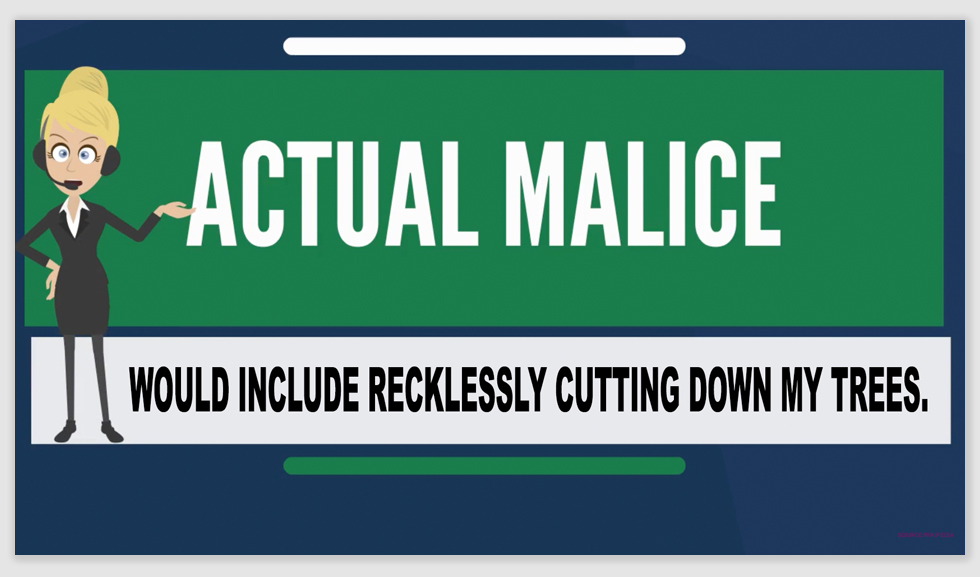
In order to recover punitive damages, the Blusts had to show that Lamar acted with “actual malice.” Actual malice, the Court said, is a state of mind under which a person’s conduct is characterized either by ill will or by such a conscious disregard for the rights and safety of other persons that its conduct is very likely to cause substantial harm.

The Blusts argued that Lamar’s act of directing their trees to be cut constituted a conscious disregard for their rights that had a great probability of causing them substantial harm. The Court agreed, finding substantial evidence in the record that Lamar’s agent consciously disregarded the Blusts’ property rights by ordering the cutting of trees on their property. Jim Weber told Lamar’s agent about where the property line fell and told her to follow the farm fence as a guide. After the cutting began, a friend of the Blusts appeared at the site to tell the Woody’s crew that it was cutting trees on the wrong property. The Blusts’ tenant farmer, Ted Eby, saw workers clearing trees from the Blusts’ property, and he spoke to the Woody’s crew and the agent, telling them they were cutting the Blusts’ trees.

Despite all of these warnings, the agent told the Woody’s workers to keep the saws humming. A reasonable juror, the appeals court said, could find that Lamar consciously disregarded the Blusts’ property rights.
A closer question, the Court observed, is whether Lamar’s agent was aware that having the Blusts’ trees cut carried with it a great probability of causing substantial harm. “We harbor no doubt,” the Court said, “that clearing the trees had a great probability of causing some harm. Indeed, removing the trees was absolutely certain to cause harm to the extent that the Blusts lost their trees. The crucial issue on appeal is whether the agent knew that this loss of the trees had a great probability of resulting in substantial harm to the Blusts, or more specifically, whether reasonable minds could differ on this issue.”

The Court said “substantial” means “major, or real importance, of great significance, not trifling or small.” Here, the “harm” was obvious: it was the loss of the Blusts’ trees. But in order to determine whether this harm was “substantial,” it was necessary to assign some measure of value to the trees. The Blusts said that someday, they might divide a portion of the farmland into residential plots, and the absence of trees would harm the value of the plots. The Blusts’ expert testified that the trees’ loss would diminish the fair market value of the subdivided property by $51,600.

The Blusts also argued that they hoped to sell the wood from three wild walnut trees someday for veneer. What’s more, the Blusts presented testimony that it would cost $40,566 to purchase and replant all of the trees or $24,335 to replant 11 of the larger trees. Lamar argued, on the other hand, that the stumpage or firewood value of the timber was only $105. Lamar also presented expert testimony that removal of the trees may have caused the Blusts’ property value to decline by at most one percent, or $3,870.

The Court held that most of the measures of damage could be characterized as “substantial.” But the record contained no evidence that Lamar’s agent knew the Blusts might subdivide their farm for residential purposes. The record also contained nothing to indicate that the agent knew of any plans to sell the walnut trees for veneer. Likewise, the agent did not know that the Blusts – who did not live on the parcel – would ever want to replace some or all of the trees. Thus, the agent could not have known that cutting the trees would harm the future value of the land as subdivided plots, frustrate the prospects of marketing veneer, or even just lead to $25,000 – $40,000 replacement costs.

However, fair market value is a different story. Even Lamar admitted that the cutting may have reduced the Blusts’ property value by $3,870. “A reasonable juror,” the Court said, “could find that a loss of this size qualifies as substantial harm and not a trivial loss.” A decline in property value because of losing trees is a “typical measure of the harm, and it is entirely predictable.”

When a verdict is influenced by passion or prejudice, the Court held, a trial court must order a new trial. However, when a verdict is merely excessive, but not influenced by passion or prejudice, a trial court must offer the plaintiff a choice between remittitur or a new trial. If the plaintiff rejects remittitur, a new trial must be ordered.

The Court agreed that the Blusts’ punitive damages award was grossly excessive under constitutional standards, and had to be set aside. Therefore, the judge properly directed the Blusts to choose remittitur or a new trial. However, the only issue tainted by error was the jury’s punitive damages award. The Blusts should not have been required to place in jeopardy their compensatory damages award or the jury’s determination that some punitive damages are warranted by undergoing a new trial on those issues.

The case was sent back to the trial court for a new calculation of punitive damages.

– Tom Root

TNLBGray