Case of the Day – Thursday, March 26, 2026

ANGELS WITH DIRTY WINGS

Filthy_animal140324Any fan of the Christmas comedy hit of the 1990s, Home Alone, remembers Angels with Dirty Wings. It was the fictional film noir movie that the kid protagonist played repeatedly. The mobster’s taunt –“Keep the change, ya filthy animal” – punctuated with a spray of .45 caliber bullets from a Model 1928 Thompson submachine gun – was used as a sound effect, part of the boy’s plot to keep the bad guys at bay.

In today’s case, the angel is Angel’s Path, a developer, and the dirt on its wings slid off a big mound the company put right on its property line as it built houses. The neighbors didn’t much like the dirt sliding into their back yard, and weren’t big fans of the stagnant water that collected after every rainstorm. But when Angel’s Path asked for summary judgment on the trespass and nuisance claims the Peters brought, for some reason, the couple opposed it on the cheap, with an affidavit from Mr. Peters and a bare letter from their engineer.

It’s seldom a good idea to save money at the most crucial moment in the litigation. Better to adhere to the old law school maxim, “too much is not enough.” You have affidavits from five experts? Use ’em all. You have five boxes of documents? Attach ’em. Opposing a motion for summary judgment is no time to spare the horses. Here, Mr. Peters should have had an affidavit from his engineer, his own survey done by a registered surveyor and recorded down at the county building, and enough pictures of shifting dirt piles and standing water to start his own Instagram site.

angelsfight140324But he didn’t. The trial court granted summary judgment to Angel’s Path, finding the survey of property lines — showing the dirt piles on its own land — more persuasive than Mr. Peters’ affidavit claim that the dirt had sloughed over the line. Peters’ affidavit was “self-serving,” the trial judge complained.

The Court of Appeals reversed. Sure, the affidavit may be a little self-serving, the Court said, but for purposes of summary judgment — a fairly high bar for a defendant to leap — the Court had little problem believing that a property owner knew where his own boundary lay. The summary judgment test, after all, is whether the evidence, taken in the light most favorable to the party against whom summary judgment is sought, shows there’s no material question of fact.

This standard required that the trial court assume that any reasonably detailed facts Mr. Peters raised in his affidavit were true. If, after doing this, the court still believes that Peters was not entitled to a judgment, then summary judgment could go for Angel’s Path. It was pretty clear that Mr. Peters was going to need a whole lot more persuasion at trial to pull the halo off Angel’s Path, but for now – at the summary judgment stage– his showing was enough to stay in the hunt. Just barely.

Incidentally, this case was brought with a companion case from the Kramers, who sued Angel’s Path, too. That decision is an interesting study in nuisance and trespass. We’ll consider that decision tomorrow.

angelspath140324Peters v. Angel’s Path, L.L.C., 2007-Ohio-7103, 2007 Ohio App. LEXIS 6211, 2007 WL 4563472 (Ct. App. Ohio, 2007). Clarence and Nanette Peters complained that Angel’s Path, LLC, a developer, damaged their two residential properties. As a result of residential property development by Angel’s Path, dirt mounds at the edge of the development property caused water run-off and flooding on their adjacent land. They sought restraining orders to prevent Angel’s Path from trespassing on their properties or continuing to alter the natural flow of water, as well as damages.

Angel’s Path filed a motion for summary judgment, arguing (1) that the earth mounds did not cause run-off to the Peters property or any sinkhole conditions and, therefore, were not a nuisance and (2) that their surveyor said that the mounds did not encroach upon appellants’ property, so no trespass had occurred. The trial court also granted summary judgment against the Peterses on both their nuisance and trespass claims. The Peterses appealed.

Held: Summary judgment was reversed. A “nuisance” is the wrongful invasion of a legal right or interest. A private nuisance is a nontrespassory invasion of another’s interest in the private use and enjoyment of land. In order for a private nuisance to be actionable, the invasion must be either intentional and unreasonable, or unintentional but caused by negligent, reckless, or abnormally dangerous conduct.

If the private nuisance is absolute, strict liability will be applied. By contrast, a qualified nuisance is premised upon negligence, essentially a negligent maintenance of a condition that creates an unreasonable risk of harm. To recover damages for a qualified nuisance, negligence must be averred and proven. A qualified nuisance is a lawful act so negligently or carelessly done as to create a potential and unreasonable risk of harm, which in due course results in injury to another.

Where damage to one property by water run-off from an adjacent property is alleged, Ohio has adopted a reasonable-use rule. A landowner isn’t allowed to deal with surface water as he or she pleases, nor is the owner absolutely prohibited from interfering with the natural flow of surface waters to the detriment of others. Instead, each landowner over whose property water flows is allowed to make a reasonable use of the land, even though the flow of surface waters is altered thereby and causes some harm to others. He or she incurs liability only when the harmful interference with the flow of surface water is unreasonable.

nuisance151019In answer to Angel’s Path’s motion for summary judgment, Mr. Peters provided an affidavit along with photos that claimed the mounds created by Angel’s Path had slid across the common property onto his property. His affidavit also said that Angel’s Path workers entered his property to cut the weeds because the slope of the mounds didn’t allow appropriate maintenance without entering his land. Finally, the Peters’ affidavit stated that the back portion of his property was now flooding and would not dry out, preventing his use of the land for rental or farming. Peters also included as a letter from his expert stating the mounds blocked the natural flow of the water, creating a “permanent pond,” and suggesting possible ways to eliminate the problem.

The Court said that Mr. Peters’ testimony about the location of his property lines, although perhaps not the best evidence to rebut a commercially prepared survey, was something presumably within the property owner’s personal knowledge. Therefore, despite the fact that he had not yet had a separate survey done, the Court would not disregard the affidavit. At the same time, the Court criticized the trial judge for placing too much weight on the fact that Angel’s Path plans had been approved by the local county engineers. The Court of Appeals said that while the county engineer and other agencies approved the Angel’s Path development plans, including the projected effects that it might have on surrounding properties, “such facts are of little consequence and comfort when examining the real-world results of the construction…”

Here, for the purposes of summary judgment, the Court concluded that the Peterses had presented prima facie evidence to establish causes of action for private nuisance and trespass. Whether Angel’s Path’s actions were reasonable, intentional, or negligent, the Court said, are decisions to be made in a trial and not on summary judgment.

– Tom Root

TNLBGray140407

Case of the Day – Tuesday, March 24, 2026

THE MASSACHUSETTS RULE GETS FLUSHED

Greed may be good ... but it doesn't get a lot of love from the court.

Greed may be good … but it doesn’t get a lot of love from the court.

Gloria Lane was a down-on-her-luck middle-aged woman who managed to just eke out an existence with her disabled brother in an old house. Their place was next to a rental property, a house equally as old, but owned by a corporate slumlord, W.J. Curry & Sons.

Do you see where this one is going? Hard cases can make bad law. Even where the result isn’t necessarily wrong — and we’re not hard-hearted enough to criticize people who were too poor to afford to fix the bathroom — cases are fact-driven.

We can imagine the scenario: a faceless corporation rolling in dough, too chary to keep up its properties and too avaricious to pay damages inflicted on the impoverished neighbors. That, at least, is the innuendo.

The Curry property included three large, healthy oak trees near the boundary with the Lane homestead. The trees are much taller than either of the houses, and those towering oaks featured limbs that protruded over Gloria Lane’s house and caused manifold problems. First, the court said, she had to replace her roof 15 years before the lawsuit “because the overhanging branches did not allow the roof to ever dry, causing it to rot.” She complained that prior to replacing the roof, “[e]very roof and wall in [her] house had turned brown and the ceiling was just falling down. We would be in bed at nighttime, and the ceiling would just fall down and hit the floor.”

In 1997, one of the oaks shed a large limb, which fell through the Lanes’ roof, attic, and kitchen ceiling. Rain then ruined her ceilings, floor, and the stove in her kitchen. The Lanes were physically unable to cut back the limbs hanging over the house, and they couldn’t afford to hire it done. For that matter, Gloria couldn’t even afford to fix the hole in her roof.

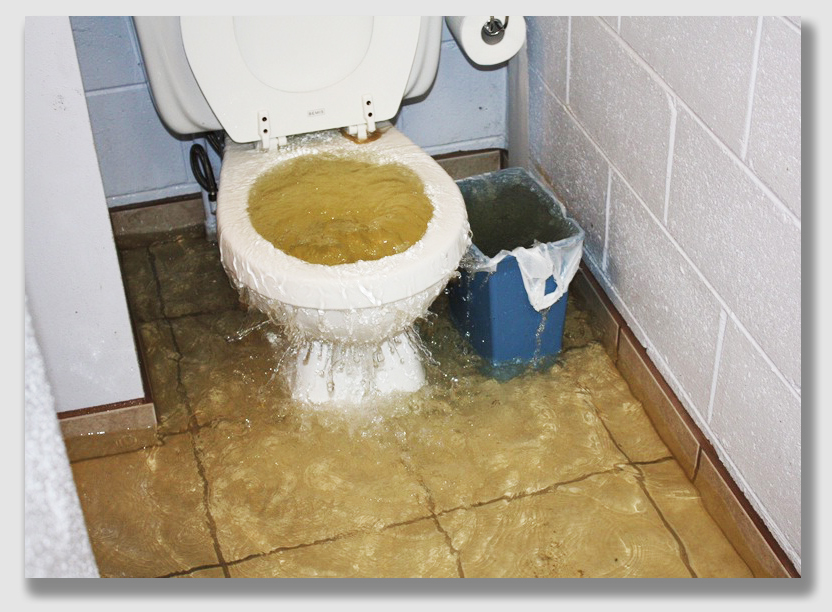
flush151015If that weren’t enough, the oaks’ roots clogged the Lane’s sewer line, causing severe plumbing problems. Gloria tried to chop the encroaching roots away from the sewer over the years, but they kept growing back and causing more plumbing problems. At the time of the lawsuit, she hadn’t been able to use her toilet, bathtub, or sink in two years because of the clogs. Instead, she went to the neighbors’ house (presumably not the Curry rental) to use the toilet. Meanwhile, raw sewage was bubbling into her bathtub, and the bathroom floor had to be replaced due to toilet backups and water spills.

Gloria told the trial court that “everything is all messed up. I can’t bathe. I can’t cook. I don’t want people coming to my house because it has odors in it, fleas, flies, bugs. It’s just been awful for me.” Ms. Lane, already under a psychiatrist’s care, said she “just can’t take too much more.”

After the branch punched a hole in her roof, Gloria asked the owner of W.J. Curry – one Judith Harris, a corporate minion who was neither W.J. nor any of his sons – to do something. She had a tree service trim the lower branches, but not the ones that would have been more expensive to reach. This didn’t solve the problems. When Gloria complained again, Ms. Harris told Gloria that she was on her own.

Now, boys and girls, these are hard facts. We aren’t dealing with the Schwalbachs, who were perfectly fit and reasonably flush, complaining to an underfunded cemetery association about a few twigs and leaves. Here, we have a dramatis personae that includes – as protagonist – a pathos-inducing poor woman caring for an invalid sibling, and – as antagonist – a soulless corporation destroying her happy home, one dropped limb by one dropped limb by one rotten roof by one clogged sewer at a time. And we’ve got some real damage, too. You try knocking on the neighbor’s door eight times a day and night to use the ‘loo, and see how you feel. Did the Massachusetts Rule have any chance of survival in the face of this heart-wrenching tale?

punch151015Of course not. The evil slumlord defendant (and we don’t know that he was evil or even a slumlord, but the story has a life of its own) argued that Tennessee followed the Massachusetts Rule. After all, it pointed out, Gloria was free to fire up her Husqvarna and clamber out onto her roof to cut down the offending limbs herself. Tennessee law firmly established that her remedies were limited to Massachusetts-style “self-help.” That means Gloria should get nothing for the hole in her roof, nothing for her falling plaster, nothing for her waterlogged stove, and nothing for the sewage bubbling in her bathtub.

The trial court agreed with W.J. Curry. It held that while it was “certainly a serious situation that the plaintiff has not been able to use her bathroom for two years … these three trees are alive and living and they do what trees normally do. They produce branches and grow, and they produce a root system. And even though you trim the branches back or you trim the roots back, they are going to produce more branches and more roots.”

Spoken like a judge whose own toilet flushes just fine. The three-judge appellate panel – a trio of jurists who were also not worried about the efficacy of their respective commodes – agreed. They observed that, after all, the trees were not “noxious” (which was a quaint notion championed by Smith v. Holt but since abandoned in Fancher v. Fagella).

The Tennessee Supreme Court reversed, adopting the Hawaii Rule, holding that living trees and plants are ordinarily not nuisances, but can become so when they cause actual harm or pose an imminent danger of actual harm to adjoining property. When that happens, the Court said, the owner of the tree had some responsibility to clean up the mess. No doubt swayed by the extensive record of travail propounded by Ms. Lane, the Court held that W.J. Curry’s trees clearly satisfied the definition of a “private nuisance.” It sent the case back to the trial court for a remedy to be crafted, one that no doubt included money damages and probably an order that the landlord cut down the oversized trees.

Sure, Gloria ... get up there and trim those branches yourself.

Sure, Gloria … get up there and trim those branches yourself.

Lane v. W.J. Curry & Sons, 92 S.W.3d 355 (Tenn. 2002). The long-suffering Gloria Lane sued W.J. Curry and Sons, Inc. a landlord owning a rental property next to her house. Over the years, her roof was damaged by branches overhanging from oaks growing on the Curry property, a branch fell, smashing into the home and causing extensive damage, and the root system substantially damaged her sewer system, rendering her home almost uninhabitable.

Gloria sued, asserting that encroaching branches and roots from the Curry trees constituted a nuisance for which she was entitled to seek damages. W.J. Curry responded that Ms. Lane’s sole remedy was Massachusetts Rule-style self-help, and she could not recover for any harm caused by the trees.

The trial court and Court of Appeals agreed with W.J. Curry and Sons, holding that an adjoining landowner’s only remedy in a case like this one was self-help, and that a nuisance action could not be brought to recover for harm caused by encroaching tree branches and roots.

Ms. Lane appealed to the Tennessee Supreme Court.

Held: Self-help is not an adjoining landowner’s sole remedy when tree branches and roots encroach. A nuisance action may be brought when the encroaching branches and roots damage the neighboring landowner’s property.

The Supreme Court held that although encroaching trees and plants are not nuisances merely because they cast shade, drop leaves, flowers, or fruit, or just because they encroach upon adjoining property either above or below the ground, they may be regarded as a nuisance when they cause actual harm or pose an imminent danger of actual harm to adjoining property. If so, the owner of the tree or plant may be held responsible for harm caused by it and may also be required to cut back the encroaching branches or roots, assuming the encroaching vegetation constitutes a nuisance.

Thumb's down to the Massachusetts Rule.

Thumbs down to the Massachusetts Rule.

The Court engaged in a lengthy discussion of the various theories of liability adopted in various states, including the Massachusetts Rule, the Hawaii Rule, and the old, pre-Fancher Virginia Rule. The Court decided that the Hawaii Rule should be followed, because it “voices a rational and fair solution, permitting a landowner to grow and nurture trees and other plants on his land, balanced against the correlative duty of a landowner to ensure that the use of his property does not materially harm his neighbor,” while being “stringent enough to discourage trivial suits, but not so restrictive that it precludes a recovery where one is warranted.” The Court criticized the Massachusetts Rule, agreeing with the notion that limiting a plaintiff’s remedy to self-help encourages a “law of the jungle” mentality by replacing the law of orderly judicial process with the doctrine of “self-help.” Yet, the Court said, the Hawaii Rule was consistent with the principle of self-help that Tennessee courts had previously enunciated.

The Court was careful to note that it was not altering existing Tennessee law that the adjoining landowner may, at his own expense, cut away the encroaching vegetation to the property line – whether or not the encroaching vegetation constitutes a nuisance or is otherwise causing harm or potential harm to the adjoining property.

– Tom Root

TNLBGray140407

Case of the Day – Thursday, December 18, 2025

VIVE LA DIFFERENCE

The general rule in this country as to boundary trees – those trees located partly on parcels belonging to more than one owner – is that the landowners have rights to the tree as tenants in common. This means that no owner can do anything to the tree without permission of the other.

There’s a good reason I suggest that owners get good advice from a local attorney. This blog is not legal advice. You pay for legal advice. What I write here is free. You get what you pay for.

What’s more, there are nearly always variations, however slight, among the states. Today’s case is a perfect example. The tree was clearly a boundary tree, but one of the owners, who did not believe he was an owner, had a tree-trimming service sever some roots and branches on his side of the property line. He sued the other owner for the cost of the tree service, alleging that the other guy owned the tree.

Of course, the other guy only owned it to the same extent the aggrieved owner did.  But in New York –unlike elsewhere – a tenant-in-common may trim on his or her side of the property line, a form of self-help that is consistent with the Massachusetts Rule but inconsistent with what everyone else says a tenant-in-common may do.

Vive la difference!

Ahmed v Zoghby, 63 Misc. 3d 866, 98 N.Y.S.3d 391 (City Ct. Middletown, NY, 2019). A large tree straddled the property line separating Shafi Ahmed’s property from that of Allen Zoghby. Allen complained that the tree’s roots were extending under and pushing through a portion of his driveway. Additionally, branches of the tree overhung his property and dropped leaves and other debris onto his roof.

Shafi produced evidence that the tree straddled the property line, that his insurance company had ordered him to fix the heaved concrete, and that leaves and twigs fell on his roof. He also produced estimates from two companies to repave the driveway, including severing the tree’s roots. Shafi eventually hired a third contractor, Max Landscape LLC, for $2,950.00 to do the work.

Allen testified that he had the entire tree (including the overhanging branches) trimmed 8-10 years before. He did not know if the tree was on his property or Shafi’s property, but he believed it straddled the property line between the two properties. Allen showed that he, too, had cracked driveway pavement.

Shafi bought his residence in December 2004. Allen bought his place in October 2002 and sold it in 2018.

Shafi sued Allen for maintaining a private nuisance, seeking damages and an order that the tree be removed.

Held: It is the long-standing rule in New York that a tree is wholly the property of him upon whose land the trunk stands. However, if a tree straddles the line between two properties, the owners of each property own the tree as tenants in common. Accordingly, the Court held that Shafi could not sue Allen for a private nuisance. Even if he could, Shafi had not proven any real, sensible damage; his action in removing the branches was a self-help action as a co-owner of the tree and was not subject to reimbursement by his neighbor. Finally, a property owner who owned a tree as a tenant in common with his neighbor could not recover damages resulting from the tree’s root system because both parties would be liable for the damage.

The Court noted that a tree is the property of the person upon whose land the trunk stands. But if the tree straddles the boundary line between two properties, the owners of each property own the tree as tenants in common. Where damages are caused by roots from a tree owned by neighbors as tenants in common, neither owner may recover from the other property owner. Rather, each is limited to self-help remedies to cure any such damage on that owner’s property caused by the tree’s roots, so long as that action does not injure the main trunk of the tree.

Overhanging branches, accumulated fallen leaves, branches, and or buds, or cosmetic damage to a garage, or branches and leaves blocking the sun, without proof of actual injury to a person or that person’s property (injury known as “sensible damage”) is not enough to sustain a claim of private nuisance. In a private nuisance context, just as it has been established that a property owner may resort to self-help in the first instance to remove tree roots adversely affecting his land, so it has been held with the removal of overhanging tree branches. Where the parties own as tenants in common, each party is entitled to conduct ordinary clipping or pruning, so long as this does not injure the tree’s main trunk.

Even if this were not so, under CPLR 214(4), actions to recover damages for injury to property must be commenced within three years of the property damage. Shafi paid a contractor to trim the tree in 2013, but did not sue until 2018. Therefore, even if he were entitled to sue, he would be too late.

Beyond that, the Court said, “overhanging branches, accumulated fallen leaves, branches, and or buds, or cosmetic damage to a garage, or branches and leaves blocking the sun, without proof of actual injury to a person or that person’s property is not enough to sustain a claim of private nuisance.” The remedy in such a case, the Court said, is self-help: “Summary abatement by self-help under these circumstances is a sufficient remedy. Just as it has been established that a property owner may resort to self-help in the first instance to remove tree roots adversely affecting his land, so it has been held with the removal of overhanging tree branches… Shafi, in essence, resorted to self-help in 2013 by hiring a contractor to remove the branches and leaves, and that self-help was appropriate in this case because of the lack of “sensible damage” from the falling and accumulating leaves.”

Third, even if the branches and leaves caused “sensible damage,” Shafi would not have a right to require Allen to reimburse him for $1,000.00 of expense, because Shafi owned the tree as a tenant in common with Allen. Shafi’s remedy, as a co-owner of the tree as a tenant in common with Allen, would be self-help by trimming the branches, so long as that action does not injure the main trunk of the tree.

– Tom Root

TNLBGray140407

Case of the Day – Thursday, October 2, 2025

WHAT’S THE BUZZ?

I dimly remember my first-year property law professor teaching us about ferae naturae (wild animals). The cases we studied then had to do with ownership. You shoot a deer bounding over the fields, and it falls for the final time in Farmer Brown’s corn. Who owns the deer?

But what if the deer was not a deer, but a family of fat old woodchucks? As we Midwesterners know, woodchucks don’t get fat by accident. Rather, they do it by ravaging someone’s field. So what if a woodchuck family lived under Farmer Brown’s cornfield year-round, eating tender shoots of corn, timothy hay, and Mrs. Brown’s buttercups and vegetable garden? And when the pickings got slim, the chucks invaded your soybeans (the roots of which they love)?

Farmer Brown knew the furry little woodchucks – diligent destroyers that they are – were ravaging the crops. Shouldn’t he have removed the pests himself, you know, shot them, poisoned them, blown them out of the earth, run them down with a tractor, borrowed a rodent-hating dog like my own stone-cold groundhog slayer, Winnipeg Rocket Riley Root? (And, by the way, yesterday was Winnie’s special day – National Black Dog Day. Enjoy the celebration!)

Back to the topic. The ‘chucks are ferae naturae, wild animals who answer to no one. Still, you might think Farmer Brown had a duty not to let his field be a staging area for rodent terrorism. (America invaded Afghanistan for much the same sin).

That question bedeviled Denny and Shirley Belhumeur, who were stung by what the trial court incorrectly called a “bee’s nest.” C’mon, people, it’s a hive!

Belhumeur v. Zilm, 157 N.H. 233, 949 A.2d 162 (Supreme Ct. N.H., 2008). Dennis and Shirley Belhumeur lived next door to Jason and Jessica Zilm. One day, Dennis got stung several times by some aggressive bees that had swarmed into Denny’s property from their hive in a tree on Jason’s property. Denny sued, claiming that Jason had actual or constructive knowledge of the bees’ existence and aggressive behavior and was negligent in not removing the hive. Additionally, Denny claimed that the bees constituted a private nuisance.

The trial court granted summary judgment in favor of Jason. Dennis, feeling like he’d been stung again, appealed.

Held: Jason was not liable for wild animals living as a natural occurrence on his property.

The Court held that the buzz is that a landowner is under no affirmative duty to remedy conditions of purely natural origin upon his land, even where the conditions are dangerous or inconvenient to his neighbors. In other words, in order to constitute a nuisance as a matter of law, human action must have contributed to the condition’s existence.

Under the doctrine of animals ferae naturae, the Court said, wild animals are presumed to be owned by no one specifically, but rather by the people generally. This doctrine has spawned a rule of law that a landowner cannot be held liable for the acts of indigenous wild animals occurring on his or her property unless the landowner has actually reduced the wild animals to possession or control, or introduced a non-indigenous animal into the area. New Hampshire does not, as a matter of judicial policy, impose absolute liability for damage by wild animals.

The doctrine of ferae naturae is actually based upon a reality not appreciably altered by the passage of time; namely, the unpredictability and uncontrollability of wild animals. The doctrine of animals ferae naturae reasonably balances the interests of landowners and the interests of those who may be harmed by the actions of wild animals found on or emanating from the landowners’ property. Here, the bees were wild, and neither Jason nor Jessica had the ability or duty to control them.

Claims for negligence rest primarily upon a violation of some duty owed by the actor to an injured party. Absent a duty, there is no negligence. Duty, the Court said, “is an exceedingly artificial concept, therefore, when charged with determining whether a duty exists in a particular case, courts necessarily encounter the broader, more fundamental question of whether a plaintiff’s interests are entitled to legal protection against the defendant’s conduct.” The decision to impose liability ultimately rests on a judicial determination that the social importance of protecting the plaintiff’s interest outweighs the importance of immunizing the defendant from extended liability. 

It is a sad fact of life that dogs bite and bees sting. There is no social utility in demanding that Jason and Jessica be liable for when it happens.

Denny complained that Jason had actually gotten estimates from tree removal companies, and in so doing, assumed a duty to Denny that he otherwise would not have had. The Court said that while Jason was the bee’s knees for doing so, that did not impose a duty on him to carry through with the job. “In determining how much action is sufficient to create a duty on the part of a person volunteering services, it is necessary to know if the conduct has gone forward to such a stage that inaction would commonly result, not negatively merely in withholding a benefit, but positively or actively in working an injury.”

– Tom Root

TNLBGray

Case of the Day – Tuesday, September 30, 2025

A RATHER SURPRISING HOLDING FROM A DELAWARE TRIAL COURT

In this tree law gig, I read a lot of cases. After a while, reading between the lines gets a lot easier.

Today’s case, which I decided was nothing special, was just about some neighbors who were over-the-top haters of the defendant. The defendant seems like a guy whose crime was that he apparently had the effrontery to move in next door and then fix up the place.

The trial court’s long opinion had flushed away most of the plaintiffs’ breathless and frantic complaint – and “flushed” is the correct verb for most of the claims the tin-foil-hatted neighbors made against the defendant– when I got to their claim that defendant Bill Collison had “damaged a maple tree near the property line by shaving the trees directly up from the property line.”

“Holy Massachusetts Rule!” I muttered to myself. Everyone knows that this claim should be summarily tossed, because the Massachusetts Rule is as universally accepted as is turkey at Thanksgiving. Assuming Bill did “shave” the tree at the property line, that’s perfectly within his rights.

Much to my shock, the Court disagreed. It held that the right of “self-help” trimming of encroaching branches is not established in Delaware, and if this court was going to do it, it would not do it on summary judgment. It became obvious to me that whatever else Judge Calvin Scott, Jr., of Newark, Delaware, reads with his morning coffee, it sure isn’t this blog.

It did not take long to find reason to question the Judge’s refusal to grant summary judgment on this issue. In the 1978 Delaware Chancery Court decision Etter v. Marone, the court ruled

At the same time, certain generally accepted principles obtain with regard to encroaching trees or hedges. Regardless of whether encroaching branches or roots constitute a nuisance, a landowner has an absolute right to remove them so long as he does not exceed or go beyond his boundary line in the process. 2 C.J.S. 51, Adjoining Landowners § 52; 1 Am.Jur.2d 775, Adjoining Landowners § 127. He may not go beyond the line and cut or destroy the whole or parts of the plant entirely on another’s land even though the growth may cause him personal inconvenience or discomfort. 2 C.J.S. 51, supra.

So the Judge seems to be wrong: Delaware is firmly in the Massachusetts Rule camp.

What with allegations of underground tanks, clogged drainpipes and extreme mental anguish contained in the messy and unsupported complaint, Judge Scott pretty clearly had his hands full. By and large, he acquitted himself masterfully in the opinion, carefully deconstructing the plaintiffs’ complaints. But I’m betting that in about nine weeks, the Judge will be sitting down to a turkey dinner with all the trimmings. When he does, he should reflect that as many of us accept the Massachusetts Rule as will be dining on the same meal that day.

Dayton v. Collison, C.A. No. N17C-08-100 CLS (Super. Ct. Del. Sept. 24, 2019), 2019 Del. Super. LEXIS 446. Margaret Dayton and Everett Jones clearly had it out for their neighbor, Bill Collison. They claimed that since 2014, Bill had removed a significant number of standing trees and about 5,000 square feet of naturally growing plants from the City of Newark’s natural buffer zone, removed a 30-year-old drainage pipe located on his property and filled the remaining pipe with rocks and debris, intentionally altered the natural grade of his property so as to interfere with the natural flow of water, and trimmed a maple tree located on Maggie and Ev’s property along the boundary line. Additionally, they claim that an underground storage tank Bill installed – apparently your garden-variety propane tank – violates Newark’s municipal ordinances.

Maggie and Ev allege Bill’s property is a public nuisance, and that they have suffered “extreme mental anguish and damages of at least a $50,000 loss in the value of their home” because of flooding caused by Bill’s alteration of the grade’ invasion of privacy due to the removal of the buffer zone, being forced to live next to a hazardous condition because of the propane tank, and “damage or potential damage” (guess they’re not sure which) to the structural integrity of their property’s foundation.

They also claim Bill trespassed on their property multiple times to “alter the natural drainage flow of water, construct a berm, cut Plaintiffs’ trees, and take pictures or otherwise spy on Plaintiffs. From this, Plaintiffs claim they have suffered and continue to suffer damages and mental anguish in a sum to be determined at trial.”

Bill moved for summary judgment, claiming that Ev and Maggie cannot bring claims based on the alleged violation of city ordinances, and showing that their claims were baseless.

Held: Summary judgment in Bill’s favor was granted on all claims except the tree-trimming claim.

The Court held that a public nuisance is one which affects the rights to which every citizen is entitled. The activity complained of must produce a tangible injury to neighboring property or persons and must be one that the court considers objectionable under the circumstances.

To have standing to sue on a public nuisance claim, an individual must be capable of recovering damages and (2) have standing to sue as a representative of the public, “as in a citizen’s action or class action.” Here, Maggie and Ev have no right to bring a claim against Bill for alleged violations of the Code and thus, no standing to sue as representatives of the public. The Newark Code creates no rights enforceable by members of the public, and thus, it presents no basis upon which the requested relief may be granted.

To determine whether an implied private right of action exists, Delaware courts ask, among other things, whether there is any indication of legislative intent to create or deny a private remedy for violation of the act. Under the Newark City Charter, the City possesses “all the powers granted to municipal corporations by the Constitution and laws of the State of Delaware, together with all the implied powers necessary to carry into execution all the powers granted..” The city manager is responsible for administering all city affairs authorized by or under the Charter and may appoint individuals to enforce specific ordinances of the Code. The Court held that these reservations showed that the City of Newark intended for it to be solely responsible for enforcing its ordinances and did not intend to create a private right of action based upon ordinance violations.

Claims that Bill’s tree cutting was creating a public nuisance on the floodplain, likewise alleged violation of City ordinances, and thus were claims that Ev and Maggie lacked any standing to bring. As well, their claim that Bill’s propane tank had been installed without a permit alleged a violation of the City Code, a claim only the City could make.

Finally, Ev and Maggie claimed Bill created a public nuisance because he allegedly removed a drainage pipe from his property and filled the remaining pipe with rocks and debris. Outside of the fact that they were able to cite no evidence that any drainpipe had ever existed on Bill’s property, only the City of Newark had jurisdiction and control over drainage.

But Ev and Maggie claimed that Bill created private nuisances, too. A private nuisance is a nontrespassory invasion of another’s interest in the private use and enjoyment of their land. There are two types of private nuisance recognized in Delaware: nuisance per se and nuisance-in-fact. A claim for nuisance per se exists in three types of cases: 1) intentional, unreasonable interference with the property rights of another; 2) interference resulting from an abnormally hazardous activity conducted on the person’s property; and 3) interference in violation of a statute intended to protect public safety. A claim for nuisance-in-fact exists when the defendant, although acting lawfully on his own property, permits acts or conditions that “become nuisances due to circumstances or location or manner of operation or performance.” Plaintiffs allege claims under both the theory of nuisance per se and the theory of nuisance-in-fact.

But saying it doesn’t make it so. The Court granted Bill’s motion for summary judgment on the private nuisance claims because Ev and Maggie did not provide sufficient evidence supporting their nuisance per se claim, and did not submit expert reports to show the necessary elements of their claims.

Ev and Maggie also argued that Bill’s destruction of certain trees on their property and his failure to respect known boundary lines also constitute a continuing nuisance. They alleged that they suffered a diminution in the value of their home, in an amount of at least $50,000, as a result of the “nuisance created and maintained by” Bill. Ev and Maggie estimated the value of their home and the loss they had suffered. They argue that, as landowners, they may offer an opinion on the value of real estate. The Court disagreed: “Although Plaintiffs might know the fair market value of their property based on what they paid for it and based on a comparison of their property to other homes in the area, Plaintiffs do not know how each of Defendant’s alleged actions changed the value of their property. To establish how each of Defendant’s actions changed the value of Plaintiffs’ property, Plaintiffs would need to identify and submit an expert report from an expert witness; Plaintiffs have not done so.”

Those tin hats really work — it’s just that THEY want you to think there’s something wrong with wearing ’em …

Ev and Maggie allege that they have suffered “extreme mental anguish” as a result of Bill’s alleged nuisances. The Court ruled that Ev and Maggie “needed to show proof of the ‘extreme mental anguish’ they allegedly suffered through a medical expert. Without expert testimony, the Court is not able to find that Plaintiffs suffered this type of harm or that Defendant’s conduct caused such harm. Plaintiffs have neither identified an expert witness to testify to this matter nor submitted an expert report regarding this matter.”

Ev and Maggie’s only victory came on their claim that Bill damaged their maple tree. They alleged that he damaged a maple tree near the property line by shaving the trees directly up from the property line. Ev and Maggie have identified and submitted a report from an arborist, Russell Carlson, detailing the manner in which the maple tree was damaged by Bill’s alleged cutting back of the branches. The report shows the damage done to the maple tree and estimates the cost of that harm.

Bill responded to their report, arguing that he has a right to engage in “self-help” to the property line. The Court held that “it remains unclear in Delaware whether a defendant has a right to engage in ‘self-help’ by cutting tree limbs that extend onto his property. The Court declines to make a determination on this issue in a motion for summary judgment. Therefore, Defendant has not shown, in the face of Mr. Carlson’s report, that he is entitled to judgment as a matter of law. Accordingly, summary judgment on this allegation is not proper.”

Ev and Maggie argued they are entitled to treble damages pursuant to 25 Del. C. § 1401, Timber Trespass. The Court may award treble damages for timber trespass when the plaintiff establishes that a trespasser “fells or causes to be cut down or felled a tree or trees growing upon the land of another”; 2) that plaintiff’s property was established and marked by permanent and visible markers or that the trespasser was on notice that the rights of the plaintiff were in jeopardy; and 3) that the trespass was willful.

Because Ev and Maggie only alleged that Bill damaged the tree, and did not cut it down altogether, they are not entitled to treble damages.

Finally, Ev and Maggie alleged that Bill intentionally trespassed on their property. The elements of a claim for intentional trespass are that the plaintiff has lawful possession of the land, the defendant entered onto the plaintiff’s land without consent or privilege, and the plaintiff shows damages. The Court held that there was a factual dispute as to whether Bill ever entered Ev’s and Maggie’s land. Thus, Bill was denied summary judgment on the trespass count.

Still, the Court pretty much savaged Ev’s and Maggie’s rather shrill and frantic claim, leaving their all-encompassing nuisance broadside a rather puny trespass and trim of a single tree.

– Tom Root

TNLBGray

Case of the Day – Monday, May 12, 2025

SMOKE GETS IN YOUR EYES

baby160601Anyone who’s ever sat next to a screaming baby on a red-eye flight knows “nuisance.” But what “nuisance” means in law may not be quite as readily identifiable as the wailing infant in seat 7B.

So just what constitutes a nuisance causing enough interference with an owner’s enjoyment of property to justify court action? The Haffners found out that wherever the line may fall, it was beyond the suffering they endured. And, in the process, they may have learned that the law is a poor bludgeon.

The Haffners had lived in the same house since 1977. The Clarks – who happen to run a tree service (but that’s not central to the case) – lived about 50 yards east of them, and the Nelsons live about 40 yards to the west. That wasn’t a problem until the Clarks and Nelsons became smokers.

They weren’t using tobacco, or even pot (this not being Colorado). Instead, they both installed rather old-fashioned but new-fangled outdoor wood furnaces. The Clarks were true early adopters, having used a wood-burning furnace since 1984. (Being tree trimmers, they had an abundant supply of fuel). The Nelsons installed their high-tech outdoor wood-burner in 2008.

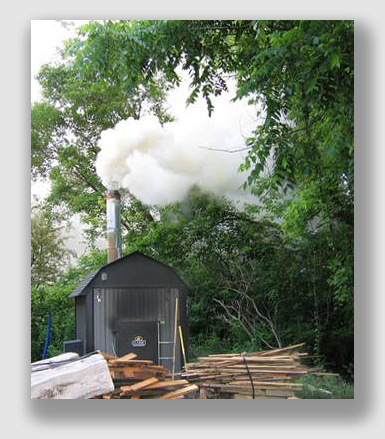
smokeB160601Choking on the enveloping smoke, the Haffners sued, alleging that the Nelsons’ and Clarks’ furnaces “generated smoke, soot, noxious fumes, and fly ash, which damaged their property, caused them physical injury, and reduced the value of their property, as well as infringed on their use and enjoyment of the land.” The Haffners asked for an injunction from the court ordering the neighbors to quench their fires, along with some money to ease their suffering.

The case should have been a dead bang winner for the Haffners. Iowa law requires that people use their own property in a manner that will not unreasonably interfere with or disturb their neighbors’ reasonable use and enjoyment of their property.” In fact, Iowa Code § 657.2 specifically defines “[t]he emission of dense smoke, noxious fumes, or fly ash in cities [as] a nuisance …”

glass-houseBut their victory went up in smoke. It turned out that the Haffners were living in a glass house, having operated their own wood furnace for 20 years. They couldn’t very well prove any damage to their property or health arising from the Nelsons’ and Clarks’ wood furnaces when they were generating smoke with their own furnace like a politician on the hustings.  The medical maladies the Haffners said were caused by the smoke existed year around, even when the furnaces were stone-cold during the summer. Other neighbors who lived nearby testified that they had not been bothered by the Clarks’ and Nelsons’ furnaces.

We know what you’re thinking: there must be a backstory here. Indeed. There was some evidence of animosity between the Haffners and their neighbors that had nothing to do with smoke.

Haffner v. Clark, 795 N.W.2d 99 (Court of Appeals, Iowa, 2010). The Haffners lived between the Clarks and the Nelsons. In about 1984, the Clarks installed a wood-burning furnace to help heat their home. The Nelsons installed an outdoor wood-burner in 2008.

The Haffners sued, alleging that smoke, soot, fumes, and fly ash infringed on their use and enjoyment of their land. The Haffners asserted claims of nuisance, negligence, assault, and trespass, and sought a court order that the Clarks and Nelsons stop using their furnaces, and for damages.

The trial court found that the furnaces were not a nuisance and that the Haffners delayed unreasonably in suing (which is to say it accepted the defense of laches and estoppel).

The Haffners appealed.

Held:  The appellate court held that the Haffners had failed to prove the neighbors’ smoke was a nuisance.

smoke160601The law of nuisance directs that “parties to use their own property in a manner that will not unreasonably interfere with or disturb their neighbors’ reasonable use and enjoyment of the neighbors’ property. A private nuisance is an actionable interference with a person’s interest in the private use and enjoyment of the person’s land.” The definition of a nuisance is “[w]hatever is injurious to health, indecent or unreasonable offensive to the senses, or an obstruction to the free use of property, so as essentially to unreasonably interfere with the comfortable enjoyment of life or property…”

The Court of Appeals observed that in determining whether an activity is a nuisance, the standard is whether normal people in the community would regard the conduct as “definitely offensive, seriously annoying or intolerable.” Under this standard, the Court agreed that smoke, odor, and other attacks to the senses could constitute serious harm. The Court admitted that saving on fossil fuels might be a societal benefit, but it was of minimal utility compared to generating foul smoke.

Nevertheless, the Haffners’ complaints did not a nuisance establish. The Haffners – who themselves had owned their own wood furnace for 20 years – were unable to present evidence proving any damage to their property or health arising from the Nelsons’ and Clarks’ wood furnaces. The medical conditions that the Haffners alleged were caused by the smoke existed year-round, even during the summer. Other witnesses living nearby testified that they had not experienced any smoke infiltration, odors, fumes, or fly ash from the Clarks’ and Nelsons’ furnaces.

The Court found it was material to its decision that the Haffners had waited 20 years before lodging any complaint with authorities, and noted in passing that there was evidence that the Haffners and their neighbors did not get along for reasons that had nothing to do with furnaces.

– Tom Root

TNLBGray

Case of the Day – Friday, March 28, 2025

I KNOW IT WHEN I HEAR IT

I don’t know how, but somehow I managed to stay awake in Constitutional Law, despite the fact that the first-year law class was right after lunch in a too-warm lecture hall. My alertness undoubtedly is why I so well recall Justice Potter Stewart’s concurring opinion in the otherwise unremarkable obscenity case Jacobellis v. Ohio.

The Justices were wrestling with how best to craft a working definition of obscenity against which to judge a triple-X movie reel confiscated from alleged porn purveyor Nico Jacobellis. Justice Potter Stewart knew better than to waste time conjuring up limitations on the meaning of “obscenity.” In his now-famous concurrence, he declared that

I shall not today attempt further to define the kinds of material I understand to be embraced within that shorthand description; and perhaps I could never succeed in intelligibly doing so. But I know it when I see it, and the motion picture involved in this case is not that.

Justice Stewart’s verbal frustration with an evanescent standard came to mind last night when I got a call from long-time reader Wendy Whist, who was being driven to distraction by the neighbor’s dogs. Wendy lives on a quiet residential street in the sleepy little Ohio town of Snoreburg. Well, it was quiet and sleepy, until neighbor Bertha Barkley acquired a pair of noisy little yapmeisters.

It may just be my perception (driven no doubt by the pair of mini-noisemakers my uncaring neighbor Ann leads past my house several times a day), but it seems to me that the smaller the dog, the more annoying the bark. That is certainly the case for Bertha’s little snack dogs: she leaves the pint-sized yappers outside all day in her fenced-in backyard. Wendy reports that the dogs bark at intruders, clouds, insects, leaves, grass, trees, the air, the moon, the sun, light, dark… you get the idea. Wendy says the cacophony is incessant.

When Wendy complained to her neighbor, Bertha – whose disdain for others makes her much more cat-like than dog-like – retorted that the dogs were in a fenced-in yard, so there was not a thing Wendy could do about the noise. When the neighbor on the other side of Bertha’s place called the police, the responding officer said that because the dogs were fenced in behind Bertha’s place, there was nothing law enforcement could do.

Wendy called me because I write about tree law. Trees have bark. Dogs bark. It’s a logical connection.

The police officer was mistaken. Like many towns, Snoreburg has an ordinance that prohibits people from “keep[ing] or harbor[ing] any animal or fowl in the Municipality which frequently create unreasonably loud and disturbing noises of such character, intensity, and duration as to disturb the peace, quiet and good order of the Municipality.” The ordinance makes the first offense a minor misdemeanor. For a second offense within two years, jail time and an order to get rid of the barking dogs (or chickens, as the case may be) may be imposed.

I suggested that the next time the nice policeman is called, point out the ordinance to him and demand politely that he go and do his best endeavor (which in this case would be to cite Bertha and her dogs).

But the whole episode set me to wondering. This blog’s approach to tree and neighbor law is much more civil and less criminal than just getting your neighbor locked up. Could Bertha’s continual and continuous barking (OK, it’s really her dogs making the noise, but it’s hard to keep Bertha’s uncivil attitude separate from her canines’ caterwauling) constitute a nuisance? Could the long-suffering Wendy sue Bertha, seeking an order requiring Bertha to abate the nuisance, which is legalese for “shut the dogs up?” Those musings reminded me of Potty Stewart wrestling with the definition of obscenity in Jacobellis. At what point does the barking cross that fuzzy line between mere irritation and legally actionable annoyance?

The court in today’s case grappled with that question. Like Justice Stewart, the panel of appellate judges eschewed drawing a bright line. Instead, they delivered the usual nuisance law mush that “the amount of annoyance or inconvenience will constitute a legal injury resulting in actual damage, being a question of degree, is dependent on varying circumstances, cannot be precisely defined, and must be left to the good sense and sound discretion of the tribunal called upon to act.”

But that being said, the appellate judges held, here the defendants’ four dogs had clearly barked themselves well over that line, indistinct though it may be. The Court of Appeals said of the nuisance that ‘they know it when they hear it, and the dogs’ barking was clearly it.’

Zang v. Engle, Case No. 00AP-290 (Ct.App. Franklin Co., Sept. 19, 2000) 2000 Ohio App. LEXIS 4222, 2000 WL 1341326. Charles Zang and his family lived next door to the Engles, who owned four dogs. Charlie testified that since they moved into their house in 1997, the dogs were outside and barked continuously. He could hear the dogs barking from inside his house, both with the windows open and closed. He described the barking in the two years prior to trial as extreme, excessive, and loud, barking that at times affected his ability to sleep, interrupted meals, and interfered with phone calls, television watching, and entertaining. Charlie, who worked from home, had to move his office from the back of his home to the front, yet he still at times heard the barking.

Ms. Zang said that it affected her ability to concentrate, it caused her to become “more stressed out” when the dogs were out and barking excessively, and it affected her mood when she entertained guests. Id. at 150-151. She has not been able to relax, and the barking has interrupted her sleep. She said, “We find that there are times when we are trying to have a normal dinner conversation and the dogs come out barking and we become so frustrated and so upset because we can’t do anything about that that we have to go and shut the windows, or we have felt on many occasions that we don’t want to necessarily be at home and that we will just leave, just to get away.”

The barking had gone on regularly over the past couple of years. Charlie kept a log of the dog barking. Entries were made almost every day from mid-December 1997, to mid-March 1999. Most days, the dogs were described as barking continuously for at least fifteen minutes up to over one hour. The remaining time the dogs were out, they barked periodically. Some of the barking occurred around 11 p.m. and 12 a.m. A lot of the barking was during the evening hours of 5 to 6 p.m. However, the logs as a whole show that the dogs were outside and barking at various times.

Charlie sued the Engles, claiming that barking dogs constituted a nuisance. The trial court agreed and ordered the Engles to abate the nuisance. The Engles appealed.

Held: The barking dogs constituted an absolute nuisance.

An absolute nuisance, for which strict liability (or liability without fault) is imposed by law, is a civil wrong arising or resulting from the invasion of a legally protected interest, and consisting of unreasonable interference with the use and enjoyment of the property of another. It is the doing of anything or the permitting of anything under one’s control or direction to be done without just cause or excuse, the necessary consequence of which interferes with or annoys another in the enjoyment of his legal rights which results in injury to another.

A private nuisance, on the other hand, involves the invasion of the private interest in the use and enjoyment of land. The law of private nuisance is a law of degree, and it generally turns on the factual question of whether the use to which the property is put is a reasonable use under the circumstances and whether there is an appreciable, substantial, tangible injury resulting in actual material and physical discomfort. What amount of annoyance or inconvenience will constitute a legal injury resulting in actual damage, being a question of degree, is dependent on varying circumstances, cannot be precisely defined, and must be left to the good sense and sound discretion of the tribunal called upon to act.

To entitle the Zangs to recover damages for a nuisance, it is not necessary that they be driven from their home or that the Engles create a positive unhealthy condition. Instead, it is enough that the Zangs’ enjoyment of life and property is rendered uncomfortable. In so determining, a trial court must look at what persons of ordinary tastes and sensibilities would regard as an inconvenience or interference materially affecting their physical comfort.

Given all of the facts, the Court held, “there was sufficient competent, credible evidence to support a finding of a private nuisance.”

The permanent injunction issued by the trial court directed in part that the Engles are “permanently enjoined and restrained from permitting any of the dogs they own or harbor, to bark in the manner described in the following paragraph, while said dogs are outside their residence… All parties understand that an infrequent bark is not what this permanent injunction is enjoining; rather, the intent of this Permanent Injunction is to restrain and enjoin the Engles’ dogs from creating an unreasonable amount of noise so as to interfere with the peace, quiet and normal enjoyment to which the Zangs are entitled in the use of their residence… The Engles are to obtain an anti-barking device for the dogs.”

The Court of Appeals held that the injunction was enforceable and proper. “The law of nuisance,” the Court held, “is a law of degree and reasonableness. It does not follow then that an injunction cannot issue which addresses the exact nuisance found to exist. Here, the nuisance is dog barking. While the amount of barking that may be found excessive cannot be measured exactly, there is sufficient evidence in the record as to dog barking that can be looked to if enforcement of the injunction is necessary.”

– Tom Root

TNLBGray140407