Case of the Day – Thursday, October 24, 2024

YOU’RE BREATHING MY AIR
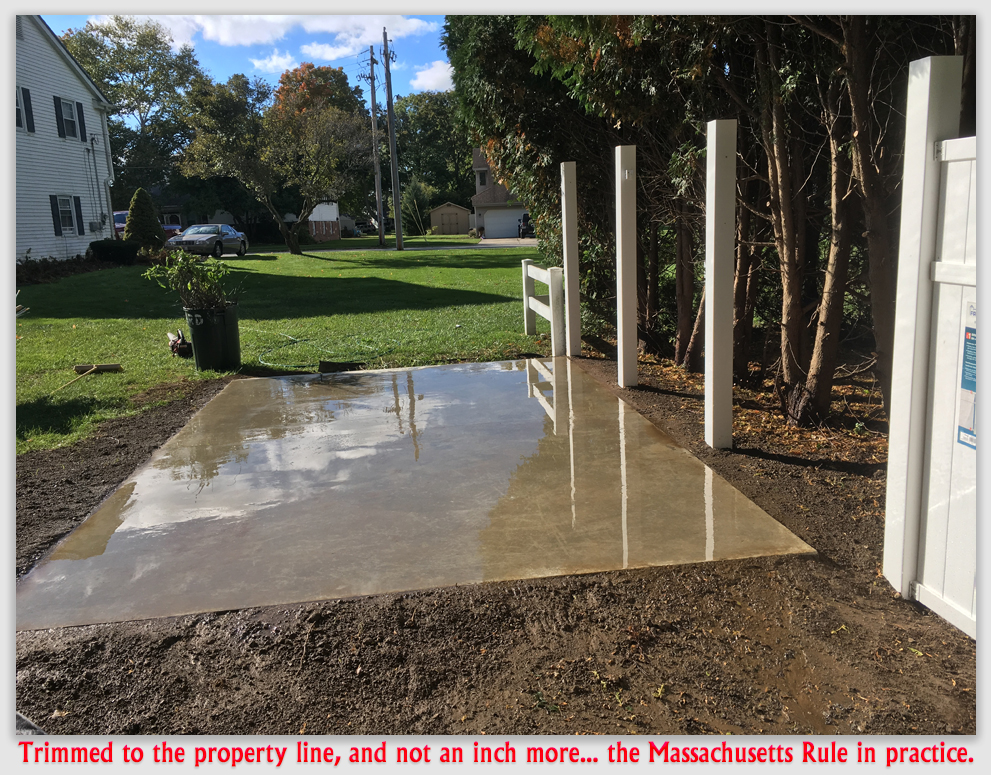
I recently undertook a home construction project (imagined and ramrodded by my wife of 45 years, of course). I found myself trimming back some gargantuan arborvitae belonging to my neighbor, whom I will call “John” because that’s his name. The arborvitae were just puny little bushes when planted by Andy and Allwyn, next-door residents two neighboring homeowners ago, but in the 25 years since they were mere shrubs planted a foot or so on John’s side of the property line, the arborvitae have grown into towering, misshapen monsters.

On my side of the property line, they have swollen well into my airspace.

My airspace? Sounds a bit pretentious, doesn’t it? But that’s what we’re really talking about when we discuss overhanging branches and limbs. We all know about adverse possession – in which a sufficiently brazen squatter can gain title to your property if he or she waits you out – and even prescriptive easements, where the same trespasser can acquire rights to use your property.

What if my neighbor had stalked out his back door last weekend and claimed his branches had been overhanging my property (and messing up the roof of my shed) for more than 21 years, giving him a prescriptive easement to my airspace? So while it’s still my air, he gets to use it. And breathe it. And there is nothing I can do about it? Whither the Massachusetts Rule?

A prescriptive easement over your neighbor’s airspace is a novel argument, indeed. Fortunately for me, if my neighbor stalks out of his backdoor, he is much more likely to confront me with a basket of zucchini or a big butternut squash than he is with a wacky airspace easement argument. He is a pretty fine neighbor.

But not everyone is blessed with a neighbor as congenial as mine. That’s lucky for me in a sense because – as the Kansas Court of Appeals observed – when neighbors cannot get along, the courts protect property rights. And when courts do that, I have something to write about. Neighbor disputes that end up in court happen frequently enough to keep me going five days a week. And there are plenty of cases I never get to.
But how about that airspace argument? In today’s case, the owner of a tree that leaned over his neighbor’s yard claimed his 75-year-old pecan tree had acquired a prescriptive easement over his neighbor’s airspace. Take that, Massachusetts Rule!

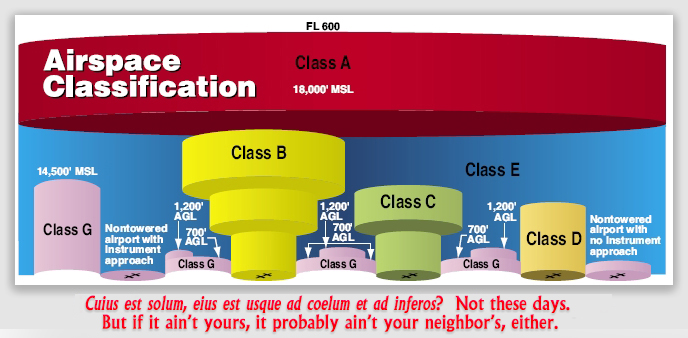
Cuius est solum, eius est usque ad coelum et ad inferos (Latin for “whoever’s is the soil, it is theirs all the way to Heaven and all the way to Hell”), a principle of property law, holds that property holders have rights to not only to the plot of land itself, but also the air above and (in the broader formulation) the ground below. (Note to self: insert here a nod of thanks to my sainted Latin teacher of yore, Emily Bernges, or else I couldn’t translate that). The principle is often referred to in its abbreviated form as the ad coelum doctrine. So was the airspace claim clever lawyering, or just a lot of hot air? Let’s see whether the Court abrogated the ad coelum doctrine or instead brought the defendant back down to earth.

Pierce v. Casady, 11 Kan.App.2d 23, 711 P.2d 766 (Kansas Ct.App. 1985). Jim Pierce and Paul Casady are adjoining landowners with a 75-year-old pecan tree between them. The pecan trunk and root flare are on Paul’s land – but only a foot from the property line – and the tree leans toward Jim’s place. In fact, according to Jim, about three-quarters of the tree overhangs his land, rather ominously, given the substantial split in the tree’s fork (which also overhangs Jim’s property).

The length of the split on one limb is four feet and on the other about two feet. If the tree fell due to the split, it would fall on Jim’s house, garage, and any cars in the driveway. Trimming the tree at the property line is not practical – unless one does not mind killing the tree in the process – because of the tree’s location and the angle at which it leans.

Jim sued for a declaratory judgment that he had the right to cut the overhanging branches back to their property line or, in the alternative, to declare the tree a nuisance to be abated by removal. Paul claimed he had acquired a prescriptive easement to Jim’s airspace. The trial court disagreed, ruling that Paul had no prescriptive right to the airspace the tree occupied and that the tree constituted a nuisance that rightly caused Jim to fear for his safety. Paul was ordered to abate the nuisance by removing the tree either at its base or at the point where it crosses plaintiffs’ property line.

Paul appealed.

Held: An easement by prescription cannot be acquired by overhanging tree branches. Furthermore, a landowner has a right to trim branches that overhang the landowner’s property even though the trunk of the tree is on a neighbor’s land, although the landowner may not go on a neighbor’s land and remove any part of a tree without the neighbor’s permission.

Trees constitute a nuisance if overhanging branches do substantial harm or the overhanging branches create an imminent danger. If a tree is a nuisance, a landowner may compel a neighbor to abate the nuisance or, if an injury occurs, look to the neighbor to pay any damages allowable by law.

The court of appeals rejected Paul’s argument that he had acquired an easement through Jim’s airspace, because such cannot be gotten by prescription, that is, by simply occupying the airspace without permission for a long enough period of time.

Jim argued that the tree could not be a nuisance. That did not affect Paul’s right to trim branches that were overhanging his property even though the trunk of the tree was on Paul’s land. The landowner may not, the Court said, go on the neighbor’s land and remove the tree or any part thereof absent his neighbor’s permission.

If the tree is a nuisance, the landowner may compel the neighbor to abate the nuisance or, if an injury occurs, look to the neighbor to pay any damages allowable by law. In this case, the Court observed, it appeared that if the tree is trimmed at the property line it would be killed. The trial court recognized this and gave Paul the option to trim back to the property line or simply remove the whole tree.

The Court held that whether the tree constituted a nuisance was a question of fact. Generally, a tree is a nuisance when it constantly drops branches and requires constant maintenance. Or, a tree is a nuisance when there is a statute so defining it. Finally, a tree becomes a nuisance when it does substantial harm or creates an immediate danger of causing harm, the Court held, relying on Whitesell v. Houlton, the case that defined the Hawaii Rule.

Kansas recognizes that trees constitute a nuisance if the overhanging branches do substantial harm or the overhanging branches create an imminent danger.
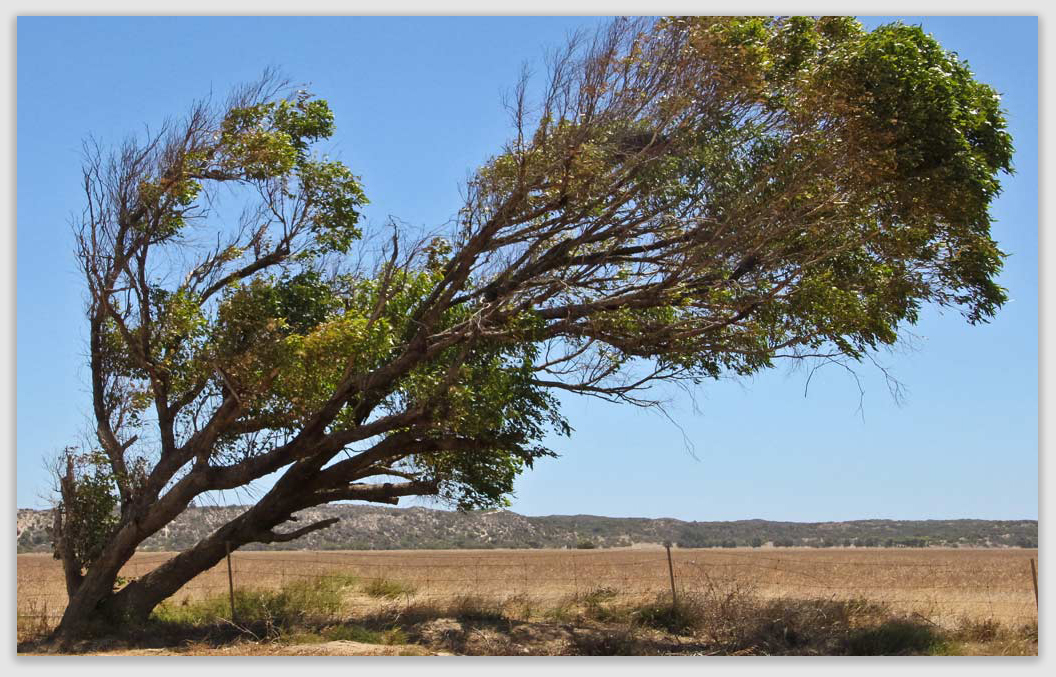
Here, the Court said, the tree was a danger to Jim, reasonably causing him to fear for his safety. The evidence supported the reasonableness of his apprehension: the split in the fork of the tree located above his property, the squeaking sound when the wind blows, the angle at which the tree leans toward Jim’s property, and the testimony of the experts.

Paul argued that the tree could be made safe by cables and bolts. The Court was unimpressed, holding that even that work would have to be done in Jim’s airspace. Paul had no right to go on Jim’s property to do that work for the same reasons Jim had no right to go on Paul’s property to trim or cut down the tree.

Paul was thus ordered to cut the tree off at the property line or remove it altogether.

The Court admitted that “the result reached here will be distasteful to all who treasure trees. The philosophy of the law is simply that whenever neighbors cannot agree, the law will protect each property owner’s rights insofar as that is possible. Any other result would cause landowners to seek self-help or to litigate each time a piece of vegetation starts to overhang their property for fear of losing the use or partial use of their property as the vegetation grows.”

– Tom Root

TNLBGray

Case of the Day -Thursday, October 10, 2024

DO YOU KNOW THE MUFFIN MAN?

the-muffin-man-07So who was it who lived on Byrum Lane-O?

No, it wasn’t the Muffin Man, but the Clarks. They had assembled several parcels of land into a pretty nice cattle spread and homestead along the Jefferson River. And they had always used Byrum Lane. The road passed across their land, across the Dwyer Place and ultimately back to some more of their land and up to their house.

Back in the 1960s, the land around the Byrums’ cow palace had been subdivided in smaller lots for homes, almost none of which (other than the Clarks’ place) had been built. Meanwhile, all the landowners and their guests used Byrum Lane, and had for a long while. The County had even maintained the road sporadically.

But then came the legal drama. When the Clarks completed their new home, the Dwyers (or maybe the Dwyers’ descendants, who were the parties to the case), told the Clarks they couldn’t use the road anymore. The Clarks sued, arguing they had a prescriptive easement. A prescriptive easement is much like adverse possession (the doctrine that lets an especially brazen and long-term trespasser gain title to your land). However, unlike adverse possession, the prescriptive easement isn’t about ownership: rather, it’s about the right to use someone else’s property. If you have used someone else’s driveway openly, notoriously, adversely, continuously and without interruption for the period of time required by statute, an easement in your favor has been created just by force of your chutzpah.

In this case, the Clarks had used Byrum Lane without permission for years, as had their predecessors, and as had just about everyone else. The County had even maintained it for a while, seemingly uncertain whether it was a public right-of-way or not. The specific issue before the Supreme Court was whether the prescriptive easement extended to the Clarks’ use of Byrum Lane to reach a house on a parcel that didn’t exist when the prescriptive easement came into being. The Court said they could. The land had been subdivided before the prescriptive easement came into being, so the Dwyers had reason to think that if an easement had come into being prescriptively, it could be used to reach one of the homes which were contemplated on the vacant lots.

private160122 Clark v. Heirs and Devisees of Dwyer, 339 Mont. 197, 170 P.3d 927 (Mont. Supreme Court, 2007). The Clarks owned real estate, which they had acquired as several tracts over a seven-year period beginning in 1979. The Dwyers owned real property that bordered a piece of the Clark land with railroad tracks acting as a visible property line. The Dwyer property was bordered on the east by a county road named “Waterloo Road” and on the north by a roadway known as “Byrum Lane.”

Byrum Lane extended from Waterloo Road, across the Dwyer property, and across the northern border of the Clarks’ property – which lay between the Dwyer land and property owned by George and Virginia Byrum – before continuing onto the Byrums’ property lying to the southwest of the Clarks’ land. In essence, Byrum Lane dissects the Clarks’ land.

The Byrums used Byrum Lane by virtue of two recorded easements in their favor. The portion of Byrum Lane crossing the Clarks’ land is a recorded 60-foot wide roadway and utility easement. The portion of Byrum Lane traveling from Waterloo Road over the Dwyer property is a road and utility easement for a 30-foot wide roadway. This portion of Byrum Lane crosses the Dwyer property from Waterloo Road for a distance of about 834 feet before reaching the Clarks’ property.

Historically, Byrum Lane was used by the Clarks and their predecessors to access the tracts the Clarks had purchased. During the period of 1979 to 1986, Byrum Lane served as the Clarks’ sole access to their house. From the period of 1986 to 1991 the Clarks used Byrum Lane to feed livestock, load hay, and move equipment. Later, after they built a new house in 1988 on one of their tracts that previously had no residence, the Clarks continuously used Byrum Lane (although they also had access to their house by way of a roadway from Waterloo Road.)

The Clarks claimed a prescriptive easement along Byrum Lane, allowing them access over the Dwyer property to their land. Following trial, the court found that Byrum Lane had been used by the public and Clarks’ predecessors since the early 1900s, had been maintained by the county road department on occasion, was generally known as a public road which the public had a right to use long before the Dwyers purchased their property, and had been used without permission by the Clarks and Byrums (as well as others) since the time the Dwyers bought their land. The Dwyers and Byrums argued that the Clarks didn’t have the right to use the road to reach a residence on a tract that hadn’t had one when the prescriptive easement came into existence.

The trial court disagreed, saying that all owners of the road were put on notice in the 1960s that the road was intended to service residences when the subdivision of the property into various tracts took place. The court concluded that the Clarks established the elements of a prescriptive easement, an open, notorious, exclusive, adverse, continuous, and uninterrupted use of the roadway for at least five years. The Dwyers appealed.

barricade160122Held: The Supreme Court upheld the trial judge. The Dwyers complained that the trial court had no business making findings about the public-use nature of the road. The Supreme Court disagreed, holding that although the action involved an alleged private easement, the public-use findings served only to give credibility to the private easement claim and had no other legal effect.

To establish a private prescriptive easement, the Court said, a party must show open, notorious, exclusive, adverse, continuous, and uninterrupted use of the easement claimed for the full statutory period of five years required by Montana Code § 70-19-404. An open and notorious use is a distinct and positive assertion of a right that is hostile to the rights of the owner and brought to the attention of the owner. Once a prescriptive easement is established, the owners of the easement are limited to the use and frequency of use that was established during the prescriptive period. If an easement is not specifically defined, it is considered to be of a size that is reasonably necessary and convenient for the purpose for which it was created, and not more. And once established, a prescriptive easement “runs with the land,” which means that the benefit or burden passes automatically to successors.

Applying these principles, the Supreme Court found that the Clarks had a prescriptive easement to use Byrum Lane. The right to use the private prescriptive roadway easement provided subdivision access extended to the Clarks’ and other tracts, lands that never had residences. The tracts were subdivided before the prescriptive easement came into being, the Court said, and the act of subdividing the tracts of land put all landowners on notice that the disputed roadway was intended to service all residences. Furthermore, the disputed roadway had been used to service parcels for several decades.

– Tom Root

 TNLBGray

Case of the Day – Tuesday, May 14, 2024

A PRESCRIPTION FOR TROUBLE

We all know about adverse possession, that peculiar legal doctrine that holds in essence that if you’re brazen enough to trespass on someone else’s land continuously for a period prescribed by statute, the property becomes yours. In most places, such as Pennsylvania, the period is 21 years long. So for 20 years, 11 months and 31 days, you’re a squatter. The next day, you’re landed gentry.

It seemed to me like judicially-sanctioned theft when I learned about adverse possession in law school (so long ago that over twice the statutory period has passed since I walked those hallowed halls). The theory, my property professor droned, was that public policy favored productive use of the land, and taking over a piece of land from an owner careless enough to let you take it over put it to more productive use,\ and thus should reward the taker. So if I like my piece of country property as a preserve for the birdies and little critters, and you want to bulldoze it for a new Starbucks, you win. The whole notion seems as cockeyed to me now as it did when I was a well-scrubbed and wide-eyed first-year law student back in the halcyon days of the 1970s.

To claim adverse possession, you have to show that your occupation of the land was open, notorious, hostile and adverse to the interest of the owner a continuous period of whatever the statute prescribes, say 21 years as an example. Some might say that if you built your Starbucks on my forest plot, and I did nothing about it for that long, I deserve to lose my land. To which I might reply that the law does not seem to offer much protection to someone when his or her property can be lost to another person simply because the thief gets away with it for long enough.

But if I thought adverse possession was screwy, I was hardly prepared for its little brother, a prescriptive easement. Adverse possession is occupation of the land. A prescriptive easement is a mere use of someone else’s land without exclusive occupation. My kids cut through the neighbor’s side yard for years as a shortcut to the church. I still do it when I’m running late. If now, 28 years after the neighbor’s house was built, he put up a fence to stop us, should we be able to claim a right to have the fence removed so that we can continue to save five minutes getting to worship? What we would have, we could argue, was a prescriptive easement.

I once had a client who was about to build a garage on a piece of his land. The power company sued, because lines that went behind his property for years had been slightly rerouted so that they crossed a corner of his place. The electric company said it had moved the lines a convenient 23 years before, and now it had a prescriptive easement, which limited my client’s use of a quarter of his property to a vegetable garden.

We stared down Reddy Kilowatt in that case, because we located an aerial photo of the town from 20 years before that showed the electric company was bluffing, and the lines had not been moved as of that date. My client sold the electric company an easement over 50 feet of backyard for about $30,000. Happy ending.

As much as I dislike the whole notion of prescriptive easements, I admire creativity. I always thought of such easements as being created by the deliberate actions of humans. My kids cut across the neighbor’s lawn. The power company restrung its lines. But the plaintiffs in today’s case showed creativity I lack. Here, they claim a prescriptive easement not because of what they did, but because of what their tree did. Because the limbs and roots of a tree they owned grew into a neighboring property and remained there for more than 21 years, they argued, they had thus obtained a prescriptive easement that would prevent the neighbor from doing anything to the tree.

It’s as if the Massachusetts Rule had an expiration date.

At first blush, it seems to ring all the prescriptive easement bells and seemed pretty doggone clever. But after thinking about the whole notion for long enough, the appeals court wisely said it simply did not make sense.

Koresko v. Farley, 844 A.2d 607 (Pa.Cmwlth. 2004). The Koreskos bought property with a line of trees on one boundary, all of which had been there for more than 21 years. The trees hang over the boundary with the neighboring property containing a house, owned by M.J. Farley Development Co. Inc. Farley had submitted a subdivision plan seeking to divide the property into two plots and build a second residence on the newly formed plot. 

The subdivision plan proposed to place a water line and driveway near the boundary trees. Upon learning of the proposal, the Koreskos sued in equity seeking injunctive relief and, of course, money damages. In their complaint, the Koreskos claimed the driveway and trench would damage the root systems of the boundary trees. Among their claims, the Koreskos alleged unreasonable interference with their prescriptive easement. They claimed that because their trees’ roots and branches encroached on the subdivided property for over 21 years, a prescriptive easement existed for the tree roots and branches, and that development of the property would unreasonably interfere with that easement; and

After the trial court held that “Pennsylvania does not and will not recognize an easement for tree roots or overhanging branches,” the Koreskos appealed.

Held: Pennsylvania will not recognize a prescriptive easement created by the growth of a tree.

A prescriptive easement is a right to use another’s property that is not inconsistent with the owner’s rights and which is acquired by a use that is open, notorious, and uninterrupted for a period of 21 years. A prescriptive easement, once acquired, may not be restricted unreasonably by the possessor of the land subject to the easement.

The law holds that overhanging tree branches are a trespass. In Pennsylvania, a landowner has the right either to compel the removal of overhanging branches or to engage in self-help. However, the Restatement notes that a continuing trespass is not a trespass at all if the actor causing the trespass has obtained an easement by adverse possession, and ponders openly whether the continued presence of encroaching tree branches, held openly, notoriously, hostilely, and continually for 21 years would create a prescriptive easement in the airspace which they hang.

If this were the case, the Court said – noting it could find no Pennsylvania law which would indicate that a prescriptive easement was not available in this situation – a landowner who suffers actual harm for the first time during the tree owner’s 22nd year of hostile ownership would be precluded from seeking any remedy whatsoever, even self-help. However, the Court said, if an action is available without a showing of damage – and a trespass action assumes damages, so it can be brought whether the trespasser has actually injured the victim’s property or not – the landowner has no reason to complain if a neighbor’s tree causes damage after the prescriptive period has run because he or she could have sued at any time during the 21-year period.

The Court held the Koreskos failed to state a claim for prescriptive easement as a matter of law. No Pennsylvania case has held such easements are cognizable, the Court said, and other jurisdictions have reasoned that such should not be recognized. Finally, the potential of widespread uncertainty occasioned by such easements convinced the Court that they should not be recognized as a matter of public policy.

The Restatement holds that to be adverse, a use must be open and notorious, for the protection of those against whom it is claimed to be adverse. It enables them to protect themselves against the effect of the use by preventing its continuance. This requirement may be satisfied by a showing that either the landowner against whom the use is claimed has actual knowledge of the use or has had a reasonable opportunity to learn of its existence.

Encroaching tree parts, the Court held, by themselves do not establish “open and notorious” use of the land. Neither roots below the ground nor branches above the ground fairly notify an owner of a neighbor’s claim for use at the surface. In the absence of additional circumstances, roots and branches alone do not alert an owner that his or her exclusive dominion of the ground is challenged. This is no different from prior legal decisions that already held that the known presence of windows near a lot line does not create a prescriptive easement for light and air.

In a Kansas decision, an appeals court in the Sunflower State held that an easement by prescription cannot be acquired by overhanging tree branches, said:

The result reached here will be distasteful to all who treasure trees. The philosophy of the law is simply that whenever neighbors cannot agree, the law will protect each owner’s rights insofar as that is possible. Any other result would cause landowners to seek self-help or to litigate each time a piece of vegetation starts to overhang their property for fear of losing the use or partial use of their property as the vegetation grows.

The Koresko Court said, “We agree with this reasoning and holding… and we expressly adopt it in Pennsylvania.”

Finally, the Court considered the consequences of the holding urged by Koreskos. Trees growing over property boundaries and streets, around utility lines, and under sidewalks are common in Pennsylvania. “A decision suggesting that the prolonged presence of these tree parts assures their unreduced continuation could cause uncertainty,” the Court held. “Both the extent of the prescriptive easement and its effect on public and private use are problematic. As a matter of sound public policy, we decline to recognize a new estate which offers uncertainty and invites clarification through litigation.”

– Tom Root

TNLBGray