Case of the Day – Friday, January 30, 2026

“YO-YO” MA

Don’t ever let your local attorney pull an abscessed tooth. And do not let your dentist practice law.

Dr. Ma needed a new office after he lost his lease to redevelopment. He found a vacant dentist’s office next to a vacant church. The empty dental abattoir was run down and needed work, but otherwise it was perfect. Dr. Ma signed a purchase agreement which expressly advised him not to rely on anything the seller or his broker said, but instead to hire his own consultants to check the place out stem to stern.

But Dr. Ma was a dentist. According to an old ad campaign for Aspen Dental, dentists can fix stalled cars, stop bank robbers in their tracks, free people trapped on an elevator… all sorts of stuff. Sort of like MacGyver with a mouth mirror. Dr. Ma didn’t need any other licensed professionals to check the property out. He could handle it. He was, after all, a dental professional.

Dr. Ma would never miss a cavity. But he did miss the fact that the property’s fenced side yard, which was the only access to the shed in which he had installed the air compressor that ran all of his dentist stuff, was really not his at all. Instead, almost all of it was part of the church. In fact, the 6-foot fence that enclosed the side yard was 3½ feet onto the church land.

A few months and countless fillings later, Dr. Ma got a letter from the church property owner, saying Grace Chinese Alliance Church wanted to buy the church property, but a survey showed Dr. Ma’s shed and fence were on church land. Dr. Ma should have referred the matter to legal counsel right then, but (did I already say this?) he was a dentist. A trained professional. He had this covered, too. The good doctor wrote back, saying, “No problem.” The church property owner could remove the fence whenever it needed to. Based on this answer, Grace bought the vacant church.

However, eight months later, when the Grace Church elders were ready to have the fence moved back to the real property line, Dr. Ma told them to go floss. He informed them that they could not move the fence, and if they tried, he would give them a root canal without novocaine. Or call the police. Or both.

First, Dr. Ma said, “Yes.” Then he said. “No.” Yes and no, up and down… Kind of like a yo-yo. “Yo-yo” Ma, it seemed.

The Church was not about to turn the other cheek. It sued, and Dr. Ma, who by now had a lawyer, claimed he had a prescriptive easement.

Everyone is familiar with adverse possession. If you squat on someone else’s land long enough without their permission, the property may become yours. A prescriptive easement is the easement version of that, a right to use a portion of someone else’s property gained by brazenly using it without permission for a sufficient period of time. If a claimant uses a property owner’s driveway without permission to reach the claimant’s back lot and does it openly, regularly and continuously for long enough, the claimant gets a prescriptive easement. It does not prevent the property owner from using his own driveway; rather, it just lets the claimant use it, too.

To establish a right to a prescriptive easement in California, a claimant must prove use of the property in question for five years.* The use has to be (1) open and notorious; (2) continuous and uninterrupted; (3) hostile to the true owner; and (4) under claim of right. Even where all of these elements are met, “when a claimant cannot satisfy the requirements for adverse possession, the claimant may not receive a prescriptive easement which extends so far that it becomes the equivalent of a fee interest and dispossesses the record title owners of part of their property.”

A true prescriptive easement does not deprive the property owner of the right to use the affected property, but rather just limits that use in favor of whatever rights the claimant has established. Dr. Ma argued he had a prescriptive easement, but his failure to determine the boundaries of his own property when he should have and his promise to let the Church move the fence when it needed to didn’t help him make his case. The real problem, however, was that Dr. Ma wanted exclusive use of the disputed property, and if he got that, it would deny Grace Church the ability to use the disputed property at all and would frustrate Grace’s intended use of the vacant chapel as its place of worship.

That dentist-as-MacGyver ad campaign we mentioned promises a “different kind of dentist.” Dr. Ma should have been a different kind of dentist: the kind who uses surveyors and lawyers early enough that these sorts of problems don’t happen.

Grace Chinese Alliance Church of the Christian and Missionary Alliance of West Covina v. Lin Ma DDS, Inc., Case No. B272415 (Ct. App. California, Second Appellate District, Jan. 25, 2018), 2018 Cal. App. Unpub. LEXIS 511

In 2010, Dr. Ma was looking for a commercial property to which to relocate his dental practice. The property at issue in this case, the Hayden property, had been used as a dental office at one time, but it was vacant and in disrepair.

Dr. Ma met with Hayden’s real estate agent to look at the property. One of Dr. Ma’s concerns was having a place to locate the air compressor used to power his tools. He discovered that the property had a compressor room, accessible only from the outside from a yard along the side of the building, adjacent to the property owned by Grace Chinese Alliance Church. The side yard was completely fenced in; it was about six feet wide from the building to the fence.

Dr. Ma entered into an agreement to purchase the Hayden property. The standard form agreement included provisions allowing Ma 30 days to obtain a survey of the property; acknowledging that Ma was buying the property in its existing condition and that no representations, inducements, promises, agreements, or assurances concerning the property had been made by the seller or his broker, and advising Ma to retain his own consultants to investigate the property. In addition to these standard provisions, the parties added several other provisions, including that “Seller and Buyer have agreed that there will be no credits given to Buyer with regard to the condition and the size of the property”; and “Seller and Buyer acknowledge that Broker has made no representations or warranties regarding the physical condition of the property. Seller and Buyer are relying on their own independent investigation in making or accepting this Agreement.”

After closing, Dr. Ma moved his dental practice into the Hayden property. A few months later, he received a letter from a lawyer for Grace Church, who said the Church property was subject to a sale escrow, and that a boundary survey conducted in connection with the sale showed that a fence and shed along Hayden’s east property line was encroaching into the Church property by about 3½ feet along nearly the entire length of the boundary between the two properties. The letter asked Dr. Ma to agree that the encroachment could be removed, and Ma replied, “We have no problem with whatever you want to do with the fence as long as it is on your property. Please let us know your future plans if the fence is removed, so that we can prepare for any security issues to our office related to this.” In reliance upon Dr. Ma’s friendly response, the Church completed the purchase of the Church property and began renovations.

Eight months later, Grace Church’s pastor wrote to Dr. Ma, telling him that for the Church to comply with City parking lot codes, it had to move the fence to the correct property line and tear out a piece of the encroaching shed. That required the Church to repave the entire parking area. The Church offered Ma $500 to help him defray the costs of compliance.

This time, getting Dr. Ma’s cooperation was like pulling teeth. He wrote back, telling the Church its survey was both unrecorded and bogus. The Church recorded the survey, but Dr. Ma continued to argue. He said the fence had been in its current location when he purchased the Hayden property, and that he had spent more than $50,000 improving the side yard where the encroachment existed. He said his possession and improvement of the property had been open and continuous, and that, therefore, the disputed property was his, or, if not, he at least had an easement by prescription. He threatened to call the cops if the Church tried to remove the fence.

The Church sued Ma to quiet title and get his fence and shed off of its land. Dr. Ma counterclaimed, saying he had a prescriptive easement to use the disputed 3½ feet, or at least an equitable easement. The trial record showed the fence was 6 feet tall, with locked gates on both ends and that the Church did not have access to its property on the other side of the fence. The Church needed to move the fence in order to use the property behind it to comply with certain parking lot requirements for the Church’s conditional use permit. The trial court ruled against the dentist, and Dr. Ma appealed.

To establish a right to a prescriptive easement in California, a claimant must prove use of the property in question for five years.* The use has to be (1) open and notorious; (2) continuous and uninterrupted; (3) hostile to the true owner; and (4) under claim of right. Even where all of these elements are met, “when a claimant cannot satisfy the requirements for adverse possession, the claimant may not receive a prescriptive easement which extends so far that it becomes the equivalent of a fee interest and dispossesses the record title owners of part of their property.”

The problem here is that a true prescriptive easement does not deprive the property owner of the right to use the affected property, but rather just limits that use in favor of whatever rights the claimant has established. If a claimant uses a property owner’s driveway without permission to reach the claimant’s back lot and does it openly, regularly and continuously for long enough, the claimant gets a prescriptive easement. It does not prevent the property owner from using his own driveway: rather, it just lets the claimant use it, too.

Here, if Dr. Ma got a prescriptive easement to use the disputed property, the Church could not use it at all. The fence prevented the Church from getting a permit to build a parking lot. Without a parking lot, Grace could not conduct services for its parishioners. Not only could Grace Church not use the disputed area behind the fence along with Dr. Ma, but its whole intended use of the church property would be frustrated.

The trial court found that Dr. Ma could not be granted a prescriptive easement because to do so would deny the Church of all of its rights to use the property. Thus, even if the court erred in finding that DDS failed to establish that its use of the disputed property was hostile, the court’s denial of the prescriptive easement was proper. The Court of Appeals agreed that in some circumstances, a court could find an exclusive prescriptive easement to be justified. “But those circumstances are very limited, and involve instances where the easement was necessary to allow a utility to provide an essential service, such as water or electricity, or to protect the health and safety of the public.”

The Court of Appeals was probably influenced by the fact that Grace Church only bought the property because of Dr. Ma’s letter saying that the fence could be moved to the correct position. It did not help that, after Dr. Ma told Grace Church he did not believe its survey, all of Ma’s own surveys showed Grace was right. It also did not help that testimony showed the dentist had tried to make a secret deal with the seller to cut out the broker’s fee, or that Dr. Ma tried to get the judge removed from the case on a spurious claim of bias. Whatever else happened, Dr. Ma did not come out of the trial looking entitled to equity, and things did not improve on appeal.

Unsurprisingly, with regard to Dr. Ma’s request for an equitable easement, the court found the equities did not weigh much in his favor. It noted that, on the one hand, the Church was unable to function as it wanted to function because it could not complete its parking lot as required for its conditional use permit without access to the disputed property; on the other hand, Dr. Ma could not show he would suffer any comparable hardship, even if he had to move the compressor or any other equipment from the shed as a result of the fence being shifted to the correct property line.

The Court of Appeals agreed. In order to be awarded an equitable easement, a claimant must be innocent. “That is, his or her encroachment must not be willful or negligent. The court should consider the parties’ conduct to determine who is responsible for the dispute. Second, unless the rights of the public would be harmed, the court should grant the injunction if the plaintiff ‘will suffer irreparable injury… regardless of the injury to defendant.’ Third, the hardship to the defendant from granting the injunction ‘must be greatly disproportionate to the hardship caused plaintiff by the continuance of the encroachment, and this fact must clearly appear in the evidence and must be proved by the defendant.”

The trial court found that the Church would be irreparably injured if an easement were granted because it would be unable to function as it wanted to function. It also found that Dr. Ma failed to show he would suffer hardship if the easement were denied that would compare to the hardship suffered by the Church if the easement were granted. Because Dr. Ma did not even try to show those findings were unsupported by the record, the Court of Appeals denied his request for an equitable easement.

* The length of time needed for an adverse possession or prescriptive easement varies from state to state. California’s 5-year period is actually much shorter than virtually all other states. Talk to a local lawyer.

– Tom Root

TNLBGray140407

Case of the Day – Friday, September 26, 2025

THE LAW OF UNINTENDED CONSEQUENCES – PART 2

I had a secretary once, a delightful country girl who careened from being sharp as a tack to dumb as a stump. One of her expressions, when she would be nattering on about something for what seemed to be hours on end, was, “Never mind me. I’m just talking out loud.”

Courts are constantly getting in trouble for “talking out loud,” saying more in a decision than is necessary. When an opinion, aside, observation or frolic unnecessary to the decision is included in an opinion, it is known as obiter dictum, Latin for “by the way.” Obiter dictum is a concept derived from English common law, wherein a judgment is comprised of only two elements: ratio decidendi and obiter dicta.

One of the early lessons law students learn in their first year is that for the purposes of judicial precedent, ratio decidendi (which means the rule of law on which a decision is based) is the only part of the decision that is binding. Any statement that is obiter dictum is persuasive only.

By the way, lawyers usually call obiter dictumdictum” for short. If there is more than one piece of dictum in a case, they are pluralized as “dicta.” (That previous “by the way” – in itself a perfect example of dictum – comes to you courtesy of my late and beloved Latin instructor, the incomparable Emily Bernges of Sturgis, Michigan. I had her a half-century ago, but in the firmament of unforgettable teachers, she is the brightest star).

Now to brush up on a little law: if I trespass on your land, you can sue to have me ejected. If you do nothing, and suffer my trespass and bad manners for long enough (usually 21 continuous years, but this can vary by state), I can sue you to quiet title, and the land becomes mine by adverse possession.

Now, instead of squatting on your place, I string a power line across a corner of it. You don’t give me permission, but again, you suffer in silence. It is not adverse possession, because you could continue to use the land under the power line. It’s just that I have taken the right to use your property without your permission, but in a way that is not inconsistent with your rights. If I maintain my power line for 21 consecutive years (at least in Pennsylvania, although different states specify different terms of years), I have not acquired ownership of the land, but I have acquired a prescriptive easement. A prescriptive easement, once acquired, may not be restricted unreasonably by the possessor of the land subject to the easement.

So that’s the progression. If I use your real estate without permission, I am a trespasser. If I remain a trespasser openly and continuously for a long enough period, I either wrest ownership of the land from you or, at the very least, obtain the right to an easement that you cannot revoke.

As we saw in yesterday’s case, Jones v. Wagner, a Pennsylvania court addressed encroaching tree branches and roots. This is unsurprising. Forty-nine other states have followed suit. But where everyone else is content with the Massachusetts Rule or the Hawaii Rule, the Virginia Rule or some amalgam of the three, the Pennsylvania court boldly went where no court had gone before. It decided that the owner of the encroaching trees became a trespasser when the branches overhung or the roots entered the subsurface. Such a holding was as contrary to common sense as it was unnecessary: trees grow, their owner does not control the growth, and simple rules allocating cost and responsibility work for everyone else with the need to resort to pounding the round peg of trespass into the square hole of encroachment.

But the Pennsylvania court did just that. And the holding begs the question: if a tree can trespass (or, more to the point, if the owner of a tree is a trespasser because of how the tree grows), might the owner also acquire a prescriptive easement if the encroachment persists long enough?

And here came the dictum. After foolishly applying trespass to tree encroachment, the Jones v. Wagner opinion speculates whether prescriptive easements could be acquired by tree trespass. That was not an issue in the case. It was pure dictum, talking out loud. But it did not take too long for another party to take the Jones v. Wagner idle musings and run with them.

Koresko v. Farley, 844 A.2d 607 (Commonwealth Ct. Pa. 2004). John and Bonnie Koresko bought a piece of property in Tredyffrin Township in 1986. Several trees, over 21 years old (which is important), grew on their property very near one property line. Branches hang over the boundary with the neighboring property.

That land was owned by Ollie Bower, who sold it to a developer in 1999. The developer wanted to subdivide the property into two lots and build two houses. The subdivision plan proposed the installation of a water line and the construction of a driveway near the boundary trees. Upon learning of the proposal, the Koreskos sued, seeking injunctive relief and money damages. The Koreskos claimed unreasonable interference with an easement. Specifically, they alleged that because their trees’ roots and branches encroached on the subdivided property for over 21 years, a prescriptive easement existed for the tree roots and branches. They assert that the development of the property would unreasonably interfere with that easement.

The trial court rejected the Koreskos’ claim, holding that “Pennsylvania does not and will not recognize an easement for tree roots or overhanging branches.”

The Koreskos appealed.

Held: Encroaching branches and roots cannot create a prescriptive easement.

A prescriptive easement is a right to use another person’s property that is not inconsistent with the owner’s rights and which is acquired by a use that is open, notorious, and uninterrupted for at least 21 years. A prescriptive easement, once acquired, may not be restricted unreasonably by the possessor of the land subject to the easement.

In Jones v. Wagner, a Pennsylvania Superior Court held that overhanging tree branches constitute a trespass. A landowner has the right to compel his or her neighbor to remove of overhanging branches, or the landowner may use self-help to cut the branches back himself or herself.

In discussing the appropriateness of self-help, the Wagner Court mused in a note:

An adverse possession action can often devolve into a pissing contest …

The Restatement notes that a continuing trespass is not a trespass at all if the actor causing the trespass has obtained an easement by adverse possession. Restatement (Second) of Torts § 161, comment d. We cannot help but wonder whether the continued presence of encroaching tree branches, held openly, notoriously, hostilely, and continually for 21 years would create a prescriptive easement in the airspace which they hang. If this would be the case, and we can find no Pennsylvania law which would indicate that a prescriptive easement is not available in this situation, a landowner who suffers actual harm for the first time during the tree owner’s twenty-second year of hostile ownership, might very well be precluded from seeking a judicial, or even self-help, remedy. This result, while not entirely unforeseeable, is anomalous. However, if an action is available without a showing of damage, the landowner has no reason to complain if a neighbor’s tree causes damage after the prescriptive period has run.

Citing this language, the Koreskis argued that their amended complaint sufficiently pleads a cause of action for unreasonable interference with a prescriptive easement. In contrast, the developer argued the Koreskis had not shown that such an easement existed. Specifically, the developer claimed, the encroachment of the tree roots and branches is not “open and notorious” conduct sufficient to create an easement.

The Commonwealth Court ruled that the Koreskis had failed to state a claim for prescriptive easement as a matter of law, for several reasons. First, encroaching tree roots and limbs by themselves cannot notify a landowner of a claim to use the ground. Second, Pennsylvania has never recognized the existence of such an easement. Third, the Court said, “well-reasoned authority from another jurisdiction persuades us that such easements should not be recognized.” Finally, the potential of widespread uncertainty such easements would cause “convinces us that they should not be recognized as a matter of public policy.”

“The requirement that, to be adverse, a use must be open and notorious is for the protection of those against whom it is claimed to be adverse,” according to Restatement of Property, Servitudes § 458, comment h. The requirement enables owners to protect themselves against the effect of the use by preventing its continuance.” To prove that an adverse use is ‘open and notorious,’ a claimant may show that either the landowner against whom the use is claimed has actual knowledge of the use or has had a reasonable opportunity to learn of its existence.

But encroaching tree parts, by themselves, do not establish “open and notorious” use of the land. Neither roots below ground nor branches above ground fairly notify an owner of a claim for use at the surface, the Court said. In the absence of additional circumstances, such as the use of the ground for maintenance or collection of leaves or fruit, roots and branches alone do not alert an owner that his exclusive dominion of the ground is challenged.

The philosophy of the law is that whenever neighbors cannot agree, the law will protect each owner’s rights to the extent possible. Any other result would cause landowners to seek self-help or litigate each time a piece of vegetation starts to overhang their property, fearing the loss of use or partial use of their property as the vegetation grows.

Finally, the Court said, “We consider the consequences of the holding urged by the Koreskis here. Judicial notice can be taken that trees growing over property boundaries and streets, around utility lines, and under [sidewalks are common in Pennsylvania]. A decision suggesting that the prolonged presence of these tree parts assures their unreduced continuation could cause uncertainty. Both the extent of the prescriptive easement and its effect on public and private use are problematic. As a matter of sound public policy, we decline to recognize a new estate which offers uncertainty and invites clarification through litigation.”

– Tom Root

TNLBGray

Case of the Day – Thursday, July 31, 2025

A SLOPPY AND LAZY TRIAL JUDGE

You have to appreciate the careful prose of an appellate court. Today’s case was brought in 1999, but was still sputtering along eight years later. The Rhode Island Supreme Court thought it knew why.

Never-ending litigation ... Rhode Island style

Never-ending litigation … Rhode Island style …

After a few pointed comparisons of the case to Jarndyce v. Jarndyce, the Rhode Island Supreme Court asked the trial court what the Dickens was going on. The trial judge took his dear sweet time writing a decision — about five years — leading the Supreme Court to mention in a note, “We are mindful of the inordinate delay of the decision of the trial justice, which this Court does not favor.”

Beautiful understatement! The Supremes were saying to the trial judge, “Hey, dude, you’re lazy!” Of course, in the decision, the high court also implicitly said, “Hey, dude, you’re incompetent, too.” The reason for that was the trial judge’s failure to make the findings the Supreme Court needed to adequately review the decision.

A court speaks through its opinions, and when the trial court doesn’t make findings of fact, no one wins. The winner doesn’t know why he won, the loser doesn’t know why he lost, and the rest of us can’t derive any useful guidance from the case. In this case, an unusual argument arose in the battle over the location of an easement. The easement holder claimed the prior owner had obstructed the easement — a driveway — and demanded that the easement and everything on it be shifted a few feet to the south. This is called an easement by substitution. Some testimony suggested that an easement by substitution had been created. But the trial court couldn’t be bothered to make any findings on the issue, leaving everyone to puzzle whether something hadn’t been proven, some witness hadn’t been believed, or just what?

Perhaps a little burninating in the Ocean State?

Perhaps a little burninating of indolent trial judges was called for in the Ocean State?

So after eight years, the case landed back in the trial court’s lap. Maybe the judge was waiting for the owners to tire of it all and settle, or to die or move to Florida… or for Rhode Island to be swallowed by the rising seas, or be consumed by an angry dragon… anything that would spare this poor trial judge from having to do his duty.

Nardone v. Ritacco, 936 A.2d 200 (Sup.Ct. R.I., Dec. 3, 2007). Nardone’s property bordered Lawton Foster Road. Ritacco owned an adjacent parcel of land behind Nardone’s property, with no frontage on Lawton Foster Road. In 1965, Nardone’s predecessor-in-interest, Ralph C. James, Sr., granted Ritacco a 50-foot right-of-way along the northern boundary line of what is now Nardone’s property. The right-of-way for ingress from and egress to Lawton Foster Road has been the subject of many years of litigation.

On Memorial Day 1999, Ritacco cut trees and vegetation within the right-of-way. Nardone sued for temporary and permanent injunctive relief to prohibit Ritacco from cutting the trees and from trespassing on Nardone’s land. The trial court entered a preliminary injunction and later found Ritacco in contempt of the order by cutting trees and vegetation outside the right-of-way. A key issue was the location of the right-of-way. In addition to arguing that the right-of-way was not originally located along the northern boundary of Nardone’s property but rather inside the boundaries of the land, Ritacco also asserted two alternative claims for relief: the existence of an easement by prescription as well as an easement by substitution over plaintiffs’ driveway. The trial court decided for Nardone, clarifying that the right-of-way was located along the northern boundary of Nardone’s property. Nardone appealed.

Held: A remand was necessary to determine whether Rotacco had acquired an easement by prescription or by substitution over Nardone’s driveway. The Supreme Court held that the trial court had properly found that the right-of-way over Nardone’s land was located on the northern boundary of the land. The deed itself placed right-of-way “along the northerly boundary line” of the premises, and Nardone’s expert witness testified that, upon examining the property, the boundaries were clear and the right-of-way was located along the northern boundary of the property. Ritacco’s expert had said that the deeds were not clear, but he hadn’t inspected the property itself, and the trial court’s discounting of his testimony was therefore reasonable.

Does this pass for judicial garb in Rhode Island?

Does this pass for judicial garb in Rhode Island?

However, Ritacco had also claimed that he had acquired an easement on land inside the Nardone boundaries by prescriptive easement. The trial court had ruled against him without a trial, but the Supreme Court ordered a remand for trial on the issues. The Supreme Court held that the trial court hadn’t addressed the issue of Ritacco’s permissive use of the driveway, let alone determine whether sufficient factual support existed to conclude that permission to use the driveway was given by Nardone or his predecessors-in-interest. A party who claims an easement by prescription bears the burden of establishing by clear and convincing evidence actual, open, notorious, hostile, and continuous use under a claim of right for at least ten years. In this case, the Court ruled, the trial judge had failed to make the specific findings of fact upon which he based his decision. When that happens, the trial court risks reversal or remand unless the record yields a full understanding and resolution of the controlling and essential factual and legal issues.

Here, there were unaddressed issues that were raised in pleadings and testified to at trial, including Ritacco’s testimony that perhaps Nardone’s predecessor-in-interest had granted him an easement by substitution. When the owner of a servient estate encloses the original easement with a wall or other structure and points out another way of ingress and egress that is accepted by the owner of the dominant estate, the new way may become the easement by substitution. The Supreme Court said that testimony indicated that James may have granted Ritacco an easement by substitution. However, the trial court failed to determine whether sufficient factual support existed to conclude that an easement by substitution was granted.

– Tom Root

Case of the Day – Thursday, June 5, 2025

SIGNS? WE DON’T NEED NO STINKIN’ SIGNS

truck141121The Andersons were livin’ large in the (very) flatlands of far north Minnesota … at least until the swampland next to theirs got sold to the State.

The Minnesota DNR built the Halma Swampland Wildlife Management Area for tourists from down south. You know, just a place to watch birds, hunt deer and bear, and be drilled by mosquitoes the size of floatplanes.

If that wasn’t bad enough, the State then put up signs to stop visitors, including the neighboring Andersons, from racing their ATVs, cars, and pickups up and down the wildlife trails. A year later, the State fenced off the boundaries, right across one of the trails.

Sadly, the Andersons’ raison d’être – a Minnesota term meaning “it’s what we live for” – for living next to the swamp was to race their ATVs, cars, and pickups up and down the wildlife trails. So they hired one of them fancy-pants city slickers with an armful of lawbooks. He told the Anderson clan that they had a prescriptive easement, that is, a right to run their pickups and cars up and down the WMA trails, because they had done it for so long.

The State unsurprisingly took a dim view of the Andersons’ activities, arguing that the recreational use statutes — not to mention Minnesota’s policy of encouraging private recreational use of land (but probably not pickup trucks being driven up and down trails) — meant that no one could acquire a prescriptive easement on recreational lands.

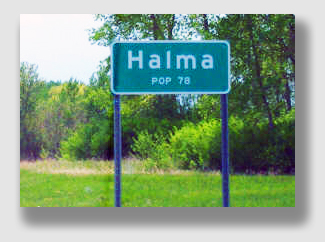
There are only 78 people in Halma - so if you don't drive your pickup through the swamp muck, there's not a lot to do.

There are only 78 people in Halma – so if you don’t drive your pickup through the swamp muck, there’s not a lot to do.

The Court had to balance competing interests here. Although one might expect that the judiciary would bend over backward in favor of a state-run recreational area, it played the case right down the middle. The Andersons won their prescriptive easements, but the court held the easements were not transferable, and they would expire on the deaths of the particular Andersons named in the suit.

Anderson v. State, 2007 Minn. App. Unpub. LEXIS 911, 2007 WL 2472359 (Minn. App. Sept. 4, 2007). Since the 1930s, the Andersons had owned a piece of land next to property now owned by the State of Minnesota. The state bought its parcel from a private owner in 1989 and created the Halma Swamp Wildlife Management Area. The WMA is managed by the Department of Natural Resources.

The DNR put up signs prohibiting motorized vehicles on the property and installed fences across a trail where it entered the WMA. Because the Andersons had used the trails on what was now state land for more than 60 years, often driving cars, pick-up trucks, and all-terrain vehicles on them, they sued the state, claiming a prescriptive easement. The trial court found the Andersons had a prescriptive easement by motor vehicle over five trail segments in a section of the WMA. The court held that the right is not assignable and will terminate with the lives of the named Andersons. The state appealed.

solomonic141121Held: The Andersons had a right to the prescriptive easement. The Court described an easement as an interest in land in the possession of another which entitles the easement owner to a limited use or use of the land in which the interest exists. Whether a prescriptive easement exists is determined in a manner similar to title by adverse possession.

A prescriptive easement may be found if the person claiming the easement has acted in a manner “hostile and under a claim of right, actual, open, continuous, and exclusive.” Adverse possession may be maintained by “tacking,” when the current adverse possessor obtained the property through transfer or descent from a prior adverse possessor. The state argued that the trial court erred by granting an easement to the Andersons when Minnesota law encouraged landowners to permit public recreation on their land and purported to protect landowners from claims arising from such recreational use. The trial court was not unsympathetic to the argument, but because the recreational-use statute was passed in 1994, it applied only to causes of action arising on or after that time.

The Court of Appeals agreed, noting that while Minnesota encouraged public use of lands and waters for beneficial recreational purposes since 1961, only in 1994 was the law changed to prohibit the creation of adverse easements on private recreational lands. The Andersons had used the property and trails beginning in the 1930s, and use continued uninterrupted until 2002, when the DNR installed signs, and 2003, when the DNR erected a fence across a trail. The evidence showed that the Andersons’ adverse use of the trails extended for 15 or more years before the state’s ownership of the land.

goodtimes141121The state argued, however, that the trial court erred by concluding that the Andersons had established a prescriptive easement because, since recreational use is encouraged by Minnesota law, the element of hostility could not be shown. What’s more, the state contended, the district court erred by determining that respondents’ adverse use of the WMA was visible.

The Court held there was ample evidence that the Andersons developed and used the trails, and it has long been recognized in Minnesota that a person who purchases land with the knowledge or with actual, constructive, or implied notice that it is burdened with an easement in favor of other property ordinarily takes the estate subject to the easement. There is no dispute that there were existing trails when the state bought the land in 1989. That fact was sufficient to sustain the trial court’s findings.

A dissenting judge said the Andersons’ use of the land was permitted by statute and state policy, and was neither inconsistent with the rights of the property owners nor hostile. Because the Andersons’ use was not hostile, he reasoned, they had not obtained a prescriptive easement. As we all know, the dissenting opinion is the losing jurist’s lament (if not whine), and – while sometimes interesting and often scathing – doesn’t really count.

– Tom Root

TNLBGray140407

Case of the Day – Friday, December 27, 2024

RUNAWAY TRAIN NEVER GOING BACK …

crash150303Mr. Elder drove his dump truck onto the Union Pacific tracks in Nephi, Utah — a town, not a soft drink — where he was promptly hit by what the Utah Supreme Court described as a “ninety-one car train.” It’s unlikely 78 cars or 23 cars or even just a set of GE diesel-electric locomotives would have caused a less deadly result.

Mr. Elder was killed, and his widow set off trying to find someone to pay for it. She sued Union Pacific and the City, suggesting that someone should have trimmed the trees near the tracks so her husband could have seen the train. The UP, which was quite adept in its own right in blaming others for grade-crossing mishaps, had a great excuse: the railroad didn’t own the offending trees to begin with.

It seems that no one ever remembered to give the Union Pacific title to its right-of-way, due to — what else? — a federal government screw-up back in the 19th century. It almost makes you wish Uncle Sam had shut down again However, the ever-resourceful Mrs. Elder argued, the Railroad had acquired all of the land under and around the tracks by prescriptive easement. She was thus in the unusual position of arguing in the lawsuit that UP was entitled to own a big piece of land on which it had been squatting for a hundred years — and was therefore liable for not keeping up the land it had never claimed to own — all at the same time.

Pretty creative lawyering! But the Utah Supreme Court held Mrs. Elder had no standing to claim the UP’s prescriptive easement on its behalf, probably because the Court suspected she didn’t have the Railroad’s best interests at heart. Imagine! As for the City, the Court agreed it had no duty under any statute to trim the trees, but it did observe the City did have a common law duty to Mr. Elder. The case was sent back to figure out whether that duty required it to trim the trees obscuring the crossing.

Elder v. Nephi City ex rel. Brough, 164 P.3d 1238 (S.Ct. Utah, 2007). Shelley Elder was killed on a Union Pacific Railroad railway track in Nephi City, Utah when the dump truck he was driving was struck by a freight train. His widow sued, contending that her husband’s death was caused by the negligence of Union Pacific Railroad and the City of Nephi.

The tracks may have been a little obscured by trees, but not quite like this.

The tracks may have been a little obscured by trees, but not quite like this.

According to Mrs. Elder, her husband would not have lost his life had a line of trees located parallel to the railroad tracks not obscured his vision of the train. The trees were situated on land owned by the City of Nephi, but Union Pacific owned the tracks and operated the train. The Railroad had no recorded property interest in the ground where the trees were located. The trial court summarily dismissed Mrs. Elder’s wrongful death claim, ruling as a matter of law that neither Nephi nor the Railroad owed a duty to Mr. Elder to ensure that the trees did not impair motorists’ ability to observe approaching trains. She appealed.

Held: The Railroad had no property interest in the trees and was under no duty to remove them. While the City of Nephi owed no statutory duty to Mr. Elder, it did owe a common-law duty to him, and the case had to be reversed on that point.

As for the Railroad’s right-of-way through Nephi, the UP route was acquired by prescriptive easement rather than by statute, and thus did not extend to land bordering tracks, including the land on which the offending trees stood. Under the Federal Townsite Act of 1867, the United States conveyed by patent to a probate judge the land within the city limits, including the railroad crossing area. Because this conveyance occurred before Congress passed the Railroad Rights of Way Acts granting railways rights-of-way through public lands, the statute could not have conveyed the right-of-way through Nephi.

Mrs. Elder claimed that the Railroad’s prescriptive easement extended not only to the railbed, however, but also to the land on which the trees stood. The Court ruled that while it wouldn’t rule that out, Mrs. Elder lacked standing to make a prescriptive easement claim on behalf of the Railroad. Standing to bring a quiet title action to perfect title is limited to parties who could acquire an interest in the property created by the court’s judgment or decree. What Mrs. Elder sought to do was to stick Union Pacific with the prescriptive easement as a way-station on the road to making the Railroad liable for her husband’s death.

As for the City of Nephi, the Court said, municipalities owe a duty of reasonable care to ordinary people, and this duty extends to travelers on their highways. The scope of a governmental entity’s common-law duty to persons using roadways under its control extends beyond the boundaries of the thoroughfare. A governmental entity does not undertake a duty to remove vegetation from private land that may obstruct the vision of motorists utilizing its roadways; nor does a private party bear a common-law duty to keep roadways free of visual obstructions caused by vegetation growing on his land.

Crossing 150303The Court ruled that the Utah statute requiring landowners to remove vegetation “which, by obstructing the view of any operator, constitutes a traffic hazard,” did not impose a duty on the City to monitor railroad crossings for visual obstructions. U.C.A. § 41-6-19.  Rather, the City’s statutory obligation to remove the trees would have been triggered by receipt of notice from the department of transportation or a local authority that an investigation had deemed the trees to be a traffic hazard. The City did not undertake any such investigation itself.

Nevertheless, the Court said, a genuine issue of material fact remained as to the allocation of duties between the City — which owned land near railroad tracks that contained irrigation ditch and trees which sprouted from the ditch embankment — and the irrigation company, which maintained irrigation ditch along the land pursuant to an irrigation easement. The common-law duty of a governmental entity to safeguard those who travel its roads may extend to visual hazards located on its land outside the bounds of the roadway itself, and the mere fact that an easement existed did not automatically assign that common-law duty to the servient estate. The issue of whether the City or the irrigation company was responsible for tree trimming, and whether the City breached its duty to the late Mr. Elder, precluded summary judgment.

– Tom Root

TNLBGray140407

Case of the Day – Wednesday, November 20, 2024

LIAR, LIAR, PANTS ON FIRE

liar150204Remember prescriptive easements? Those are easements and other rights over property that can be taken because they are exercised adversely to the owner for a number of years (the number varies from state to state).

For example, the electric company strings wires across the corner of your homestead. You didn’t give anyone permission to do that. The wires hang there for 21 years, providing a perch for the pigeons and a trellis for the kudzu. You don’t like them, but you don’t do anything about them. Then you sell the place to Sherman Shyster, an angry lawyer with a laptop and printer. He immediately sues the power company for trespass. But because the wires have been hanging there for a sufficient number of years, the court that the electric company has gained the air rights over that corner of the property by a “prescriptive easement.”

The exercise of adverse rights – the wires hanging there – must be done openly, notoriously and continuously. Anything less, and there’s no easement. In today’s case from California, Gabriele wanted a nice driveway on a sloping hill, but he couldn’t fit it onto his fairly vertical land. So he made a deal with his neighbor, Mrs. Hoehne. She gave him a non-exclusive easement to build a drive on a described bit of land, and in return, he agreed to build a nice road for her to use to come down to and across a retention pond and dam she had.

Before the drive was built, Mrs. Hoehne sold her land to Ms. Cobb. Ms. Cobb didn’t much want Gabrielle’s driveway cutting across her place, but she was stuck with her predecessor’s easement. Still, she asked Gabriele about his intentions before construction began, and he showed her a sketch of the proposed drive.

oops150204Oops. The driveway didn’t get built according to plan, instead wandering onto Mrs. Cobb’s non-easement property. When Ms. Cobb finally had her own engineer study the layout of the driveway eight years later, he found the encroachment. California’s time period for a prescriptive easement is only five years, but Ms. Cobb claimed that Gabriele lied to her with the misleading driveway sketch. Therefore, she argued, his possession during the five-year period was neither open nor notorious.

Ah, the Court said, there’s a real difference between predicting today how the project will turn out, and describing tomorrow how it did really turn out. A prediction that doesn’t come true is not the same as a subsequent lie swearing that something that didn’t happen really did.

Gabriele thought the driveway would lie completely within the easement. No lie. The driveway turned out not to lie completely within the easement. While the error was lamentable, it was not a lie. That is, predicting a future lie isn’t a lie. Got that?

The court ruled that the driveway could stay where it was, having acquired the right by prescriptive easement.

Cobb v. Gabriele, 2007 Cal. App. Unpub. LEXIS 3448, 2007 WL 1247308 (Cal.App. 6 Dist., Apr. 30, 2007). In 1989, the Gabrieles bought a parcel of unimproved land along Salinas Road. Their engineer prepared plans for a driveway directly onto their land from Salinas Road, but the county wouldn’t permit it because the land was too steep. The Gabrieles discussed an easement with their neighbor, Phyllis Hoehne, who ultimately executed a non-exclusive easement for ingress, egress and public utilities over a piece of her land. The easement provided that the Gabrieles would build a driveway, drainage facilities, and erosion improvements on the easement land, and would allow Hoehne to use the driveway portion to access a retention dam located on her property. The Gabrieles also agreed to build an access road across the dam.

Gabriele's driveway was this long ... but not this nice.

Gabriele’s driveway was this long … but not this nice.

Hoehne then sold her land to Cobb, who didn’t much like the easement. Gabrielle built the driveway without notice to Cobb two years later, and when she demanded to know what he was doing, showed her a sketch that depicted the proposed driveway completely within the easement boundaries.

Somehow, the driveway wasn’t built according to the plan, but instead went outside the easement and encroached on between 100 and 120 feet on Cobb’s property. The Gabrieles have used the driveway continuously since its construction, having paved it in 1997. But the Gabrieles didn’t build what they had promised Hoehne. When Cobb asked about the access road, the Gabrieles explained that the road was just going to be a roughed-in dirt road the width of a bulldozer blade, to be used only for a fire exit. Gabriele said Cobb had changed her mind and didn’t want the roughed-in road. But in March 2000, Cobb’s attorney wrote to the Gabrieles about the easement. He asserted that some of the improvements that were supposed to have been constructed in connection with the driveway had not been completed and that the driveway had been construed in a location outside of that designated by the easement. However, Cobb testified that at that time she did not have “absolute knowledge” that the driveway was outside the easement. She said her attorney had made that accusation to cover all possibilities should there be litigation.

In 2003, Cobb received a survey showing the encroachment. Cobb sued that year to quiet title and prayed for declaratory and injunctive relief. She wanted an order that the driveway must be moved. She asserted causes of action for trespass, nuisance, breach of contract, negligence, waste, failure to maintain, unreasonable use, fraud, diversion and diminution of water, and damages to trees, and she sought compensatory and punitive damages.

The trial court granted the Gabrieles’ motion for summary adjudication on the claims for trespass, nuisance, negligence, waste, fraud, diversion/diminution, and damage to trees and the request for punitive damages, finding them barred by the three-year statute of limitations, but found in Cobb’s favor on her claim for failure to maintain. The trial court also found that the Gabrieles had a prescriptive easement over the property where the driveway went outside of the written easement.

Cobb appealed.

Held: The judgment was affirmed. The Court of Appeals found that Gabrieles had shown the elements necessary to establish a prescriptive easement and that the use of the property has been open, notorious, continuous and adverse for an uninterrupted period of five years.

The Court said that the requirement that the use be hostile and adverse and under a claim of right means that the property owner has not expressly consented to or permitted, allowed, or authorized the use of his or her land, and the user does not recognize or acknowledge the owner’s rights, not necessarily that one must know that the use constitutes an encroachment or trespass. In short, where one openly and continuously — even mistakenly — uses another’s property for the 5-year period without the owner’s interference, it is presumed that the use was adverse, hostile, and by claim of right.

human150204Here, the record showed that the driveway encroached on Cobb’s property. Cobb knew about the recorded easement and had constructive knowledge of its boundaries. As well, she knew exactly where the driveway was constructed and saw the Gabrieles continuously use it for more than the prescriptive period. Finally, there was no evidence that Cobb expressly permitted the Gabrieles to use any area outside the easement, nor was there evidence that the Gabrieles intended to stop using the entire driveway or remove part of it if they had known that part of it was outside the easement.

Cobb claimed the Gabrieles failed to establish the open-and-notorious element because Gabriele concealed the fact that the driveway encroached on her property. She noted that Gabriele assured her that the driveway would be inside the easement and gave her a diagram to that effect. Given the concealment, Cobb argued, she did not have knowledge or constructive notice that the driveway constituted an encroachment.

The Court, however, said that before the driveway was actually constructed, Gabriele gave Cobb a sketch showing that it would be within the easement. Thus, it only represented his understanding of where the driveway would be located, not where it had been located. There was no evidence that when Gabriele gave Cobb the sketch, he knew the driveway would be constructed outside the easement, nor is there evidence that after it was built, the Gabrieles knew it encroached on Cobb’s property. And at trial, Cobb conceded that the Gabrieles did not know about the encroachment until her engineer conducted his survey in 2003.

Mrs. Cobb simply couldn’t have it both ways.

– Tom Root

TNLBGray140407

Case of the Day – Tuesday, October 29, 2024

THE CAMEL’S NOSE

camelnose150209Prescriptive easements – easements across someone’s land acquired, usually by public utilities, because of a lapse of time – are fairly common. That’s usually because no one thinks twice about utility poles and overhead lines – or buried gas lines, for that matter – until an issue arises and the landowner discovers to his or her chagrin that the utility never obtained an easement for the overhead or underground facilities, but too much time has passed to do anything about it.

In today’s case, a prickly landowner with the unlikely name of Lindburgh Jackson didn’t much like the overhead power lines and the utility pole on the land he bought in 1978. But somehow, for all of his complaining, he never bothered to check to see that Alabama Power had an easement to be there. It didn’t.

Unfortunately, for Unlucky Lindy, it took him nearly 25 years to challenge APCo, and only then because – as is increasingly common in our wired world – some new fiber optic system named Lightwave wanted to use the APCo poles and easement for its cable.

APCo easily proved that it had a prescriptive easement over Jackson’s land. After all, it had been trespassing with its poles for over 21 years. But the Alabama Supreme Court held that just because APCo had snagged an easement from Jackson for free to maintain electric lines didn’t mean Lightwave could cross the land with impunity, even on the APCo poles. The camel’s nose might be in the tent, but that didn’t mean that the whole camel could necessarily follow. APCo could use the easement for electricity transmission, but not for anything else it cared to.

The Supreme Court’s ruling suggests that Alabama at least takes a very strict view of how much a landowner has given up when he or she loses an easement by prescription — and that’s probably a good thing.

powerlines150209Ex parte Lightwave Technologies, L.L.C., 971 So.2d 712 (Sup.Ct. Ala. Apr. 27, 2007). Lindburgh Jackson owned property in Auburn, Alabama. Alabama Power Company has maintained power lines across his land and a utility pole on the property since he bought the place in 1978. Mr. Jackson never much cared for APCo, and has complained continually about APCo’s use and maintenance of the lines and the pole, but he did nothing about them.

Sometime in 2001, Lightwave Technologies – pursuant to a “pole-sharing” agreement with APCo – installed fiber-optic cable on the utility pole on the Jackson property. The City of Auburn had authorized Lightwave to install its cable and had established the route for such placement. Jackson sued everyone, APCo, Lightwave, and the City of Auburn, alleging among other claims that APCo had conspired with Lightwave to commit trespass on his property. The trial court entered a summary judgment in favor of all the defendants.

The Court of Civil Appeals concluded that because APCo had maintained the power lines in opposition to Jackson’s objections from April 1983 until September 2003, it had obtained an easement by prescription over the portion of his land it used. The Court of Civil Appeals upheld judgment for APCo with respect to the trespass claim filed against it and found for APCo and Lightwave on the conspiracy claim.

Undaunted, Jackson appealed to the Supreme Court of Alabama.

Held: APCo could not give Lightwave the right to use its prescriptive easement over Jackson’s land.

In order to determine whether APCo had the right to permit Lightwave to use the easement, the Court considered first whether APCo has the right to apportion its prescriptive easement and whether its apportionment to Lightwave was within the scope of the prescriptive easement. The Court said that the term “apportionability” in reference to easements refers to the easement owner’s right to divide the easement to produce independent uses or operations.

In general, the Court observed, an exclusive easement in gross is apportionable to the extent the additional use is authorized by the manner or terms of the easement’s creation. An easement in gross is an easement that benefits an easement holder personally whether rather than the benefit of the easement accruing to another piece of land. An exclusive easement grants unfettered rights to the owner of the easement to use the easement for purposes specified in the grant to the exclusion of all others, including the servient owner. Here, the Court held, APCo’s prescriptive easement was an exclusive easement in gross because it permits APCo to use the easement for the construction and maintenance of power lines and precludes, by its nature, Jackson and Matthews from using the easement for that purpose.

Just because a utility pole on a prescriptive carries one wire doesn't mean that it may carry more than one ...

Just because a utility pole on a prescriptive carries one wire doesn’t mean that it may carry more than one …

Prior decisions held that easements and easements acquired by condemnation may be apportioned when the language in the document or condemnation order creating the easement indicates an intention to convey or to grant the right to apportion and when the apportionment does not constitute an additional servitude. But, the Court said, the decisions cannot stand for the proposition that a prescriptive easement – like the one in this case – is apportionable as a matter of law. Although the Court agreed that APCo’s prescriptive easement could be apportioned, the question to be resolved is exactly what rights APCo possessed that it could apportion.

In Alabama, the scope of an easement established by prescription is determined by the extent of the use. An easement holder is not entitled to materially alter the scope of its easement. Here, Jackson allowed APCo to gain a prescriptive easement over the disputed property. However, while Lightwave may have affixed its line to the power pole nearly 3 years before Jackson filed this action, one can hardly conclude that a relatively short 3-year delay amounts to acquiescence by Jackson of the apportionment. The Supreme Court ruled that APCo acquired the right to string power lines across the disputed property, but it did not acquire a right to string any line or cable providing something other than, or related to, electrical power over the easement.

Because APCo’s prescriptive easement is limited in scope to the extent of the use that created it, APCo’s apportionment of the prescriptive easement does not serve to insulate it from the conspiracy claim, nor does APCo’s attempt to apportion its prescriptive easement insulate Lightwave from either the trespass claim or the conspiracy claim against Lightwave.

– Tom Root

TNLBGray140407