Case of the Day – Tuesday, May 14, 2024

A PRESCRIPTION FOR TROUBLE

We all know about adverse possession, that peculiar legal doctrine that holds in essence that if you’re brazen enough to trespass on someone else’s land continuously for a period prescribed by statute, the property becomes yours. In most places, such as Pennsylvania, the period is 21 years long. So for 20 years, 11 months and 31 days, you’re a squatter. The next day, you’re landed gentry.

It seemed to me like judicially-sanctioned theft when I learned about adverse possession in law school (so long ago that over twice the statutory period has passed since I walked those hallowed halls). The theory, my property professor droned, was that public policy favored productive use of the land, and taking over a piece of land from an owner careless enough to let you take it over put it to more productive use,\ and thus should reward the taker. So if I like my piece of country property as a preserve for the birdies and little critters, and you want to bulldoze it for a new Starbucks, you win. The whole notion seems as cockeyed to me now as it did when I was a well-scrubbed and wide-eyed first-year law student back in the halcyon days of the 1970s.

To claim adverse possession, you have to show that your occupation of the land was open, notorious, hostile and adverse to the interest of the owner a continuous period of whatever the statute prescribes, say 21 years as an example. Some might say that if you built your Starbucks on my forest plot, and I did nothing about it for that long, I deserve to lose my land. To which I might reply that the law does not seem to offer much protection to someone when his or her property can be lost to another person simply because the thief gets away with it for long enough.

But if I thought adverse possession was screwy, I was hardly prepared for its little brother, a prescriptive easement. Adverse possession is occupation of the land. A prescriptive easement is a mere use of someone else’s land without exclusive occupation. My kids cut through the neighbor’s side yard for years as a shortcut to the church. I still do it when I’m running late. If now, 28 years after the neighbor’s house was built, he put up a fence to stop us, should we be able to claim a right to have the fence removed so that we can continue to save five minutes getting to worship? What we would have, we could argue, was a prescriptive easement.

I once had a client who was about to build a garage on a piece of his land. The power company sued, because lines that went behind his property for years had been slightly rerouted so that they crossed a corner of his place. The electric company said it had moved the lines a convenient 23 years before, and now it had a prescriptive easement, which limited my client’s use of a quarter of his property to a vegetable garden.

We stared down Reddy Kilowatt in that case, because we located an aerial photo of the town from 20 years before that showed the electric company was bluffing, and the lines had not been moved as of that date. My client sold the electric company an easement over 50 feet of backyard for about $30,000. Happy ending.

As much as I dislike the whole notion of prescriptive easements, I admire creativity. I always thought of such easements as being created by the deliberate actions of humans. My kids cut across the neighbor’s lawn. The power company restrung its lines. But the plaintiffs in today’s case showed creativity I lack. Here, they claim a prescriptive easement not because of what they did, but because of what their tree did. Because the limbs and roots of a tree they owned grew into a neighboring property and remained there for more than 21 years, they argued, they had thus obtained a prescriptive easement that would prevent the neighbor from doing anything to the tree.

It’s as if the Massachusetts Rule had an expiration date.

At first blush, it seems to ring all the prescriptive easement bells and seemed pretty doggone clever. But after thinking about the whole notion for long enough, the appeals court wisely said it simply did not make sense.

Koresko v. Farley, 844 A.2d 607 (Pa.Cmwlth. 2004). The Koreskos bought property with a line of trees on one boundary, all of which had been there for more than 21 years. The trees hang over the boundary with the neighboring property containing a house, owned by M.J. Farley Development Co. Inc. Farley had submitted a subdivision plan seeking to divide the property into two plots and build a second residence on the newly formed plot. 

The subdivision plan proposed to place a water line and driveway near the boundary trees. Upon learning of the proposal, the Koreskos sued in equity seeking injunctive relief and, of course, money damages. In their complaint, the Koreskos claimed the driveway and trench would damage the root systems of the boundary trees. Among their claims, the Koreskos alleged unreasonable interference with their prescriptive easement. They claimed that because their trees’ roots and branches encroached on the subdivided property for over 21 years, a prescriptive easement existed for the tree roots and branches, and that development of the property would unreasonably interfere with that easement; and

After the trial court held that “Pennsylvania does not and will not recognize an easement for tree roots or overhanging branches,” the Koreskos appealed.

Held: Pennsylvania will not recognize a prescriptive easement created by the growth of a tree.

A prescriptive easement is a right to use another’s property that is not inconsistent with the owner’s rights and which is acquired by a use that is open, notorious, and uninterrupted for a period of 21 years. A prescriptive easement, once acquired, may not be restricted unreasonably by the possessor of the land subject to the easement.

The law holds that overhanging tree branches are a trespass. In Pennsylvania, a landowner has the right either to compel the removal of overhanging branches or to engage in self-help. However, the Restatement notes that a continuing trespass is not a trespass at all if the actor causing the trespass has obtained an easement by adverse possession, and ponders openly whether the continued presence of encroaching tree branches, held openly, notoriously, hostilely, and continually for 21 years would create a prescriptive easement in the airspace which they hang.

If this were the case, the Court said – noting it could find no Pennsylvania law which would indicate that a prescriptive easement was not available in this situation – a landowner who suffers actual harm for the first time during the tree owner’s 22nd year of hostile ownership would be precluded from seeking any remedy whatsoever, even self-help. However, the Court said, if an action is available without a showing of damage – and a trespass action assumes damages, so it can be brought whether the trespasser has actually injured the victim’s property or not – the landowner has no reason to complain if a neighbor’s tree causes damage after the prescriptive period has run because he or she could have sued at any time during the 21-year period.

The Court held the Koreskos failed to state a claim for prescriptive easement as a matter of law. No Pennsylvania case has held such easements are cognizable, the Court said, and other jurisdictions have reasoned that such should not be recognized. Finally, the potential of widespread uncertainty occasioned by such easements convinced the Court that they should not be recognized as a matter of public policy.

The Restatement holds that to be adverse, a use must be open and notorious, for the protection of those against whom it is claimed to be adverse. It enables them to protect themselves against the effect of the use by preventing its continuance. This requirement may be satisfied by a showing that either the landowner against whom the use is claimed has actual knowledge of the use or has had a reasonable opportunity to learn of its existence.

Encroaching tree parts, the Court held, by themselves do not establish “open and notorious” use of the land. Neither roots below the ground nor branches above the ground fairly notify an owner of a neighbor’s claim for use at the surface. In the absence of additional circumstances, roots and branches alone do not alert an owner that his or her exclusive dominion of the ground is challenged. This is no different from prior legal decisions that already held that the known presence of windows near a lot line does not create a prescriptive easement for light and air.

In a Kansas decision, an appeals court in the Sunflower State held that an easement by prescription cannot be acquired by overhanging tree branches, said:

The result reached here will be distasteful to all who treasure trees. The philosophy of the law is simply that whenever neighbors cannot agree, the law will protect each owner’s rights insofar as that is possible. Any other result would cause landowners to seek self-help or to litigate each time a piece of vegetation starts to overhang their property for fear of losing the use or partial use of their property as the vegetation grows.

The Koresko Court said, “We agree with this reasoning and holding… and we expressly adopt it in Pennsylvania.”

Finally, the Court considered the consequences of the holding urged by Koreskos. Trees growing over property boundaries and streets, around utility lines, and under sidewalks are common in Pennsylvania. “A decision suggesting that the prolonged presence of these tree parts assures their unreduced continuation could cause uncertainty,” the Court held. “Both the extent of the prescriptive easement and its effect on public and private use are problematic. As a matter of sound public policy, we decline to recognize a new estate which offers uncertainty and invites clarification through litigation.”

– Tom Root

TNLBGray

Case of the Day – Friday, May 10, 2024

BATTLING INSURERS


flo161221It’s an awful thing to see two insurance companies, slugging it out toe to toe, fighting each other to the death. Imagine Flo stomping on the GEICO Gecko…

Well, maybe “awful” is a slight overstatement, but today’s case does pit two insurance companies against each other. One insured an engineering firm against professional negligence (malpractice), while the other one insured the company against everything else. And you can bet that they were arguing over who would get the honor of picking up the check.

Compare it to a doctor’s office: if your doctor cuts off your ear when he or she was supposed to be curing your eczema, that would be covered by the professional insurer (assuming a jury thought it might be malpractice). If after you get the ear cut off, you slip and fall on a wet floor while paying, the doctor’s general insurer would cover your sore tush (financially, of course).

The engineering firm, an outfit named Czop/Specter, Inc. (pronounced “czop-specter”), had a contract with the Commonwealth of Pennsylvania to inspect its highways, and — when it found a dangerous condition — to schedule crews to fix it. Czop/Specter had an employee whose credentials were approved by PennDOT, who took special training in highway standards and then performed the inspections. When poor Mr. Cuthbertson (just your average motorist) was hurt by some driver who blew through a stop sign, his lawyer — who had no interest in committing legal malpractice — sued everybody. Claiming that the driver who hit his client couldn’t see a stop sign obscured by trees and foliage, Cuthbertson included the engineering firm Czop/Specter as a defendant in the suit, claiming that Czop/Specter should have identified the obscured sign and had the trees trimmed. Czop/Specter’s insurance companies were fighting over whether the negligence that the plaintiff alleged was covered by the professional liability policy (the cut-off ear) or the general policy (a slip on the wet floor).

The insurers sued in federal court, asking it for a declaratory judgment – simply an order from the court determining whether any damages that might be awarded because of any negligence should be paid by the professional liability insurer or general insurer. The professional liability insurance company claimed that the allegedly negligent inspection wasn’t a professional service, but instead could have been performed by anyone. The general insurer argued the liability wouldn’t belong to it, because its policy specifically excluded inspections from covered acts. The court said that the employee who performed the inspections had to be approved beforehand by PennDOT, had to complete special training and — although not an engineer himself — had other specialized education in herbicide application which was necessary for the position. The court’s conclusion: you don’t have to be a doctor or lawyer to provide professional services.

obscure151106Is there a lesson here? The court seemed to suggest that because the claimed negligence didn’t fall under one policy, it necessarily had to fall under the other. But that ain’t necessarily so. It’s entirely possible that Czop/Specter could have found itself being sued for negligence on a matter that no one ever contemplated — a passenger in a car hit because of an obscured sign because of an untrimmed tree because of a negligent inspection — one that was covered by neither policy. A lesson for arborists and tree specialists. You’d be wise to carefully read those boring, tedious, incomprehensible policies.

Lumbermens Mut. Cas. Co. v. Erie Ins. Co., 2007 WL 2916172 (E.D.Pa., Oct. 21, 2007). Donald Cuthbertson, Jr. was injured in an auto accident when another driver drove through a stop sign and collided with the car in which Cuthbertson was riding. Cuthbertson sued in state court, alleging among other things that the accident occurred because the driver did not see “an obscured and otherwise difficult to observe stop sign… due to a combination of factors, including tree branches, vegetation, bushes, brush and grass which obstructed visibility of eastbound drivers west of the stop sign.”

Czop/Specter, Inc., held a contract with the Pennsylvania Department of Transportation to perform inspections on the highway and to schedule any work required as a result of the discovery of hazardous road conditions resulting from overgrown vegetation. The inspection and scheduling services were performed by Czop’s employee, David Riley. In his complaint, Cuthbertson asserted that Czop was negligent in the performance of the contract.

Lumbermens Insurance provided a defense to Czop under the terms of an Architects and Engineers Professional Liability Policy that covered claims “arising out of a wrongful act in the performance of ‘professional services’.” Professional services were defined as “those services that the insured is legally qualified to perform for others in the insured’s capacity as an architect, engineer, land surveyor, landscape architect, construction manager or as defined by endorsement to the policy.” Lumbermens claimed that Erie Insurance Exchange — which insured Czop against general claims — had the obligation to defend, because the inspection services weren’t “professional services.” Erie’s policy contains an endorsement excluding from coverage “damages due to any services of a professional nature, including but not limited to… supervisory, inspection, or engineering services.” Erie argued that the services performed by Czop through Riley constituted supervisory and inspection services and, therefore, the claim is excluded from coverage under the Erie policy. The battling insurers asked a federal district court to settle the dispute between them.

The plaintiff argued that the engineering firm inspector had ignored the risk ...

The plaintiff argued that the engineering firm inspector had ignored the risk …

Held: Lumbermens must defend Czop from the lawsuit because the services were professional in nature. Under the law, a ‘professional’ act or service is one arising out of a vocation, calling, occupation, or employment involving specialized knowledge, labor, or skill, and the labor or skill involved is predominantly mental or intellectual, rather than physical or manual.

In determining whether a particular act is of a professional nature or a ‘professional service,’ a court must look not to the title or character of the party performing the act but to the act itself. Riley’s services under the Engineering Agreement were “services of a professional nature” because the job entailed Riley’s inspection and supervisory services, which could not have been performed by just “anyone” and which were expressly excluded from coverage under the Erie policy. The Engineering Agreement required Czop to submit Riley’s credentials for approval by PennDOT for the position of “Roadside Development Consultant.” Riley was then trained by a PennDOT employee, and he attended mandatory seminars that prioritized needed work and roadside vegetation control. Upon completing his training, Riley conducted inspections in order to identify hazards, scheduled roadside work to be performed by others in accordance with PennDOT’s standards, and supervised the contractors performing the work.

The Court found that Riley could not have performed the job without the specialized training he received from PennDoT. Riley did not hold an engineering degree, although Czop is an engineering firm. Riley did, however, have specialized herbicide training which he used in connection with his inspection responsibilities under the Engineering Agreement. One need not be a doctor or a lawyer to render professional services. The job that Czop was paid for was the inspection and supervisory services performed by Riley. His failure to inspect and supervise the trimming of the vegetation that obscured the stop sign — if it happened — would constitute a “wrongful act in the performance of professional services,” as that term was defined in the Lumbermens policy.

– Tom Root

TNLBGray

Case of the Day – Friday, March 22, 2024

THOSE OLDIES BUT GOODIES

Anglo-American jurisprudence is built on stare decisis, the notion that a decision, once rendered, may be relied upon by future generations to be a correct and reliable explanation of the law.

It does not always work this way. Some decisions are sufficiently wrong-headed (take, for example, Plessy v. Ferguson) that reversal is both legally and morally right. But as the row over Roe v. Wade illustrates, reversal of precedent is never undertaken lightly.

That’s how a Pennsylvania decision that’s almost 80 years old can make its way into our lineup. Dare v. City of Harrisburg is old, but it’s still good law. As an application of the law of nuisance, as well as an explanation of the police power of a municipality to regulate nuisances for the commonweal, this case is fresh enough to have been tweeted just yesterday. It’s an old case, but a good one.

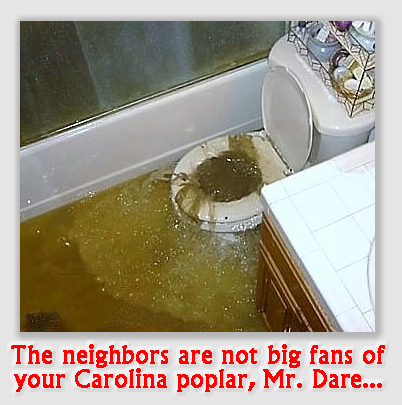
Mr. Dare clearly was a guy who loved his Carolina poplar. The tree is vigorous and rapidly growing, and – at least by the account in the case – can sniff out a water source like a bloodhound working a spoor. When it finds a water source – especially one as nutrient-rich as a sewer, it pries the source open like a squirrel cracking a nut.

Great for the tree. Not so great for the sewer. Or the city that has to maintain it, or the poor homeowner who watches unspeakable things backflow into his or her basement.

Carolina poplar – a cottonwood-family tree

Dare v. City of Harrisburg, 16 Pa. D. & C. 22 (Pa. Common Pleas 1930). In August 1925, the City of Harrisburg established a Shade Tree Commission under an Act providing for the planting and care of shade trees. A few short years later, the Commission ran headlong into Mr. Dare, who had a healthy, full-grown 35-year-old Carolina poplar shade tree in front of his property, one of nine such trees along the street.

In the fall of 1929, the Shade Tree Commission ordered the Carolina poplar removed to be replaced with a Norway maple tree.

The Norway maple was well suited to the Harrisburg climate and soil. The Carolina poplar, on the other hand, grows rapidly, is short-lived and has fibrous roots which can extend up to 100 feet in search of water. The roots have a tendency to penetrate the smallest crevices, and particularly enter sewers seeking moisture and food.

The City had a sewer about 38 feet from the tree, which was clogged twice, backing up into nearby homes, during the summer of 1929. Each time, crews pulled bushels of small matted Carolina poplar roots from the sewer. The Shade Tree Commission found that Mr. Dare’s Carolina poplar tree was likely to continue to clog the sewer, costing the City money and causing sewer backups that damaged other homes.

Mr. Dare argued that the Commission’s proposal to remove the tree was arbitrary, unreasonable, and an abuse of any discretion that the statute may have vested in the Commission. He said the problem was a shoddily built sewer, and that removing the tree constituted an unconstitutional taking of his property without compensation.

Held: The tree was a nuisance, and the Shade Tree Commission could order its removal without paying compensation to Mr. Dare. The evidence showed that the tree grew out to the sewer and stopped it, different from a case where the growth of the city around the tree was what created the condition now being called a nuisance.

The Court admitted that “it is a serious matter to destroy a beautiful shade tree and thus somewhat diminish both the market value and the advantages of one’s home. But when the tree has become a nuisance and the municipal authorities have upon proper evidence so determined, the court cannot say that a determination to remove such tree is either arbitrary or unreasonable.”

The Shade Tree Commission Act of 1907 gave the Commission the “exclusive and absolute custody and control of and power to plant, set out, remove, maintain, protect and care for shade trees.” This language, the Court said, gives the commission the exclusive power to remove. A municipality has a right to control trees and to remove them, and courts will not interfere unless there is an abuse of discretion or the power is exercised willfully, wantonly and unnecessarily. Where trees become a nuisance, the municipality does not act in the exercise of eminent domain but under the police power and needs no permissive statute.

Nor must the City pay compensation to the tree’s owner. The Court agreed with the principle from a Municipal Corporations treatise that “without regard to who owns trees in the street, the municipality has the right to control them, and it may in proper cases in the interest of public safety, convenience or health, cut them down. It is well settled that a municipality, even in the absence of a permissive statute, may remove trees, when necessary as against the objection of the abutting owner, without compensation, in connection with making improvements on the street, or where they are an obstruction to travel. For example, to improve and render a highway safe and convenient for travelers, to carry out a plan or system of street improvements, or to prevent the roots of trees from clogging a city sewer.”

Mr. Dare cited Bushong v. Wyomissing Borough, a prior case, in which municipal authorities were denied the right to remove a private landowner’s tree. But there, the Court said the City attempted to remove Norway maple trees (which is the species intended to be substituted in the instant case), which were well adapted to the conditions in the borough, and to plant in its place a Crimean linden, which had not been planted in the borough before and was not an established shade tree. In that case, the Court said, “it was very properly held that shade trees were not nuisances per se, and that the removal of beautiful and ornamental trees which add to the desirability and the value of properties, merely for the sake of uniformity, would be exercising an unreasonable and arbitrary power. But in the case of Mr. Dare’s Carolina poplar, there was “no question of the removal of the tree for the purpose of making municipal improvements, thus exercising the power of eminent domain or merely removing the tree to plant a tree of another kind, which may not be any better adapted to the soil and environment. The question is whether the city has the right, in the exercise of its police power, to direct the removal of a tree which has become a nuisance. We base our decision on that proposition alone.”

– Tom Root

TNLBGray140407