Case of the Day – Friday, January 9, 2026

THE PENNSYLVANIA CHAINSAW MASSACRE

We write a lot about trespass and the wrongful cutting of trees as a civil matter, where courts award money damages and occasionally injunctive relief. So much so, perhaps, that it’s easy sometimes to forget that trespass is also an offense against the public peace that is punishable in every state as a crime.

Darlene Gall’s nickname could have been “Unmitigated.” There is pretty clearly a backstory of neighbor animosity here, but all we get are the facts of the offense: one summer day, while her neighbor Gloria was at work, Darlene drove onto Gloria’s yard and lopped a 20-foot-long branch off an apple tree. She then dragged it back to her place behind her pickup truck.

Darlene already had a driveway, meaning that the easement was not essential to get from her house to the road. But rather than use her Massachusetts Rule rights to trim the tree limb back to the edge of her easement, Darlene went next door and took a bough – the whole bough. Darlene said she did this because the branch scratched her truck cab when she drove by on her easement. And because someday an ambulance might have to get to her house by means other than her driveway. And because Gloria’s people dumped dirt in the easement once. And so on.

When another neighbor saw Darlene cut the branch and tow it away, he reported it, and Darlene got charged with criminal trespass, a misdemeanor. She admitted to cutting the branch but tried to convince the judge she thought she had the right to walk onto Gloria’s land with her chainsaw whirring. Her lawyer argued that it is “a well-settled principle in the civil law that a non-owner of vegetative property, like a tree, is privileged to physically damage the property when it is intruding onto her property.”

Well, not exactly. The Massachusetts Rule lets a landowner cut off boughs and roots of neighbor’s trees which intrude into his or her land when the tree causes “sensible harm.” Darlene could have cut the apple tree branch back to the edge of the easement. But the branch’s encroachments were not a license for her to enter her neighbor’s yard and cut the encroaching limbs all the way back to the trunk.

Commonwealth v. Gall, 2017 Pa. Super. Unpub. LEXIS 1709 (Pa. Superior Ct. 2017). Darlene Gall drove onto her land owned by her neighbor, Gloria Hieter, and used an electric chainsaw to cut down a 20-foot limb from an apple tree. She then threw a rope around it and dragged it behind her truck back to her own property. She did so without asking Gloria’s permission, because she claimed the limb was blocking her use of an easement, making it impossible for her to drive past without scratching the roof of her vehicle. She also rather disingenuously claimed she was concerned about the possibility of an ambulance being able to reach her property by means other than her driveway.

Darlene was charged with the crime of simple trespass, which is a misdemeanor that prohibits a person, knowing that he or she is not licensed or privileged to do so, from entering or remaining in any place for the purpose of (among other things) defacing or damaging the premises. She was found guilty and sentenced to pay a $50.00 fine and costs of prosecution.

Darlene appealed.

Uh… but then, it’s not trespassing.

Held: Darlene was guilty of criminal trespass. She complained there was no evidence to show she knew she was not allowed to go onto Gloria’s land to cut the branch that was interfering with the use of her easement. But the Superior Court agreed with the trial judge that Darlene knew that the base of the apple tree was on her neighbor’s property, that she knew she was entering Gloria’s property, and that she intended to enter the property in order to cut the tree branch.

The trial court found from circumstantial evidence that Darlene knew she was not privileged to be on her neighbor’s property to cut down the apple tree branch. But she argued on appeal that the evidence was insufficient, and anyway, the law permitted her to be on the property for the purpose of removing a personal hazard to her health and that she did not have the specific intent of defacing or damaging the premises.

The Superior Court, however, observed that intent can be proven by circumstantial evidence and inferred from timing. Here, Gloria testified that she drives past the easement, which is on her left, to go to work. A neighbor, Mr. Goldman, heard the chainsaw and the large cracking sound and saw Darlene’s truck going by, towing this huge branch around 11:30 am on a Tuesday. The Superior Court said it was permissible to infer from Darlene’s choosing to cut down the branch at a time Gloria would not be at home that Darlene knew she was not privileged to enter Gloria’s land to cut down the branch. Gloria confirmed that Darlene never asked her about the tree branch.

Darlene took a bough… but not like this.

Mostly, Darlene was heisted by her own petard. She whined that “there was nothing there to say I couldn’t go up there. There was nothing there, no signs or nothing. They posted, actually, their signs into my easement, in other words, with the — may I say something? There was a time when they encroached on my easement there, trying to take it on me, and it cost me thousands of dollars in court to establish that I had the right to that road. They were pushing dirt on my — they built a shed a foot over their property line without a permit, and I have no… other way to explain the need to go on there and just take care of it myself.”

The trial court said Darlene “seems all too aware of where the easement line is and where her property is and where her property isn’t. She acknowledges that she went four steps onto her neighbor’s property.” The Superior Court concluded that Darlene “knew that she was not licensed or privileged to enter onto her neighbor’s property to cut down the apple tree branch. Furthermore, as has already been stated above, [Darlene] has been quite forthright about her entry onto [Gloria’s] land having the sole destructive purpose of removing the apple tree branch that was hanging in the easement.” What’s more, the fact that Gloria’s property was not posted with “No Trespassing” signs was irrelevant for the crime of simple trespass. It was enough that Darlene knew she was trespassing.

Darlene tried to raise necessity as a defense of justification, but the trial court held that “the necessity would be as to why she had to go onto the property as opposed to cutting the limb at the edge of the easement, and that’s not what’s in front of us today.” In other words, for necessity to work, Darlene had to show why exercising her rights under the Massachusetts Rule – that is, to trim the apple tree branch to the edge of her easement – was not good enough.

On appeal, Darlene argued that cutting the limb “was to avoid a ‘harm or evil,’ namely the harm of not being able to receive emergency services at her home,” and therefore, she “was privileged to enter upon [Gloria’s] property to cut the potentially harmful branch.” But before the trial court, all she said was that her “entry upon the alleged victim’s premises was for the sole purpose of maintaining the right-of-way, and not to intentionally deface or damage the alleged victim’s property.” When the issue is not raised before the trial court, the appellate court will not entertain it.

Darlene’s conviction was upheld.

– Tom Root

TNLBGray140407

Case of the Day – Friday, September 26, 2025

THE LAW OF UNINTENDED CONSEQUENCES – PART 2

I had a secretary once, a delightful country girl who careened from being sharp as a tack to dumb as a stump. One of her expressions, when she would be nattering on about something for what seemed to be hours on end, was, “Never mind me. I’m just talking out loud.”

Courts are constantly getting in trouble for “talking out loud,” saying more in a decision than is necessary. When an opinion, aside, observation or frolic unnecessary to the decision is included in an opinion, it is known as obiter dictum, Latin for “by the way.” Obiter dictum is a concept derived from English common law, wherein a judgment is comprised of only two elements: ratio decidendi and obiter dicta.

One of the early lessons law students learn in their first year is that for the purposes of judicial precedent, ratio decidendi (which means the rule of law on which a decision is based) is the only part of the decision that is binding. Any statement that is obiter dictum is persuasive only.

By the way, lawyers usually call obiter dictumdictum” for short. If there is more than one piece of dictum in a case, they are pluralized as “dicta.” (That previous “by the way” – in itself a perfect example of dictum – comes to you courtesy of my late and beloved Latin instructor, the incomparable Emily Bernges of Sturgis, Michigan. I had her a half-century ago, but in the firmament of unforgettable teachers, she is the brightest star).

Now to brush up on a little law: if I trespass on your land, you can sue to have me ejected. If you do nothing, and suffer my trespass and bad manners for long enough (usually 21 continuous years, but this can vary by state), I can sue you to quiet title, and the land becomes mine by adverse possession.

Now, instead of squatting on your place, I string a power line across a corner of it. You don’t give me permission, but again, you suffer in silence. It is not adverse possession, because you could continue to use the land under the power line. It’s just that I have taken the right to use your property without your permission, but in a way that is not inconsistent with your rights. If I maintain my power line for 21 consecutive years (at least in Pennsylvania, although different states specify different terms of years), I have not acquired ownership of the land, but I have acquired a prescriptive easement. A prescriptive easement, once acquired, may not be restricted unreasonably by the possessor of the land subject to the easement.

So that’s the progression. If I use your real estate without permission, I am a trespasser. If I remain a trespasser openly and continuously for a long enough period, I either wrest ownership of the land from you or, at the very least, obtain the right to an easement that you cannot revoke.

As we saw in yesterday’s case, Jones v. Wagner, a Pennsylvania court addressed encroaching tree branches and roots. This is unsurprising. Forty-nine other states have followed suit. But where everyone else is content with the Massachusetts Rule or the Hawaii Rule, the Virginia Rule or some amalgam of the three, the Pennsylvania court boldly went where no court had gone before. It decided that the owner of the encroaching trees became a trespasser when the branches overhung or the roots entered the subsurface. Such a holding was as contrary to common sense as it was unnecessary: trees grow, their owner does not control the growth, and simple rules allocating cost and responsibility work for everyone else with the need to resort to pounding the round peg of trespass into the square hole of encroachment.

But the Pennsylvania court did just that. And the holding begs the question: if a tree can trespass (or, more to the point, if the owner of a tree is a trespasser because of how the tree grows), might the owner also acquire a prescriptive easement if the encroachment persists long enough?

And here came the dictum. After foolishly applying trespass to tree encroachment, the Jones v. Wagner opinion speculates whether prescriptive easements could be acquired by tree trespass. That was not an issue in the case. It was pure dictum, talking out loud. But it did not take too long for another party to take the Jones v. Wagner idle musings and run with them.

Koresko v. Farley, 844 A.2d 607 (Commonwealth Ct. Pa. 2004). John and Bonnie Koresko bought a piece of property in Tredyffrin Township in 1986. Several trees, over 21 years old (which is important), grew on their property very near one property line. Branches hang over the boundary with the neighboring property.

That land was owned by Ollie Bower, who sold it to a developer in 1999. The developer wanted to subdivide the property into two lots and build two houses. The subdivision plan proposed the installation of a water line and the construction of a driveway near the boundary trees. Upon learning of the proposal, the Koreskos sued, seeking injunctive relief and money damages. The Koreskos claimed unreasonable interference with an easement. Specifically, they alleged that because their trees’ roots and branches encroached on the subdivided property for over 21 years, a prescriptive easement existed for the tree roots and branches. They assert that the development of the property would unreasonably interfere with that easement.

The trial court rejected the Koreskos’ claim, holding that “Pennsylvania does not and will not recognize an easement for tree roots or overhanging branches.”

The Koreskos appealed.

Held: Encroaching branches and roots cannot create a prescriptive easement.

A prescriptive easement is a right to use another person’s property that is not inconsistent with the owner’s rights and which is acquired by a use that is open, notorious, and uninterrupted for at least 21 years. A prescriptive easement, once acquired, may not be restricted unreasonably by the possessor of the land subject to the easement.

In Jones v. Wagner, a Pennsylvania Superior Court held that overhanging tree branches constitute a trespass. A landowner has the right to compel his or her neighbor to remove of overhanging branches, or the landowner may use self-help to cut the branches back himself or herself.

In discussing the appropriateness of self-help, the Wagner Court mused in a note:

An adverse possession action can often devolve into a pissing contest …

The Restatement notes that a continuing trespass is not a trespass at all if the actor causing the trespass has obtained an easement by adverse possession. Restatement (Second) of Torts § 161, comment d. We cannot help but wonder whether the continued presence of encroaching tree branches, held openly, notoriously, hostilely, and continually for 21 years would create a prescriptive easement in the airspace which they hang. If this would be the case, and we can find no Pennsylvania law which would indicate that a prescriptive easement is not available in this situation, a landowner who suffers actual harm for the first time during the tree owner’s twenty-second year of hostile ownership, might very well be precluded from seeking a judicial, or even self-help, remedy. This result, while not entirely unforeseeable, is anomalous. However, if an action is available without a showing of damage, the landowner has no reason to complain if a neighbor’s tree causes damage after the prescriptive period has run.

Citing this language, the Koreskis argued that their amended complaint sufficiently pleads a cause of action for unreasonable interference with a prescriptive easement. In contrast, the developer argued the Koreskis had not shown that such an easement existed. Specifically, the developer claimed, the encroachment of the tree roots and branches is not “open and notorious” conduct sufficient to create an easement.

The Commonwealth Court ruled that the Koreskis had failed to state a claim for prescriptive easement as a matter of law, for several reasons. First, encroaching tree roots and limbs by themselves cannot notify a landowner of a claim to use the ground. Second, Pennsylvania has never recognized the existence of such an easement. Third, the Court said, “well-reasoned authority from another jurisdiction persuades us that such easements should not be recognized.” Finally, the potential of widespread uncertainty such easements would cause “convinces us that they should not be recognized as a matter of public policy.”

“The requirement that, to be adverse, a use must be open and notorious is for the protection of those against whom it is claimed to be adverse,” according to Restatement of Property, Servitudes § 458, comment h. The requirement enables owners to protect themselves against the effect of the use by preventing its continuance.” To prove that an adverse use is ‘open and notorious,’ a claimant may show that either the landowner against whom the use is claimed has actual knowledge of the use or has had a reasonable opportunity to learn of its existence.

But encroaching tree parts, by themselves, do not establish “open and notorious” use of the land. Neither roots below ground nor branches above ground fairly notify an owner of a claim for use at the surface, the Court said. In the absence of additional circumstances, such as the use of the ground for maintenance or collection of leaves or fruit, roots and branches alone do not alert an owner that his exclusive dominion of the ground is challenged.

The philosophy of the law is that whenever neighbors cannot agree, the law will protect each owner’s rights to the extent possible. Any other result would cause landowners to seek self-help or litigate each time a piece of vegetation starts to overhang their property, fearing the loss of use or partial use of their property as the vegetation grows.

Finally, the Court said, “We consider the consequences of the holding urged by the Koreskis here. Judicial notice can be taken that trees growing over property boundaries and streets, around utility lines, and under [sidewalks are common in Pennsylvania]. A decision suggesting that the prolonged presence of these tree parts assures their unreduced continuation could cause uncertainty. Both the extent of the prescriptive easement and its effect on public and private use are problematic. As a matter of sound public policy, we decline to recognize a new estate which offers uncertainty and invites clarification through litigation.”

– Tom Root

TNLBGray

Case of the Day – Thursday, September 25, 2025


THE LAW OF UNINTENDED CONSEQUENCES – PART 1

If there’s a Holy Grail of arboriculture law, it’s the Massachusetts Rule, that grand old lady of New England self-reliance. The Massachusetts Rule holds that if a neighbor’s trees’ branches overhang or roots intrude into your land, you cannot sue to have the encroachment removed. All you can do is solve the problem yourself.  As the Massachusetts court put it:

the neighbor, though without right of appeal to the courts if harm results to him, is, nevertheless, not without remedy. His right to cut off the intruding boughs and roots is well recognized [and] in his own hands. The common sense of the common law has recognized that it is wiser to leave the individual to protect himself, if harm results to him from this exercise of another’s right to use his property in a reasonable way, than to subject that other to the annoyance, and the public to the burden, of actions at law, which would be likely to be innumerable and, in many instances, purely vexatious.

But it’s always been a little puzzling to me. When your tree overhangs a neighbor’s property, does “harm” have to “result[] to him” before a self-help remedy is permissible? What if you just don’t like those big honkin’ branches overhanging your yard, leaving your prize roses in the shade? Or they sway in a stiff breeze, turning on your back yard motion-detecting spotlight?

The Massachusetts Rule seems to suggest that if the tree isn’t causing “sensible harm,” you can’t touch it.

Sensible harm? What might that be?  I have a beautiful oak tree standing in the corner of my property. Some of the branches hang over the backyard of my neighbor, a guy who is truly a prince of good humor. In the autumn, my oak leaves fill every inch of his yard (downwind from mine) to a depth of nearly a foot. It seems pretty clear to me that if my neighbor decided to trim back my oak to the property line, I could hardly complain.

But I also have a pair of pine trees that soar majestically, extending nearly half of their branches over the fence and into my other neighbor’s airspace. They drop nothing to speak of, and really cause him no problems whatsoever. Does the Massachusetts Rule extend to him, too, and permit him to lop off the overhanging branches (and thus ruin my trees’ symmetry), simply because the branches hang over some of his lawn?

I like my neighbors, and I am not about to delve into the nuances of the Massachusetts Rule in a lawsuit in the local Court of Common Pleas. But, as we can see in today’s case, there are those who are willing to do so, and who have read the Massachusetts Rule’s “if harm results to him…” language as being a hard requirement that harm must result to a neighboring landowner before he or she can oil up the chainsaw and address the overhanging problem.

For their benefit, Pennsylvania courts went out on a limb 25 years ago by applying the law of trespass to overhanging branches and encroaching roots. Today, we’ll read about how that came to be. Tomorrow, we’ll consider a case where a crafty lawyer took the trespass theory (and an ill-advised piece of dictum from today’s case) and tried to spin it towards its obvious conclusion.

Jones v. Wagner, 425 Pa.Super. 102, 624 A.2d 166 (Pa.Super. 1993). The Joneses and Wagners are adjoining landowners, with a fence separating their properties. The Joneses own a row of tall hemlock trees. While they were on vacation, the Wagners trimmed the branches of the trees to the extent that the branches hung over the boundary line separating the neighbors’ property. The Joneses sued, demanding that the Wagners pay them the replacement value of each of the 26 trees that line the boundary, about $31,000.

The Joneses’ theory was novel. They claimed the Wagners owed them damages because the trees they trimmed were not harming them. They argued that even under the Massachusetts Rule, a landowner is only allowed to trim branches and roots to the property line – that is, exercise a self-help remedy – if the overhanging branches or roots are causing him sensible harm beyond the occasional shedding of leaves and twigs. Because the trees were not doing so, the Joneses claim, the Wagners’ trimming was the pursuit of a remedy without a right, and that made the Wagners liable for damages.

The trial judge was having none of it and held that the Joneses had no cause of action. He dismissed their complaint with prejudice, and they appealed.

Held: The self-help remedy available under the Massachusetts Rule does not require prior injury to the landowner availing himself or herself of the remedy.

While, the Court admitted, there does exist some conflict regarding when a landowner may institute an action for injunctive or monetary relief against an adjoining landowner whose trees overhang the property line, one common thread connects all such cases: the landowner whose land is encroached by the overhanging branches may trim the limbs to the extent of the encroachment. The Court noted another decision that said, “The cases are in agreement that trees ordinarily aren’t nuisances; that overhanging branches which merely cast shade or drop leaves on the land are not nuisances; that if under any circumstances overhanging branches or protruding roots do constitute a nuisance it is only when they do sensible or substantial harm; and that, whether nuisances or not, a landowner may always cut away to his property line branches and roots from trees of the adjoining owner.”

(Note: “Sensible harm” appears to be a term used nowhere in law except with respect to tree encroachment, and has nowhere been defined.  The ten cases or so in which the term appears all seem to assume the reader knows what it is, apparently “harm that can be sensed.”  The question as to its meaning reminds me of Supreme Court Justice Potter Stewart’s famous riff on the meaning of obscenity, in Jacobellis v. Ohio: “I shall not today attempt further to define the kinds of material I understand to be embraced within that shorthand description; and perhaps I could never succeed in intelligibly doing so. But I know it when I see it…”  So what is “sensible harm?” You’ll probably know it when you see it.)

The Joneses’ contention that the Wagners had to suffer “sensible harm” before availing themselves of the Massachusetts Rule remedy “is only relevant if the appellees seek their remedy in a court of law or equity,” the Court ruled. “A showing that encroaching tree limbs, branches, or roots have caused sensible damage is not a precondition to exercising a self-help remedy.”

It is an ancient principle of law, the Court said, that a landowner has the exclusive right to the space above the surface of his or her property, owning everything above and below ground level to an indefinite extent. On the same principle, courts have held that tree branches extending over adjoining land constitute a nuisance – at least in the sense that the landowner encroached on may himself cut off the offending growth.

But whether a suit for injunction and damages may be maintained without proof of actual damage is a point upon which the authorities have not been clear. In some other jurisdictions, damage caused by encroaching branches and roots are never actionable, self-help being the landowner’s only remedy. This is the “Massachusetts Rule.” Others require proof of some “sensible or substantial” damage before an action for damages in trespass is available, while some jurisdictions allow both actions at law and at equity upon this showing. Hawaii allows an action upon a showing of actual damage or upon “imminent danger” of damage (known in the tree law world as the “Hawaii Rule“). Finally, some jurisdictions hold that proof of damage only determines the amount of damages recoverable, and not whether a cause of action exists. These jurisdictions, however, are ones in which statutes, not common law, recognize the existence of the cause of action.

The Court said it is fundamental that a landowner has a cause of action against any person who has committed a trespass upon his or her lands, and it is not necessary for the landowner to allege any actual damage as an element of the cause of action. This is because the harm is not to the physical well-being of the land, but rather to the landowner’s right to peaceably enjoy full, exclusive use of his or her property. In fact, there is a property right in the airspace above the land, which may be invaded by overhanging structures, or telephone wires, by thrusting an arm above the boundary line, or by shooting across the land, even though the bullets hit the surface. Thus, the Court observed, an aggrieved landowner has a cause of action against an adjoining landowner whose trees overhang the boundary line. Otherwise, his or her right to enjoy exclusive peaceable use of the property is diminished.

The continuing presence of the branches and trees overhanging property lines indicates that the nature of the relief afforded to the aggrieved landowner is not simply monetary. The Restatement notes that a continuing trespass is committed by the “continued presence of a structure, chattel, or other thing which the actor has tortiously placed there, whether or not the actor has the ability to remove it.”

A trespass occurs by a mere overhang. Furthermore, given the rather unremarkable observation that trees will tend to grow, the trespass, even if remedied once, is bound to recur just as soon as the trees or shrubbery regenerate. Thus, the trespass is “continuing” and the possessor of land is entitled to pursue a proper remedy.

We are convinced, the Court ruled, that Pennsylvania law “entitles a landowner to protect his property interest by maintaining an action to compel a person who has caused a trespass to remove it.” It is not suggested anywhere that a showing of harm is a prerequisite to recovering in trespass. A landowner may avail himself or herself of every available remedial avenue in an effort to protect the incidents of land ownership. “Anything less, in our view,” the Court said, “is a travesty.”

Thus, the Court concluded that Pennsylvania law affords a full panoply of remedies to a landowner whose property is encroached by overhanging branches or tree limbs (thus following the Hawaii Rule):

• First, an aggrieved landowner may exercise a self-help remedy by either trimming or lopping off the branches to the extent his or her property is encroached;

• Second, if the landowner has incurred reasonable expenses in the course of exercising a self-help remedy, he or she may recoup those expenses from the trespasser; or

• Third, he may, on a trespass theory, seek a court order compelling the trespassing neighbor to remove the trees to the extent of the encroachment and seek appropriate money damages.

Pennsylvania law requires no showing of physical harm or damage to the land before a landowner can enforce his or her right to freely enjoy unencumbered and exclusive use of property he rightfully possesses. The mere “tree trespass” is enough.

The Wagners were only exercising their right to trim the branches and limbs of the Joneses’ encroaching trees. They may not be held liable for doing so.

– Tom Root

TNLBGray

Case of the Day – Monday, August 18, 2025

GIVE ‘EM AN INCH …

fence150722We continue our tour through the House of Bad Neighbor Horrors today (see our post from Wednesday) with a look at neighbors Paula A. Luckring and Christopher Blair.

An old legal adage holds that “a bad settlement is better than a good lawsuit.” Paula Luckring sued her neighbor, arguing that branches from his trees overhung her property, and that they were doing all the kinds of things trees do – you know, dropping twigs and leaves, leaking sap, growing roots, just normal tree stuff. Paula insisted that she was entitled to something north of $13,000 because the trees were “trespassing” on her property, making claims that sounded a lot like her lawyer had read Fancher v. Fagella.

Neighbor Chris Blair counterclaimed, pointing out that if Paula wanted to really get technical, her deck – which she claimed was being damaged by his trees – was built partly on his property, and it should be removed.

The case looked like the trial would be the Saturday night main event, but alas … before trial, the parties settled. There’s nothing wrong with that. Civil actions are just a formalized means of settling disputes, a little more complex and fact-driven than “rock, paper, scissors,” but often, it seems, just as random. When the parties find a means short of a full-blown trial to resolve things, time and money are saved, and people are able to get on with their lives.

That must be what Chris thought, because he settled the case with Paula before trial. He agreed to give Paula title to an 11-foot strip of his own land and to build, at his own expense, a fence marking the new boundary line between their properties.

appease150722We have to hand it to Chris. He apparently was a Bible scholar, and remembered Matthew 5:39 – 40: “But I say to you, do not resist an evil person; but whoever slaps you on your right cheek, turn the other to him also. If anyone wants to sue you and take your shirt, let him have your coat also…” For that matter, Neville Chamberlain thought that giving Hitler Czechoslovakia would keep the brown shirts out of Paris.

We’re not saying Ms. Luckring was evil, nor would we ever equate her territorial ambitions with those of the Third Reich. For a concession to be effective, however, the party being appeased has to be acting in good faith. This is rarely the case. Rather, the problem is that the party being appeased has probably acted in bad faith in order for affairs to get to the point that appeasement is necessary. Hitler had the “Anschluss.” Without it, Chamberlain wouldn’t have needed to make a deal. Putin started by taking South Ossetia from Georgia. Then, he grabbed Crimea, and now he is busy trying to take Ukraine (if not Moldova, Estonia and the other Baltic states as well). History has shown us that appeasement doesn’t work because appeasement only convinces the appeased party that bad conduct pays. And just two years ago today, notwithstanding years of negotiations, the Taliban just went ahead and took it all.

Ask Chris Blair about appeasement. Chris thought he had bought peace by giving away a piece of this land. But when Chris hired a fence company to build the agreed-upon fence along the new boundary, Paula Luckring refused to let the contractor set foot on her property during the construction process. It’s hard to build a fence from one side only. To further appease Ms. Luckring, the contractor built the fence 13 inches into Chris’s side of the boundary. After that, when Chris’s caretaker (Chris himself had severe Parkinson’s, a condition that undoubtedly only goaded Ms. Luckring into further predations) would try to use a weed whacker on the grass growing in the 13-inch space between the new boundary and the fence, Ms. Luckring demanded that he do the cutting without setting foot on her property. However, she magnanimously conceded, she would cut the grass on the 13-inch strip… if Chris gave her an easement for the 13 inches of space.

nomans150722The trial court was drawn back into what it called the “predictable drama” that arose from Ms. Luckring’s demands. It told Paula that she had to pay to have the fence moved and reinstalled right along the boundary. No 13-inch “no man’s land.” No easements. No more trespassing actions.

Naturally, Ms. Luckring appealed. The appellate panel was having none of it. It held that “a mere cursory review of the Plaintiff’s pleadings and her own testimony … adduces an ongoing pattern of bullying of a Defendant who granted her the moon and the stars in acquiescing to her unceasing demands, and yet was confronted with demands for more …” It’s not unheard-of for a plaintiff to cripple her case by her own testimony, but to prove yourself to be a bully?

Under the circumstances, making Paula pay to relocate the fence seemed to the court to be a lot like justice. Approximate justice, but still justice.

Luckring v. Blair, 2014 Pa. Dist. & Cnty. Dec. LEXIS 3 (Com.Pl.Ct. Pennsylvania, Dec. 3, 2014). Paula Luckring sued neighbor Christopher Blair, alleging that his pine and sycamore trees trespassed onto her property, causing public safety issues that had been presented to the local township authorities. She additionally complained of damage caused by “tree sap, needles, branches, cones, roots” constituting a “nuisance” because the trees overhung, fell upon, and grew under her property which caused damage such as a broken window, damage to a deck and stamped concrete, as well as clogging a sewer line and causing landscape damage. She demanded $13,369 for cutting down or trimming the offending trees and restoring her property to its previous condition.

trespass150722Blair countered that he had given Luckring permission to trim the sap-dripping white pine tree all the way back to its trunk, but her trimming caused the sap to drip excessively because there were no tree branches remaining to catch and absorb its flow. He also said that she had previously accepted his written permission and cut down the encroaching white pine tree at her own expense. He argued she should not now be able to renegotiate that contract. He also counterclaimed, alleging that Luckring was trespassing on his property with her deck and retaining wall.

The parties settled the case before trial by signing a settlement agreement that called for Blair to grant title to Luckring, free of charge, to an 11-foot strip of his own land and to build, at his own expense, a fence marking the new boundary line between their respective parcels. Nevertheless, the parties were back in court a year later seeking to resolve the predictable drama ensuing from the Plaintiff’s abject and literal refusal to allow the fence company to set foot on her newly acquired property in order to erect the structure. The contractor then built the fence thirteen inches inside the Blairs’ side of the new property line in order to appease the Plaintiff in that regard. Adding further insult to injury to Blair, who suffered from severe Parkinson’s Disease, Luckring demanded that when Blair cut the tall grass and weeds on the 13-inch strip of his property on Luckring’s side of the fence, such work must be accomplished without setting foot on her land. She offered to cut the grass and weeds herself, but only if Blair granted her an easement to that additional piece of his property.

The appellate court enforced the settlement agreement by ordering Luckring to move the fence to the boundary line of the respective properties at her own expense.

Luckring appealed.

Held: The enforcement of the settlement agreement was upheld.

The appellate panel noted with disdain that after Blair applied for a building permit for the fence in May 2013, Luckring made multiple calls to Haverford Township officials to note her opposition to the fence despite having agreed in the settlement not to oppose in any manner the erection of the fence and to waive any and all objections thereto. She also erected signs on her property pointing in the direction of Blair’s residence that said “No Trespassing,” and put up a sign on her property ordering the fence company not to install the fence all the way to the sidewalk, contrary to Blair’s instructions. She also initiated a verbal confrontation with Mary Blair, in which she accused the Blairs of being “too cheap to get their own survey”, even though the settlement agreement required Luckring to bear the expense; and she hammered stakes into the ground on Blair’s property and – after the fence was built – she entered Blair’s property to “wash” the brand new fence.

Whatever Ms. Lucking might do for a living, we're betting it's not driving the Welcome Wagon.

Whatever Ms. Lucking might do for a living, we’re betting it’s not driving the Welcome Wagon.

The Court noted that when Luckring was asked at the hearing to expound upon her belief that the parties must strictly adhere to the terms of their settlement agreement regarding the need to care for the portion of the Blairs’ land outside the fence line and abutting her property, she replied that if the caretaker stepped on her property during this process, he would be trespassing and that she would sue.

The Court concluded that a “mere cursory review of the Plaintiff’s pleadings and her own testimony at the Hearing on the Defendant’s Petition to Enforce Settlement adduces an ongoing pattern of bullying of a Defendant who granted her the moon and the stars in acquiescing to her unceasing demands, and yet was confronted with demands for more. The parties’ Settlement Agreement and Release provided for a fence to be built by the Defendant on his side of the new boundary line of the neighboring properties, albeit without trespassing on the Plaintiff’s land. A reasonable interpretation of this requirement would result in the edge of the fence being placed on the edge of the Plaintiff’s new property line and not crossing this point of demarcation. Moreover, the momentary intrusion involved in its construction would be of no concern whatsoever with regard to the fence contractor’s presence on the Plaintiff’s side of the boundary line in order to complete the effort. However, the Plaintiff took the extreme position that enforcement of these provisions must be strict, and refused to permit the fence installer to step on her property to undertake its construction in the place designated by the Defendant in express accordance with the parties’ stipulated Agreement. As a result, the fence contractor took it upon itself to erect the structure thirteen inches inside the Defendant’s side of the boundary line, instead of on the line itself, in order to placate the Plaintiff. The Plaintiff then added to this mix of unreasonableness and bad faith by complaining that the Defendant’s landscaper was stepping on her property when clearing weeds and high grass growing on the 13-inch strip on her side of the fence that remained in the ownership and possession of the Defendant.”

Calling Luckring’s conduct “obdurate and [in] bad faith,” the Court concluded that Luckring had not acted in good faith, and the trial court’s order that she pay to move the fence “was warranted and necessary to achieve justice in this case.”

– Tom Root

TNLBGray140407

Case of the Day – Thursday, July 24, 2025

A TREE GROWS IN BROOKLYN – AND THAT’S DIFFERENT

Poster140306Time was, trees were just trees, and what they did, how they lived, grew and died, was out of the control of the property owner. No one blamed little Francine Nolan if the tree growing in Brooklyn fell on a Sabrett’s cart.

About the time little Francine was living in her Williamsburg tenement, an influential group of judges, scholars, and lawyers in Philadelphia formed an organization known as the American Law Institute. They believed, among other things, that they could write comprehensive treatises about all areas of the law – which they called “Restatements” – that would serve as authoritative statements of the principles of common law. No more confusion, no more divergence of holdings, no more contentious arguments! You can just about hear the group, lemonades hoisted (this was during Prohibition, after all), singing “We Are the World.”

I hear the ALI singing ...

I hear the ALI singing …

Alas, Prohibition failed, and so did the ALI’s goal of replacing all of those tedious casebooks and treatises with the Restatement of the Law. Everyone loved the Restatements, but far from replacing state common law, case reporters, and codes of statutes, the volumes became just another secondary source. To be sure, some of the ALI members never really thought an entire law library could be replaced with one shelf of Restatements, notably Benjamin Cardozo. He believed that the Restatement “will be something less than a code and something more than a treatise. It will be invested with unique authority, not to command, but to persuade.”

The Restatement of the Law continues today, with some volumes in their third printing. And courts love them, even if they don’t always follow them.

Today’s case is a good example. When the Browns’ tree fell on Ms. Barker’s property, it made a mess. She sued her neighbors, arguing that they should have recognized that the tree was at risk of falling and done something about it. The Browns pointed out that no less persuasive source than the Restatement (Second) of Torts said that they weren’t responsible for the natural condition of trees on their property. The trial court agreed and threw the case out.

The appellate court disagreed. It rejected the Restatement approach as being outdated and not sufficiently attuned to the differences between urban and rural life. In other words, the Court said, if a tree grows in Brooklyn, little Francine had better keep her eye on it.

Francine - be careful that tree doesn't fall on the hot dog vendor's cart.

Francine – be careful that tree doesn’t fall on the hot dog vendor’s cart.

Barker v. Brown, 236 Pa.Super. 75, 340 A.2d 566 (Pa.Super. 1975). Virginia Barker’s property adjoins that of the Browns. Both are located in a residential district of State College. A large tree stood on the Browns’ property, a tree that Barker said the Browns knew or should have known was in a decayed, rotting, and dangerous condition. Barker alleged that the Browns negligently failed to take steps to avert the danger and, as a result, the tree fell onto her property.

The tree’s fall destroyed two of Barker’s trees, valued at about $600 each. Barker had to have the fallen tree removed from her property at a cost of $147.50, and the process required her to miss two days of work, causing lost wages of $34.00. Finally, the incident resulted in a loss of value to Barker’s property in the amount of $600.00.

The trial court threw out the case on the grounds that section 363 of the Restatement (Second) of Torts (1965) precluded holding the Browns to blame. That section provided:

(1) Except as stated in Subsection (2), neither a possessor of land nor a vendor, lessor, or other transferor, is liable for physical harm caused to others outside of the land by a natural condition of the land.

(2) A possessor of land in an urban area is subject to liability to persons using a public highway for physical harm resulting from his failure to exercise reasonable care to prevent an unreasonable risk of harm arising from the condition of trees on the land near the highway.

Held: The appellate court reinstated the lawsuit.

The court held that the Restatement’s distinction between natural and artificial conditions – a distinction that had never been the focus of prior Pennsylvania court decisions – was outdated. “It may very well be true,” the Court said, “that the distinction between artificial and natural conditions was valid in a time when landowners were possessed of, and hence would have been charged with the care of large quantities of land. It would still be valid today in rural areas where large landholdings are common. [However], we do not believe that the distinction should be applied to land in or near a developed or residential area. Urban living, by altering the purpose for which the land is used, must also bring with it certain responsibilities. A tree growing in an urban or residential area does not have the same natural relation to surrounding land as a tree located in a rural setting.”

Basswood140306While acknowledging that its approach imposed more cost on landowners, the Court nevertheless believed that “the relatively minor expenditures in time and money that it will take to inspect and secure trees in a developed or residential area is not large when compared with the increased danger and potential for damages represented by the fall of such a tree.”

The Court thus held that a possessor of land in or adjacent to a developed or residential area was subject to liability for harm caused to others outside of the land by a defect in the condition of a tree thereon, if the exercise of reasonable care by the possessor would have disclosed the defect and the risk involved, and repair would have made the tree reasonably safe.

In this case, the Court held, Barker alleged in her complaint that the Browns “knew, or should have known, that the said tree was in a decayed, rotting, and dangerous condition.” This is denied by the Browns, but for purposes of this appeal, the Court had to accept the facts alleged in Barker’s complaint as true. On remand, it noted, the question would be one for the fact finder.

– Tom Root

Case of the Day – Friday, January 3, 2025

SELF-HELP WEEK

Quite unintentionally, 2024 (slogan “At Least It’s Not 2020”) – as it slunk out the door in well-deserved shame – is ending with an orgy of self-reliance versus resorting to the courts. On New Year’s Eve, we reviewed a Florida case, Balzer v. Maxwell, in which the court held that the fact that an aggrieved landowner has no remedy but self-help means that when he or she exercises that right, the tree owner has no claim for what might become of the tree. Yesterday, we read a Massachusetts court holding that, on the other hand, when a city takes over an abandoned property for taxes, it assumes liability for hazard trees on the property.

In today’s case, Pennsylvania applies the Massachusetts Rule principles of self-reliance to encroaching tree roots.

Keiper v. Yenser, 1967 Pa. Dist. & Cnty. Dec. LEXIS 171 (Common Pleas Ct, Carbon County, Pa., January 23, 1967). Bill and Becky Keiper complained that for more than five years, the roots of Yensers’ willow tree have been extending into their land and penetrating their sewer line, which has cost the Keipers $166.07. They seek reimbursement for the money they have spent and a court order for the permanent abatement of the root encroachment (that is, an order that the Yensers remove the roots at their expense).

The Yensers filed a demurrer; in the alternative, they argued that laches prevented the Keipers from winning, and contended that abatement should not be ordered because the Keipers had an adequate remedy at law.

Held: The Keipers claim had to be dismissed.

Pennsylvania has no statute that would permit the Keipers to claim that the Yensers’ tree was a nuisance. Nor was there any case precedent.

However, looking at other states, the Court noted that in Gostina v. Ryland, a Washington state case, the court held that “were it not for our statute of nuisances, the respondents herein would not be accorded any judicial relief”. And Michalson v. Nutting, the Court said, held in very similar circumstances that “the neighbor, though without right of appeal to the courts if harm results to him, is nevertheless, not without remedy. His right to cut off the intruding boughs and roots is well recognized. His remedy is in his own hands. The common sense of the common law has recognized that it is wiser to leave the individual to protect himself, if harm results to him from this exercise of another’s right to use his property in a reasonable way than to subject that other to the annoyance, and the public to the burden, of actions at law, which would be likely to be innumerable and, in many instances, purely vexatious.”

Thus, the Court held that while the Keipers could cut the offending roots themselves, they had no cause of action to compel the Yensers to do so. “It is a principle well settled by many adjudicated cases, that an action does not lie for a reasonable use of one’s right, though it be to the injury of another. For the lawful use of his own property, a party is not answerable in damages, unless on proof of negligence…”

– Tom Root

TNLBGray140407

Case of the Day – Monday, September 22, 2024

A GAME OF INCHES

Baseball, they say, is a game of inches. So are boundary trees, called “line trees” in the State of Pennsylvania (which, by the way, also calls itself a “Commonwealth” instead of a “State”).

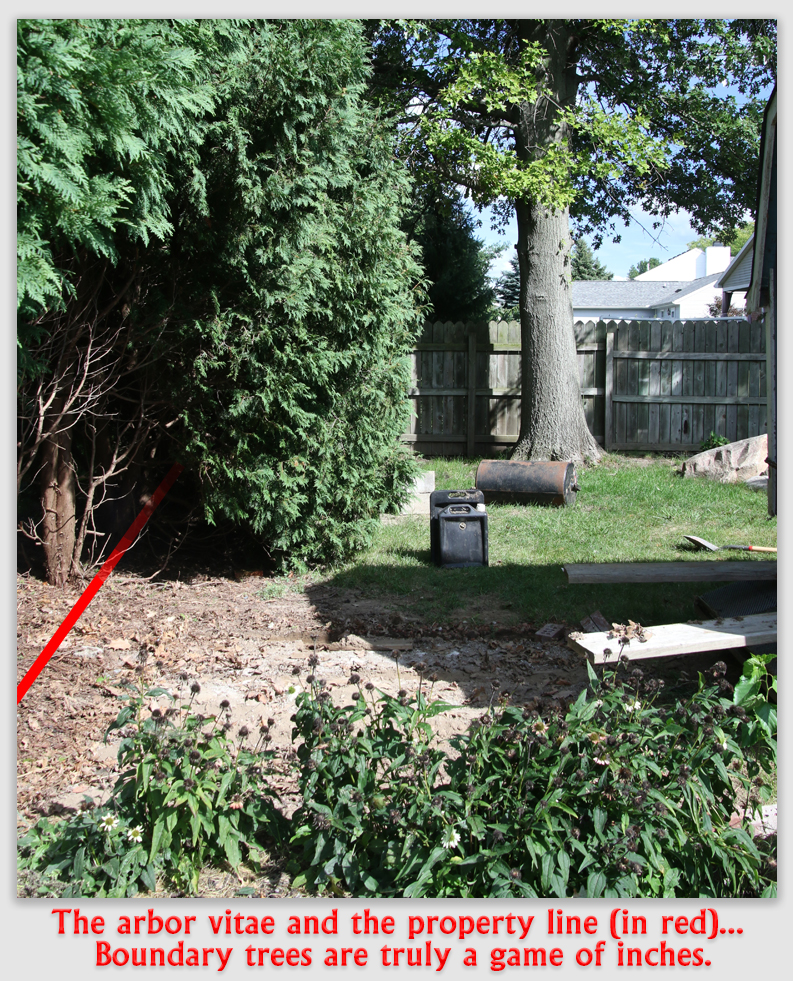
Life imitates art, I guess. Last weekend, I hauled away our 25-year old shed. I am replacing it with a newer, larger shed – complete with electricity, windows, and (if I have anything to do with it) a beer refrigerator. Replacing it will come with a set of problems, specifically a line of arborvitae trees, standing behind the shed along the property line.

The arborvitae were tiny little shrubs when our next-door neighbor (two owners ago) planted them in the late 1990s. Now, they’re monsters.

I need to trim back a few of the arborvitae before the concrete pad for the new shed gets poured. Having read some of what I have written about boundary trees over the past few weeks, I figured I had better be sure I was dealing with some good old-fashioned Massachusetts Rule trimming of branches overhanging my property (and not with some oversized arborvitae that had grown across the property line to become boundary trees).

I found the iron pin on one end of the property line and the post on the other, and I ran a line through the trees. Sure enough, two of them have grown across the property line. Lucky for me, the ones I need to trim are still solidly anchored completely on my neighbor’s land. Those I can trim back, exercising both my Massachusetts Rule rights and my ratcheting loppers.

It seems strange that a matter of inches differentiates the trees I can trim with abandon and the trees that I cannot touch without my neighbor’s permission. (I have a great neighbor, by the way, so it is probably not a problem).  Nevertheless, the perverseness of the interplay between boundary trees and encroaching trees that stand completely on land other than one’s own is puzzling and irritating to me in an academic and legal way.

My situation is similar to the one in today’s case, which pits a car wash against a restaurant over a row of pine trees that may or may not be on the boundary. Because of the vagaries of how the pine trees at the root of the lawsuit grew along the property line, no one really won: the restauranteur wanted the trees gone, and the car wash owner wanted the trees to remain.

In the end, some of the trees stayed, some did not. And it was all a game of inches…

Wolfinger v. Moates, 7 Pa. D. & C.4th 220 (Pa.Com.Pl. 1990). A line of pine trees separated the Wolfinger Car Wash property from the Moats Restaurant property. Bill Moats received complaints from his patrons about the pine trees, that encroached on his parking lot, scratched diners’ cars and dropped pine cones everywhere (even damaging his lawnmower).

Bill decided to cut down the trees. He told his neighbor, “Suds” Wolfinger, what he planned. Suds was shocked. He liked the trees, partly because they served as a barrier between his business and the restaurant. Plus, his customers preferred parking under them, using the shade while they wiped down their cars. Suds asked Bill not to cut them down.

Bill cut them down anyway, taking out four of the 13 trees on his first day wielding his chainsaw. Suds raced to his lawyer, and together they raced to the courthouse for a temporary injunction. After Bill was forced to stop, Suds tried to make the injunction permanent.

The court found that the two tracts of real estate shared a common boundary line, and 13 trees stood on or near the line. A survey showed that the first five trees, including the four Bill had cut down, were all on his property. Lucky Bill. The next three, however, straddled the boundary. The  Court referred to them as “line trees.” Tree No. 9 was on Bill’s land, but some bark on the flare touched the boundary line. The last four trees were all on Bill’s land.

Held: Bill was not allowed to cut the three trees that straddled the boundary.

Pennsylvania law made it unlawful “for any owner or owners of any undivided interest in timber land within this Commonwealth to cut or to remove, or to cause to be cut or removed, from the said land, any timber trees, without first obtaining the written consent of all co-tenants in said premises.”

The Court held that the statute dictated its holding that the owners of adjacent tracts of real estate own all trees growing on their common boundary line as tenants in common. Tenants in common are prohibited from unilaterally cutting down or removing such commonly owned line trees.

Applying the general rules of law governing tenancy in common, the Court held, “We conclude neither adjoining real estate owner may remove a tree growing on a common boundary line. Consequently, in the case at bar, notwithstanding the fact that only inches of the trunks of trees 6, 7 and 8 are on the boundary line between the properties of the plaintiffs and defendants, those trees are jointly owned by plaintiffs and defendants. Therefore, defendants may not remove them.”

Suds was not satisfied. He argued that Tree No. 9 was commonly owned as well because the bark of the tree’s trunk touched the boundary line. Citing the Illinois case Ridge v. Blaha, the Court held that the critical question was “whether any portion of the trunk of the elm tree grows on plaintiff’s property… The law… is determined by the exact location of the trunk of the tree at the point it emerges from the ground.” The fact that the bark of Tree No. 9 touched the line, the Court said, was insufficient to create a tenancy in common.

Trees 1 through 5 and 9 through 13, therefore, were Bill’s sole property. He could cut them down as he wished. But the injunction would become permanent on Trees No. 6 through 8, leaving them to provide both shade and pine cones.

– Tom Root

TNLBGray140407