Case of the Day – Thursday, September 4, 2025

MRS. PALSGRAF GOES TO THE CITY BY THE BAY

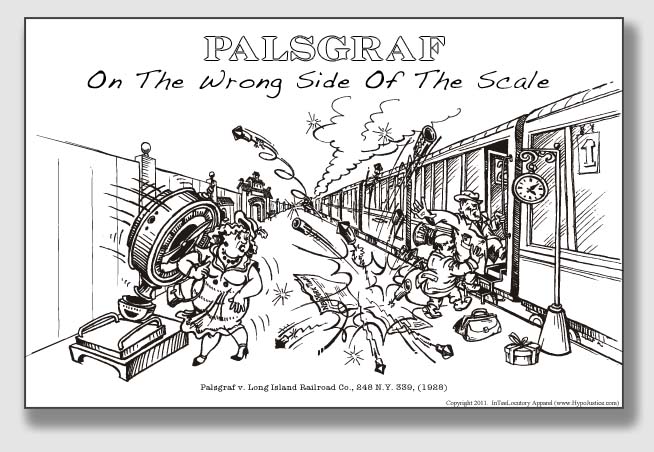
We all remember Mrs. Palsgraf, the unfortunate matron injured at the Long Island railroad station.  Mrs. Palsgraf was waiting for a train, standing some distance from the platform. On the platform, an overzealous passenger tried to jump aboard a moving train. He lost his balance but was kept from falling by two platform guards, one of whom grabbed his arm while the other pushed him from behind.

The passenger was carrying an unlabeled box under his arm. The box fell to the tracks, some fireworks inside the unmarked box detonated, and the loud noise, somehow (no one ever really explained how), caused a set of scales standing by the station to fall on Mrs. Palsgraf.

Quick, who gets sued? Why, Long Island Railroad, of course. Not because of some obscure legal theory, but rather for the best reason of all: the LIRR had a lot of money. The guards and the passenger did not.

Every law student knows what happened. Mrs. P won $6,000 at trial, which was upheld on appeal. But then the case reached the New York Court of Appeals (the highest court in the Empire State). Renowned jurist Benjamin Cardozo wrote a 4–3 opinion that remains a staple of tort law, taught to law students nearly a century later. Cardozo ruled that the LIRR guards were not negligent because, in helping the man board, they had no duty of care to Mrs. Palsgraf because injury to her was not a foreseeable harm that could flow from aiding a man with a package. Thus, the conception that tort liability can only occur when a defendant breaches a duty of care the defendant owes to a plaintiff was born.

Palsgraf’s an amusing case, but then it’s all fun and games until someone gets hurt.  And someone sure did in today’s case, handed down by the U.S. Court of Appeals for the Ninth Circuit.

In what the Court called the events a “Rube Goldbergesque system of fortuitous linkages,” the life of a young woman was snuffed out in San Francisco by the denouement of a string of events that started with a Bureau of Land Management ranger being reassigned from the Mexican border to Montana.

Steinle v. United States, 11 F.4th 744 (9th Cir., August 24, 2021).  John Woychowski worked as a ranger for the Bureau of Land Management, part of the United States Department of the Interior, assigned to El Centro, California. While traveling to Montana by private car, John and his family stopped to enjoy a warm San Francisco night in June 2015. John parked on the street along the Embarcadero, a waterfront tourist mecca, and the family walked to a restaurant.

When they returned, they discovered that in San Francisco, “BMW” means “break my window.” The tailgate window was broken and some property was gone.

Unfortunately, the property included a nondescript backpack that contained John’s government-issued service weapon, a holstered Sig Sauer P239. The pistol did not have the BLM-issued trigger lock on it.

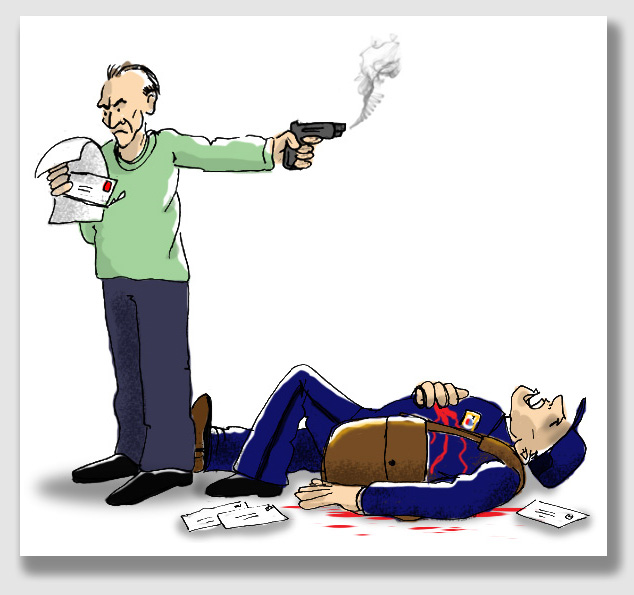
Four days later, a homeless undocumented immigrant named Juan Lopez-Sancherz found the handgun about a half mile from the break-in, wrapped in rags and sitting on a bench. He picked it up and fired it. The bullet ricocheted off the ground, striking and killing Kathryn Steinle. 

The political universe had a field day, Juan was an illegal immigrant, having been deported five times and with seven prior felony convictions. Not a nice guy. The kind of guy President Trump likes to talk about. The gun control people went nuts, the anti-immigrant people really went nuts, and Juan was painted as criminal excrement for whom the death penalty was too merciful a fate. When the dust settled and common sense prevailed, a jury acquitted Juan in 2019 of murder, manslaughter, and assault, and his conviction for being a felon in possession of a firearm was overturned soon after. Juan’s crime, it turned out, was gross stupidity, something that is not yet a felony.

No one knows who stole the pistol, how many people possessed it in the four days between June 27 and July 1, who took the pistol out of the holster and wrapped it in a shirt or rag (or why they did so), or how the pistol came to be left near the bench where Juan found it. But Kate’s family had to sue someone (and I won’t judge them for that, as they struggled with a horrific and unexpected loss), so they sued everyone. They sued Juan, they sued San Francisco (for being a sanctuary city that had let Juan wander free), and – of course – sued the federal government under the Federal Tort Claims Act.

The Steinles alleged that John was negligent in failing to secure his firearm properly and in leaving it, loaded, in an unattended vehicle in an urban location where the firearm could be easily stolen. The federal district court entered summary judgment in favor of the United States, ruling that John owed no duty to Kate under California law and that his actions were not a proximate cause of her death.

Kate’s family appealed.

Held, the government was not liable because John was not negligent.

Under the FTCA, the United States may be held liable for “personal injury or death caused by the negligent or wrongful act or omission of any employee of the Government… under circumstances where the United States, if a private person, would be liable to the claimant in accordance with the law of the place where the act or omission occurred.” 28 U.S.C. § 1346(b)(1).

So far, so good. But in California, to prove negligence, a plaintiff in a negligence suit must demonstrate that the defendant had a legal duty to use due care, a breach of such legal duty, and the breach as the proximate or legal cause of the resulting injury.

Legal causation has two components: cause in fact and proximate cause. Because the factual causes of an event may be traced far into the past, the Court ruled, the law imposes additional limitations on liability. Those additional limitations relate not only to the degree of connection between the conduct and the injury, but also to public policy. The doctrine can bar liability even when the defendant’s conduct is a factual cause of harm, depending on the manner in which the injury occurred or the extent to which the ultimate harm is attenuated from the breach of duty alleged.

Here, the connection between John’s storage of the pistol in his vehicle and Kate’s death “is so remote that, as a matter of law, his acts were not the proximate or legal cause of the fatal incident,” the Court held. “Several events—many of which remain unknown—intervened after John left the loaded pistol in his vehicle: (1) someone broke into the locked vehicle; (2) someone stole a seemingly innocuous backpack; (3) someone found a pistol in that backpack; (4) someone removed the pistol from its holster, then wrapped it in a cloth and abandoned or lost it a half-mile away; (5) Lopez-Sanchez picked up the firearm, four days later, and fired it, apparently aimlessly; and (6) the bullet ricocheted off the ground and struck Kate.”

There were no winners in this one. Kate is dead, her parents grieve, and Juan served five years before being acquitted and deported yet again.

No winners. Except for the United States government, which did not have to pay. And BLM Ranger John Woychowski. He got promoted.

– Tom Root

Case of the Day – Friday, June 20, 2025

A SQUIRRELY CAUSATION THEORY

Oh, if it were only that easy ...

Oh, if it were only that easy …

In the world of negligence, it’s not enough that the person who screws up – referred to generally as the “actor” – is stupid. After all, the world is chock-a-block with stupidity, and if being an imbecile were enough to make one liable, we’d all walk through life with our checkbooks perpetually open.

No, idiocy is not enough to create liability. Instead, the stupidity must be the “proximate cause” of the damage suffered by the plaintiff. For all of you proponents of chaos theory, you can consider it the obverse of the “Beijing Butterfly Effect.” You remember the illustration: the beat of a butterfly’s wings in Beijing today sets a minuscule air current in motion, which sets other air in motion, and so on nearly ad infinitum, until the air currents set into circulation cause a thunderstorm a week later in New York City. Small changes in input result in big changes in output. Just ask Edward Lorenz.

Lorenz was a scientist, not a lawyer. Had he been an attorney, he might have sued the butterfly because he got wet hailing a taxi at 52nd and 5th Avenue. But the law wouldn’t have been with him, because his damages – a soaking-wet bespoke wool coat and trousers – were not proximately caused by the butterfly’s erratic flight around the Forbidden City seven days prior. It’s the lesson every first-year law student learns in Palsgraf v. Long Island Railroad, a now-legendary tort case from pre-Depression New York.

Chaos isn't such a bad thing ... the theory gave us Benoit Mandelbrot's beautiful and repeating fractals.

Chaos isn’t such a bad thing … the theory gave us Benoit Mandelbrot’s beautiful and repeating fractals.

The facts were almost Rube Goldbergian. Mrs. Palsgraf – the Countess of Causation herself – had just arrived at the station to catch a commuter train. A passenger carrying a package, while hurrying to board a moving train, appeared to two Long Island Railroad employees to be falling. The employee standing on the passenger car steps tried to pull the passenger into the car while the other employee tried to push the rider into the car from behind. Their efforts to aid the passenger caused the unlucky fellow to drop the package he was holding. The box – about 15 inches long and wrapped in newspapers – struck the rails in between the cars.

The package contained fireworks, and it, of course, exploded when it hit the rails. The shock from the blast caused a panicked bystander to stumble into a pair of scales, which fell over, striking Helen Palsgraf. Palsgraf sued the Long Island Railroad (of course, because no one else in the chain of causation had any money), claiming her injury resulted from negligent acts of the Railroad’s employee in pushing the passenger onto the train. The trial court and the intermediate appeals court agreed with Mrs. Palsgraf.

The Long Island Railroad appealed the judgment to the Court of Appeals, New York’s highest court. In a celebrated opinion by then-Chief Judge Benjamin Cardozo, the Court held that there was no way the LIRR employee could have known that the newspaper-wrapped parcel was dangerous and that pushing the passenger would thereby cause an explosion. Without a reasonable perception that one’s actions could harm someone, there could be no duty towards that person, and therefore no negligence for which to impose liability. Whether the Railroad employees had acted negligently toward the passenger they manhandled was irrelevant for Palsgraf’s claim, because the only negligence that a person can sue for is a wrongful act that violates his or her own rights. “If the harm was not willful, [a plaintiff] must show that the act as to him had possibilities of danger so many and apparent as to entitle him to be protected against the doing of it though the harm was unintended.”

palsgraf150611This is known as “foreseeability,” a concept that tends to limit liability to the consequences of an act that could reasonably be foreseen rather than to every single consequence that follows. Otherwise, liability could be unlimited in scope, as causes never truly cease having effects far removed in time and space. (This returns us to the wayward Beijing butterfly). Today’s case is a current illustration of what happens when a plaintiff’s lawyer slept through that particular session of tort law class.

The actors were a dumpster, a black squirrel, and a black hole. OK, not a black hole, more like a tennis ball-sized hole that provided the furry critter with access to the dumpster. Ms. Hansen dumped her garbage in the dumpster. The dumped bags startled the squirrel, which had perhaps gotten in the dumpster through the hole. The squirrel leaped from the dumpster in alarm, and in turn startled Ms. Hansen, who fell and hurt herself.

So, who was at fault? Ms. Hansen naturally blamed the condo association and Waste Management for permitting a hole to remain in the lid (perhaps because both of the defendants had insurance). Being students of Palsgraf, the appellate panel made short work of this one, asking how the defendants could reasonably have foreseen that failing to seal a tennis ball-sized hole in the dumpster lid could cause a condo owner to fall down. They could not, of course. Ms. Hansen was out of court.

The squirrel is still on the loose.

Hansen v. Getchell, 70 Mass.App.Ct. 1101, 872 N.E.2d 840 (2007). Sandra Hansen had been a resident of the Beal’s Cove Village condominiums for nearly 10 years. She fell after being startled by a squirrel that leaped from a garbage dumpster she had opened to deposit some trash.

Hansen has owned a condominium unit at Beal’s Cove since 1997. During her years there, Hansen had actually seen animals such as raccoons and squirrels on the property, which is close to some woods. She also had seen animals at Beal’s Cove near a different dumpster, as well. However, this being America, someone had to be at fault, so she sued Getchell, trustee of the Beal’s Cove Village Condominium Trust, and Waste Management, Inc., the waste removal contractor.

Squirrels can be frightening creatures. Just look at the terror on this victim's face.

Squirrels can be frightening creatures. Just look at the terror on this victim’s face.

Hansen claimed that the dumpster had a hole in the lid the size of a tennis ball, a squirrel-size hole that had been there for weeks and which provided squirrels an unfettered means of access. Her expert opined that the failure to repair the hole in the lid was a substantial contributing cause of her injuries, and she blamed the defendants for not fixing it. The trial court granted summary judgment to the defendants because Hansen failed to establish that the defendants owed her a duty, and she failed to demonstrate a causal relationship between the claimed negligence and her resulting injury.

Held: The dismissal was upheld. The Court of Appeals said that whether the case was analyzed from the standpoint of the defendants’ duty to Hansen or from the standpoint of whether the breach of their duty proximately caused Hansen’s injury, she lost. The requisite foreseeability was absent.

Although there was evidence that the parties were aware that animals frequented the dumpster, the Court held that squirrels and other animals were a naturally occurring condition that the defendants didn’t create. There was no proof that squirrels or other animals that got in the dumpster made a habit of leaping out at unknowing depositors of trash. And even if – given the pesky and mischievous nature of squirrels – the defendants could have foreseen that they would leap from the dumpster, it wasn’t foreseeable that the leap would lead to a condominium tenant becoming injured.

In other words, it was not reasonably foreseeable that, as a direct result of the unrepaired hole in the lid, a person accessing the dumpster would be startled, fall, and become injured. Neither Getchell nor Waste Management, Inc., had a duty to guard against such unforeseeable harm.

– Tom Root

TNLBGray140407

Case of the Day – Monday, March 17, 2025

SHOOTING THE MESSENGER

celltree150330

When is a tree not a tree?

Today’s case has nothing to do with trees, unless you count those awful faux-tree cell phone towers many cities are requiring cellphone carriers to erect. While not arboriculture-related, today’s decision illustrates the danger of stretching causation, a risk that has reared its ugly head in tree liability cases before (as we shall see tomorrow).

Captain Robert Johnson was a jailer at the Lee Correctional Institution in South Carolina. As a correctional officer, Mr. Johnson was responsible – among other duties – for seizing cell phones and other contraband from inmates.

In March 2010, an assailant entered Mr. Johnson’s home and shot him six times in the chest and stomach. His wife, Mary Johnson, witnessed the attack. Mr. Johnson survived but underwent many surgeries and months of rehabilitation.

The U.S. Attorney for the District of South Carolina concluded after a thorough investigation that a group of inmates ordered the attack in retaliation for Mr. Johnson’s confiscation of their contraband cell phones and other goods. The U.S. Attorney found that an unnamed inmate had used a cell phone to communicate with the shooter, Sean Echols. That inmate also paid Echols. Echols eventually pled guilty to conspiracy to use interstate facilities in murder-for-hire under federal law.

This is where the case begins to provide a lesson for those of us interested in negligence. One would think that the wrongdoers would be sued – the conspirators, the shooter – but the Johnsons knew full well that the inmates didn’t have anything, and the shooter, who’s now serving 20 years, was unlikely to have much of a pocketbook, either. The challenge for the Johnsons’ attorney was to find someone with deep pockets.

He found someone (or several someones). Let’s shoot the messenger, or – in this case – the people who owned the medium used to deliver the conspirators’ messages. Using a “but for” analysis that would have impressed Mrs. Palsgraf, the Johnsons’ lawyer figured that but for the fact that cellphone towers were located near the prison, there wouldn’t have been any cellphone calls from the prison, and thus, no one could have called the shooter to importune him to shoot Capt. Johnson. For that matter, without cell phones, the prisoners wouldn’t have been stirred up to begin with. So whom should we sue? The cellphone companies, of course, as well as the guy who owns the land the cell towers are sitting on, just for good measure.

Of course, this kind of attenuated reasoning is what makes fat people sue McDonald’s for selling Big Macs (no Big Macs, no temptation, no overeating, no fat people), or why a man sued Walmart because a plastic bag of groceries split in the parking lot, a can of LaChoy chow mein fell on his wife’s foot, the foot became infected and she died. Really.

It’s too bad Captain Johnson got shot, and we’re all glad he recovered. But to conclude that cell carriers should pay is to stretch causation to the absurd. I blame the Johnsons’ lawyer, who should have known better.  Perhaps a copy of Prosser on Torts should fall out of his briefcase onto his foot, and… well, you get it.

Johnson v. American Towers, LLC, 781 F.3d 693 (4th Cir., 2015). Robert Johnson, a prison guard in Bishopville, South Carolina, was shot multiple times in his home. The ensuing investigation revealed that the attack was ordered by an inmate at the prison where Mr. Johnson worked, using a contraband cell phone. Mr. Johnson survived the attack and, with his wife, later brought suit. The Johnsons did not, however, sue the typical defendants – the shooter, a prison inmate, or an employee. Rather, the Johnsons sued several cellular phone service providers and owners of cell phone towers, seeking to recover under state-law negligence and loss of consortium theories. The Johnsons alleged that the cell providers “were aware of the illegal use of cellphones by inmates using signals emitted and received at the defendants’ towers” and that “this use created an unreasonable risk of harm.” According to the Johnsons, the defendants failed to take steps to curb illegal cellphone use.

In the district court’s view, “the Johnsons’ argument suggests only a desire to conduct a fishing expedition to determine if there is any factual basis for asserting claims against any Defendants… This is not enough.” Thus, the trial court dismissed the case on several technical issues, the most significant of which was that the complaint, even if true, could not make the cell phone companies liable.

The Johnsons appealed.

messenger150330Held: The Johnsons’ claims fail due to the “speculative nature of their allegations.”

The Court of Appeals reviews rulings on motions to dismiss de novo, accepting all the factual allegations in the complaint as true and drawing all reasonable inferences in the Johnsons’ favor.

Even reviewing the lower court’s decision according to this relaxed standard, the Court concluded that “the Johnsons have failed to allege sufficient facts to set forth a plausible claim for relief.” A complaint must be dismissed if it does not allege enough facts to state a claim to relief that is plausible on its face. A properly pleaded complaint must offer more than “’[n]aked assertions’ devoid of ‘further factual enhancement.’” A claim has facial plausibility when the plaintiff pleads factual content that allows the court to draw the reasonable inference that the defendant is liable for the misconduct alleged. In other words, a complaint must include “more than an unadorned, the-defendant-unlawfully-harmed-me accusation.”

The Johnsons’ complaint contained the bare assertion that “an inmate at the prison using a cell phone ordered a co-conspirator outside of the prison to kill Captain Johnson.” The Fourth Circuit Court of Appeals held that the Johnsons had failed to offer “any further factual enhancement to support their claims against the Defendants. For example, the Johnsons’ complaint does not identify the wireless service provider who carried the alleged call or when the alleged call occurred. Without more factual allegations, it is impossible for a district court to assess the Johnsons’ claims.”

The Court said that the complaint would leave the cellphone carriers unable to determine whether it carried the alleged call without more identifying information.

The appellate court said that the Johnsons were free to file a new lawsuit if they could come up with additional information because the district court dismissed the complaint without prejudice. However, “as currently drafted… the complaint resembles a prohibited fishing expedition rather than a properly pleaded complaint.”

– Tom Root

TNLBGray140407