
DOING NOTHING IS NOT AN OPTION
 “A stitch in time saves nine” is an idiom that’s been around for three hundred years or so. It also is an everyday explanation of the equitable doctrine of laches.
It always seemed a little ironic that English common law needed an entire branch of jurisprudence known as “equity.” Oliver Wendell Holmes, Jr., famously lectured a litigant once that his courtroom was “a court of law, young man, not a court of justice.” It was precisely because there was so much law and so little justice that medieval England developed a parallel judicial system known as courts of equity, where litigants could get just results that were precluded in the courts of law by hidebound rules of pleading and damages.
The basis of equity is contained in the maxim “Equity will not suffer an injustice.” Other maxims present reasons for not granting equitable relief. Laches is one such defense.
 Laches is based on the legal maxim “Equity aids the vigilant, not those who slumber on their rights.” In other words, “you snooze, you lose.” Laches recognizes that a party to a lawsuit can misplace evidence, lose witnesses, and thus forfeit a fair chance to defend himself or herself after the passage of time from the date the wrong was committed. If the defendant can show disadvantages because, for a long time, he or she relied on the fact that no lawsuit would be started, then the case should be dismissed in the interests of justice.
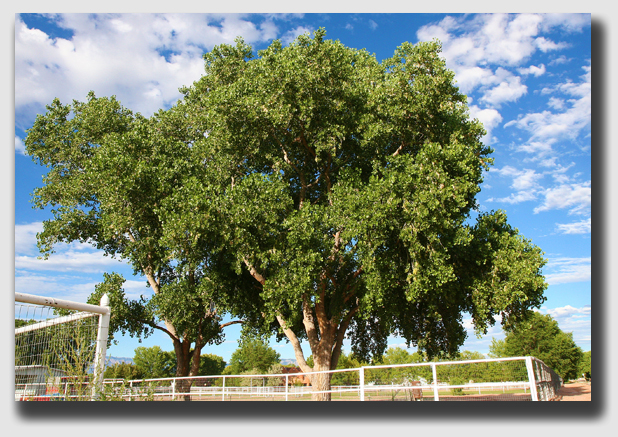
Ms. Garcia suffered encroachment from a copse of boundary-tree elms for a long time, perhaps too long a time, without doing anything about it. She could have trimmed roots and branches that intruded into her alfalfa fields years before – New Mexico law let her do that – but she fretted and stewed in silence. When she finally wanted to take action, the elms were so big that the trunks themselves had crossed the property line. Her “self-help” would have killed the trees.
The lesson? As Ed McMahon used to adjure us, “You must act now.”
Garcia v. Sanchez, 108 N.M. 388, 772 P.2d 1311 (Ct.App. N.M. 1989). This dispute between neighboring landowners involves trees originally planted on the defendant’s property which have overgrown and now encroach upon the plaintiff’s property. By the time Garcia bought her land in 1974, ten elm trees planted some years before near the common property line were well established. Although originally planted inside the defendant’s property line, over the years, the trees had reached full size and had grown so that nine of them were directly on the boundary, with the trunks encroaching onto the plaintiff’s property from one to fourteen inches.
Garcia used her land for growing field crops. Sanchez’s side had a driveway and residence. Garcia didn’t complain about the trees until 8 years after buying her property. Two years after her first complaint, she sued.
The trial court found Garcia’s actions in providing water and nutrients to her crops had caused the trees to grow toward her property, but it concluded that Sanchez negligently maintained the elm trees, allowing the roots and branches to damage the crops on Garcia’s property. The court also found that she had not suffered enough damage to warrant the removal of the trees and that cutting any substantial portion of the trunks of the trees would seriously harm them. The court found that yearly trenching of the roots and trimming of branches on Garcia’s side of the property line would essentially resolve any problems resulting from the encroachment of tree roots and overhanging branches on her property, so it ordered Sanchez to pay $420.80 for damage to Garcia’s alfalfa, to yearly trench the roots and trim the branches of the trees, and to provide water and nutrients to the trees in order to restrict their growth toward plaintiff’s property.
The parties appealed.

Elms make good boundary trees
Held: The Court of Appeals reversed and remanded. It held that the trees originally planted inside a property line, which had grown to encroach onto adjoining property along the boundary, were not jointly owned under the common boundary line test absent an oral or written agreement to have the trees form the boundary line between the parties’ property. It agreed that the trial court’s refusal to order that Sanchez remove the encroaching trees was not an abuse of discretion, observing that the trial court had tried to balance equities by weighing the value of trees against the agricultural character of the property involved and the nature of the harm suffered by Garcia.
But the Court of Appeals went further: it ruled that the harm caused to Garcia’s crops by the elms’ overhanging branches and tree roots is not actionable. Instead, following Abbinett v. Fox, the Court held that a plaintiff’s remedies are normally limited to self-help to protect against the encroaching branches and roots. But here, Garcia waited too long: her plan now, after years of suffering in silence, to remove a substantial portion of the root system or trunk of the encroaching trees (her Massachusetts Rule right) may endanger lives or injure Sanchez’s property, and that laches gives a court the right to limit the exercise of her self-help plan under its equitable authority.
The Court sent the case back to the trial court to determine whether Garcia’s failure to exercise self-help to control encroaching roots, branches and tree trunks over an extended period should preclude injunctive relief now.
– Tom Root



 Tree and Neighbor Law For Homeowners and Professionals