PRIDE GOETH BEFORE A FALL
Rural lawyers are quite familiar with the not-so-legal but all-too-real concept of being “homered,” a problem I mentioned a week or so ago.
 Being “homered” is a phenomenon that occurs when an out-of-town client, especially one represented by big-city out-of-town lawyers, appears in a small rural county courthouse on the opposite side of a case against a local resident represented by a local lawyer.
As a matter of law, it means nothing that the judge plays golf with the local lawyer, or that the local litigant had been sitting in the next pew over from the judge’s family for two decades or more. The law does not countenance favoritism, and the judge has taken an oath.
That’s the law. But it is not real life. As a matter of fact, you can be sure that Vicki Lawrence was wrong when she warned you not to “trust your soul to no backwoods southern lawyer.” Indeed, if your case against a big pipeline company is being heard in the local courthouse, there’s no one to whom you would be better advised to trust your soul, or at least your case, than that shambling wreck of an attorney who needs a haircut and is wearing his lunch on his jacket lapel.
The other side might have good lawyers, indeed, very good lawyers from very good law firms from the big city. But that clownish local yokel with the battered briefcase is a great lawyer… because he knows the judge.
When you’re actively homering your opponent, luck is on your side. Of course, as my beloved 2nd-grade teacher Minta Newmeyer taught me a few years ago, “luck” is defined as the result of preparation meeting opportunity. So having a couple of good-old-boy experts won’t hurt, and neither will not accepting everything the smarty-pants experts from the pipeline company say at face value.
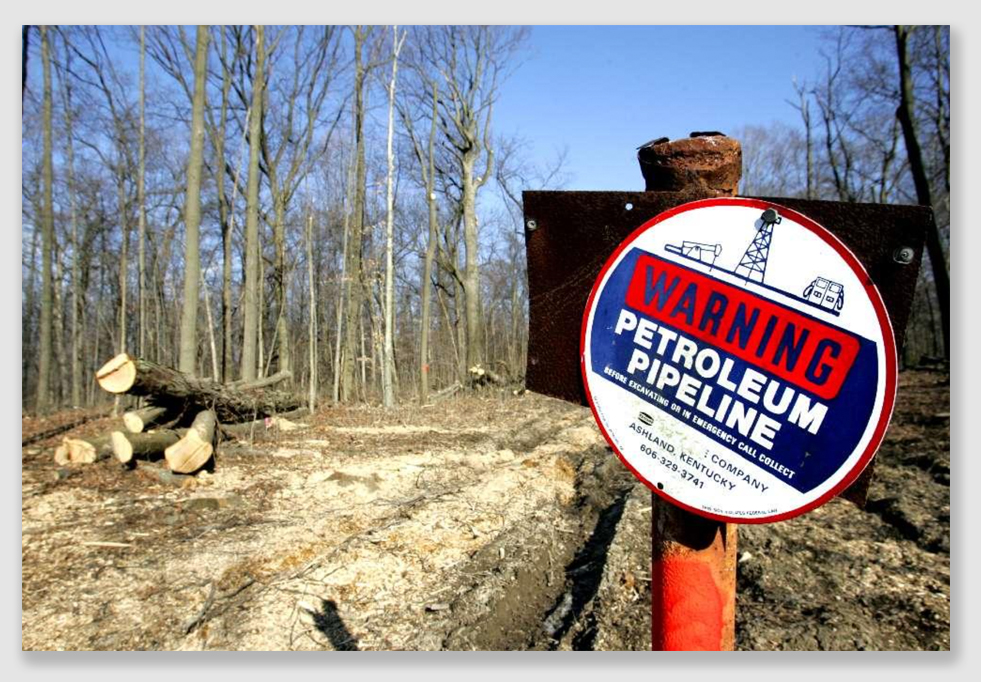
In today’s case, there is simply no way a longtime local landowner should have won against the big pipeline operator. When Buckeye Pipeline showed up at Bob Pichulo’s door after 25 years of silence wanting to clear-cut its easement, the company’s judgment that the trees should be removed should normally have been sufficient to carry the day. But Bob and his hometown legal talent found some experts of their own and – perhaps benefitting as well from the fair winds and following seas that result from homering the other side – pretty much beat the brakes off the haughty pipeline people.
 It hardly helped Buckeye’s cause that its case was largely one of ipse dixit. The pipeliner’s case could charitably be summarized as “we own the easement, and the trees need to be cut because we say so.” Even after being called on it, Buckeye continued to spin, saying the tree roots were dangerous to the pipeline because they said so, and the trees could make lightning strike the pipeline because they said so. It’s a bad idea to make outrageous claims that you cannot back up.
The moral: When you’re Goliath going up against David, try a little humility. And duck when he slings that stone.
Pichulo v. Buckeye Pipeline Co., 2019 Mich. App. LEXIS 261 (Ct.App. Michigan, Feb. 14, 2019). Bob Pichulo bought some property in Mount Morris Township back in 1992. Thirty-three years before the sale, the previous owners had granted Buckeye Pipeline an easement to construct and maintain an oil pipeline across the property.
Bob knew about the easement when he bought the place. Yet it hardly affected him for about 23 years. Then, in 2015, Buckeye sent him a letter informing him of Buckeye’s intent to remove 13 Norway maple trees that were on the easement. Buckeye asserted that the trees had to be removed because they obstructed aerial surveillance of and access to the pipeline in case of an emergency or for repairs. In response, Bob sued seeking a temporary restraining order and permanent injunction against cutting the trees.
After an evidentiary hearing on the preliminary injunction motion, the trial court ordered that all underbrush be removed from the easement and the branches on the Norway maples be trimmed to provide a 10-foot clearance.
Buckeye later moved for summary disposition of Bob’s complaint, arguing that it was entitled to remove the trees as a matter of law. Bob responded that there was a real question whether the removal was reasonably necessary for Buckeye’s use of the easement. The trial court agreed with Bob.
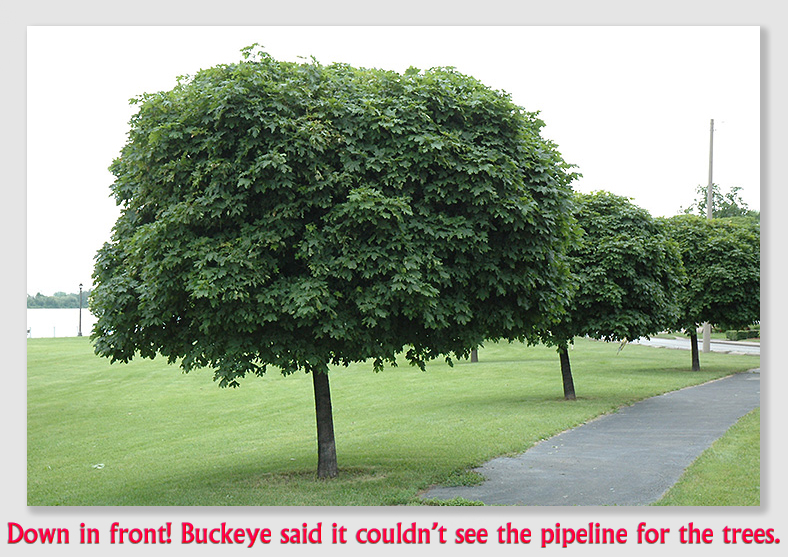
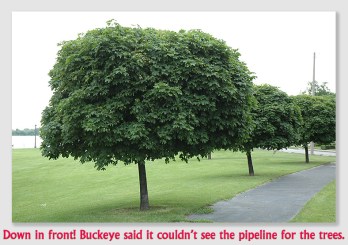 Over the course of the four-day trial that followed, the trial court heard Bob’s testimony about the value of the trees to him; pilots’ testimony about the visibility of the pipeline easement after the clearing of underbrush and pruning of the trees; testimony from an expert who estimated that the trees were older than the pipeline, grew shallow roots and had a monetary value of nearly $50,000; and testimony from experts in oil pipeline regulation, maintenance, and safety who disagreed about whether Buckeye’s proposed plan to remove the trees was reasonably necessary for its enjoyment of the easement.
The trial found Bob’s evidence to be more credible and convincing and held that the removal of the Norway maples was not reasonably necessary. Consequently, it permanently enjoined Buckeye from removing them.
Buckeye appealed.
Held: Bob was entitled to his permanent injunction.
Buckeye argued that it was entitled to judgment as a matter of law. Its argument, in essence, was that it had the easement for the purpose of maintaining its pipeline and cutting down the trees was maintenance. No one could question Buckeye’s judgment that the trees should go.
An easement is a right to use the land burdened by the easement rather than a right to occupy and possess the land, as does an estate owner. The use of an easement must be confined to the purposes for which it was granted, including any rights incident to or necessary for the reasonable and proper enjoyment of the easement, which rights are to be exercised with as little burden as possible to the owner of the land.
When considering the scope of an easement, a court must discern the parties’ intent as shown by the plain language of the document granting the easement. “Where the language of an easement is plain and unambiguous,” the Court said, “it is to be enforced as written and no further inquiry is permitted… Under our well-established easement jurisprudence, the dominant estate may not make improvements to the servient estate if such improvements are unnecessary for the effective use of the easement or they unreasonably burden the servient tenement.”
There was no question the easement gave Buckeye a “right of way” and “free ingress and egress,” for the purpose of constructing, maintaining, operating, altering, repairing or removing the pipeline. And “maintenance” in an easement generally includes the right to clear “the property [of trees] to ensure maintenance and inspection,” the term “maintenance including maintaining the property in the appropriate condition so that it is accessible in the event that repair of the pipeline is required.” What Buckeye proposed to do by removing the trees was undoubtedly encompassed by the right of maintenance.
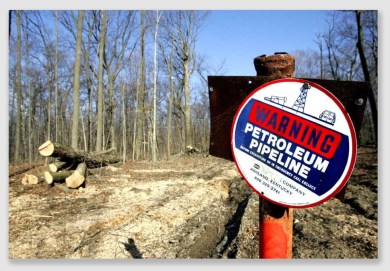 Buckeye argued that this conclusion required the trial court to grant it summary disposition. But a trial court also is required to consider “(1) whether the tree removal is needed for Buckeye’s effective use of the easement and (2) whether the tree removal unreasonably burdens Bob’s servient estate.” Those questions, the Court wrote, are in regard to the extent and scope of the easement, and generally are questions of fact.
Bob and Buckeye presented competing testimonial and documentary evidence regarding whether aerial surveillance of or access to the pipeline was unreasonably obstructed by the trees. Thus, the Court concluded, there remained a question of fact as to the extent of the burden presented by the trees and their roots with respect to potential emergencies and repairs. In light of such questions of fact to be decided at a trial, Buckeye was properly denied summary judgment.
That was especially true because the trial court made reasonable findings of fact that undercut Buckeye’s claims. Buckeye said the trees had to go in order to give Buckeye access to the right-of-way and the pipeline, to respond to emergencies as they arise, and to remove the risks that the tree roots posed to the pipe. Buckeye’s expert, William Byrd, testified that the trees and their roots inhibited Buckeye’s access to the pipeline because excavation equipment could not reach the pipeline in an emergency. Byrd opined that the removal of the trees was reasonably necessary for future maintenance and that such actions were common in the oil pipeline industry. Bob contradicted that evidence with testimony from his own expert Richard Kuprewicz. Rich concluded that the removal of the trees was not reasonably necessary in anticipation of potential maintenance. He said federal regulations did not declare a set width for pipe excavation and opined that removal of the trees to access the pipeline when the time for such maintenance came would not significantly extend the time required to perform such excavation, should the need arise.
The trial court found Bob’s expert to be more credible when he said there was already adequate space to access the pipeline and that the potential requirement to remove the trees before performing any excavation, if needed, would not cause a significant delay. The appellate court gave deference to the trial court’s findings of fact.
Buckeye also argued that the trial court clearly erred by finding that it is not permitted to remove the trees in anticipation of a future emergency. Buckeye introduced testimony that the Norway maples would present a significant burden both in identifying an emergency and accessing the pipeline in case of an emergency. Buckeye’s patrol pilot testified and provided photographs showing that his aerial view of the pipeline and easement was obstructed by the trees. Buckeye’s agent also testified that the trees would significantly delay Buckeye’s ability to properly access the pipeline. He noted that federal regulations required Buckeye to prepare an emergency plan. Buckeye already has such a plan, but to carry it out, it argued, it must remove the trees in question.

Mark Twain says there are none of these …
Bob’s evidence contradicted Buckeye’s claims. He elicited testimony from another pilot that the easement around the pipeline plainly was visible when flying past the property at the proper angle. Bob also provided photographs showing an unobstructed view of the pipeline, which is identified in the photographs by the presence of yellow tape. His expert Rich, meanwhile, testified that in cases of emergency, it would be entirely improper and unsafe to rush to the scene of the leak with large machinery and to begin excavation. Instead, he testified, the s pipeline had internal sensors that allowed for the identification of leaks in general areas, which could then be isolated and the flow of oil through that area stopped. This effectively reduced the amount of environmental contamination without having to rush in with dangerous machinery.
While Rich agreed that federal regulations required an emergency plan, he pointed out that the regs did not require the removal of any trees.
The trial again found Bob’s expert to be more credible. With respect to locating an emergency via aerial surveillance, the trial court relied on the pilot’s photographs and testimony establishing that the pipeline was visible. Because the trial court’s decision on this issue relied on admissible and compelling evidence in the record, the Court of Appeals said, it was not clearly erroneous and thus carried the day.
The Court said, “Given our deference to the trial court’s credibility determinations and [its] decision to believe [Rich] instead of Buckeye[‘s] expert and the trial court’s reliance on admitted evidence, the record presented does not provide any reason for us to be “left with a definite and firm conviction that a mistake has been made. Thus, based on the facts as found by the trial court, Buckeye’s request to remove the Norway maple trees was not reasonably necessary for Buckeye to prepare for an emergency.
 Finally, Buckeye argued that the trees had to be removed because their roots presented a danger to the pipeline. In support of that, its expert testified that tree roots acted as conduits for electricity, so they could cause lightning to strike the pipeline. In addition, Buckeye presented evidence that the roots potentially could grow toward and eventually chip away at the pipes, and its expert testified that the tree roots could entangle the pipeline, causing damage. On cross-examination, however, he acknowledged that he was aware lightning strikes could happen but did not know of any specific examples. Bob countered with expert testimony from an arborist who testified that the root system of a Norway maple stays in the top 10 inches of soil, which is above the pipeline. As to the tree roots and potential pipeline erosion, Bob’s expert explained that the pipeline’s cathodic protection would be able to provide a timely alert that a tree root was encroaching on the pipeline and, if that failed, other tools could be used to identify external corrosion of the pipeline.
The trial court again found Bob’s evidence more credible, weighing the fact that Buckeye’s expert could not identify any particular instance where a lightning strike on a pipeline had been conducted by a tree root. Considering that evidence in light of the arborist’s testimony that the tree roots did not go as deep as the pipeline and Rich’s testimony that Buckeye would be alerted to any encroaching root in a timely manner, the trial court found that removal of the trees was not reasonably necessary for Buckeye’s maintenance of the pipeline. The Court of Appeals held that the trial judge’s conclusion was not clearly wrong and thus had to be accepted.
In sum, the Court of Appeals said,
Buckeye asserted that the Norway maple trees had to be removed because they were a danger to the pipeline and an obstruction to surveillance and access. Buckeye’s contentions rely on a misapplication of the law in Michigan with regard to easements. Buckeye, under the terms of the easement at issue here, does not have the right to ensure freedom from any and all obstructions or dangers to the pipeline. That simply is not the standard for such inquiries. Instead, Buckeye’s rights under the easement are limited to freedom from unreasonable obstructions or dangers. The extent, or reasonableness, of the obstruction presented by the trees is a fact question for the trial court to decide and it did so here. The trial court, after considering all of the evidence and weighing the credibility of the witnesses, decided that removal of the Norway maple trees was not reasonably necessary for Buckeye’s maintenance, operation, or repair of the pipeline.
– Tom Root


 Denise tried futilely to undo the consequences of her earlier indolence. Alas, a stitch in time saves nine. The Court ruled that she had had plenty of notice, but her decision to ignore the lawsuit was her problem, and undoing the default she so richly deserved would have turned her problem into her neighbors’ problem. And they were already smarting from the loss of their trees.
 The Court reminded the defendant that if she really had found the damage showing to be flawed and superficial, she could have come to the hearing and contested it. Snooze and lose, indeed.
 The rule is, however, flexible in its application. The ultimate goal is compensation for the harm or damage done. Thus, a court may apply whatever method is most appropriate to compensate a plaintiff for his or her loss. Here, the Court said, given the fact that the Bolognas’ trees could be restored, it was proper for the trial court to use the cost-of-restoration method.











 Tree and Neighbor Law For Homeowners and Professionals