Case of the Day – Friday, July 19, 2024

THE MASSACHUSETTS RULE LIVES!

We should all age this well. Right, Joe?

The Massachusetts Rule, which we have rightly or wrongly identified as the wellspring whence flows all tree law on encroachment, is a spry 93 years old this year. Older even than our current President. Over the years, other states have chipped, chipped, chipped away at its granite-solid underpinnings, the notion that your neighbor has no right to sue you if your healthy tree sends branches spanning over her property or roots snaking through her subsoil.

After being belted and flayed by decisions from a host of more encroachment-progressive states over the years, the Massachusetts Rule finally received some good news two days ago: Massachusetts’ highest court issued an opinion that was a full-throated defense of the venerable Rule.

Don’t like the mess your neighbor’s honey locust makes in your gutters? Or the way his sweet gum roots are displacing your basement wall? Tough noogies. The Massachusetts Rule holds that you are free (at your expense, so maybe we should not use the word “free”); that is, you are entitled to cut down the offending branches or dig up the offending roots up to your property line with his place.

What you are not free to do is to sue your neighbor because his tree is a nuisance. As the Bay Staters put it, your rights are limited to self-help.

To be sure, the Massachusetts Rule has gotten a raft of bad press in the last few decades. Hawaii is the most famous, with the Hawaii Rule (set out in Whitesell v. Houlton). That rule holds that your neighbor is liable to you if encroaching branches or roots from her tree cause “sensible harm” to your property. Complaints that the Massachusetts Rule was archaic, a relic of an era when population density was much less and life was simpler, have become common. Don’t believe it? Refer to the definitive decision assessing the various rules, Herring v. Lisbon Partners, for the modern view that the Massachusetts Rule is an arboreal dinosaur.

Well, it turns out the old dinosaur still has a bite. A Massachusetts litigant with more spare change for legal fees than she had common sense sued her neighbor because, she claimed, the neighbors’ stately oak caused algae to grow on her roof. She demanded her neighbors cut it down. They declined, pointing out to her that the Massachusetts Rule immunized the owner of a healthy tree from such an obligation, and, by happy coincidence, they were all in Massachusetts, so the Rule applied to them.

The neighbor was undeterred, and she hired a lawyer (who undoubtedly told her she was backing the wrong horse). But back it she did. She lost in the trial and appeals courts, both of whom took pains to explain the Massachusetts Rule to her.

“But,” we imagine she said, “the Massachusetts Rule is a doddering fossil, rejected by just about all modern thinking in our sister states’ courts! It should be consigned to the dustbin of history!”

But the Supreme Judicial Court of Massachusetts seized the opportunity not only to refuse to undo the plucky 87-year-old Rule but to explain how all the other states who had rejected it as irrelevant in the modern day and age are just plain wrong.

Famous Massachusetts patriot John Adams died on July 4, 1826. His last words were reputed to be a joyful acknowledgment that his old friend, Thomas Jefferson, survived him. As he expired, Adams breathed, “Jefferson lives!

He could have said the same about the Massachusetts Rule. Despite all the grief that the Herring court, the Fancher court, the Lane court, and even the Whitesell court have given it, the Rule still lives.

Shiel v. Rowell, Case No. SIOC-1274 37, 480 Mass. 106, 101 N.E.3d 290 (Sup.Jud.Ct. Mass, 2018). Keli-Jo and John Rowell owned property next to Mary Shiel. The Rowells’ property included a 100-foot tall sugar oak tree with majestic branches that stretched over Mary’s property.

Alas, Mary was not a fan of the tree. She complained that the tree caused algae buildup on her roof. She demanded that the Rowells cut it down. They refused. So Mary sued, demanding money for damage to her roof and an injunction ordering the Rowells to cut back the branches overhanging Mary’s land.

A District Court judge dismissed Mary’s claims, on the ground that under Massachusetts law, a person whose property is injured by a neighbor’s healthy tree has no cause of action against the tree’s owner. The appellate court agreed.

Mary appealed to the Supreme Judicial Court, admitting that the Massachusetts Rule was against her but asking that the Rule be thrown out as antiquated.

Held: The Massachusetts Rule remains the law.

The law in Massachusetts has long been that a landowner may not hold a neighbor liable for damage caused by that neighbor’s healthy tree.

In Michalson v. Nutting, roots from Nutting’s poplar tree clogged the Michalsons’ sewer and drain pipes, and cracked his concrete cellar, risking serious damage to the house’s foundation. The Court concluded that Mr. Nutting could not be held liable for that damage because “an owner of land is at liberty to use his land, and all of it, to grow trees.” The Court recognized Mr. Michalson had the right to cut off intruding boughs and roots and reasoned that “it is wiser to leave the individual to protect himself, if harm results to him from this exercise of another’s right to use his property in a reasonable way, than to subject that other to the annoyance, and the public to the burden, of actions at law, which would be likely to be innumerable and, in many instances, purely vexatious.”

Mary urged the Court to adopt the Hawaii Rule, which grants neighbors the right to sue to resolve disputes in court over healthy trees. A neighbor may use the courts to require that the tree owner pay for damage and cut back branches and roots if the tree causes, or there is an imminent danger of it causing, “sensible harm” to the neighbor’s property. The Hawaii Rule, like the Massachusetts Rule, allows any landowner the right to cut back overhanging branches or intruding roots from a neighboring landowner’s tree. But unlike the Massachusetts Rule, the Hawaii Rule offers the aggrieved homeowner a right to sue to have branches and roots removed by the tree’s owner.

Mary argued the Massachusetts Rule is outdated because these days people are living in closer proximity to one another on smaller tracts of land than when the Massachusetts Rule was adopted. She contended that trees today are more likely to cause damage to neighbors’ property than in days past, and tree owners are better able to manage their trees. This, she maintained, justifies giving parties a right to sue to resolve disputes in court.

The Rowells argued in favor of stare decisis, the doctrine that courts should adhere to rules previously adopted in resolving similar cases. While adhering to stare decisis is not an inexorable command, the Court held, it is “our preferred course because it promotes the evenhanded, predictable, and consistent development of legal principles fosters reliance on judicial decisions, and contributes to the actual and perceived integrity of the judicial process.”

Even more than that, the Rowells maintained, the Massachusetts Rule is more sensible than the Hawaii Rule. The Court agreed. “We would discern a need to change the Massachusetts Rule if it were outdated and no longer fit the circumstances of contemporary life,” the Court said. But, the Court ruled, the Rule is still very relevant.

It may be true that people today are living in closer proximity to one another on smaller tracts of land than they were when the Massachusetts Rule was adopted in the early Twentieth Century. But if changes in property ownership would lead us to believe that tree owners are now better able to monitor their trees,” the Court said, “the same would be true for their neighbors to monitor and trim encroaching trees. It may be easier to recognize impending or potential harm to one’s own property from overhanging branches and intruding roots than it would be for the tree owner to recognize what is happening next door. And even if it is also true that trees today are more likely to cause property damage to neighbors’ property, it would be “undesirable to categorize living trees, plants, roots, or vines as a ‘nuisance’ to be abated.”

The Court recognized that other states, such as North Dakota, Tennessee and Virginia, had declared the Massachusetts Rule to be an antique. The Court rejected the rationales in those cases, observing that while the cases all said the Massachusetts Rule was outdated, none ever explained satisfactorily why that would be. True, as those decisions noted, the Massachusetts Rule law arose at a time when land was so unsettled and uncultivated that the burden of inspecting it and putting it in a safe condition would have been unduly onerous and out of all proportion to any harm likely to result. But this rationale seemed to apply to danger trees only. If a tree is healthy, it does not need to be put “in a safe condition” to begin with, and Massachusetts Rule trees must be healthy trees to begin with in order to come within the Rule.

Mary did not identify any consequences of the Massachusetts Rule, the Court observed, that would not have been thoroughly appreciated by when the Rule was adopted. The growth of trees “naturally and reasonably will be accompanied by the extension of boughs and the penetration of roots over and into adjoining property of others,” the Court declared in Michalson, and that has not changed.

Contrary to the criticisms of the Rule, the Court ruled, “multiple benefits to the Massachusetts Rule [are] still relevant to circumstances of contemporary life. The rule simplifies the assignment of responsibility, leaving no doubt as to the rights and obligations of the parties and minimizing legal costs. It reduces “unnecessary burdening of courts” and vexatious lawsuits: “The Massachusetts Rule today, just as it did when Michalson was decided,” the Court found, “may prevent unnecessary legal harassment from neighbors who merely have an axe to grind for reasons other than purported tree problems.”

Thus, the Court ruled, “We retain the law that an individual whose property is damaged by a neighbor’s healthy tree has no cause of action against a landowner of the property upon which the tree lies.”

The dinosaur still roars.

– Tom Root

TNLBGray140407

Case of the Day -Tuesday, July 2, 2024

NOW LOOK WHAT YOU’VE DONE!

Rarely (as in “I don’t recall when I’ve ever said this before”) do I caution that the prevailing law in any particular state is wrong, and likely to be cruisin’ for a bruisin’ the next time an appellate court has to think about it. But I feel comfortable issuing that warning about today’s case.

From Ohio (home of rock ‘n roll, pro football, the first guy to walk on the moon, the brothers who turned a bicycle into the first airplane, and a ton of other cool things), comes a case that pretty much runs smack into Fancher, Herring, the Hawaii Rule, and a raft of other cases reflecting the modern view that a homeowner whose tree is wreaking havoc on the neighbor’s property may be ordered by a court to fix the damage at his expense.

To be fair, this case may be proof of the old legal aphorism that “hard cases make bad law.” Even the most cursory reading of the facts suggests that Dave Rababy may well have been a horse’s ass, hounding his neighbor because a tree dropped leaves and twigs on his property. Speaking as a guy who owns all of my five southerly neighbors’ leaves every fall – and these things are the size of dinner plates – I understand how it can be irritating to have other peoples’ leave on your lawn. But I would never sue them over it. I don’t think I would…

Dave had no such compunction, and his emesis of woe delivered to the court made him the boy who cried wolf. He howled so loudly about leaves and twigs and that his trimming crew was not allowed to trespass on Roy’s property and hack away at the offending tree, and minutiae of a similar nature, that his real complaint – his driveway was being heaved and foundations dislodged by the roots – got lost in the underbrush. In Fancher, Whitesell and even Iny, such damage was enough to get the neighbor’s tree declared a nuisance. If Dave had exercised a little plaintiff self-control, he might have gotten there, too.

We are too urban and too suburban, and our properties are too developed for the Massachusetts Rule to be the exclusive remedy for genuine harm done by a neighbor’s tree. That is the way the law is trending throughout the civilized world, and it is bound to reach Ohio sooner or later.

Rababy v. Metter, 30 N.E.3d 1018 (Ct.App. Cuyahoga Co., 2015). David Rababy and Roy Metter were next-door neighbors. Dave’s driveway abutted Roy’s property in certain places and nearly abuts in others. A fence separated the properties, and a stand of mature trees ran along the fence on Roy’s side of the boundary line.

Dave sued Roy for negligence, nuisance, trespass, and interference with a business contract. Dave asserted that trees at the edge of Roy’s property extended over his own property, and dropped leaves, needles, sap, and branches onto his car and home, and that some of the trees were rotten. He said the trees cast shadows over his property and cause mold growth on his roof, as well as damaged his driveway and foundation.

Dave complained he had a company to trim the overhanging branches, but Roy’s daughter prevented the unnamed landscape service company from properly performing this work. The complaint alleged the trees constituted an ongoing nuisance and trespass and that Roy negligently maintained the trees. Dave asked for $52,500: $37,000 for future tree trimming services and $15,000 in compensatory damages.

Both parties filed motions for summary judgment. Dave argued that on “an ongoing basis, Roy’s trees encroach onto my property, specifically over my home and driveway. His trees deposit leaves, debris, and sap onto my property, causing damage.” Dave also repeated the claim about Roy’s daughter running off the tree trimmers.

Roy argued that he owed no duty to Dave to trim otherwise healthy trees on his property. He claimed the trees were mature and preexisted either party’s ownership of the property. He said that a year before, Dave hired Cartwright Tree Service to trim the row of pine trees that ran along the driveway. He said no one complained when Cartwright trimmed the overhanging branches from Dave’s property free, but when Cartwright began trimming branches and trees back further than the property line, Roy’s daughter objected. Roy said that he has no objection to Dave trimming the overhanging branches back to the property line.

Dave replied with new allegations that the trees in question were decaying or dead. Attached to the reply was a new affidavit that averred that the trees were decaying and dangerous and that one had fallen on his property. He included a picture of a tree that appears to have fallen across a driveway. However, the affidavit was neither signed nor notarized.

The trial court granted Roy’s motion for summary judgment and denied Dave’s. Dave appealed.

Gen. Robert E. Lee – a man rapidly being consigned to the ash head of history – knew something about duty … and even he couldn’t have found that Roy owed one to Dave.

Held: Roy owed Dave no duty, so the trial court’s dismissal of the case was upheld.

In order to succeed in a negligence action, the Court said, Dave must demonstrate that Roy owed him a duty, that Roy breached the duty, and that he suffered damages that proximately resulted from Roy’s breach. Here, Dave offered evidence that falling pine needles, leaves, sap, and sticks had damaged his car, driveway, and roof. He also alleges, without evidentiary support, that encroaching tree roots damaged his driveway and home.

While he showed damage, Dave was unable to show that Roy owed him any duty. A landowner is generally not responsible for the losses caused by the natural condition of the land. Instead, the Court observed, states generally allow one impacted by such growth the remedy of self-help. A privilege existed at common law, such that a landowner could cut off, sever, destroy, mutilate, or otherwise eliminate branches of an adjoining landowner’s tree that encroached on his land. But, the Court said, whether a separate remedy exists is an open question.

The Massachusetts Rule provides that in almost all circumstances, the sole remedy for damages resulting from the natural dropping of leaves and other ordinary debris from trees is the common law remedy of self-help. The rule does provide a limited exception for dead trees, just as Ohio has established a duty for urban landowners of reasonable care relative to the tree [hat overhangs a public street, including inspection to make sure that it is safe.” Where constructive or actual knowledge of an unreasonably dangerous condition exists on the land of an urban landowner, such as a dead tree, the duty prong of a negligence claim may be satisfied.

The reasoning set forth in support of the Massachusetts Rule, the Court said, is apt to the facts of this case: “[T]o grant a landowner a cause of action every time tree branches, leaves, vines, shrubs, etc., encroach upon or fall on his property from his neighbor’s property, might well spawn innumerable and vexatious lawsuits.” The Court thus adopted the Massachusetts Rule as the law of this jurisdiction.

But Dave also argued that in Ohio a “landowner in an urban area has a duty to exercise reasonable care to prevent an unreasonable risk of harm to others from decaying, defective or unsound trees of which such landowner has actual or constructive notice.” Dave contended Roy’s trees were in such a defective condition and thus constituted a nuisance. Dave also argued that Roy, an urban landowner, had a duty to inspect his trees and protect others from a dangerous condition created by any unsound trees. Even if such a duty existed, the Court said, it only is breached when the owner has actual or constructive notice of a dangerous condition.

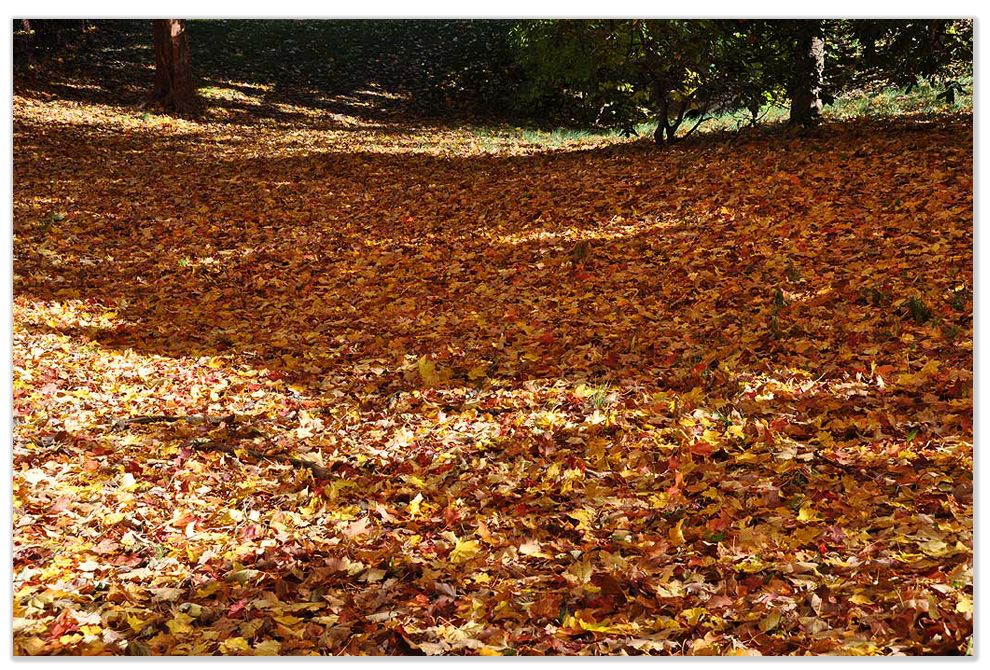
Leaves – often a pain in the arse, but seldom a nuisance

The Court held that Dave put forth no evidence that any of the trees constituted a dangerous condition of which Roy was aware or should have been aware. He presented no any evidence that the trees are dead, decaying, or unsound, and cited no case holding that “the normal yearly life-cycle of a tree and the natural shedding of leaves, twigs, and sap constituted a nuisance. Thus, he provided no compelling justification for a court to hold that Roy’s trees case constituted a nuisance or a dangerous condition. The problems Dave had experienced with the trees “are the natural consequence of living in an area beautified by trees. Dave’s remedy is to trim tree limbs that overhang his property back to the property line, to which Roy averred he has no objection.”

The trees at issue in this case do not constitute a nuisance, and Roy is not negligent in regard to them.

Dave also asserted that the trees on Roy’s property constituted a trespass. But the elements of a successful trespass claim include an unauthorized intentional act, and entry upon land in the possession of another. Here, there is no intentional act. Dave claimed that Roy’s actions of not removing or trimming the trees constitute an intentional act. But, the Court said, as it explained, Dave’s remedy for intrusion by vegetation is to trim it back to the property line.

In sum, Dave’s claims that detritus falling from trees from the neighboring property constituted a trespass, a nuisance, and negligence were simply not actionable. The Court cited a Maryland case that “it is undesirable to categorize living trees, plants, roots, or vines as ‘nuisances’ to be abated. Consequently, we decline to impose liability upon an adjoining landowner for the ‘natural processes and cycles’ of trees, plants, roots, and vines.”

– Tom Root

TNLBGray140407

Case of the Day – Wednesday, June 5, 2024

WE OWN IT ALL

Over the years, these august blogs have pretty much settled the question of a landowner’s right to trim his or her neighbor’s trees to the property line – the Massachusetts Rule – whether the trimming is above the ground (branches) or below the ground (the roots). But what if the trimming kills the tree or – as in today’s case – makes it fall down?

The answer can be found in the ancient Latin maxim “cujus est solum ejus est usque ad coelum et ad inferos.” I recognize that every time I trot out any Latin, I fondly recall Mrs. Emily Bernges, my sainted Latin teacher from high school days (and those days were many days ago). I recall her again today because not only was she a crackerjack instructor and a gifted disciplinarian (in an all-male school with only two female teachers, she could calcitrare asinus when juvenile male asinus needed calcitraring), but she was able to instill in my young hormone-soaked teenage brain a love for writings of Marcus Tullius Cicero and Gaius Julius Caesar that remains with me several years later (try “57” as a good approximation).

So what would Emily tell us about today’s case? She would ring the hotel desk bell she kept next to her jar of pencils, say, “Class, attention!” and then explain that cujus est solum ejus est usque ad coelum et ad inferos translates as “to whomsoever the soil belongs, he owns also to the sky and to the depths.” We would protest that such can hardly be the state of legal affairs because that would mean that every satellite transiting the sky would be committing countless trespasses as it crossed the continent.

It is true, Emily would tell us (it seemed to me she knew everything, so her being versed in some medieval common law would hardly have surprised me), that the cujus est solum doctrine – a relic of the Middle Ages – has been somewhat abrogated by aviation. The Supreme Court severely curtailed the “to the sky” part of the rule during World War II, ruling in United States v. Causby that the amount of sky a landowner owned was paltry. However, the part of the cujus est solum doctrine addressing ownership of the depths is still pretty good law.

In today’s case, the excavation at the neighbor cancer center (a place that, unfortunately, is near and dear to my heart) pretty clearly caused the neighbor’s oak to fall, because a major part of the tree’s root system – that had grown onto cancer center property – was severed. The Alabama Supreme Court held that in excavating one’s property, a landowner should not negligently cut the roots of a neighbor’s tree. However,  the Court said, as long as the cutting was non-negligent, if the neighbor’s tree fell as a result, well, cujus est solum ejus est usque ad coelum et ad inferos to you, unlucky neighbor. 

That “negligent” versus “non-negligent” severing part of the ruling is puzzling. I’m not sure of the difference between negligent and non-negligent cutting, or for that matter, whether there even is a difference. If you own ad inferos (and the Court says you do own to the depths), and remove any roots you find while excavating your inferos, that appears to be your right… no matter whether you sever them with a backhoe, hire hungry beavers or even detonate a small nuclear device. It is the fact the roots were severed that caused the tree to fall, not how the roots were severed.

Harding v. Bethesda Regional Cancer Treatment Center, 551 So.2d 299 (Supreme Court, Alabama, 1989): Bethesda Regional Cancer Treatment Center hired general contractor GBB to build a concrete containment facility for a radiotherapy linear accelerator, part of Bethesda’s cancer treatment facility. The concrete containment facility was located along the property line separating BRCT land from the rear of the Hardings’ property.

A few weeks after GBB completed the excavation needed for site preparation, a large tree located on the Hardings’ property fell during a wind storm, damaging their home. The Hardings claimed trespass, contending that the excavation work had been conducted across their property line. They also sued in negligence, claiming that the root system of their tree was cut and the tree undermined during the excavation on Bethesda Regional’s property.

The trial court entered summary judgment in favor of BRCT and GBB. The Hardings appealed.

Held: BRCT and the contractor, GBB, were not liable to the Hardings.

Intrusion upon land without the consent of the possessor is an essential element of trespass quare clausum fregit. BRCT and GBB offered affidavits of the excavators that at no time did they encroach on the Hardings’ property, as designated by boundary line markers. The Court held that the affidavits shifted the burden to the Hardings to produce some evidence of encroachment. Dr. Harding’s affidavit averred that the “excavation and digging was done on what appeared to me to be my property… Mr. Lynn [a surveyor] advised me that in fact excavation work had been performed on my property.” But that affidavit was hearsay and speculation, the Court said, not admissible evidence.

The Court held that BRCT and GBB showed that the excavation work was done in a skillful, prudent, and workmanlike manner. Under Alabama law, a landowner has a right to excavate on his own property for a lawful purpose, close to the boundary line, as long as he does not endanger the lateral support of the adjoining property. The Hardings made no claim involving lateral support, but instead only complained that their tree roots, which intruded onto the BRCT property, were cut.

An adjoining landowner has a right to remove limbs that hang over his property. Given that right (enshrined in the Massachusetts Rule), the Court said, “An analogy can certainly be made regarding a property owner’s right to remove roots extending onto his property. This is especially true in light of the landowner’s right to excavate on his own land. To deny such a right would create an oppressive restriction on the use of one’s own land.”

The doctrine of cujus est solum ejus est usque ad coelum et ad inferos (“to whomsoever the soil belongs, he owns also to the sky and to the depths”) may have been qualified insofar as air flight and oil and gas law is concerned, the Court observed, but “it still extends to air space that can be occupied by limbs of trees, and, we hold today, to the depths that can be occupied by roots of trees.”

The owner of property has no duty to refrain from the non-negligent cutting roots of a tree that intrude upon his property. Here, the Court found, a civil engineer and land surveyor indicated in his affidavit that the survey of the lot showed “the location of a large hardwood tree which evidently blew over in a recent wind storm. The tree was on the property line and had been excavated underneath for construction of the adjoining parking lot… [O]ur opinion is that the wind blew the tree over because its root system had been cut and exposed.” An agricultural extension agent said in his affidavit that the “excavation [that cut the roots] made this tree highly susceptible to wind damage.” While these affidavits provided evidence that the tree roots had been cut and that the tree became more susceptible to wind damage because of the exposed root system, the Court said, they did not set forth any facts to establish negligent excavation.

– Tom Root

TNLBGray140407

Case of the Day – Thursday, May 23, 2024

GETTING BULLDOZED

bulldoze161229Yesterday, we tackled the first of several inter-related questions raised by an Iowa reader. She wrote that a neighbor planned to bulldoze a driveway along a steep grade right next to her land. She feared that the bulldozing would destroy root systems of her trees — many a century or more old — and so badly destabilize the slope that it would cause landslides that carried away her land.

We identified four questions in our reader’s inquiry. We tackled the first question yesterday, about trees that might be exactly on the boundary line, and we concluded that Iowa law would not let her neighbor take steps that would destroy them (such as wiping out the root systems) without our reader’s OK.

But that answer begs the question of what will happen to trees that are growing entirely on our questioner’s land but extend their branches or root systems onto the neighbor’s place. (The third question — what if the neighbor’s bulldozing causes the steep slope to collapse, bringing some of our reader’s land down as well — and the final question about whether our reader could get an injunction to stop the harm before it starts, will be addressed tomorrow.)

The short answer to today’s question is found in the century-old case of Harndon v. Stultz. That decision adopted what years later would be called the “Massachusetts Rule,” specifically that a landowner has no right to judicial help in stopping an encroaching tree from his or her neighbors, but he or she may trim its branches and roots back to the property line. Under the rule of Harndon, it would appear that the neighbor could bulldoze out the root systems that have grown onto his land without liability.

But we’re not entirely satisfied that this would be the answer. Remember first that the plaintiff in Harndon complained that the trees in question were damaging her land, the roots tying up the ground and the trees shading what otherwise would be cropland. The court didn’t have a lot of sympathy for her, but it did recognize that she was suffering because the tree was just doing what trees are doing.

The United States has been moving inexorably toward the Hawaii Rule, which provides a landowner judicial relief where the trees are nuisances, and not merely being trees. Witness the Virginia decision of Fancher v. Fagella, in which the tree was causing substantial damage to the plaintiff’s home. The obverse of this coin is illustrated in the question posed here: what happens when the neighbor is suffering absolutely no damage whatsoever from the trees in question? As our reader explained it, the neighbor merely wants to bulldoze a road on a steep slope along a very narrow piece of property. During the bulldozing, it’s likely that root systems will be severed and trees badly damaged or killed.

Our suggestion that there may be more to it than a century-old case suggests isn’t that far off. A California decision, Booksa v. Patel, already has held that a neighbor must act reasonably in exercising his or her self-help rights, and “reasonable” is expressed in terms of taking steps that are no greater than those needed to ameliorate the harm the neighbor seeks to correct. Professors Prosser and Keeton, in their seminal work The Law of Torts (5th ed. 1984) §57, say that a landowner has a privilege to make use of the land for his own benefit and according to his own desires, which is an integral part of our whole system of private property; but it has been said many times that this privilege is qualified by due regard for the interests of others who may be affected by it. The possessor’s right is therefore bounded by principles of reasonableness, so as to cause no unreasonable risks of harm to others in the vicinity.”

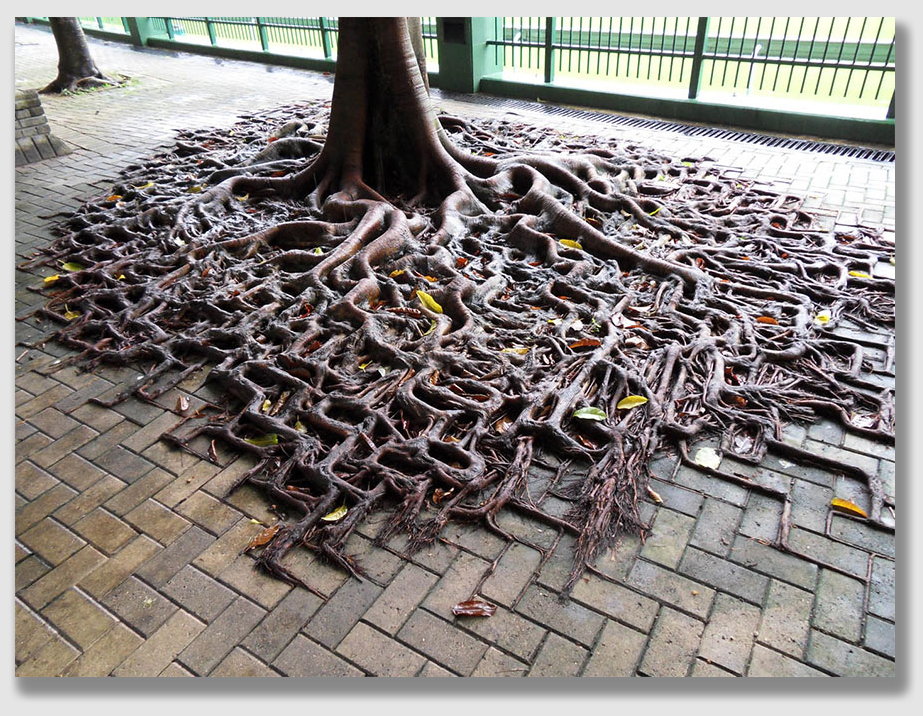
Remember, no one said our neighbor's roots are invasive.

Remember, no one said our neighbor’s roots are invasive.

In the case our reader has raised, it may well be that the time is ripe not to reverse Harndon v. Stultz, but rather to add to the body of law it represents by finding that a neighbor’s right of self-help is circumscribed by reasonableness. Under that standard, where a neighbor kills a tree by removing a root system, where the tree admittedly has caused no sensible harm to him, might be unreasonable.

It’s certainly something our reader’s Iowa attorney might want to consider.

Tomorrow: What if the bulldozing causes landslides on our reader’s property?

Harndon v. Stultz, 124 Iowa 440, 100 N.W. 329 (S.Ct. Iowa, 1904). Harndon and her husband owned and farmed an 80-acre tract of land. Stultz had 160 acres just to the south of the Harndon farm. Many years before, the Harndons planted a willow hedge along the entire south line of the farm, and later, Stultz extended the hedge eastward. The Harndons claimed that Stultz had agreed with them to maintain the west half of the hedge line and the Harnsons would maintain the east half. Some years later, the Harndons dug up the eastern half of the hedge, replacing it with a fence. Mrs. Harndon then demanded that Stultz do the same. Stultz refused, and she sued for an order finding the hedge to be a nuisance and requiring Stultz to cut it down. She argued that the willow had spread through the soil, and so much shade was cast by willows that it rendered a portion of the Harndons’ land unusable. As an alternative, the Harndons asked that, if Stultz had no duty to remove the hedge, they be allowed to do so at their expense. The trial court dismissed the petition, and the Harndons appealed.

Tomorrow - Could our reader's neighbor cause a landslide?

Tuesday – Could our reader’s neighbor cause a landslide?

Held: The Court adopted what was essentially the Massachusetts rule years ahead of its time. Nothing in the law, the Court said, made it a defendant’s duty to cut down a hedge or tree simply because, over a passage of time, the owner’s neighbor found the roots and the shade of the growing trees injured the productiveness of his land. The raising of trees, the Court held, is a legitimate use to which an owner may put his land. If the limbs of such trees overhang the land of a neighbor, he may cut them off at the line, and, if the roots penetrate the neighbor’s soil, he may dig them out, but that is the extent to which he may carry his objection.

The Court said that an adjoining property owner may cut off the overhanging branches of trees at the property line, and dig out the roots penetrating the soil on his land. However, that property owner is not entitled to compel the owner of the tree to cut it down, regardless of whether the care and maintenance were provided by the owner or by the adjoining property owner. On the other hand, the Court said, trees standing on the boundary line between lands of adjoining owners are the common property of both parties, which neither may destroy without the consent of the other. The Court upheld the trial court but modified the decree to let the Harndons remove the hedge at their cost, based on Stultz’s statement during oral argument on appeal that she didn’t object to its removal.

– Tom Root

TNLBGray

Case of the Day – Tuesday, May 21, 2024

SHORT AND SWEET

There have been more than a few recurring themes in our posts over the past decade-plus. Some of the most repeated are (1) hire a lawyer when you should have one, such as anytime you feel the need to sue someone; (2) courts follow prior decisions – called stare decisis – in order to bring certainty to the law; and (3) the Massachusetts Rule has traditionally been the law of the land, and while that has been changing, it is still the “go to” rule in most places.

Alas, Virginia Scott is not one of our regular readers. Had she been back in 2010 (and yes, we were around then, when people were still surfing the Web with their Packard Bell 286s sporting 56K modems), she would have consulted a lawyer about the mess that trees belonging to her neighbor, Julie, were making in her yard. She would have told the lawyer that she wanted damages for the dropped leaves and twigs, and she wanted to be compensated for what she paid tree trimmers to cut the offending branches and roots back to her property line.

The lawyer would have said, “Nothing doing,” or words to that effect, which would have saved Virginia the cost and aggravation of trying a do-it-yourself lawsuit against Julie. As well as having her hat handed to her by the trial court and the court of appeals.

“But,” Virginia wailed, “the law is stupid. It should be changed.” Notably, that argument has worked some places – Virginia, Hawaii, North Dakota – but Virginia had no idea how to press for modification of the rule, and the Court was unimpressed.

At least the Court of Appeals kept it short and sweet. As we will be…

Scott v. McCarty, 41 So.3d 989 (Fla.App. 4 Dist. 2010). Virginia Scott owned property next to Julie McCarty’s place. Dr. Julie had some pretty lush trees – this being Florida, plants like to grow there – and eventually some of the branches were overhanging Virginia’s place, and the roots were intruding underground.

Virginia sued the Doc for the damages Julie’s trees caused her property and for the cost of trimming the branches back to the property line and digging up the intruding roots. Apparently, having spent so much on damage repair and tree trimming, Virginia decided to save money on a lawyer and represented herself.

The trial court dismissed her complaint forthwith, citing the Florida common law rule that “a possessor of land is not liable to persons outside the land for a nuisance resulting from trees and natural vegetation growing on the land. The adjoining property owner to such a nuisance, however, is privileged to trim back, at the adjoining owner’s own expense, any encroaching tree roots or branches and other vegetation which has grown onto his property.”

This rule not seeming right to Virginia, she appealed.

Held: Virginia’s case was properly dismissed. The Court of Appeals said that the reason for Florida’s common-law rule “was that it was wiser to leave the individual to protect himself than to subject the other to the annoyance of actions at law which would likely be innumerable.”

On appeal, Virginia acknowledged that the common-law rule, first adopted in the 1987 Florida appellate case Gallo v. Heller, was the prevailing law, but she asked the Court to “take a different course.” The Court refused to do so, saying that “the Gallo view is the predominant view in the country… [and] departing from the precedent would invite further litigation between neighbors on this issue, which as a public policy matter should be avoided.”

– Thomas L. Root

TNLBGray140407