
WE OWN IT ALL
 Over the years, these august blogs have pretty much settled the question of a landowner’s right to trim his or her neighbor’s trees to the property line – the Massachusetts Rule – whether the trimming is above the ground (branches) or below the ground (the roots). But what if the trimming kills the tree or – as in today’s case – makes it fall down?
The answer can be found in the ancient Latin maxim “cujus est solum ejus est usque ad coelum et ad inferos.” I recognize that every time I trot out any Latin, I fondly recall Mrs. Emily Bernges, my sainted Latin teacher from high school days (and those days were many days ago). I recall her again today because not only was she a crackerjack instructor and a gifted disciplinarian (in an all-male school with only two female teachers, she could calcitrare asinus when juvenile male asinus needed calcitraring), but she was able to instill in my young hormone-soaked teenage brain a love for writings of Marcus Tullius Cicero and Gaius Julius Caesar that remains with me several years later (try “57” as a good approximation).
 So what would Emily tell us about today’s case? She would ring the hotel desk bell she kept next to her jar of pencils, say, “Class, attention!” and then explain that cujus est solum ejus est usque ad coelum et ad inferos translates as “to whomsoever the soil belongs, he owns also to the sky and to the depths.” We would protest that such can hardly be the state of legal affairs because that would mean that every satellite transiting the sky would be committing countless trespasses as it crossed the continent.
It is true, Emily would tell us (it seemed to me she knew everything, so her being versed in some medieval common law would hardly have surprised me), that the cujus est solum doctrine – a relic of the Middle Ages – has been somewhat abrogated by aviation. The Supreme Court severely curtailed the “to the sky” part of the rule during World War II, ruling in United States v. Causby that the amount of sky a landowner owned was paltry. However, the part of the cujus est solum doctrine addressing ownership of the depths is still pretty good law.
In today’s case, the excavation at the neighbor cancer center (a place that, unfortunately, is near and dear to my heart) pretty clearly caused the neighbor’s oak to fall, because a major part of the tree’s root system – that had grown onto cancer center property – was severed. The Alabama Supreme Court held that in excavating one’s property, a landowner should not negligently cut the roots of a neighbor’s tree. However, the Court said, as long as the cutting was non-negligent, if the neighbor’s tree fell as a result, well, cujus est solum ejus est usque ad coelum et ad inferos to you, unlucky neighbor.
That “negligent” versus “non-negligent” severing part of the ruling is puzzling. I’m not sure of the difference between negligent and non-negligent cutting, or for that matter, whether there even is a difference. If you own ad inferos (and the Court says you do own to the depths), and remove any roots you find while excavating your inferos, that appears to be your right… no matter whether you sever them with a backhoe, hire hungry beavers or even detonate a small nuclear device. It is the fact the roots were severed that caused the tree to fall, not how the roots were severed.
Harding v. Bethesda Regional Cancer Treatment Center, 551 So.2d 299 (Supreme Court, Alabama, 1989): Bethesda Regional Cancer Treatment Center hired general contractor GBB to build a concrete containment facility for a radiotherapy linear accelerator, part of Bethesda’s cancer treatment facility. The concrete containment facility was located along the property line separating BRCT land from the rear of the Hardings’ property.
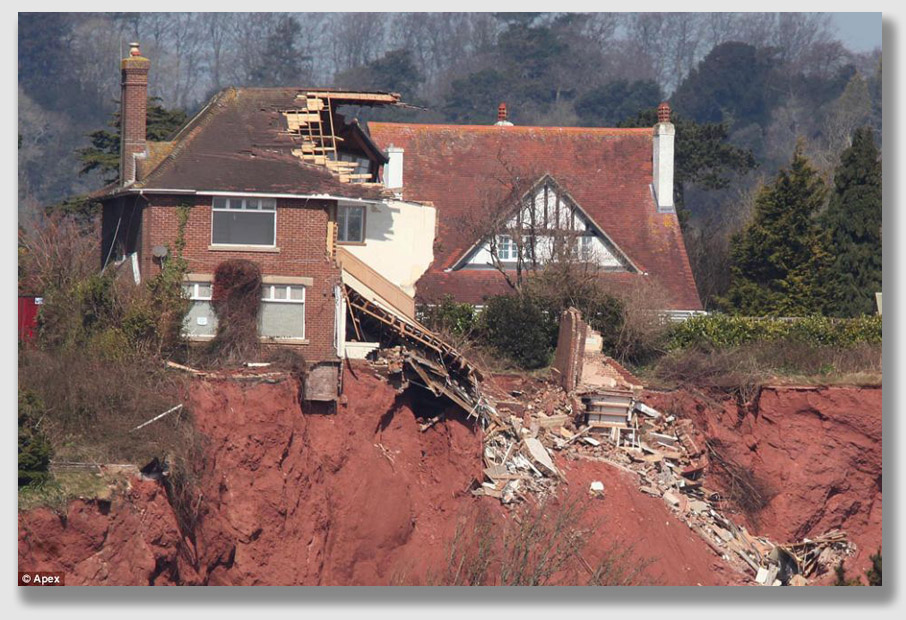
A few weeks after GBB completed the excavation needed for site preparation, a large tree located on the Hardings’ property fell during a wind storm, damaging their home. The Hardings claimed trespass, contending that the excavation work had been conducted across their property line. They also sued in negligence, claiming that the root system of their tree was cut and the tree undermined during the excavation on Bethesda Regional’s property.
The trial court entered summary judgment in favor of BRCT and GBB. The Hardings appealed.
Held: BRCT and the contractor, GBB, were not liable to the Hardings.
Intrusion upon land without the consent of the possessor is an essential element of trespass quare clausum fregit. BRCT and GBB offered affidavits of the excavators that at no time did they encroach on the Hardings’ property, as designated by boundary line markers. The Court held that the affidavits shifted the burden to the Hardings to produce some evidence of encroachment. Dr. Harding’s affidavit averred that the “excavation and digging was done on what appeared to me to be my property… Mr. Lynn [a surveyor] advised me that in fact excavation work had been performed on my property.” But that affidavit was hearsay and speculation, the Court said, not admissible evidence.
 The Court held that BRCT and GBB showed that the excavation work was done in a skillful, prudent, and workmanlike manner. Under Alabama law, a landowner has a right to excavate on his own property for a lawful purpose, close to the boundary line, as long as he does not endanger the lateral support of the adjoining property. The Hardings made no claim involving lateral support, but instead only complained that their tree roots, which intruded onto the BRCT property, were cut.
An adjoining landowner has a right to remove limbs that hang over his property. Given that right (enshrined in the Massachusetts Rule), the Court said, “An analogy can certainly be made regarding a property owner’s right to remove roots extending onto his property. This is especially true in light of the landowner’s right to excavate on his own land. To deny such a right would create an oppressive restriction on the use of one’s own land.”
The doctrine of cujus est solum ejus est usque ad coelum et ad inferos (“to whomsoever the soil belongs, he owns also to the sky and to the depths”) may have been qualified insofar as air flight and oil and gas law is concerned, the Court observed, but “it still extends to air space that can be occupied by limbs of trees, and, we hold today, to the depths that can be occupied by roots of trees.”
 The owner of property has no duty to refrain from the non-negligent cutting roots of a tree that intrude upon his property. Here, the Court found, a civil engineer and land surveyor indicated in his affidavit that the survey of the lot showed “the location of a large hardwood tree which evidently blew over in a recent wind storm. The tree was on the property line and had been excavated underneath for construction of the adjoining parking lot… [O]ur opinion is that the wind blew the tree over because its root system had been cut and exposed.” An agricultural extension agent said in his affidavit that the “excavation [that cut the roots] made this tree highly susceptible to wind damage.” While these affidavits provided evidence that the tree roots had been cut and that the tree became more susceptible to wind damage because of the exposed root system, the Court said, they did not set forth any facts to establish negligent excavation.
– Tom Root



 Tree and Neighbor Law For Homeowners and Professionals