Case of the Day – Wednesday, December 18, 2024

TAKING THE “EASE” OUT OF EASEMENT

It started out harmlessly enough. About 65 years ago, the owner of a piece of land gave some neighbors an easement to use a gravel driveway over his property in order to get to their own houses. But time marched on, the grantor of the easement moved elsewhere, and a few conveyances later, Chris Clark and his wife owned the property over which the easement ran (the “servient estate,” we call it).

The Clarks apparently liked neither the easement nor the easement holders. Chris argued that the easement and the driveway it surrounded were in the wrong place, but that complaint seemed to just be a makeweight for his general irritation over there being an easement at all. Trees and shrubs overgrew the gravel driveway, but when the easement holders would try to trim them back, Chris and his wife would threaten them, even calling the police on one occasion. Chris erected stakes and signs marking what he thought was the proper easement, leaving a width more suitable for a rattlesnake to negotiate than a car or pickup truck. It got so bad that even the fire department complained it could not get to the easement holders’ homes in the event of fire.

You could have made it easy, Chris. Read your deed, note the easement it reserved to the dominant estate, and then just go with the flow for a change… But not you: you’re the guy who intends to take the “ease” out of easement, but all you ended up doing – several years and a lot of legal fees later – was to find yourself under a permanent injunction that left you a lot more restricted than you would have been if you had just shaken hands with your neighbors and made it easy.

You can’t spell “easement” without “e-a-s-e,” but you can spell “l-a-w-s-u-i-t” without it if you put your mind to it.

Crittenden v. Clark, 2018 Ill.App.Unpub. LEXIS 2236 (Ct. App. Illinois, Dec. 18, 2018). The Crittendens and some of their neighbors had a permanent easement over Chris Clark’s property for purposes of getting to access their residences and businesses. The easement was improved with a gravel driveway, but memories clouded over exactly where it lay. Over the years, trees and bushes encroached on part of it, even as Chris got increasingly steamed at the easement holders.

The easement holders were equally unhappy with Chris. Whenever they attempted to maintain or improve the easement by removing trees and shrubs or even fixing potholes, Chris threatened them and called the cops. Later, Chris placed signs and metal stakes inside the easement area. The distance between the signs and stakes prevented the easement holders from getting through. Additionally, it was impossible for fire, emergency, and waste removal vehicles to access their properties properly.

There had been many other arguments between the holders and Chris related to the maintenance and use of the easement. Chris even threatened to move the driveway at one point.

Finally having had enough, the Crittendens and five neighbors sued Chris for a declaratory judgment that they had an “exclusive right to reasonable maintenance of the Permanent Easement at their expense to preserve their ingress and egress without unreasonable interference” from Chris. They requested an injunction prohibiting Chris “from interfering with the full rights of ingress and egress over the Permanent Easement, including a mandatory injunction ordering Defendant to remove the existing impediments to such access.” The Crittendens demanded attorney fees.

The trial court granted the injunction, ruling that the easement was 20 feet wide and 13.5 feet tall. Inside the easement area, Chris was prohibited from “inserting any object that would restrict or impede the use of the drive portion of the easement” by the easement holders. The injunction gave Chris until November 30, 2016, to trim the trees and remove any impediments, after which the easement holders could remove trees, shrubs and other impediments that interfered with the easement.

Chris appealed.

Held: The permanent injunction was affirmed.

Chris argued that the trial court erroneously granted a permanent injunction. He said the court should have simply affirmed “the existence of the Subject Easement as platted,” which he claimed should just be a 10-12 foot-wide gravel driveway rather than allowing the Crittendens to improve the easement with a wider drive. Chris argued that the court materially altered the easement, placed a greater burden on his servient estate, interfered with his use and enjoyment of the land, and exposed him to liability to the electric utility because the wider easement purportedly invaded the utility’s easement. Chris argued the easement holders suffered no irreparable harm and the equities did not favor their position.

The Crittendens cited trial evidence supporting the court’s finding that the defendant unreasonably interfered with their rights under the easements.

An easement is a right or privilege in the real estate of another. The Crittendens and their neighbors, the Court said, as the owners of the dominant estates are entitled to the “necessary use of the easements.” This means such use as is “reasonably necessary for full enjoyment of the premises,” including the right to maintain the easement. Easement holders may not, however, for the mere sake of convenience, “materially alter the easements so as to place a greater burden on the servient estate or interfere with the use and enjoyment of the servient estate by its owner.”

Chris, the Court said, as the owner of the servient estate may use his property for any purpose that is consistent with the easement holders’ use of the easement, provided Chris’s use does not materially interfere with or obstruct the use of the land as a right of way. The reasonableness of the use of an easement presents a question of fact that depends on the circumstances of the case.

Here, the Court ruled, the trial judge’s findings were supported by the evidence, and the injunction was not an abuse of discretion. Chris insisted the easement was only the existing 10-12’ wide drive, but the evidence showed the easement area is about twice that width. The rule is that the owner of a right of way for ingress and egress has the right to use the full width of the area or strip having definite boundaries, unhampered by obstructions.

This case depended a lot on witness credibility, and Chris’s habit of preventing the Crittendens from maintaining the drive, placing delineators and signs along the drive that made it impossible for two cars to use it at the same time, and planting lilacs within the easement area, did not help his case. The Court of Appeals held that “instead of altering the parties’ rights and obligations with respect to the easements, it is apparent that the trial court merely intended to allow plaintiffs to restore the drive to something approximating what it believed were the dimensions prior to the mid-2000s. It seems that the court also had safety concerns in mind.” The width the trial court allowed for the easement comported with a fire chief’s testimony about the requirements for this drive as a fire apparatus access road.

The Court dismissed Chris’s fear that he might encounter problems with ComEd if the width of the drive was changed, noting that the Crittendens’ easement predated ComEd’s utility easement, and ComEd’s own evidence showed that there was no clearance issue.

– Tom Root

TNLBGray140407

Case of the Day – Tuesday, September 24, 2024

IT DOES NOT MAKE SENSE

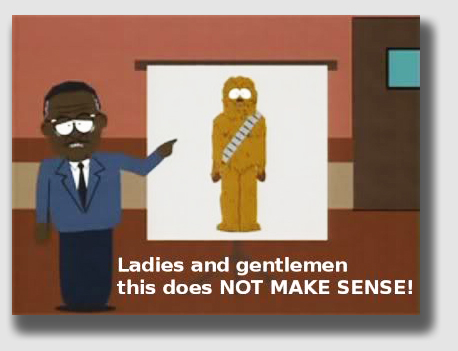
Every good trial lawyer knows how to employ the Chewbacca Defense.

Every good trial lawyer knows how to employ the Chewbacca Defense.

Sometimes you wonder when you read a decision, “What were they thinking? That does not make sense.”

Today’s case is something like that. The facts are straightforward enough. Smith sold a gas station-restaurant-bar to Mendonsa, but carefully secured Mendonsa’s promise that he wouldn’t let the trees on the plot get so high that they shaded Smith’s adjacent orchard. Wouldn’t you know it, Mendonsa at some point decided he liked tall trees, or he didn’t like trimming trees, or he couldn’t find his clippers, or something. He let the trees grow, and they shaded four of Smith’s something-berry trees (we have no idea what he was raising in the orchard, but this being California, they probably weren’t plantain trees).

Anyway, Smith sued, and Mendonsa, for some foolish reason, fought the action. The trial court found for Smith in due course and then worked some rump math, figuring the past damages were about $140.00 a year (this was 1952, when a dollar was worth a bit more than now), and multiplied over three years, the damages were $420.00 (or $4,862 in 2024 dollars). The Court also enjoined Mendonsa from maintaining trees over 15 feet or branches which were hanging over Smith’s land.

On appeal, Mendonsa complained that the damage calculations were too imprecise and that the injunction was unduly burdensome on him. The Court of Appeals disagreed, finding the calculations pretty good for an uncertain case, and anyway complaining that “[t]he wrong was that of the appellants and they are not in a favored position to urge the technical rules governing awards of damages.”

This case may be the legal equivalent of this - what were they thinking?

This case may be the legal equivalent of this – what were they thinking?

Huh? In the words of South Park’s parody of Johnnie Cochran in the legendary Chewbacca defense: “that does not make sense.” If the wrongdoer isn’t entitled to argue that the court has to follow the “technical rules” of assessing damages, then who is? It’s a cinch the plaintiff isn’t going to do anything to restrain the court in calculating damages. This is probably one of those “hard cases make bad law” kinds of decisions … but even so, it’s difficult to feel much sorrow for Mr. Mendonsa, who should have been enjoined and been made to pay damages.

A deal’s a deal, after all.

Smith v. Mendonsa, 108 Cal.App.2d 540, 238 P.2d 1039 (Ct.App. Cal. 1952). Smith entered into an agreement with Mendonsa concerning the use of a gas station, restaurant and bar he had sold to him. Mendonsa agreed that he would permit no trees to remain on the site which exceeded a height of 15 feet;, and that if any tree got taller than that height, Smith would have the right to remove the same. The purpose of the agreement was to prevent the shading of Smith’s orchard next door. land and to prevent trees on the appellants’ property from overhanging it. Mendonsa let the trees get too tall, and Smith sued to enforce the deal. The trial court agreed with Smith and awarded him money damages for past violations as well as an injunction prohibiting Mendonsa from maintaining any tree in excess of 15 feet in height or from permitting branches of any tree to overhang the orchard. Mendonsa appealed, complaining that the damages awarded weren’t supported by the record and that the injunction was too harsh.

Mendonsa let the trees get a little too tall …

Held: The damages and injunction were upheld. The Court observed that the record showed that the shading of the orchard trees near  Smith’s property line was detrimental to the growth of the trees themselves and would, during some seasons, decrease the yield of fruit on the affected trees. Four trees were affected, the evidence showed, and while the proof of damage was not exact, it nonetheless gave some fairly definite basis for computation.

With respect to growing crops, the measure of damages is the market value of the probable yield without detriment, minus the cost of producing and marketing, and minus the return actually received. The damages awarded amounted to about $140.00 per year, and the period of the damage was three years. Additionally, there was damage in that the trees themselves were retarded in growth by the shade.

The Court concluded that the record furnished adequate support for the award made. Anyway, the Court said, Mendonsa was in the wrong, and thus he was not in any position to demand the application of the technical rules governing awards of damages. Where a party has suffered damage, the Court held, a liberal rule should be applied in allowing a court or jury to determine the amount, and that, given proof of damage, uncertainty as to the exact amount is no reason for denying recovery.

As for the injunction, the Court held, in cases involving promises as to use of property, injunctive relief — depending upon the inadequacy of damages — may be granted. A deal is a deal, the Court seemed to say, and where Mendonsa made the promise to keep the trees trimmed back and then violated it, the award of a perpetual injunction from maintaining any tree in excess of the agreed-upon height and from permitting branches to overhang was not an abuse of the trial court’s discretion.

It is, after all, the duty of the court to encourage the keeping of agreements properly made and to give adequate remedy for breach thereof when it occurs, particularly where the breach is deliberate and wrong is willful.

– Tom Root

TNLBGray

Case of the Day – Monday, September 22, 2024

A GAME OF INCHES

Baseball, they say, is a game of inches. So are boundary trees, called “line trees” in the State of Pennsylvania (which, by the way, also calls itself a “Commonwealth” instead of a “State”).

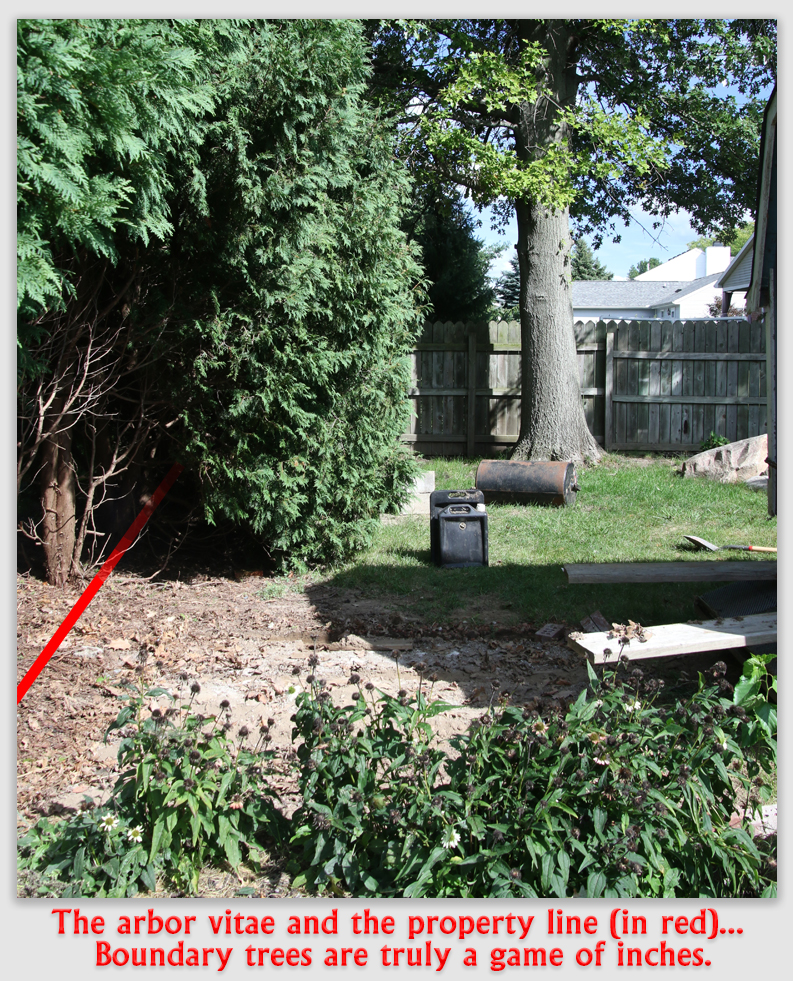
Life imitates art, I guess. Last weekend, I hauled away our 25-year old shed. I am replacing it with a newer, larger shed – complete with electricity, windows, and (if I have anything to do with it) a beer refrigerator. Replacing it will come with a set of problems, specifically a line of arborvitae trees, standing behind the shed along the property line.

The arborvitae were tiny little shrubs when our next-door neighbor (two owners ago) planted them in the late 1990s. Now, they’re monsters.

I need to trim back a few of the arborvitae before the concrete pad for the new shed gets poured. Having read some of what I have written about boundary trees over the past few weeks, I figured I had better be sure I was dealing with some good old-fashioned Massachusetts Rule trimming of branches overhanging my property (and not with some oversized arborvitae that had grown across the property line to become boundary trees).

I found the iron pin on one end of the property line and the post on the other, and I ran a line through the trees. Sure enough, two of them have grown across the property line. Lucky for me, the ones I need to trim are still solidly anchored completely on my neighbor’s land. Those I can trim back, exercising both my Massachusetts Rule rights and my ratcheting loppers.

It seems strange that a matter of inches differentiates the trees I can trim with abandon and the trees that I cannot touch without my neighbor’s permission. (I have a great neighbor, by the way, so it is probably not a problem).  Nevertheless, the perverseness of the interplay between boundary trees and encroaching trees that stand completely on land other than one’s own is puzzling and irritating to me in an academic and legal way.

My situation is similar to the one in today’s case, which pits a car wash against a restaurant over a row of pine trees that may or may not be on the boundary. Because of the vagaries of how the pine trees at the root of the lawsuit grew along the property line, no one really won: the restauranteur wanted the trees gone, and the car wash owner wanted the trees to remain.

In the end, some of the trees stayed, some did not. And it was all a game of inches…

Wolfinger v. Moates, 7 Pa. D. & C.4th 220 (Pa.Com.Pl. 1990). A line of pine trees separated the Wolfinger Car Wash property from the Moats Restaurant property. Bill Moats received complaints from his patrons about the pine trees, that encroached on his parking lot, scratched diners’ cars and dropped pine cones everywhere (even damaging his lawnmower).

Bill decided to cut down the trees. He told his neighbor, “Suds” Wolfinger, what he planned. Suds was shocked. He liked the trees, partly because they served as a barrier between his business and the restaurant. Plus, his customers preferred parking under them, using the shade while they wiped down their cars. Suds asked Bill not to cut them down.

Bill cut them down anyway, taking out four of the 13 trees on his first day wielding his chainsaw. Suds raced to his lawyer, and together they raced to the courthouse for a temporary injunction. After Bill was forced to stop, Suds tried to make the injunction permanent.

The court found that the two tracts of real estate shared a common boundary line, and 13 trees stood on or near the line. A survey showed that the first five trees, including the four Bill had cut down, were all on his property. Lucky Bill. The next three, however, straddled the boundary. The  Court referred to them as “line trees.” Tree No. 9 was on Bill’s land, but some bark on the flare touched the boundary line. The last four trees were all on Bill’s land.

Held: Bill was not allowed to cut the three trees that straddled the boundary.

Pennsylvania law made it unlawful “for any owner or owners of any undivided interest in timber land within this Commonwealth to cut or to remove, or to cause to be cut or removed, from the said land, any timber trees, without first obtaining the written consent of all co-tenants in said premises.”

The Court held that the statute dictated its holding that the owners of adjacent tracts of real estate own all trees growing on their common boundary line as tenants in common. Tenants in common are prohibited from unilaterally cutting down or removing such commonly owned line trees.

Applying the general rules of law governing tenancy in common, the Court held, “We conclude neither adjoining real estate owner may remove a tree growing on a common boundary line. Consequently, in the case at bar, notwithstanding the fact that only inches of the trunks of trees 6, 7 and 8 are on the boundary line between the properties of the plaintiffs and defendants, those trees are jointly owned by plaintiffs and defendants. Therefore, defendants may not remove them.”

Suds was not satisfied. He argued that Tree No. 9 was commonly owned as well because the bark of the tree’s trunk touched the boundary line. Citing the Illinois case Ridge v. Blaha, the Court held that the critical question was “whether any portion of the trunk of the elm tree grows on plaintiff’s property… The law… is determined by the exact location of the trunk of the tree at the point it emerges from the ground.” The fact that the bark of Tree No. 9 touched the line, the Court said, was insufficient to create a tenancy in common.

Trees 1 through 5 and 9 through 13, therefore, were Bill’s sole property. He could cut them down as he wished. But the injunction would become permanent on Trees No. 6 through 8, leaving them to provide both shade and pine cones.

– Tom Root

TNLBGray140407

Case of the Day – Friday, September 20, 2024

THE OYES DON’T HAVE IT

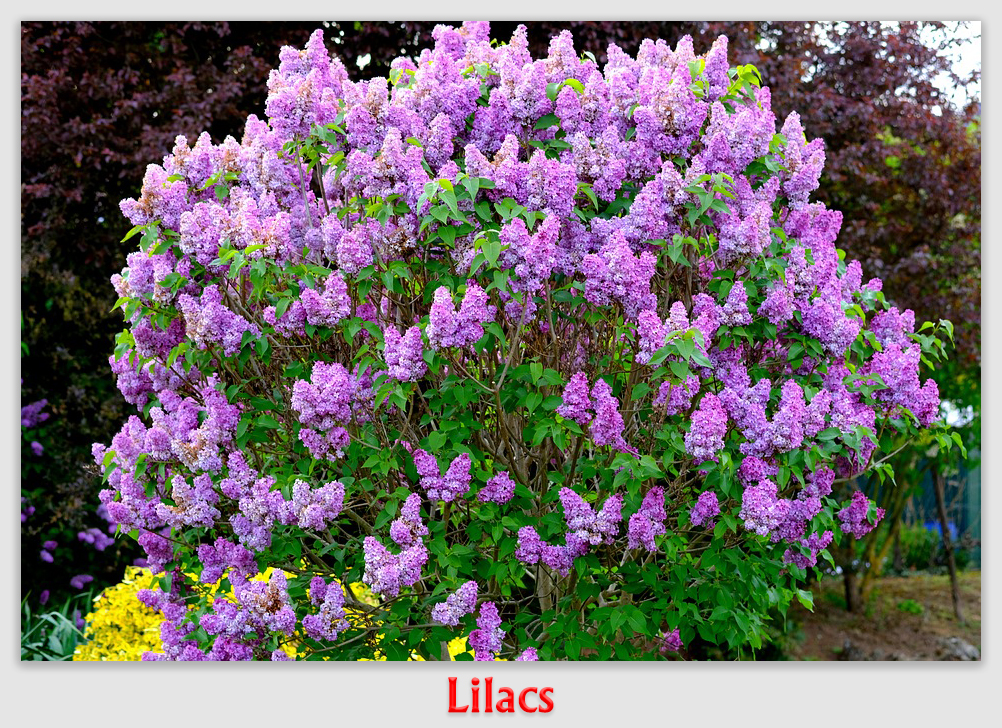
You sort of wonder how a kerfuffle over some lilac bushes and a bridal wreath bush in a backyard can end up in the state supreme court. I mean, even back in 1983, legal fees were not insignificant. These bushes were on the back boundary of a couple of properties, so we’re not even talking curb appeal.

Regardless, Raymond Oye did not like the shrubs on the property line. He and his wife thought they were ugly. Neighbor Lou Ann Patterson did not. But Ray started tearing them out anyway. When Lou Ann protested, Mr. Oye said, ‘Nay.’

There ensued a trial, an appeal and a trip to the Supreme Court in Lincoln, Nebraska, the principal purposes of which seemed to have been to enrich some lawyers and reach a result Mr. Oye should have seen coming like a freight train through a tunnel. Now mind you, we have no problem with enriching lawyers. We sort of see it as a happy ending. But not everyone feels that way, nor should they.

More than once, we’ve told would-be clients to save their money and suck it up, because they weren’t going to win. We often quote the old legal saw, “A bad settlement is better than a good lawsuit.” It’s an enduring aphorism, probably because it’s true.

In this case, the Oyes didn’t have it, and never did. Compromise with Ms. Patterson would have been much cheaper.

Patterson v. Oye, 214 Neb. 167, 333 N.W.2d 389 (Supreme Ct. Neb. 1983). Lou Ann Patterson owned a piece of property next to Ray and Jeanette Oye’s place. Their backyards abutted on a 132-foot north-south line, with Lou Ann’s property being slightly higher at the boundary line. Lou Ann’s house was built by Truman Clare in 1955, and she bought it in 1972. The Oyes’ residence was built in 1956 by Elmer Larsen, who planted lilac bushes and some beautiful bridal wreath on the southern third of the boundary line.

Both Elmer and Truman said the bushes contributed to their privacy and improved the general appearance of their backyards. When Elmer sold the property to Lou Ann, the bushes were at least six feet high and had spread out by natural growth. Some other bushes grew on the property line, and Elmer trimmed them, but he never claimed to own the bushes.

Between 1973 and 1977, Lou Ann and the Oyes both maintained the bushes, although the Oyes performed more work than Lou Ann did. Nevertheless, Lou Ann considered the bushes to be growing on the boundary line and to be common property. She said that they provided her privacy and added to the aesthetic value of the property. The Oyes claimed that they owned the bushes inasmuch as Elmer had planted them and they had done most of the caring for the bushes. In fact, Ray Oye claimed that in 1973, Lou Ann told him she thought the hedge belonged to him.

The Oyes considered the brilliant purple of the lilacs and delicate whites of the bridal wreath to be ugly. Ray wanted to remove the hedge and build a rock wall, partly to divert runoff from his land. So Ray started to work, removing about 48 feet of bushes at the north end of the boundary line before Lou Ann objected. The neighbors’ efforts at compromise failed, so Lou Ann sued, alleging trespass and asking for damages and an injunction.

As of the time of trial, the remaining bushes were 12 to 18 inches wide at their base, growing on the boundary line, and were untrimmed, spread out and intermingled with other growth. The cost of replacing the bushes Ray had torn out was from $300 to $1,500.

The trial court found that the shrubs were on the boundary line and issued an injunction against Ray and Jeanette cutting any more of the bushes. The court further ruled that Oyes owed Lou Ann $400.00 in trespass damages.

The Oyes appealed.

Held: A tree, standing directly upon the line between adjoining owners so that the line passes through it, is the common property of both parties, and neither owner may cut and destroy it without the consent of the other. When one common owner threatens damage to a commonly owned tree or shrub, a court may issue an injunction to prevent the damage.

Traditionally, where the tree trunk impinges upon the lot line, “and when the respective owners have for years jointly cared for the tree, and divided the expenses of protecting it… then each has an interest in the tree sufficient to demand that the owner of the other portion shall not destroy the tree.” The equities in a boundary tree favor the shade and other benefits of a tree.

The Supreme Court of Nebraska found that Lou Ann and the Oyes owned the bushes growing on their common boundary line as tenants-in-common and that the Oyes wrongfully removed and destroyed about 48 feet of those bushes, for which the trial court properly assessed $400 in damages. The Court found that if the Oyes continued on their course of conduct, they might “harm, damage, or destroy some or all of the remaining bushes growing on the boundary line, which would cause irreparable damage to plaintiff and unnecessary litigation, and that the terms of the trial court’s injunction are equitable.”

The Oyes argued that the injunction would impose years of unreasonable future hardship on them and invite abuse from Lou Ann. The Court was unmoved: “Defendants are reminded that the law provides avenues of relief in the event they feel aggrieved. Where there is a change of circumstances, they may apply to the court to vacate or modify the decree.”

To channel the late Rodney King, Mr. and Mrs. Oye, can’t we all just get along?

– Tom Root

TNLBGray

Case of the Day – Friday, August 23, 2024

THOSE DOG-GONE COVENANTS

baddog160108More and more home developments deliver to their residents not just houses, but a particular ambience, one which remains free of eyesores like sheds, clotheslines, and even colors of exterior trim and paint that are deemed outside the color scheme of the place. These restrictions are often contained in the deeds conveying ownership of the homes. And quite often, the restrictions begin to be violated before the ink is dry.

Many of the violations are slight, not worth the time of the neighbors or associations charged with enforcing the restrictions. But someone usually pushes things too far, and then defends himself or herself in court by complaining that Joe Doaks or Jane Doe down the street violated the same restriction, too, and no one complained about it.

In today’s case, an Ohio dog trainer tries the same excuse when the homeowners’ association tries to shut down his obedience school.

It’s like complaining to a cop that everyone is speeding, making his act of stopping you somehow … well, unfair. Like President Carter told us once, “Life is unfair.” And so is selective enforcement. But that doesn’t mean that you can’t do it.

Here, the Court told Marchus that what mattered wasn’t whether other people were getting away with violating the covenants. What mattered was whether there was a “substantial value” to the restriction which should be protected. Where substantial value could be found, equity will enforce a restrictive covenant. No matter who else is violating it.

covenants160108The guy down the street is selling on eBay for a living? Once a day, he loads his pickup truck with small boxes and goes to the post office? There’s probably no “substantial value” to be served by enforcing the prohibition. But Mr. Marchus’s baying hounds? Customers and their masters were driving in and out all day long on the private road?  The other property owners were worried about wear and tear on the road, the congestion, and liability for accidents. Those concerns were legitimate.

The Court refused to let the neighborhood go to the dogs.

Rockwood Homeowners Assn. v. Marchus, 2007-Ohio-3012, 2007 Ohio App. LEXIS 2766, 2007 WL 1731621 (Ct. App. Lake Co., June 15, 2007). Rockwood Homeowners Association consists of the owners of ten individually owned tracts of land on Girdled Road in rural Lake County, Ohio. Each owner has a primary residence on the property. The residences are accessed by Rockwood Lane, a paved, private road running off Girdled Road.

The developers drafted specific land use restrictions which were attached to each deed, restrictions intended to preserve the rustic character of the land while permitting property owners to operate a home-based business without detracting from the rural atmosphere. Section I(A) of the Declaration of Restrictions provides that “no commercial or institutional activity shall be conducted on these lots, which is not wholly contained within the residential dwellings or which causes damage to the private gravel drive by heavy vehicles.” The Bylaws for the Homeowners Association incorporate the restrictions.

grads160108Over the years, various owners operated home-based businesses from their Rockwood Estates residences, including a pest control business, a security systems business, a log home business and a tree maintenance business. In September 2001, one owner, Dick Marchus, built a 60′ x 80′ building to be used as a dog training facility. After it was done, his wife ran her dog training business in the new outbuilding, conducting one class on Monday and two classes per day from Tuesday through Saturday. While some attendees would arrive with two or three dogs, she limited the commercial vehicle traffic to ten cars per class.

Almost immediately, the Association sought an injunction to keep Marchus from continuing the operation of the commercial activities from the outbuilding on the grounds that the activity violated the covenant. The Marchuses answered and counterclaimed. At trial, the Association argued the Marchus’s business was in violation of the restrictions. Marchus admitted the activities were not contained within the residential covenant, but he argued the restrictions had been waived or abandoned by the Association’s failure to enforce the restrictions against the past violations of other property/business owners. The trial court granted the injunction, and Marchus appealed.

Held:   The trial court’s injunction was affirmed. The Court of Appeals noted that restrictive covenants on the use of property are generally viewed with disfavor. However, this disfavor may be overcome by evidence of a plan or scheme into which the restrictions are incorporated and notice of that plan or scheme. A plan like the Rockwood one, designed to maintain the harmony and aesthetic balance of a community, will often be upheld where the restrictions are reasonable.

The evidence indicated the restriction was drafted with the intent of maintaining the bucolic atmosphere of the development and prohibiting increased traffic from entering and exiting the development. The Court said the restriction was uniform and applied to all property owners in the development. When the evidence was viewed as a whole, the Court said, it concluded the restrictions and the development to which they pertained were premised upon a general plan or scheme.

The evidence also showed that Marchus had notice of the restrictions. Consequently, the Court found that the restriction was valid and enforceable. As for waiver or abandonment, the Court said, the test was whether, under the circumstances, there remained a substantial value in such restriction which should  be protected. Where there was a substantial value to the dominant estate remaining to be protected, equity will enforce a restrictive covenant.

Even with the Marchuses' restricting classes to only ten vehicles (leading to dog carpools, no doubt), it was still too much for the neighbors ...

     Even with the Marchuss’ restricting classes to only ten vehicles (leading to dog carpools, no doubt), it was still too much for the neighbors …

Here, the Court found, various residents expressed concerns they held since Greta Marchus opened the business. Increased traffic created congestion and destroyed the rural atmosphere of the development. Because the residents were responsible for the upkeep and maintenance of their private drive, some worried about the increased repair cost resulting from the wear and tear. Some were concerned about being exposed to liability if any of the Marchuses’ customers happened to be injured on the private road. The Court found that the concerns expressed were legitimate and rationally related to the appellants’ violation of the covenant, and thus, there was still a substantial value in the restriction.

As for acquiescence, the evidence didn’t show that prior businesses operated anywhere but in the owners’ residences, which was permitted by the restrictions.

– Tom Root

TNLBGray