Case of the Day – Thursday, January 29, 2026

FOR THE LORD’S SAKE, PEOPLE… STOP!

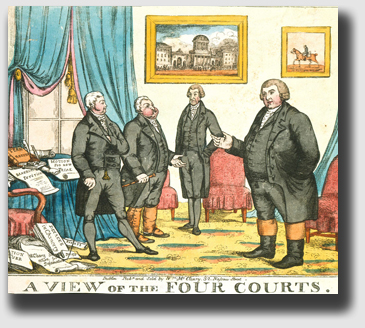
You would think that a church could get along with its neighbors. Maybe it was the Methodist elders. Maybe the neighbor was a minion of hell. Who can tell from the abbreviated decision in today’s case, handed down by the New York Supreme Court, Appellate Division.

A word of caution here: New York is not like the rest of the world. In New York State, the Supreme Court is a trial court, the Supreme Court Appellate Division is the court of appeals, and the Court of Appeals is the supreme court. There – isn’t that easy? So the next time someone claims to sit on the New York Supreme Court, just say, “Yeah, you and a thousand other judges.”

Today’s decision involved a party wall, hardly a matter of importance to most folks. But the principle is an important one. Trespass is one of those common law torts (consider a tort to be a “wrong”) that can be committed all too easily. You don’t have to intend to commit a trespass. All you have to do is intend to step where you step. So if you trip on the sidewalk and fall onto someone’s front lawn, it’s not a trespass, but if you step off the sidewalk to avoid a puddle, it is.

What’s more, in every trespass, damages are presumed. There have been cases in which people trespassed while all the while believing they were on their own property. Sometimes, they leave the premises on which they trespassed better off than before they arrived.

No matter. The law presumes they damaged it.

Obviously, this can cause all sorts of nonsensical results. For that reason, while the law will always assume damages, it won’t always order the trespass to end. Sometimes, the trespass causes so little inconvenience to the property owner and – if it were ordered to cease – would cause such injury to the trespasser, that an injunction would not make sense. The law will generally avoid ordering a result that is wasteful.

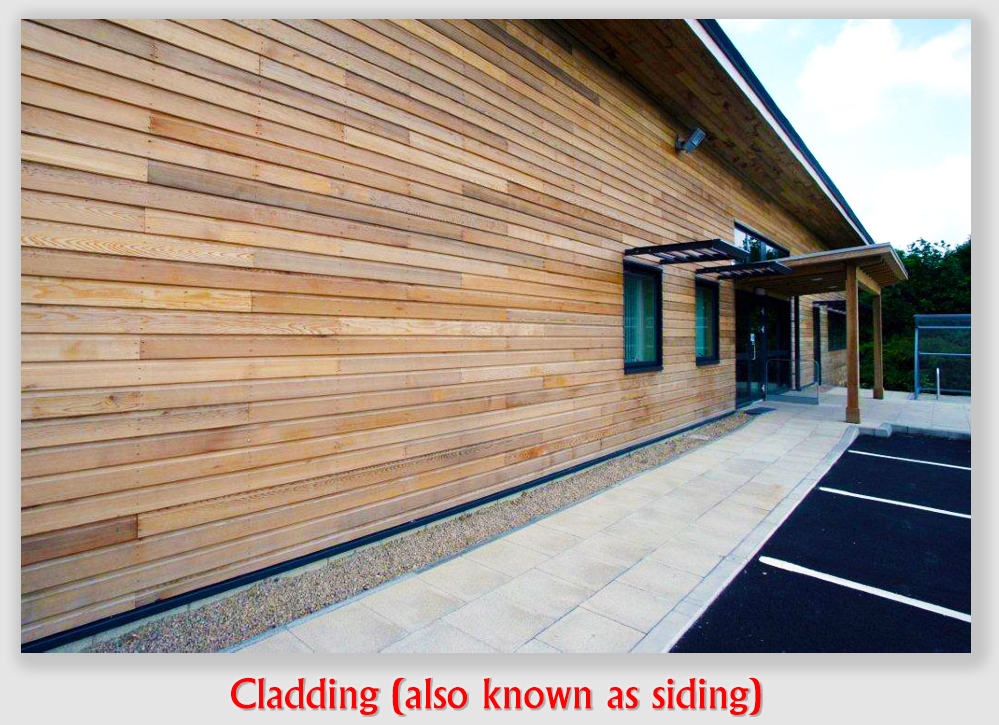
In today’s case, Mr. Kimball installed drip edge and cladding on the party wall, with a small portion of it (we’re talking inches) protruding over the Church’s vacant property. Drip edges prevent rainwater and ice melt from running under the shingles and into the wall. Cladding is a finish, such as vinyl siding, covering the rather ugly concrete block wall. In this case, it protruded onto church property probably 2” beyond where the wall stood.

What would have been the point, other than sheer orneriness, of making Mr. Kimball rip the siding and drip edge off the wall? After all, those additions were needed only because the Church tore down its building, leaving a bare wall exposed to the elements. The court of appeals was not going to demand such a wasteful and damaging result.

The law is not always an ass.

Kimball v. Bay Ridge United Methodist Church, Case No. 2017-03575 (Sup.Ct. New York, Appellate Div., Jan. 24, 2028), 2018 N.Y. App. Div. LEXIS 443. Mr. Kimball and the Bay Ridge UMC owned buildings with a party wall, that is, a common wall along the property boundary that supported and was integral to both buildings.

The Lord only knows what went on between the Church and the Kimballs, but things seemed to start when the Methodists tore down their building a decade ago (leaving the party wall, of course, because it was part of Mr. Kimball’s building, too. About seven years after the church building was razed, Mr. Kimball installed cladding and a drip edge along the church side of the wall.

For reasons not clear in the opinion, Mr. Kimball sued the Church for a declaratory judgment and injunction. The Church rendered unto Caesar itself, and its lawyers counterclaimed for trespass, because Mr. Kimball’s cladding and drip edge extended however so slightly into Church airspace, on the holy side of the party wall. In addition to damages, the Church wanted an injunction requiring Mr. Kimball to tear out the cladding and drip edge.

The trial court granted the Church’s trespass complaint, awarding it damages and ordering Mr. Kimball to remove the offending installation. Mr. Kimball appealed.

Held: The appellate court agreed that there was undoubtedly a trespass, but drew the line at an injunction. New York law provided that an “action may be maintained by the owner of any legal estate in land for an injunction directing the removal of a structure encroaching on such land [but n]othing herein contained shall be construed as limiting the power of the court in such an action to award damages in an appropriate case in lieu of an injunction or to render such other judgment as the facts may justify.”

In order to obtain injunctive relief under the statute, the appellate court said, the Church was “required to demonstrate not only the existence of [an] encroachment but that the benefit to be gained by compelling its removal would outweigh the harm that would result to [the encroaching party] from granting such relief.” Here, the Methodists did not show that the “balance of equities weighed in its favor.” In other words, what it gained by having Mr. Kimball rip out the cladding and drip edge was bupkis, maybe an inch of space eight feet or so off the ground. But by tearing out the cladding and drip edge, Mr. Kimball would lose the ability to keep water from rotting his roof and joists.

So Mr. Kimball had to pay some damages (and they probably amounted to $1.98 or so), but the law would not make him rip out the cladding and drip edge to satisfy the Church elders.

– Thomas L. Root

TNLBGray140407

Case of the Day – Wednesday, August 13, 2025

PEOPLE BEHAVING VERY BADLY

The late Jeffrey Epstein, Ye, Vladimir Putin, Yahya Sinwar, George Santos, Robert Menendez, even President Trump (whose increasingly shrill insults blast people who are (or were) supporters)… we’ve had a belly full of people behaving badly irecently.

Like we need this, here are a few more:

Welcome to the neighborhood ...

Welcome to the neighborhood …

Meet the Cooleys, neighbors who were so bad as to drive the Court to write a plaintive plea that everyone should try to get along. How bad, you ask? Well, Mrs. Cooley tried to run down her neighbor with her car. She built a chicken-wire spite fence. Her son threatened to beat up his elderly neighbor (who had just had a heart transplant). Yes, that bad…

This case is one of those rare fact-driven trial court decisions worth reading just to get the flavor of the Court’s incredulity that people could carry on like this. At one point, the judge observes that “[o]ne could almost use that well-worn lawyer’s expression ‘I rest my case’ after merely viewing Mrs. Cooley’s Exhibit 12, which in gruesome detail sets out the ‘this is my property’ syndrome.” The court finally issues a 15-point injunction ordering the Cooleys to stop doing 12 acts of malice, and the Quarantas to refrain from three others. It found application for a seldom-used Connecticut statute prohibiting structures built out of malice, banning a chicken-wire monstrosity erected by the Cooleys as a “spite fence.” Finally, it found the often-alleged but seldom-proven “intentional infliction of emotional distress” tort to have been shown here and ordered the Cooleys to pay the Quarantas’ legal fees.

At the end of its opinion, the Court ordered each party to read his final words out loud. Those were a plea by the Court for these people to rewind the clock to the beginning and try to get along. The Court’s frustration and sense that no matter what the law said, nothing would stop the bickering, is evident in the opinion. Not great moments in the development of the law … just a neighbor law tale worth reading.

There was even a

There was even a “spite fence” in the story …

Quaranta v. Cooley, 2007 Conn. Super. LEXIS 3199, 2007 WL 4577942 (Conn.Super. 2007). People behaving very badly. You know how the opinion’s going to go when the Court begins by quoting an old Supreme Court opinion that “… it is the bickerings, spite, and hatred arising from neighborhood quarrels; it is difficult for any legislation to remedy such evil.”

The Quarantas were senior citizens who had lived in the same home for 26 years. Mr. Quaranta was on a life support system and eventually had a heart transplant. The Cooleys were younger than the Quarantas, but had a 25-year-old son and health considerations of their own. When the original landowner subdivided his property into the lots which became the homes of the Cooleys and Quarantas, there was an existing paved driveway to the Quarantas’ home from the street, bordered with a split rail fence and a grassy area on each side. The landowner created by deed two 25’ easement roads (for a total width of 50 feet) over the same area on which his driveway existed. Each lot owned 25’ of the road, and each owner had the right to pass over the 25 feet owned by the other. The practical effect of these easements is to allow all three parcels of land to share access to the public street with one common driveway. Although the neighbors couldn’t see each others’ homes, they ended up in a continuing vitriolic spat in which each side accused the other of using the “F” word, raising the middle finger on numerous occasions, and other immature and harassing behavior, such as the noisy racing of vehicles, the blowing of car horns and trash placement fights.

ass150721The Court held that the Cooleys, who were New York City dwellers unused to suburban life, utterly lacked credibility on the stand. It found that the battle began with Mrs. Cooley delivering a letter to the Quarantas within 30 days of her having moved in, in which she told them their lampposts and driveway sat on the Cooley property. Then, the Cooley son began throwing keg parties at the Cooley home, with noisy partygoers parking all along the right-of-way. The parties were noisy and annoying, and afterward, the Quarantas found themselves cleaning up empty bottles and cigarette butts. The parties were held about four times a month. The Quarantas complained without effect. The grand finale was the Cooley Halloween Party in 2005. When Mrs. Quaranta went out in her nightgown to ask for peace and quiet, the partygoers cursed her – one exposing himself to her – and urinated toward her. After this, Mrs. Cooley and her daughter, took to riding at high speed over the grassy area, even leaving deep tire tracks. Although the Cooleys’ trash pickup was on Friday, they would put their trash out all week long, at a spot where it was viewable only from the Quarantas property. Animals got to the trash during the week, and the Quarantas did the cleanup. Mrs. Cooley would drive fast down the mutual passage raising dust and her middle finger while blowing her horn the entire distance. She overdosed her own lawn with weedkiller, killing all of the grass ostensibly so she wouldn’t have to mow. Her lawn, of course, fronted on the Quarantas’ lush and meticulous yard.

badneighbora140204There were countless verbal confrontations as well. The Cooley son yelled at Mr. Quaranta, a man past 65 with a heart transplant, “Hit me! I’ll wipe the ground up with you.” Previously, another judge had ordered the parties to refrain from intimidating, threatening, harassing, stalking, assaulting, or attacking each other, and to refrain from entering the property of the other, until the dispute was tried and resolved on the merits. After that, the Cooleys built an ugly chicken wire fence on the side of the passage that fronts the Quarantas’ house only. The trial court was called upon to mediate the dispute.

Held: The Court found for the plaintiffs, the Quarantas. It held that Mrs. Cooley’s testimony was so bad that it noted that “[o]ne could almost use that well-worn lawyer’s expression ‘I rest my case’ after merely viewing Mrs. Cooley’s Exhibit 12, which in gruesome detail sets out the “this is my property” syndrome. The court found it unsurprising that she took an axe to – and threatened to destroy – anything, even things of beauty, found on her property. These items included a lamppost, (that provided her light with the Quarantas paying for the electricity), fences (that enhanced the entrance to both their properties), a beautiful birch tree (with no professional evidence that it had to be cut down), a ceramic nameplate, (which her son admitted smashing) and even shrubbery. “Such warmth!” the Court said. “And it shows in the fifty-plus exhibits.”

The Court held that the chicken wire fence was maliciously erected, based on its character, its location, and the obvious state of mind and motive of the defendant. It ordered the fence removal pursuant to §52-480 of the Connecticut Statutes. It found that the Cooleys had exceeded the use of the right of way in a vindictive and malicious manner so as to harm the Quarantas, rather than just for ingress and egress. It held that a number of the Cooleys’ activities on this simple right-of-way were, “in layman’s terms, ludicrous, and in legal terms harmful, unnecessary, illegal and unreasonable.” It issued a detailed injunction spelling out 12 acts in which the Cooleys were not to engage, and 3 acts in which the Quarantas were not to engage.

A happy ending? Not with these folks ...

A happy ending? Not with these folks …

Based upon the totality of the evidence, the Court held that the Cooleys directly and indirectly negligently and intentionally caused severe emotional distress to the Quarantas, and knew or should have known that their acts would result in severe emotional distress to the plaintiffs. In the case of Mr. Quaranta, the distress was found to be life-threatening. The Cooleys evidenced a reckless indifference to the Quarantas’ rights and showed an intentional and wanton violation of these rights. The injury was inflicted maliciously, with evil motive and violence. The Court awarded the Quarantas their legal fees as damages.

The Court took the unusual step of ordering a final statement to be personally read by the parties. It begged both parties to “go back to the day the Cooleys moved in and put everything back the way it was. Let us dig a hole and bury all of the ill feelings and hatreds that are all consuming.” The Court, writing this on Thanksgiving Eve, ended by noting that “[t]he person whom many people honor in this Holiday Season forgave everyone. Isn’t it time that the Quarantas and the Cooleys caught the spirit of the Season?”

Postscript: They did not. Rather, they were back in court repeatedly between 2007 and 2013, arguing over contempt motions filed against each other. Oh, the humanity …

– Tom Root

TNLBGray140407

Case of the Day – Thursday, July 31, 2025

A SLOPPY AND LAZY TRIAL JUDGE

You have to appreciate the careful prose of an appellate court. Today’s case was brought in 1999, but was still sputtering along eight years later. The Rhode Island Supreme Court thought it knew why.

Never-ending litigation ... Rhode Island style

Never-ending litigation … Rhode Island style …

After a few pointed comparisons of the case to Jarndyce v. Jarndyce, the Rhode Island Supreme Court asked the trial court what the Dickens was going on. The trial judge took his dear sweet time writing a decision — about five years — leading the Supreme Court to mention in a note, “We are mindful of the inordinate delay of the decision of the trial justice, which this Court does not favor.”

Beautiful understatement! The Supremes were saying to the trial judge, “Hey, dude, you’re lazy!” Of course, in the decision, the high court also implicitly said, “Hey, dude, you’re incompetent, too.” The reason for that was the trial judge’s failure to make the findings the Supreme Court needed to adequately review the decision.

A court speaks through its opinions, and when the trial court doesn’t make findings of fact, no one wins. The winner doesn’t know why he won, the loser doesn’t know why he lost, and the rest of us can’t derive any useful guidance from the case. In this case, an unusual argument arose in the battle over the location of an easement. The easement holder claimed the prior owner had obstructed the easement — a driveway — and demanded that the easement and everything on it be shifted a few feet to the south. This is called an easement by substitution. Some testimony suggested that an easement by substitution had been created. But the trial court couldn’t be bothered to make any findings on the issue, leaving everyone to puzzle whether something hadn’t been proven, some witness hadn’t been believed, or just what?

Perhaps a little burninating in the Ocean State?

Perhaps a little burninating of indolent trial judges was called for in the Ocean State?

So after eight years, the case landed back in the trial court’s lap. Maybe the judge was waiting for the owners to tire of it all and settle, or to die or move to Florida… or for Rhode Island to be swallowed by the rising seas, or be consumed by an angry dragon… anything that would spare this poor trial judge from having to do his duty.

Nardone v. Ritacco, 936 A.2d 200 (Sup.Ct. R.I., Dec. 3, 2007). Nardone’s property bordered Lawton Foster Road. Ritacco owned an adjacent parcel of land behind Nardone’s property, with no frontage on Lawton Foster Road. In 1965, Nardone’s predecessor-in-interest, Ralph C. James, Sr., granted Ritacco a 50-foot right-of-way along the northern boundary line of what is now Nardone’s property. The right-of-way for ingress from and egress to Lawton Foster Road has been the subject of many years of litigation.

On Memorial Day 1999, Ritacco cut trees and vegetation within the right-of-way. Nardone sued for temporary and permanent injunctive relief to prohibit Ritacco from cutting the trees and from trespassing on Nardone’s land. The trial court entered a preliminary injunction and later found Ritacco in contempt of the order by cutting trees and vegetation outside the right-of-way. A key issue was the location of the right-of-way. In addition to arguing that the right-of-way was not originally located along the northern boundary of Nardone’s property but rather inside the boundaries of the land, Ritacco also asserted two alternative claims for relief: the existence of an easement by prescription as well as an easement by substitution over plaintiffs’ driveway. The trial court decided for Nardone, clarifying that the right-of-way was located along the northern boundary of Nardone’s property. Nardone appealed.

Held: A remand was necessary to determine whether Rotacco had acquired an easement by prescription or by substitution over Nardone’s driveway. The Supreme Court held that the trial court had properly found that the right-of-way over Nardone’s land was located on the northern boundary of the land. The deed itself placed right-of-way “along the northerly boundary line” of the premises, and Nardone’s expert witness testified that, upon examining the property, the boundaries were clear and the right-of-way was located along the northern boundary of the property. Ritacco’s expert had said that the deeds were not clear, but he hadn’t inspected the property itself, and the trial court’s discounting of his testimony was therefore reasonable.

Does this pass for judicial garb in Rhode Island?

Does this pass for judicial garb in Rhode Island?

However, Ritacco had also claimed that he had acquired an easement on land inside the Nardone boundaries by prescriptive easement. The trial court had ruled against him without a trial, but the Supreme Court ordered a remand for trial on the issues. The Supreme Court held that the trial court hadn’t addressed the issue of Ritacco’s permissive use of the driveway, let alone determine whether sufficient factual support existed to conclude that permission to use the driveway was given by Nardone or his predecessors-in-interest. A party who claims an easement by prescription bears the burden of establishing by clear and convincing evidence actual, open, notorious, hostile, and continuous use under a claim of right for at least ten years. In this case, the Court ruled, the trial judge had failed to make the specific findings of fact upon which he based his decision. When that happens, the trial court risks reversal or remand unless the record yields a full understanding and resolution of the controlling and essential factual and legal issues.

Here, there were unaddressed issues that were raised in pleadings and testified to at trial, including Ritacco’s testimony that perhaps Nardone’s predecessor-in-interest had granted him an easement by substitution. When the owner of a servient estate encloses the original easement with a wall or other structure and points out another way of ingress and egress that is accepted by the owner of the dominant estate, the new way may become the easement by substitution. The Supreme Court said that testimony indicated that James may have granted Ritacco an easement by substitution. However, the trial court failed to determine whether sufficient factual support existed to conclude that an easement by substitution was granted.

– Tom Root

Case of the Day – Monday, March 31, 2025

NEIGHBORS BEHAVING BADLY

There aren’t any winners in today’s neighbor-aggravating-neighbor case, one that had its genesis in one neighbor deciding that encroaching tree branches meant he could hack the trees – which stood on his neighbor’s land – back to mere stumps.

Things fell apart from there. The neighbors alleged two more atrocities in the ensuing year, and they blamed the tree hacker, because… well, why not? The Court, I think, was all too credulous, partly because the tree-cutter was not a native English speaker and was too easily dismissed for that reason.

I suspect that because the all-too-clear video of one altercation has Craig, who portrayed himself as the victim to the court, calling Mr. Cheung things – such as “f—face” – that would have gotten Craig’s teeth relocated in any midwestern bar. And he told Mr. Cheung that he was under arrest, a claim that I would have found amusing. But then, I have three years of law school and many more of law practice behind me. Mr. Cheung is an immigrant, and may well come from a place where arbitrary arrest is the rule rather than the exception.

Old Craig did not seem terribly rattled by Mr. Cheung’s alleged threat to kill him, and as a threat – if that’s what it was – it was dishwater-weak.

The wily Confederate raider (whose conduct in other quarters, I hasten to add, was abhorrent and who has not yet been rehabilitated by the current Administration), General Nathan Bedford Forest, is widely credited with saying that his guiding tactical principle is “getting there firstest with the mostest.” That’s what Craig and his wife did here, it seems, got to court first with a double-barreled assault that the neophyte Hogan Cheung was helpless to fend off.

Still, had Hogan only been a faithful treeandneighborlawblog reader, he would have been well aware of the Massachusetts Rule, and only cut the offending branches to the fence line. And all of the ensuing unpleasantness could have been avoided.

Stolarczyk v. Cheung, 2019 Cal. App. Unpub. LEXIS 2271 (Ct.App. 1st Dist., March 28, 2019). Craig and Shana Stolarczyk and their two young children live on a property that adjoins the parcel on which Hogan Cheung, his wife, two small children, and mother-in-law live in San Mateo. A fence that runs between the Stolarczyks’ backyard and Cheung’s side yard.

The Stolarczyks complained that Hogan Cheung had cut down two trees on their side of the fence a few years ago. Matters escalated from there into general ugliness. At one point, Craig and Shana said, someone dumped gasoline on their backyard, with a dribble that seemed to run from the dump location to the fence. Hogan denied having done so.

Craig’s and Shana’s landlord lived next door. Being aware of the problems, he installed a security camera on his own property that took in the Stolarczyks’ and Cheungs’ backyards. The camera recorded, among other things, a verbal altercation between Craig and Hogan over the camera installation. Craig taunted Hogan with obscenities. Hogan asked Craig to take the camera down. When Craig refused, Hogan covered the camera lens. Craig then told Hogan he was under arrest followed by the same vile epithet first used to address him. Hogan asked Craig if he was threatening him. Craig again told Hogan that he was under arrest, and Hogan responded, “That’s fine, thank you. And I will always come back for you.”

Craig asked Hogan if he ‘want[ed] to do something?” Hogan said, “I already did something.” Craig accused Hogan of pouring gasoline on his yard, to which Hogan replied, “No one put gas, you put your gas and you[‘re] blaming it on people.” Craig asked Hogan if he “want[ed] to settle it,” to which Hogan responded, “You don’t need to settle it, you’re dead.” Laughing, Craig told Hogan he was going to call the police because he was just threatened.

Hogan admitted he cut down overgrown trees planted in the Stolarczyks’ backyard in March 2016. Prior to cutting the trees, Hogan twice requested the Stolarczyks’ landlord manage the trees to no avail. According to Hogan, the trees grew fast, crossed the fence by three feet to four feet, and left limbs over his house and satellite dish. In addition, noise from the trees swaying in the wind and scraping and rubbing against the walls of his house made it difficult to sleep. Hogan stated he did not cut down the trees completely, only the portions rubbing against his house that were overgrown.

Hogan denied pouring gasoline in the Stolarczyks’ yard, and he said he placed tape over the camera lens because his wife was afraid, seeing the camera as “a really bad invasion looking into my house in the bathroom[], whatever [his wife] was doing.” He acknowledged he called the police about the camera before he taped over it and that an officer told him not to touch it. Prior to covering it, he also asked the Stolarczyks to take it down but they threatened and cursed him. Addressing the “you’re dead” statement he made to Craig, Hogan explained that Craig and his companion were cursing and provoking him, that his English was not “too good,” and he did not know what to say. He said his comment was not a threat but his way to end the conversation and signal he no longer wanted to talk. Hogan denied ever threatening to kill Craig.

In 2016, the Stolarczyks suspected herbicide was dumped over the fence into their yard, and in July 2017, Craig was overwhelmed by the smell of gasoline in his backyard. He said he smelled gas in the soil all along the fence line and observed discolored and foul-smelling mulch. The fire department confirmed the presence of a gasoline odor and doused the area with water.

The Stolarczyks filed a petition for a civil harassment restraining order against Hogan Cheung the next month.

The trial court acknowledged Hogan’s right to reasonably trim a neighbor’s trees that cross into his property but held he was not entitled to simply cut off the foliage to a point below the fence line. The court also noted the ongoing and escalating nature of the dispute and found Hogan Cheung to be “not the most believable witness” ever to appear in court. The court found his explanation that he did not understand what he was saying on the video to be “ludicrous” and did not see him as a victim in any way. Based on the video, the court found Hogan was self-confident and assertive when he taped over the camera, which the court said the property owner had every right to place on his property. Nothing suggested the camera was positioned to film the interior of Hogan Cheung’s home. With respect to the chemicals on their property, the court found it was “a reasonable inference to draw that someone else is responsible for that and I think that [the Stolarczyks’] concerns are legitimate that [Hogan Cheung was] responsible for that… I think without question, it has been sufficiently proven that Mr. Cheung damaged their property. He vandalized their property. There is a reasonable inference to be drawn, and it’s for that issue I am still going to issue a restraining order.”

The order required Hogan Cheung to stay five yards away from the Stolarczyks and to refrain from harassing or contacting them, or destroying their personal property. Mr. Cheung appeals.

Held: The restraining order was upheld.

Under Section 527.6 of the California Code of Civil Practice, a person who has suffered harassment… may seek a temporary restraining order and an order after hearing prohibiting harassment.” Harassment is “a knowing and willful course of conduct directed at a specific person that seriously alarms, annoys, or harasses the person, and that serves no legitimate purpose. The course of conduct must be that as would cause a reasonable person to suffer substantial emotional distress, and must actually cause substantial emotional distress to the petitioner.”

Hogan Cheung argued the court erred in granting the restraining order because the Stolarczyks failed to establish several of the required elements of Section 527.6 by clear and convincing evidence. In particular, he contends that the Stolarczyks failed to prove his conduct served no legitimate purposes, caused them substantial emotional distress, or posed any risk of future harm.

The Court of Appeals rejected his argument. “We find no merit to Cheung’s broad contention that his version of what happened was ‘equally likely’ as the Stolarczyks’ and did not amount to harassment.” Hogan claimed the Stolarczyks failed to prove his acts served no legitimate purpose: he said his trimming trees encroaching on his property and covering a surveillance camera directed towards his house were lawful acts with legitimate purposes. But Hogan Cheung cut the trees below the fence line, and not just those portions extending into his property. Also, the video camera was neither located on the Cheung property “nor trained on the inner sanctum of Cheung’s house.” It hardly helped Hogan’s case that he admitted that he was told by police not to touch the camera but did so anyway. “All of this evidence,” the Court said, “supports an implied finding that Cheung’s acts served no legitimate purpose.”

Hogan also claimed his conduct did not cause the Stolarczyks substantial emotional distress. In fact, the trial court rebuked Craig for behaving badly, describing his behavior in the video as “antagonistic and sarcastic and profane.” Nonetheless, the appellate court said, the petition for a restraining order was not filed solely based upon the camera incident nor was Craig the sole petitioner. Despite Craig’s laughter and the potty-mouthed taunting that he displayed that evening, the Court ruled that the “trial court could reasonably infer that both Craig and Shana suffered substantial emotional distress from having their trees chopped down and the debris left in their yard, and from having chemicals poured into their backyard where their small children play.”

The record likewise permitted the finding of likely future harm, supporting “the conclusion that a restraining order was necessary to prevent bad acts from continuing into the future. Cheung initially chopped down the Stolarczyks’ trees in March 2016; the Stolarczyks smelled gasoline along their fence line in July 2017; the altercation over the camera occurred in August 2017; and by the time of the hearing in September 2017, the trees had regrown to twice the height of the fence.” The dispute had not resolved itself in over a year, and the trees were growing large again. “Because we’re talking about trees that were cut in 2016, and Mr. Cheung still, it would appear, has issues with the fact that these trees are on his neighbor’s property and continue to grow and grow tall,” the Court said, the record supported a finding of threat of future harm.

– Tom Root

TNLBGray140407

Case of the Day – Tuesday, March 4, 2025

TEACH YOUR CHILDREN WELL

Evil-Spawn-1Mrs. Dahlquist and her evil spawn, Jeff Zube, lived in pretty close proximity to several neighbors, including the Careys. The constant obscenities, threats, spitting from balconies onto the neighbors, rotten eggs and lit cigarette butts got a little wearing on the Careys. They finally sought an anti-harrassment order under a California statute — Section 527.6 of the Code of Civil Procedure — to get Ma Dahlquist’s gang of two to stop.

Common law provides no remedy to restrain a neighbor who, unfortunately, has a sewer for a mouth and a tar pit for a soul, sad to say. Statutes like the California’s CCP § 527.6 are not all that common, but they are becoming more and more so, because – and here we can all bemoan the erosion of the Republic – neighbors like Joe and Dorothy (who’ll mow your lawn for you and deliver warm brownies from time to time) are getting to be scarcer, and next-door harridans like Ms. D and her whelp are becoming more common.

The lesson in today’s case is that if you’re going to be nasty to one neighbor, be sweet to the others. If you’re a jerk to everyone, expect some piling on. Not surprisingly, that happened here: complainants against Ms. Dahlquist and fil came out of the woodwork, with everyone on the block more than happy to cite the constant bird-flipping, the obscene insults, and general squalor that surrounded the harpie and her mordant boy.

CarrieDahlquist and Zube, of course, denied everything. Movie fans will remember the memorable Blues Brothers scene with Jake Blue (John Belishi) telling a gun-totin’ Mystery Woman (Carrie Fisher) that “it wasn’t my fault!” In the face of rather detailed, graphic even, descriptions of the Dahlquist/Zube misconduct by the neighborhood, the trial court didn’t believe a word of it.

BelushiThe Dahlquist/Zube gang appealed. Appellate courts expect that – winner or loser – a party will give the court a reasonably complete and balanced assessment of the record below. Not Dahlquist and Zube. If the fact didn’t fit with their worldview, they just left it out. That didn’t leave much in their recitation of the “facts.” The Court of Appeals wasn’t detained long by this creative pleading: it held that the record below amply made out a pattern of harassment that was such that it would cause a reasonable person to suffer substantial emotional distress. It certainly did for the Careys, and the Court found that under the circumstances, a three-year order was fully justified.

Carey v. Dahlquist, 2007 Cal. App. Unpub. LEXIS 10631, 2007 WL 4555793 (Cal.App. 1 Dist.)  Dahlquist and Carey live next door to each other in Sausalito, California. Dahlquisht’s 19-year-old son, Zube, lives with her. Carey filed a § 527.6 petition alleging that, among other things, her neighbor Dahlquist screamed obscenities at her and used “constant foul language, verbal comments (‘this is war’) and written threats.” Dahlquist had also “ordered tree people onto my property and cut down (removed two 30 ft high trees).” Carey requested an order that Dahlquist stay away from her and that “she not be able to come out on her deck and scream obsenities [sic] at me or my husband as I go up and down my stairs.” In addition, Carey asked the court to order that Dahlquist “not hire workmen to come onto my property and destroy my property” and that she “pay for the survey and replace the trees she removed.”

The same day, Carey filed an application for a temporary restraining order against young Zube, alleging that in a two-page list of “confrontations” with Zube, he had thrown eggs from his balcony, shouted obscenities at her husband as he came up the stairs, threw poppers onto the stairs while Carey and her husband were walking up the stairs, and made “exceptional noise” emanate from his stereo. On multiple occasion, lighted cigarette butts were found on the wooden stairs at Carey’s house. Neighbors provided affidavits complaining of similar acts.

The record also contained a declaration from Jeff Zube’s father claiming that Carey was a chronic complainer, and anyway, young Zube would be leaving soon for Santa Barbara to attend college. Nevertheless, the trial court granted the petition as to both Zube and Dahlquist, holding Zube had “an out-of-control and extremely disrespectful side of you and I’ve seen it in court, and I’ve heard it from the testimony.” The court found that Carey and her witnesses were credible and Dahlquist and Zube were not. It issued a 3-year restraining order, and Dahlquist and Zube appealed.

restraining-order1Held: The order was upheld. Section 527.6 provides that a person who has suffered harassment as defined in the statute may seek an injunction prohibiting harassment as provided in this section. “Harassment” is unlawful violence, a credible threat of violence, or a knowing and willful course of conduct directed at a specific person that seriously alarms, annoys, or harasses the person and that serves no legitimate purpose. The course of conduct must be such as would cause a reasonable person to suffer substantial emotional distress and must actually cause substantial emotional distress to the plaintiff. A “course of conduct’ is a pattern of conduct composed of a series of acts over a period of time, however short, evidencing a continuity of purpose, including following or stalking an individual, making harassing telephone calls to an individual, or sending harassing correspondence to an individual by any means, including, but not limited to, the use of public or private mails, interoffice mail, fax, or computer e-mail.

The Court decided that Carey had provided clear and convincing evidence of a knowing and willful course of conduct by Dahlquist. She described confrontations with Dahlquist in which Dahlquist threatened legal action against her and shouted obscenities at her husband as he came up the stairs. Carey found Dahlquist’s behavior threatening. Carey’s neighbor testified that he, too, had been on the receiving end of threatening and harassing behavior from Dahlquist, including her falsely accusing his wife of leaving an obscene message on her voicemail. The Court held that the trial judge had found substantial evidence on which the base the issuance of a permanent injunction.

As for Zube, the evidence established that he had thrown lighted cigarettes on the wooden stairs leading to Carey’s home, that he had spit on the deck, and had thrown poppers on the stairs while Carey was walking up them and also shouted obscenities at Carey. Neighbors confirmed that this sort of behavior had been directed at them as well. Substantial evidence, therefore, supports the trial court’s issuance of the permanent injunction. The continuing course of harassing conduct by Zube and Dahlquist left both Carey and her husband fearful and distressed. This showing was sufficient to indicate a reasonable probability that the course of conduct would continue into the future. It didn’t matter that Zube was leaving for college (think John Belushi in Animal House). The trial court found his other testimony lacked credibility, and the Court of Appeals said it was entitled to disregard his representation that he was leaving.

Even if he did, like a bad penny, he’d probably return.

– Tom Root
TNLBGray140407

Case of the Day – Thursday, February 20, 2025

INJUNCTION JUNCTION

Pipelines are tubes through which money flows. There are barrels of revenue and gallons of net income in building those capital-intensive projects.

Yesterday, we read how Buckeye Pipeline Co., got whupped by local tree owner Bob Pichulo. And that was no mean feat. Buckeye is not just a couple of guys in a rusty Reading work truck. Instead, it is a subsidiary of Buckeye Partners, L.P. a master limited partnership that in turn is owned by IFM Investors, a global fund manager owned by 27 Australian pension funds. The IFM bought Buckeye in 2019 in a deal valued at $10.3 billion. At the time, Buckeye had prior year revenue of $4 billion and about $400 million in net income. Buckeye’s assets included 6,000 miles of pipeline, with over 100 delivery locations and 115 liquid petroleum products terminals with aggregate tank capacity of over 118 million barrels, and a network of marine terminals located primarily in the East and Gulf Coast regions of the United States, as well as in the Caribbean.

So Bob was a problem, but not much of one. Or it would not have been if Buckeye had just gone ahead and cut down the 13 maple trees, and paid the $50,000 Bob’s expert said the trees were worth. Buckeye would have had the clear view and open space it wanted for the pipeline. Cut the check, Buckeye. It’s only money. And by your metric, not much money at that.

But Bob’s backwoods Wolverine lawyer had one final trick up his rumpled sleeve. Bob did not ask for money. Instead, he asked for and got a permanent injunction. So Buckeye no longer had the option of cutting the trees and tendering a check to Bob.

Injunctions are extraordinary remedies, generally reserved for cases where the harm is irreparable, that is, not compensable with dollars.

On appeal, Buckeye whined that the trial judge should not have granted an injunction, because Bob’s own expert said the trees were worth $50K. The very fact that Bob could assign a dollar value to his trees, Buckeye argued, meant that the harm was not irreparable.

Everyone knew what Buckeye meant. What it meant was that if it lost, it would trespass anyway, cut the trees it wanted removed, and then remedy its trespass with a checkbook. The trial court did not intend to let that happen.

Pichulo v. Buckeye Pipeline Co., 2019 Mich. App. LEXIS 261 (Ct.App. Michigan, Feb. 14, 2019). Bob Pichulo bought some property in Mount Morris Township back in 1992. Thirty-three years before the sale, the previous owners had granted Buckeye Pipeline an easement to construct and maintain an oil pipeline across the property.

Bob knew about the easement when he bought the place. Yet it hardly affected him for about 23 years. Then, in 2015, Buckeye sent him a letter informing him of Buckeye’s intent to remove 13 Norway maple trees that were on the easement. Buckeye asserted that the trees had to be removed because they obstructed aerial surveillance of and access to the pipeline in case of an emergency or for repairs. In response, Bob sued seeking a temporary restraining order and permanent injunction against cutting the trees.

After an evidentiary hearing on the preliminary injunction motion, the trial court ordered that all underbrush be removed from the easement and the branches on the Norway maples be trimmed to provide a 10-foot clearance.

Buckeye later moved for summary disposition of Bob’s complaint, arguing that it was entitled to remove the trees as a matter of law. Bob responded that there was a real question whether the removal was reasonably necessary for Buckeye’s use of the easement. The trial court agreed with Bob.

Over the course of the four-day trial that followed, the trial court heard Bob’s testimony about the value of the trees to him; pilots’ testimony about the visibility of the pipeline easement after the clearing of underbrush and pruning of the trees; testimony from an expert who estimated that the trees were older than the pipeline, grew shallow roots, and had a monetary value of nearly $50,000; and testimony from experts in oil pipeline regulation, maintenance, and safety who disagreed about whether Buckeye’s proposed plan to remove the trees was reasonably necessary for its enjoyment of the easement.

The trial found Bob’s evidence to be more credible and convincing, ruling that the removal of the Norway maples was not reasonably necessary. Consequently, it permanently enjoined Buckeye from removing them.

Buckeye appealed.

Yesterday, we discussed how Bob’s experts, perhaps with the help of a judge inclined to find the home team a little more believable, steamrolled Buckeye. What we did not talk about was the permanent injunction.

Buckeye complained that the trial court abused its discretion by issuing a permanent injunction against it cutting down Bob’s trees. It claimed the injunction was not a proper remedy because Bob had a legal remedy available, the loss of Bob’s trees was not irreparable, and a weighing of the harms between the parties and the risk to public safety should have favored Buckeye.

It is true, the Court said, that injunctive relief is an extraordinary remedy that “issues only when justice requires, there is no adequate remedy at law, and there exists a real and imminent danger of irreparable injury,” and that he grant of such injunctive relief is within the sound discretion of the trial court. The general rule is that a court will balance the benefit of an injunction to the plaintiff against the inconvenience and damage to the defendant, and grant an injunction or award damages “as seems most consistent with justice and equity under all the circumstances of the case.”

“While an injunction may lie when a tort is merely threatened,” the Court said, “a cause of action for damages will not.”

Buckeye argued that the trial court should not have granted injunctive relief in favor of Bob because the harm to him could be remedied by the payment of money damages. Bob’s expert did testify that the Norway maples had an established value based on their health and age. However, the Court said, just because an object has monetary value does not rule out a permanent injunction. Permanent injunctions are permitted not only “[w]hen an injury is irreparable,” but also when “the interference is of a permanent or continuous character, or the remedy at law will not afford adequate relief”

Thus, the Court ruled, proof that monetary damages would not be adequate or that there would be a permanent interference also could warrant an injunction. Here, the trial court credited testimony from the plaintiff that the trees had a sentimental value to him and that no amount of money would satisfy his loss. Further, the trial court noted that removal of the trees would have been permanent, because they reasonably could not be replaced, considering the arborist’s testimony that the trees were quite old and took over 70 years to grow.

Additionally, the Court noted that when a tort merely is threatened, the proper remedy is for an injunction, not for damages. “The trial court did not clearly err in determining that removal of the trees was not reasonably necessary to the defendant’s use of the easement,” the Court of Appeals ruled. Bob showed that Buckeye was threatening to commit a trespass or, in other words, a tort. Consequently, the Court said, injunctive relief was the proper remedy.

In a last gasp, Buckeye argued that the trial court did not weigh potential harm to the plaintiff, the defendant, and the public. Buckeye is correct that, typically, a trial court is required to “balance the benefit of an injunction to plaintiff against the inconvenience and damage to defendant,” and only issue an injunction if it would be “consistent with justice and equity under all the circumstances of the case.” However, such balancing is not required where a trespass could result from an intentional or willful act. Here, Buckeye made no secret of its intent to remove the 13 Norway maples. “Therefore,” the Court held, “defendant’s proposed action was intentional and willful.”

Even assuming that the trial court did not properly balance the harms, the error would have been inconsequential, because the trial court was not required to do so.

– Tom Root

TNLBGray140407

Case of the Day – Thursday, January 9, 2025

THE HORSE HAS BOLTED

Anyone wanting to witness an exercise in futility only has to examine some of the laws passed by Congress, largely meaningless gestures intended to prevent something that has already happened.

I give you TSA for example. To be sure that no one takes a utility knife (the uninitiated call them “box cutters”) onto a  plane again after 9/11, TSA makes grannies remove their shoes and uses machines that reveal your bodily imperfections to the world. This is little more than “security theater,” intended to make us feel safer despite the government’s own evidence that TSA checkpoints are weapons sieves.

In the tree world, after the Emerald Ash Borer was already hopping amok across North America, states responded with roadside signs warning people against transporting firewood.

The Emerald Ash Borers, of course, being illiterate insects, did not read the signs. Rather, the little green destroyers continued their march unimpeded.

Sure stopped those Emerald Ash Borer critters…

When Frances Levine’s neighbor Ida decided to hack down a boundary tree, Frances got a restraining order stopping the butchery. By then, the tree was pretty much done for. The trial court, recognizing that the tree was much too far gone, declined to issue a permanent injunction against further tree removal. The tree was already beyond repair: issuing an injunction against killing it now would be futile.

Frances would not take ‘no’ for an answer… until she heard it two more times from two higher courts.

What Ida did was not right, and could get Frances some damages. But the act was done, and an order prohibiting the act would not unring the bell.

Levine v. Black, 312 Mass. 242, 44 N.E.2d 774 (Supreme Ct. Mass. 1942): A large tree was located on the property line between Frances Levine’s lot and a parcel owned by Ida Black. The boundary line ran just about through its center, which was only about two feet from Frances’ southerly wall. It was from 50 to 60 feet high and in “a reasonably healthy condition” before Ida began chopping the branches.

Ida was looking to build a new repair shop extending to the northerly boundary of their land, and finding the tree in her way, began to cut it down without Frances’ consent. Ida intended to remove the entire tree. She cut and carried away branches and limbs, some of which extended over Frances’ residence.

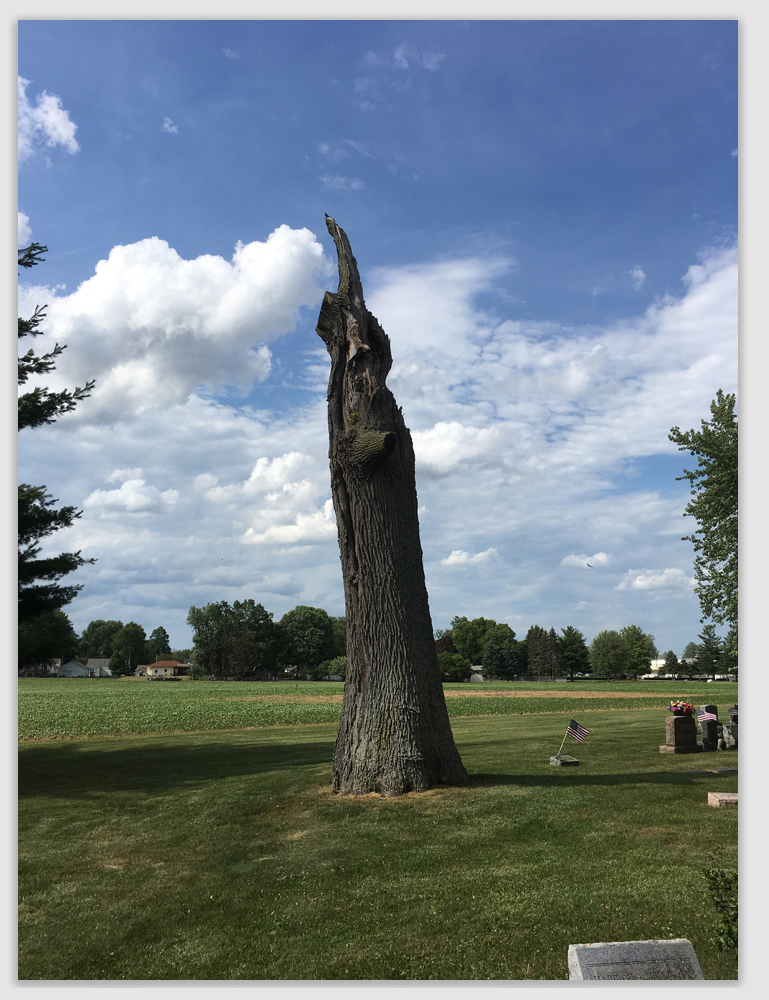
When Frances yelled at Ida about the arboreal butchery, Ida stopped, and thereafter a court issued a restraining order. The trunk of the tree is still standing, but the upper part has been reduced to two denuded limbs, the highest point of which is about forty feet from the ground. , “and there is an entire absence of branches and foliage.” On the south side of the trunk, there is a large scar resulting from the removal of the bark by chopping it with an axe.

Frances sued, but the trial court dismissed the action. She appealed. The appellate court ruled that both parties equally owned the tree, but Ida had damaged the tree so badly that an injunction would have served neither party. The court held that the tree would never grow back, and therefore it would have been more beneficial to both parties to have the tree chopped down. Thus, the court of appeals affirmed the trial court decree dismissing  Frances’ action for a permanent injunction to prevent Ida from cutting down a tree.

Frances appealed to the Supreme Court of Massachusetts.

Held: The court of appeals was right. The damage had been done, and an injunction should not issue.

The Court observed that where the trunk of a tree stands wholly on the land of one property owner, he is deemed the owner of the entire tree. This is true despite the fact that the Massachusetts Rule gives his or her neighbor the right to cut off limbs and roots which invade his premises. But where, as in the present case, the trunk stands across the boundary line, it has generally been said that under these circumstances both parties own the whole tree as tenants in common.

In other cases, the Court admitted, it has been held that each party has title to only that part of the tree on his side of the line but has a right to prevent his neighbor from so dealing with his part as unreasonably to injure or destroy the whole. But here, resolving inconsistencies in the two approaches is not necessary. Under either view, “it is difficult to see why either owner should have any less right to cut off branches and roots than he would have if the trunk stood entirely upon the other’s land.”

But this case, the Court ruled, it is unnecessary to determine whether “the value of a tree to one owner is to be weighed against the detriment to the other owner of being unable to use all of his land for building purposes.” That is because the overarching principle applicable here is that relief by injunction will not be granted where the granting of it would be but a futile gesture and would serve no useful purpose in protecting any substantial right or interest of the party applying for it.

Before this suit was brought, the Court said, “the tree had been reduced to a condition in which it could be of no benefit to the plaintiff from the viewpoint either of beauty or of utility. It was and still is a bare skeleton consisting of a trunk and two limbs, with no other branches or foliage whatever. There is nothing to show that the lapse of any reasonable period of time will restore it to attractiveness or value. Its removal would now appear to be advantageous to both parties and harmful to neither.”

The Court did not intend to reward Ida’s trespass, Rather, it simply recognized reality, that to deny a permanent injunction under these circumstances “is merely, in dealing solely with the question of injunctive relief, to take a practical view of an existing situation for which an injunction can afford no genuine remedy.”

– Tom Root

TNLBGray140407