Case of the Day – Friday, February 20, 2026

THE DOMINATRIX

Hardly anything can sow discord among neighbors like an easement. Rarely described with much specificity or limited as to use by a detailed statement of purpose, easements cause problems for the holder. Or the grantor. Or often, both.

Where the easement is for the benefit of an adjacent property owner, we talk about the dominant estate – the property being benefited – and the subservient estate, which is the property (or property owner) burdened by the easement.

In today’s case, the Dzingles bought a landlocked parcel of land about 60 years ago, and – in order to get back and forth from the road – bought an ingress easement from their neighbor. As the name implies, the easement, 25 feet wide and containing a “trail,” was intended to let the Dzingles get to and from their property. The property was held by the Marilyn Dzingle Trust, making her sort of the Dominatrix.

The mind is fallible (just ask Joe Biden… or even Donald Trump).  Especially where the owner of the subservient estate (cool term, right?) sells the property to someone else, someone like Jim Platt. Jim knew what he was buying, and he wasn’t the kind of guy to spend a lot of time poring over deeds and those appurtenances, principal places of beginning, heirs and assigns, and all of the legal mumbo jumbo. He knew the Dzingles had a driveway going over his land, and who needed to know any more than that?

Jimbo, that’s who. When Dzingle cleared vegetation from either side of his drive (but within the 25’ limit of the easement), Platt objected that the Dzingles had diminished the value of his property. When Platt dropped a dumpster next to the driveway, crowding the use of the road, the Dzingles objected right back. Platt said, “Sure, I’m encroaching on the easement, but you still have enough room to get by.”

Well, enough was finally enough. When the Dzingles wanted to build a modular house, they needed 22 feet of clearance to haul the pieces in. Those of us who are good at math can figure that this should be fine, with 1½ feet of clearance on each side. Well, yeah, except for Jimmy’s dumpster, and he would not move it.

So the Dzingles took Jimmy Platt to school, this class being held in a courtroom. And by the time class was over, Jimmy Platt figured out what all that fine print on the deed really meant.

Dzingle Trust v. Platt, Case No. 330614 (Ct.App. Mich., Feb. 14, 2017) 2017 Mich.App. LEXIS 227. The Dzingles had contentedly enjoyed their landlocked 59 acres for nigh on 50 years, partly because they had had the foresight to buy a 25-foot ingress easement from their neighbor. But time passed, and after Jim Platt bought the subservient estate, the parties began feuding over what rights the dominant estate had over the easement.

The deed granting the easement stated that it was “an easement for ingress and egress over a parcel of land 25 feet wide…” and referred to an attached survey for the exact location of the easement. The survey clearly identified the location of the easement and indicated that the “existing trail lies entirely within easement.”

The Dzingles placed gravel in the easement and cleared vegetation to use it for ingress and egress and to improve his attached residential property with a water well and pond, which required large trucks to use the easement. They planned to build a modular home on the property, but delivering the modules would require 22 feet of clearance, just within the easement’s 25-foot width. Jim complained that the Dzingle’s vegetation cutting within the easement “unreasonably burdened my property and eliminated my use of the property.” For their part, the Dzingles complained that Jim Platt’s placement of a dumpster in the easement did not let them use the full 25 feet for ingress and egress. That may be so, Jim said, but it did not keep the Dzingles from ingress or egress.
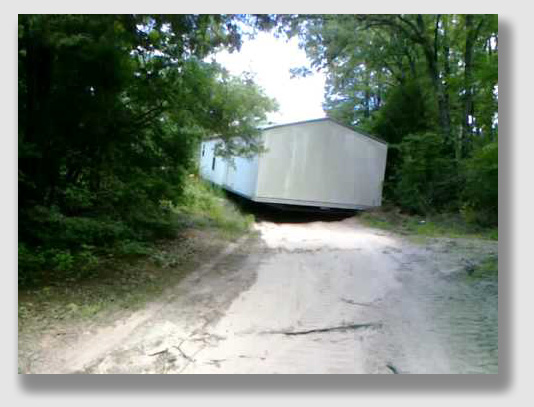
The Dzingles sued for a declaratory judgment regarding their rights to remove obstructions to bring the modular home onto the property and asked the trial court to order Platt to remove his dumpster and any other obstacles from the easement. The trial court granted summary judgment to the Dzingles, holding they were entitled to the full 25-foot easement, and clearing brush from the easement was not an addition or improvement to the easement. The trial court rejected Jim Platt’s argument that the Dzingles’ proposed use of the easement would materially increase the burden on his estate because their rights as the dominant estate to ingress and egress on the easement were paramount to Platt’s rights to wildlife and natural beauty. Finally, the trial court ruled that Platt must remove his dumpster from the easement because it was inconsistent with the Dzingles’ rights to ingress and egress.

Jim Platt appealed.

Held: The Dzingles’ rights extended to the whole 25 feet of the easement, and those rights included trimming vegetation so that the easement was usable for its intended purpose. It’s a rough lesson for a subservient estate holder to learn, but the dominant estate holder’s “rights are paramount to the rights of the soil owner to the extent stated in the easement grant.” The language of the instrument that granted the easement determines the scope of the easement holder’s rights.

In this case, the deed grants the Dzingles an easement for “ingress and egress.” The deed does not define ingress and egress, so the Court referred to a dictionary to determine the common meaning of the terms. “Ingress” is the “right or ability to enter; access,” and “egress” is defined as the “right or ability to leave; a way of exit.” Thus, an “ingress-and-egress easement” is an easement that grants the right to “use land to enter and leave another’s property.” Thus, the Court concluded the deed expressly granted the Dzingles the right to enter and leave their property, and the right to do so is paramount to Jim Platt’s rights in the same property.

What’s more, the easement gives the dominant estate “all such rights as are incident or necessary to the reasonable and proper enjoyment of the easement.” While the dominant estate’s exercise of the easement must place as little burden as possible on the subservient estate, still “the making of repairs and improvements necessary to the effective enjoyment of an easement… is incidental to and part of the easement.”

A repair maintains an easement in the condition it was in when the easement was made. Improvements, on the other hand, are alterations to an easement, and alterations are not permitted unless necessary for the effective use of the easement, provided they unreasonably burden the servient tenement. Here, the Dzingles offered evidence that clearing vegetation, placing gravel in the easement, and using the easement to allow large trucks to improve the Dzingle acreage were consistent with the use of the easement since the easement was granted. Thus, the Court said, the Dzingles “presented evidence that removing vegetation and leveling would maintain the easement in the condition and uses it was in when the easement was granted. Platt presented no contrary evidence that clearing or leveling were outside the easement’s scope or changed the easement’s character.”

Finally, the Court said, any rights in the grant of an easement must be reasonably construed. The Dzingles have a right to reasonable ingress and egress, but they are not entitled to an unobstructed right-of-way. However, the Court said, the evidence showed that Jim’s dumpster intruded into the easement, and the Dzingles showed they needed at least 22 feet of the 25-foot easement for clearance to move the modular home pieces onto the property. Jim Platt may use the easement as long as his use does not interfere with the Dzingles’ right of ingress and egress. However, the Court said, because the Dzingles need the vast majority of the easement for ingress clearance and the dumpster intrudes into the easement, Jim Platt must move the dumpster.

– Tom Root

TNLBGray140407

Case of the Day – Monday, February 9, 2026

WYSIWYG

Referees make mistakes. And that’s a good thing. It keeps our juices flowing, gives us a safe target for our anger, and even – thanks to the Internet – lets us relive our ire even when the underlying game’s been forgotten.

Judges make mistakes, too. If that weren’t so, there’d hardly be a need for courts of appeal or even the Supreme Court.

In today’s case, an electric utility sued back in the 1960s to force a landowner to give it an easement for building and maintaining power lines. The court granted the easement — which consisted of four separate rights — but somehow left out the part where it got an easement of 25 feet on either side of a right-of-way to keep trees trimmed. Some 45 years later, the utility wanted to assign its right to the City of Jackson, Missouri, so the City could build its own power line.

The case ended up in court, where the utility argued that just because the 1969 court forgot to mention the 25-foot easement, that didn’t mean it wasn’t there. After all, the utility asked for it and the court never said it couldn’t have it. When the damages were assessed so that the landowner could get fair compensation for the condemnation, the commissioner charged with assessing the cost included the 25-foot easement. Just an oversight, the utility argued.

There’s an old adage in the law that a court speaks through its record. And in this case, while the 1969 Order probably did omit the 25-foot easement through oversight, that didn’t matter. The Order was clear and unambiguous in how it described the easement. Where the language is clear, a reviewing court won’t second-guess.

The 25-foot wide strips were not covered by the prior easement, no matter what the parties may have meant at the time. Like the Dramatics’ old song went, “Whatcha see is whatcha get.”

dramatics150923City of Jackson v. Bettilee Emmendorfer Revocable Trust, 260 S.W.3d 913 (Mo.App., 2008). The Bettilee Emmendorfer Revocable Trust owned land in Jackson, Missouri, which had been the subject of a condemnation action 40 years before, when the property was owned by others. Back then, Union Electric petitioned for rights over four portions of the land: a 100-foot easement, for the purpose of installing electric transmission lines, 25-foot sections on either side of the 100-foot easement for maintaining trees, overhanging branches and obstructions, two smaller easements for use in connection with the transmission lines, and an easement for ingress and egress.

The court’s order in that prior case granted Union Electric the 100-foot easement, easements to the two separate parcels, and an easement for ingress and egress. However, the court failed to mention Union Electric’s request for an easement on the 25-foot strips on either side of the 100-foot easement. A report of commissioners filed in the case indicated the commissioners viewed the 25-foot sections on either side of the 100-foot easement as well as the 100-foot portion itself to be within the easement, and it set damages at $22,224.

In October 2006, Union Electric entered into an agreement with the City of Jackson to allow Jackson to build a new electric line on the eastern edge of the 100-foot easement. Jackson and Union Electric entered into a partial assignment of the easement in accordance with that agreement. But noticing the old trial court order had a hole in it, the City sought a declaration of rights as to whether the 1969 condemnation action awarded Union Electric the 25-foot sections on either side of the 100-foot easement, whether Union Electric has the right to assign to Respondent the right to construct an electric transmission line on the 100-foot easement, and whether the construction of an additional electric transmission line amounts to an additional taking of property from the Trust. The Trust asserted the 1969 Order made no mention of an easement or other rights condemned or established on either side of the 100-foot easement. The Trust also argued that construction of an additional electric transmission line would increase the burden on the property “beyond the scope of the intended and authorized use of the easement,” grant of the easement would be “inconsistent with the original use of the easement,” and the additional utility poles and electric transmission lines would interfere with reasonable use and enjoyment of the property.

The trial court held that Union Electric’s easement included the right, permission and authority to trim, cut and remove trees, overhanging branches and obstructions on 25 feet on each side of the 100 feet right of way which may endanger the safety of or interfere with the transmission lines, and it had the power to assign the right to the City. The Trust appealed.

What the court's actual order says is what goes ...

What the court’s actual order says is what goes …

Held: The 25-foot strips are not covered by the easement. The 1969 order establishing the easements made no mention of and contained no reference to the 25-foot sections on either side of the 100-foot easement, and thus, those portions are not part of the easement. When interpreting easements, courts ascertain the intention of the grantor from the instrument itself. Only when the language of the deed is “unclear and ambiguous” should a court resort to the rules of construction and consider extrinsic evidence. A contract is not ambiguous simply because parties disagree about its meaning. Rather, an ambiguity arises only “when the terms are susceptible of more than one meaning so that reasonable persons may fairly and honestly differ in their construction of the terms.

Here, the Court said, nothing in the lower court language was unclear or ambiguous in the documents creating the easement, thus leaving a court to judge the easement only by the plain language of those documents without the need to refer to extrinsic evidence. The report of the commissioners, while it apparently valued the 25-foot sections in determining damages, does not supersede the court’s unambiguous order.

As for the right to assign, the Court held, it was equally clear and unambiguous that the order granted the easement holder the ability to construct a “line or lines,” permitted the holder to “add to and relocate” the electric transmission lines, and referenced “successors and assigns,” thus indicating that assignments are permitted.

– Tom Root

TNLBGray140407

Case of the Day – Thursday, September 18, 2025

INCORPOREAL HEREDITAMENTS

The man on the right is a corporal ... and a combat vet with a Purple Heart. The man on the right, a major general, is not a corporal. The guy in the middle is just a politician. But none of them is an incorporeal hereditament.

The man on the left is a corporal. The man on the right is a major general, not a corporal, but he may have once been one. The guy in the middle is just a politician and probably was never a corporal. But none of them is now or ever has been an incorporeal.

Today, we’re considering incorporeal hereditaments. Lawyers like cool terms like these, because they can charge more when their clients can’t understand what they’re saying. Here at treeandneighborlaw.com, we demystify the law for you. That’s us – the homeowner’s friend.

Before we pull a muscle patting ourselves on the back, let’s get to today’s topic. A hereditament is nothing more than a right that can inherited. A corporeal one is that may be seen and handled, like a piece of real estate. Back in the day, conveyance of land was done by livery of seisin, wherein the propert seller would actually hand the buyer a twig or clump of dirt, a ritual conveyance of the real estate being sold. An incorporeal hereditament, on the other hand, is something that couldn’t be symbolically passed off, something intangible like an easement.

Sound boring? Some North Carolinians found out that boring or not, it’s important. A couple of landowners had, over the past 11 years or so, planted trees, built fences and otherwise taken actions inside a 30-foot driveway easement that encroached on the use of the passage by its owners. The easement owner, stymied in his use of the drive, sued. The defendants argued “too little, too late:” the plaintiffs were way beyond the 6-year statute of limitations for suing on incorporeal hereditaments. The plaintiffs said, “Poppycock!” (a term that may be mildly vulgar in the UK but in the legal world means “fiddlesticks!”). The statute didn’t start running until the invasion of the easement had passed the 20-year period for adverse possession of land or prescriptive easements. In other words, the plaintiff argued, he was allowed 26 years from the time the trees were planted and fences were built to bring a lawsuit.

The Court of Appeals disagreed, siding with the defendants. This wasn’t a case of someone trespassing, taking land by adverse possession or a right by prescriptive easement. This was someone trying to undo an express easement. The lawsuit simply related to an incorporeal hereditament, and it was subject to the 6-year statute.

The incorporeal hereditament not taken ... as Robert Frost might have said.

The incorporeal hereditament not taken … as Robert Frost might have said.

The result is curious. It means that an owner of an easement, a right that is often as valuable as the property itself, can lose that right by interference by the servient estate owner in a relatively brief period of time. To use a legal term, “you snooze, you lose.”

Pottle v. Link, 654 S.E.2d 64 (N.C.App., 2007). The Pottles owned Tract 6 on Cedar Island, and Snug Harbor South, LLC, owned Tract 4. Both of these owners held 30-foot wide easements allowing ingress to and egress from the public road to Tracts 6 and 4 and other lots. Mr. Link owned Tract 3 and Mr. Willets owned Tract 5, adjacent lots that were the servient estates over which the easements ran. About 11 years before the lawsuit was filed, Link planted several oak, cypress, holly, and cedar trees on Tract 3, joined several years later by two more oak trees to replace two that had been destroyed by hurricanes.

He maintained the trees by installing an irrigation drip line and planting other vegetation on the tract In the summer of 2004, Willets installed a post and rope fence on Tract 5, and in 2005, Link built a fence. The Pottles and the LLC sued, arguing that Link’s trees impeded traffic on the easement and that Willets’ post and rope fence encroached on the easement as well. Plaintiffs filed a motion for summary judgment, arguing that Link and Willets had refused to clear the easements to provide access to property that had no other routes of access. Link and Willets moved for summary judgment, too, arguing that the 6-year statute of limitations for injuries to incorporeal hereditaments had expired and that the plaintiffs’ actions constituted an abandonment of the easement. The trial court granted summary judgment to the plaintiffs. The defendants appealed.

Here's a legal expression anyone can understand ...

Here’s a legal expression anyone can understand …

Held: Summary judgment for the plaintiffs was reversed, and the defendants won on many of the issues. The Court of Appeals noted that the parties agreed that all encroachments, except the fences installed in 2004 and 2005, were planted or installed approximately nine to eleven years before the lawsuit. The only question, the Court said, was which statute of limitations applied. An affirmative easement is a right to make some use of land owned by another without taking a part thereof, while a negative easement prohibits the owner of a servient estate from doing something otherwise lawful upon his estate because it will affect the dominant estate. Easements are incorporeal hereditaments, defined as “[a]n intangible right in land, such as an easement.” N.C. Gen.Stat. §1-50(3) requires that an action for injury to any incorporeal hereditament be brought within six years. The plaintiffs argued that the injury in this case was similar to an adverse possession, having a limitation period of twenty years, but the Court disagreed, holding that the cases relied on by the plaintiffs related to a defendant’s continuous trespass onto the plaintiffs’ property, not on plaintiffs’ incorporeal hereditament.

Because an injury to an incorporeal hereditament was at issue in this case, rather than a continuous trespass or a prescriptive easement to property held in fee, the Court held that N.C. Gen.Stat. §1-50(3) applied, and the plaintiffs’ case thus was barred because the six-year statute of limitations had been exceeded. All but two encroachments onto the plaintiffs’ easement began 9 to 11 years before the lawsuit. The defendants were therefore entitled to partial summary judgment as a matter of law. The fences had not been in place for more than six years, but because the defendants argued that the fences did not encroach on the easement, an issue of fact existed, and summary judgment in favor of the plaintiffs had to be reversed.

The case was sent back for trial on the question of whether the fences encroached on the easement.

– Tom Root

TNLBGray140407

Case of the Day – Wednesday, September 17, 2025

WHO YOU GONNA CALL?

So who you gonna call?

    So who you gonna call?

It’s not easy to defeat a utility company holding an easement for transmission lines, despite the fact that the power outage that spawned the Energy Policy Act of 2005 and turbocharged the North American Electric Reliability Corporation happened two decades years ago. The great Blackout of August 2003, after all, started primarily when power lines sagged into trees in the Cleveland, Ohio, area.

Yeah, it’s tough to beat the power company and its chainsaw-wielding minions … but the Corrigans did it for a while. They had granted an easement to a Cleveland electric utility for a transmission line. In the wake of the blackout, the utility told the Corrigans (and thousands of others) that it would vigorously pursue cleaning up vegetation in the easements. This means, among other things, no trees within 25 feet of the lines.

The Corrigans had a big silver maple that was about 22-1/2 feet from the lines. They loved that tree, so they hired an arborist at considerable expense to trim it away from the lines and to inject the tree with a hormone to slow growth. Tough luck, the utility said, it’s coming down anyway.

So who do you call when the power company shows up with chainsaws and a gleam in its institutional eye? The Corrigans raced to the local common pleas court and asked for an injunction. The trial judge agreed, and the Court of Appeals concurred. Both of those courts sided with the Corrigans that the utility could only cut trees that were “a possible threat to the transmission lines.”

It seemed important to the Court of Appeals that the community had not experienced any service interruptions since the Corrigans had pruned the tree, although that reasoning’s pretty thin. The tree has to only fall once, cascading one failed transmission line into a continental disaster. But the Court seems to have been favorably impressed by the amount of money the Corrigans had spent getting the tree professionally trimmed.

utilitytrim140515The utility saw an issue here that was bigger than just the Corrigans and their lone silver maple tree. It framed the question as being one of who was really in charge here, the 88-odd common pleas courts spread throughout Ohio or the Public Utilities Commission of Ohio. The Ohio Supreme Court agreed that this was indeed the issue, and ruled that the inclusiveness of the state statute and regulations delegating power to the Public Utilities Commission of Ohio gave PUCO the sole authority to decide questions of vegetation management. (Ohioans spell out the acronym “P-U-C-O”: please don’t try to pronounce it as though it were a word).

I have to admit that the appellate decision left me with the uneasy feeling that the Court of Appeals’ attempt to do some rump justice here may have made it much more difficult for a utility to exercise its easement rights. To be sure, a utility being sued in a case like this would have to be prepared with an expensive and eye-popping case that graphically depicts the dangers that a tree in the transmission path — even a well-cared-for tree — can pose.

The Ohio Supreme Court’s holding provides electric utilities a much friendlier forum in which they must litigate issues of vegetation management, although that may not be a bad thing. Utilities have to walk a fine line, incurring ire if property owners think trees were pruned too aggressively, and facing universal fury (not to mention catastrophe) when service is interrupted by vegetation coming into contact with transmission and distribution lines.

Corrigan v. Illuminating Co., 122 Ohio St.3d 265 (Sup.Ct. Ohio 2009). The Corrigans granted a quitclaim deed to The Illuminating Company, the local electric utility, for a transmission line to run through their yard. The easement gave the Illuminating Company the right to “enter upon the right-of-way occupied by said transmission lines … with full authority to cut and remove any trees, shrubs, or other obstructions upon the above-described property which may interfere or threaten to interfere with the construction, operation and maintenance of said transmission lines.” The Corrigans had a large silver maple tree located about 22.5 feet from the centerline of the transmission lines. At considerable expense, they had their own arborist trim the tree and inject slow-growth hormone to keep the tree from posing a risk to the transmission line. Nevertheless, the Illuminating Company decided to remove the tree, and the Corrigans sued for an injunction.

The trial court granted an injunction barring the Illuminating Company from removing the tree, and the Court of Appeals agreed. The electric utility – seeing the issue as one that transcended the issue of one tree but rather affected the company’s ability to manage vegetation in its rights-of-way throughout the state – appealed to the Ohio Supreme Court.

Held: The Corrigans argued that the issue was purely a contract matter, but the Supreme Court disagreed. Noting that “[t]here is no question that the company has a valid easement and that the tree is within the easement” and the easement’s language was unambiguous that the utility had the right to remove trees that might interfere with its transmission lines, the Court said the issue was the correctness of “the company’s decision to remove the tree instead of pruning it.” That was “really an attack on the company’s vegetation-management plan [and] that type of complaint is a service-related issue[] which is within PUCO’s exclusive jurisdiction.”

The statute creating PUCO to administer and enforce these provisions provides that the commission hears complaints filed against public utilities alleging that “any regulation, measurement, or practice affecting or relating to any service furnished by the public utility, or in connection with such service, is, or will be, in any respect unreasonable, unjust, insufficient, unjustly discriminatory, or unjustly preferential.” This jurisdiction is “so complete, comprehensive and adequate as to warrant the conclusion that it is likewise exclusive.”

The Court used a two-part test to reach its determination. First, it asked whether the commission’s administrative expertise was required to resolve the issue in dispute, and, second, whether the act complained of constituted a practice normally authorized by the utility.

rules140515The Ohio Administrative Code chapter on electric service and safety standards requires utility companies to establish a right-of-way vegetation-control program to maintain safe and reliable service. The Code requires that each electric utility inspect its electric transmission facilities (circuits and equipment) at least once every year, in accordance with written programs, and takes a number of factors into consideration, such as arcing, sagging, and line voltage, as well as regulatory requirements from OSHA, FAA, and the Army Corps of Engineers. In addition, electric utilities are required to comply with the American National Standards Institute’s National Electrical Safety Code. The utilities are required to submit their programs to the Commission, which will resolve any disputes as to the efficacy of the plan.

The Court concluded that the Ohio Administrative Code made it clear that PUCO’s administrative expertise is required to resolve the issue of whether the removal of a tree is reasonable.

The second part of the test determined whether the act complained of constitutes a practice normally authorized by the utility. Again, the Court said, the Administrative Code clearly held that vegetation management is necessary to maintain safe and reliable electrical service. Thus, the Supreme Court ruled, the second part of the test was satisfied, and the Corrigans’ complaint fell within the exclusive jurisdiction of PUCO.

That meant that the Illuminating Company’s decision that the silver maple interfered or threatened to interfere with its transmission line was a service-related question and one that the Corrigans could only dispute in front of PUCO. The Court of Appeals judgment was thrown out.

– Tom Root

TNLBGray140407

Case of the Day – Thursday, June 19, 2025

INEXACTINESS

It’s been a long time, 46 years more or less since law school graduation. Ah, that was a time! For a sweet few months in the spring of 1977, I knew absolutely everything about the law. All anyone had to do was ask me (and sometimes they didn’t even need to ask: I’d just volunteer).

Alas, by the middle of June, a week after commencement, I was cramming for the bar exam and finding out I did not know so much after all. It’s been all downhill since then. The longer I go, the more I’m shocked to discover what I either no longer know or never knew to begin with. Beyond what lawyers should know, many clients are shocked that many learned counselors aren’t as learned as clients imagine lawyers should be, such as being to recite all 50 titles (plus appendices) of the United States Code or recall the dissent in a case decided in Pocatello, Idaho, 42 years ago.

Lawyers get called on all the time to be knowledgeable and thorough in many different areas of the law.  That’s why there are law books. And (because we’re over two decades into the 21st Century) databases. And even ChatGPT (if you don’t mind bogus cases containing bogus holdings, but be warned that the judges don’t like it much).

Today’s case reminds us why it’s a good idea for all lawyers, including the most seasoned practitioners, to look things up and review the basics whenever he or she tackles some task not performed that often. And not on ChatGPT, either.

Richard Stafursky and his siblings were squabbling over inherited land.  They settled it by Richard taking one chunk of land, and his brother and sister together owning an adjacent one.  Richard gave his siblings an easement to cut grass and brush on a 3-acre portion of his land, provided the brush they cut was under 2” in diameter.  He had a lawyer draft the easement into the deed, and then he conveyed his land — including the easement — to some tree-hugging nonprofit organization of which he was chairman.

Then the battle began.  The tree-hugging group wanted to return the whole tract to nature and told Richard’s siblings they couldn’t cut down any trees when they cut brush.  What’s more, the group transplanted native trees in the meadow that was subject to the easement.  Finally, the nonprofit sued to get the court to issue a ruling as to what the easement meant.

How’d the lawyer screw it up?  Easy. He thought he remembered how to write an easement. Easy-peasy, right? Write down the restriction, what the subservient estate holder was allowed to do or had to put up with. Then bill the client. And take a long lunch.

Had counsel refreshed his recollection of easement law, he would have recalled the nuance. Easements are driven by purpose.  That’s black-letter law in Massachusetts.  And nothing in the ‘cut no 2″-plus brush’ easement language written into the deed suggested a purpose.

No one seemed to be able to agree on why Richard had given the easement to his brother and sister.  When Richard was hauled into court as a witness, he claimed that the easement was just an artifice to help sell the property. The trial court rejected his explanation as meaningless at best and a fraud at worst.  Then Richard took a different tack, claiming there was no purpose to the easement whatsoever.  The brother and sister said the purpose was to preserve their view.  The lower court had to find some purpose in order to enforce the easement and thus decided the brother and sister’s explanation was the one that made the most sense.

The Massachusetts Court of Appeals upheld the decision, having no problem with the notion that the easement was a “view easement” (despite the apparent fact that Richard, who was trying to stick it to his siblings, denied the easement had a purpose at all).  Clearly, the easement’s lack of explanation as to its purpose and its unusual provisions about brush under 2” in diameter left the court in a position of having to provide much more guidance and interpretation than should have been necessary. In fact, had the easement been properly drafted, there would probably have been no lawsuit to begin with (assuming, of course, Richard had not wanted to stir things up in some other mischievous manner).

As the lower court quite rightly noted, all of the problems could have been avoided if the lawyer drafting the easement had shown as much care in stating the reason for the easement as he did in describing the limitations on what could be done.

World Species List-Natural Features Registry Institute v. Reading, 75 Mass.App.Ct. 302, 913 N.E.2d 925 (Ct.App. Mass. 2009) Richard Stafursky, the previous owner of some property that included a 3-acre tract, granted his brother-in-law and sister, Jim and Sandra Reading — the owners of a next-door parcel — an easement permitting them “to enter on to the [three-acre] parcel [subject to the easement] for the sole purpose of cutting grass and brush no larger than two (2) inches in diameter when measured one (1) foot from the ground, excluding any cutting of grass and brush on wooden land as shown on said survey of the three-acre easement.” At the time the easement was granted, the 3-acre parcel consisted of two open meadows with a wooded area that was not to be cut in the middle.  Richard deeded his land to the plaintiff Institute, a nature conservancy trust that he founded, which intended the return the whole large tract to its natural conditions. 

Shortly thereafter, the Institute demanded that the Readings give advance notice before exercising the easement, that the neighbors not cut any trees (even those within the size limitation) and that the neighbors not remove any trees the Institute had transplanted to the area.  The Institute contended that the sole purpose of the easement was to enable Richard to sell his property.  The neighbors replied that the purpose of the easement was to enhance their view and that they had acted within their rights as beneficiaries of the easement by cutting within the cutting area to maintain that view, and that the plaintiff does not have the right to transplant trees or other vegetation into the cutting area.

Held: The easement was a “view easement” and the neighbors had the right to exercise it.  The Court said that “we do not consider it dispositive that the easement language here does not explicitly state that the purpose of the right to cut vegetation is to permit the benefitted landowner to enjoy the view. The purpose and effect of the view easements are not simply to limit the uses that the plaintiffs can make of their own property. Rather, the view easements here have taken on the defining characteristics of an affirmative easement by conferring on the defendants the right to enter and use land in the possession of another, and we conclude that this fact is dispositive.”

The Court noted that the limitation on cutting only grass and brush that was less than two inches in diameter was consistent with the circumstances of the grant of the easement, “representing a compromise between the desired uses of the easement property – as an open meadow for a view on the one hand and the potential restoration to a natural landscape on the other.”

The Court put a stop to World Species’ attempts to regulate the easement. First, the Court held that the word “brush” in the easement language included small trees. World Species could not stop the cutting of trees, nor could it defeat the easement by transplanting trees with a trunk larger than 2 inches. The Court said to allow this “conduct is inconsistent with Readings’ view easement. The easement area would become reforested if World Species were permitted to transplant trees of that size onto the easement area as such trees would exceed the dimensions of vegetation that [the Readings were] allowed to cut, thereby creating a condition that would eventually cause the view to disappear.”

The Court did agree with the Land Court judge that the easement grant had to be exercised regularly. That is, the Court said, the “Readings must use it or lose it. If [the Readings] do not regularly cut vegetation, small trees existing on the easement area will grow until they exceed two inches in diameter when measured one foot above the ground and he will no longer be permitted to cut such vegetation. Over time, the land will become reforested and the Readings will lose the view benefit… derived from the easement.”

– Tom Root

TNLBGray140407

Case of the Day – Wednesday, March 12, 2025

RESISTANCE IS FUTILE

One of the back room perks of running a tree law website is that we can see what kinds of searches lead readers to our little patch of the Internet. Probably the top search is some kind of encroachment issue, where a neighbor’s tree is overhanging the searcher’s property, or a dead tree next door is about to fall on the searcher’s roof… that kind of thing.

But a perennial also-ran is the irate homeowner or tree-hugger complaining about a swarm of cretins wielding chainsaws, trimming trees for the benefit of power lines exercising the same care and restraint William T. Sherman showed when he toured Georgia in the fall of 1864.

There are two immutable truisms to remember when the power company tree-trimming contractors come around. First, the odds are very high that the power company does own an easement across your property that lets Leatherface and his buddies butcher your trees. Second, if you want to stop the sylvan massacre, you will soon discovery that – as the Borg liked to say – resistance is futile.

Today’s case, from California, illustrates just how immune utilities and their contractors are to the entreaties of the homeowners whose lands the easements cross. The Sarales, who ran a walnut farm, sued to stop Pacific Gas & Electric from excessively trimming their walnut trees. The California Court of Appeals agreed with them that it had jurisdiction to determine whether PG&E’s easements across their lands were valid. But once the easements were held to be valid, the courts’ inquiry ended. Any complaint that PG&E was being unreasonable in its use of the easement, that is, in how enthusiastically it was hacking up the trees within the easement, could only be done in a proceeding before the California Public Utilities Commission.

Cutting a swath through Georgia prepared General Sherman for a career as a tree-trimming contractor for an electric company.

Such a hearing with the Commission, pitting a homeowner against a public utility before the same government agency that regulates the utility is akin to putting a mouse between two cats. But such is the law almost everywhere.

Sarale v. Pacific Gas & Electric Co., 117 Cal.Rptr.3d 24, 189 Cal.App.4th 225 (Ct.App. 3rd Dist., 2010). The Sarales own farmland across which PG&E claimed an easement for electric transmission lines pursuant to a 1915 written grant. The right-of-way gave PG&E “the right of erecting, constructing, reconstructing, replacing, repairing, maintaining and using for the transmission and distribution of electricity… and also a right of way [giving PG&E] full right and liberty of cutting and clearing away all trees and brush on either side of said center line whenever necessary or proper for the convenient use and enjoyment of the said line of towers and wires and right of way…”

Until November 2004, PG&E periodically trimmed the Sarales’ walnut trees for about 10 feet on either side of the lines. After November 2004, however, over the Sarales’ protest, PG&E began trimming the walnut trees up to 20 feet away from the lines, rendering unproductive what had been “producing trees.”

The Sarales sued PG&E, which defended by saying it was “legally mandated to take appropriate measures to maintain vegetation clearances and, accordingly, we have trimmed and continue to trim all trees that may interfere with our electric power lines-pursuant to both our rights under our easement/ right of way as well as the rules and regulations under which we are required to operate.”

The Sarales denied the existence of a utility easement on their land, but said if the easement were found to exist, PG&E should be “authorized by law to trim no further than the distance established by the court, radially measured at time of trimming and not further, without [the Sarales’] permission.” They sought an injunction preventing PG&E from “destroying vegetation or trimming crops under cultivation” and demanded damages for trespass.

PG&E responded that California Public Utilities Code § 1759 barred the court from exercising jurisdiction over the Sarales’ claims because to do so would interfere with “an ongoing supervisory or regulatory program over which the public utilities commission has sole jurisdiction.”

PG&E’s contractors were only reasonably managing the easement.

The trial court agreed with PG&E, reasoning that the acts alleged by the Sarales “involving and related to… PG&E’s vegetation management practices under and around its power lines fall within the commission’s regulatory jurisdiction. This court, therefore, has no jurisdiction over the Sarales’ first amended complaint… Before proceeding against PG&E in superior court… the Sarales must first seek a finding from the public utilities commission that PG&E’s vegetation management practices are excessive or otherwise out of conformance with regulations.’

Held: The Court of Appeals agreed with the trial court. The California Public Utilities Commission holds the “broad authority to ‘supervise and regulate every public utility in the State’.” Section 1759 of the Public Utilities Code bars any court action that hinders or interferes with the exercise of regulatory authority by the Commission.

This broad authority authorizes the commission to “do all things, whether specifically designated in the Public Utilities Act or in addition thereto, which are necessary and convenient in the exercise of its jurisdiction over public utilities.”

No courts in the state, except the Supreme Court and the courts of appeal, have jurisdiction to reverse a Public Utilities Commission order. Nevertheless, the state legislature has provided for a private right of action against utilities for unlawful activities and conduct. The right of action is limited to those situations in which an award of damages would not hinder or frustrate the commission’s declared supervisory and regulatory policies.

The California Supreme Court has a three-part test to determine whether an action is barred by § 1759: (1) whether the commission had the authority to adopt a regulatory policy; (2) whether the commission had exercised that authority; and (3) whether the superior court action would hinder or interfere with the commission’s exercise of regulatory authority.

Here, the Sarales conceded the commission had authority to regulate trimming distances around power lines. The commission’s authority to “supervise and regulate every public utility in the State” included the authority to require utilities to maintain its systems and equipment “in a manner so as to promote and safeguard the health and safety of its employees, passengers, customers, and the public.” The court said regulating tree trimming distances around power lines effectuated this purpose.

The commission had clearly exercised its authority. Its General Order No. 95 provided rules governing the construction of overhead electric lines. Rule 35 of General Order No. 95 specifically governed tree trimming and had been changed in 1997 to require wider trimming margins from power lines.

The court held that for purposes of applying the test, “what matters is that the commission has exercised its authority to adopt a regulatory policy relating to tree trimming around power lines…”

Finally, the court held that an action for damages against a public utility is barred by § 1759 “not only when an award of damages would directly contravene a specific order or decision of the commission, i.e., when it would ‘reverse, correct, or annul’ that order or decision, but also when an award of damages would simply have the effect of undermining a general supervisory or regulatory policy of the commission, i.e., when it would ‘hinder’ or ‘frustrate’ or ‘interfere with’ or ‘obstruct’ that policy.”

Here, the Sarales’ suit against PG&E essentially advances claims of “excessive” tree pruning based on past vegetation management practices. Section 1759 saves the commission and utility companies from defending against lawsuits every time adjustments are made to protocols for vegetation management around power lines. The record, in this case, indicates that the standards for vegetation management surrounding power lines had been revised by the commission 13 times in 57 years. “Allowing owners of land containing overhead power lines to seek individualized judicial determinations of what might be ‘necessary’ or ‘proper’ vegetation,” the court said, “would cause a regulatory nightmare for the commission that § 1759 was intended to prevent.”

– Tom Root