Case of the Day – Tuesday, January 6, 2026

RESTRICTIVE COVENANTS ARE CHILD’S PLAY

I have previously reported harrowing tales of homeowner woe at the hands of a homeowners’ association. You remember the kind of officious, annoying kid in junior high school who was on student council? Well, he grew up and is on the HOA board.

In today’s case, two well-heeled homeowners bought the house next door, planning to demolish it and turn the property into a playground for their kids. And to think you couldn’t find a Barbie Dreamhouse left in the store for your offspring this Christmas…

But the property manager for the HOA that oversaw the development – seeking to enforce a deed restriction that required prior approval before “changes or alterations” – got a court to issue an injunction.

Injunctions aren’t easy to come by. The biggest hurdle is that the HOA had to convince the court that it was likely to prevail in the case. Homeowners Bob and Kathy Guzzetta argued that “change and alteration” was different from “demolition.” They had not changed anything that existed. Instead, they had simply taken away something, leaving nothing.

The grant of the injunction suggested to us that the court found their argument to be a “dead-bang loser.” It seemed like game, set, and match for the HOA – well before the first day of trial.

But trials have a way of turning losers into winners. The Guzzettas, undeterred by the pall of imminent defeat a preliminary injunction cast over their case, put their evidence on anyway. And they won.

The court, it seems, was no fan of restrictive covenants. Such covenants, the court rightly observed, “implicate contractual rights, such as the right of a buyer and seller to enter into a binding contract, but they also implicate property rights, such as one’s right to the free use of her land. In situations where these two rights conflict, the law favors the free use of land.”

Applying that standard, the court said, the analysis was simple. “Changes and alterations” required prior consent, but the Guzzettas were right: taking something away was not the same thing as changing or altering. After all, nothing else in the covenants required that a house even be on the lot. It was just that if there was a house on the lot, the HOA had to approve it. Requiring prior approval of something did not imply that prior approval of nothing was required as well.

Just a little something for the kiddies…

Service Corp. of Westover Hills v. Guzzetta, 2009 Del. Ch. LEXIS 221 (Del.Ch., 2009). The Guzzettas had been homeowners in Westover Hills for 11 years when they bought the property next to theirs. The adjoining property included a 1943 colonial-style house and mature maple and oak trees. The Guzzettas intended to raze the house to expand their backyard for their children.

However, properties in Westover Hills are subject to deed restrictions that bind all owners within the development. One of the restrictions provides that “no building, fence, wall or other structure shall be commenced, erected, or maintained, nor shall any addition to or change or alteration therein be made, until the plans and specifications, showing the nature, kind, shape, height, materials, floor plans, color scheme, location and frontage on the lot and approximate cost of such structure shall have been submitted to and approved in writing by” Service Corp., the property manager.

Service Corp. had the right to refuse to approve any such plans or specifications that it found not suitable or desirable for aesthetic or other reasons. Since 2004, Service Corp. has used an Architectural Review Committee to initially review proposals, request additional information as necessary, and make recommendations to the Service Corp. board. Service Corp. had approved demolitions before, as well as landscape plans.

The Guzzettas proceeded with their plans without obtaining approval, and Service Corp. sought an injunction prohibiting the demolition of the home and landscaping. The trial court granted a preliminary injunction until a trial on the merits could be held, but at trial it reversed course, finding in favor of the Guzzettas. 

Held: The Guzzettas didn’t need HOA approval to demolish the house next door. The restrictive covenant at issue held that “no building, fence, or wall or other structure shall be commenced, erected or maintained, nor shall any addition to or change or alteration therein be made” until the plans and specifications were approved by the HOA. Service Corp. argued that the Guzzettas’ planned demolition was a “change” within the plain meaning of that word. But the court, resorting to the dictionary, concluded that an “alteration” to a structure might encompass a new paint scheme. At the same time, a “change” was more radical, such as the gutting of a house followed by a complete refurbishment. While either of these terms might conceivably include a demolition, that interpretation made no sense when read with the requirement in the same covenant that the HOA must approve “the plans and specifications, showing the nature, kind, shape, height, materials, floor plans, color scheme, location and frontage on the lot and approximate cost of such structure…”

The court held that “the complete demolition of a structure so that it is replaced only by a grassy field would result, by necessity, in a change that has no ‘height, shape, materials, floor plans, color scheme, location or frontage’.” After all, how can the HOA approve plans for a grassy field? The third clause, the court held, “narrows the broad coverage of the second clause. Read together, the second and third clauses apply only to ‘changes’ to an existing structure, where some structure will remain afterward. Accordingly, because the Guzzettas do not propose to leave any structure on the Property following demolition, the second and third clauses of Article V do not require them to submit their plans for the complete demolition of the adjacent house to Service Corporation for approval.”

Service Corp. argued that the drafters obviously intended to prevent homeowners from making such a radical change to a property as the Guzzettas proposed without the consent of the organization representing the community. But the Court held that the restrictive covenants did not require that a structure be erected on every plot, but only that the plans be approved if a building were constructed. “Presumably,” the Court drily observed, “vacant lots could thus exist in Westover Hills.” In fact, one of the covenants provided that “free or open spaces shall be left on every plot built upon, on both sides of every residence erected thereon, which free spaces shall extend the full depth of the plot.” 

The lesson here is that because restrictive covenants tie a property owner’s hands, limiting what he or she can do with property that has been bought and paid for, a court is likely to construe such covenants strictly against the organization that imposed them. It’s a fair bet that if the writers of the covenants had ever imagined that homeowners like the Guzzettas would tear down a house in favor of – horrors! – green open space, the restrictive covenants would have required the hobnail boots of the HOA to march over the plans ahead of time. But no one imagined such a matter would arise, and the court was not about to rewrite the covenant to pull the HOA’s chestnuts out of the fire.

The game may have gone to the HOA. But the set and match belonged to the Guzzettas.

– Tom Root

TNLBGray140407

Case of the Day – Tuesday, September 30, 2025

A RATHER SURPRISING HOLDING FROM A DELAWARE TRIAL COURT

In this tree law gig, I read a lot of cases. After a while, reading between the lines gets a lot easier.
Today’s case, which I decided was nothing special, was just about some neighbors who were over-the-top haters of the defendant. The defendant seems like a guy whose crime was that he apparently had the effrontery to move in next door and then fix up the place.

The trial court’s long opinion had flushed away most of the plaintiffs’ breathless and frantic complaint – and “flushed” is the correct verb for most of the claims the tin-foil-hatted neighbors made against the defendant– when I got to their claim that defendant Bill Collison had “damaged a maple tree near the property line by shaving the trees directly up from the property line.”

“Holy Massachusetts Rule!” I muttered to myself. Everyone knows that this claim should be summarily tossed, because the Massachusetts Rule is as universally accepted as is turkey at Thanksgiving. Assuming Bill did “shave” the tree at the property line, that’s perfectly within his rights.

Much to my shock, the Court disagreed. It held that the right of “self-help” trimming of encroaching branches is not established in Delaware, and if this court was going to do it, it would not do it on summary judgment. It became obvious to me that whatever else Judge Calvin Scott, Jr., of Newark, Delaware, reads with his morning coffee, it sure isn’t this blog.

It did not take long to find reason to question the Judge’s refusal to grant summary judgment on this issue. In the 1978 Delaware Chancery Court decision Etter v. Marone, the court ruled

At the same time, certain generally accepted principles obtain with regard to encroaching trees or hedges. Regardless of whether encroaching branches or roots constitute a nuisance, a landowner has an absolute right to remove them so long as he does not exceed or go beyond his boundary line in the process. 2 C.J.S. 51, Adjoining Landowners § 52; 1 Am.Jur.2d 775, Adjoining Landowners § 127. He may not go beyond the line and cut or destroy the whole or parts of the plant entirely on another’s land even though the growth may cause him personal inconvenience or discomfort. 2 C.J.S. 51, supra.

So the Judge seems to be wrong: Delaware is firmly in the Massachusetts Rule camp.

What with allegations of underground tanks, clogged drainpipes and extreme mental anguish contained in the messy and unsupported complaint, Judge Scott pretty clearly had his hands full. By and large, he acquitted himself masterfully in the opinion, carefully deconstructing the plaintiffs’ complaints. But I’m betting that in about nine weeks, the Judge will be sitting down to a turkey dinner with all the trimmings. When he does, he should reflect that as many of us accept the Massachusetts Rule as will be dining on the same meal that day.

Dayton v. Collison, C.A. No. N17C-08-100 CLS (Super. Ct. Del. Sept. 24, 2019), 2019 Del. Super. LEXIS 446. Margaret Dayton and Everett Jones clearly had it out for their neighbor, Bill Collison. They claimed that since 2014, Bill had removed a significant number of standing trees and about 5,000 square feet of naturally growing plants from the City of Newark’s natural buffer zone, removed a 30-year-old drainage pipe located on his property and filled the remaining pipe with rocks and debris, intentionally altered the natural grade of his property so as to interfere with the natural flow of water, and trimmed a maple tree located on Maggie and Ev’s property along the boundary line. Additionally, they claim that an underground storage tank Bill installed – apparently your garden-variety propane tank – violates Newark’s municipal ordinances.

Maggie and Ev allege Bill’s property is a public nuisance, and that they have suffered “extreme mental anguish and damages of at least a $50,000 loss in the value of their home” because of flooding caused by Bill’s alteration of the grade’ invasion of privacy due to the removal of the buffer zone, being forced to live next to a hazardous condition because of the propane tank, and “damage or potential damage” (guess they’re not sure which) to the structural integrity of their property’s foundation.

They also claim Bill trespassed on their property multiple times to “alter the natural drainage flow of water, construct a berm, cut Plaintiffs’ trees, and take pictures or otherwise spy on Plaintiffs. From this, Plaintiffs claim they have suffered and continue to suffer damages and mental anguish in a sum to be determined at trial.”

Bill moved for summary judgment, claiming that Ev and Maggie cannot bring claims based on the alleged violation of city ordinances, and showing that their claims were baseless.

Held: Summary judgment in Bill’s favor was granted on all claims except the tree-trimming claim.

The Court held that a public nuisance is one which affects the rights to which every citizen is entitled. The activity complained of must produce a tangible injury to neighboring property or persons and must be one that the court considers objectionable under the circumstances.

To have standing to sue on a public nuisance claim, an individual must be capable of recovering damages and (2) have standing to sue as a representative of the public, “as in a citizen’s action or class action.” Here, Maggie and Ev have no right to bring a claim against Bill for alleged violations of the Code and thus, no standing to sue as representatives of the public. The Newark Code creates no rights enforceable by members of the public, and thus, it presents no basis upon which the requested relief may be granted.

To determine whether an implied private right of action exists, Delaware courts ask, among other things, whether there is any indication of legislative intent to create or deny a private remedy for violation of the act. Under the Newark City Charter, the City possesses “all the powers granted to municipal corporations by the Constitution and laws of the State of Delaware, together with all the implied powers necessary to carry into execution all the powers granted..” The city manager is responsible for administering all city affairs authorized by or under the Charter and may appoint individuals to enforce specific ordinances of the Code. The Court held that these reservations showed that the City of Newark intended for it to be solely responsible for enforcing its ordinances and did not intend to create a private right of action based upon ordinance violations.

Claims that Bill’s tree cutting was creating a public nuisance on the floodplain, likewise alleged violation of City ordinances, and thus were claims that Ev and Maggie lacked any standing to bring. As well, their claim that Bill’s propane tank had been installed without a permit alleged a violation of the City Code, a claim only the City could make.

Finally, Ev and Maggie claimed Bill created a public nuisance because he allegedly removed a drainage pipe from his property and filled the remaining pipe with rocks and debris. Outside of the fact that they were able to cite no evidence that any drainpipe had ever existed on Bill’s property, only the City of Newark had jurisdiction and control over drainage.

But Ev and Maggie claimed that Bill created private nuisances, too. A private nuisance is a nontrespassory invasion of another’s interest in the private use and enjoyment of their land. There are two types of private nuisance recognized in Delaware: nuisance per se and nuisance-in-fact. A claim for nuisance per se exists in three types of cases: 1) intentional, unreasonable interference with the property rights of another; 2) interference resulting from an abnormally hazardous activity conducted on the person’s property; and 3) interference in violation of a statute intended to protect public safety. A claim for nuisance-in-fact exists when the defendant, although acting lawfully on his own property, permits acts or conditions that “become nuisances due to circumstances or location or manner of operation or performance.” Plaintiffs allege claims under both the theory of nuisance per se and the theory of nuisance-in-fact.

But saying it doesn’t make it so. The Court granted Bill’s motion for summary judgment on the private nuisance claims because Ev and Maggie did not provide sufficient evidence supporting their nuisance per se claim, and did not submit expert reports to show the necessary elements of their claims.

Ev and Maggie also argued that Bill’s destruction of certain trees on their property and his failure to respect known boundary lines also constitute a continuing nuisance. They alleged that they suffered a diminution in the value of their home, in an amount of at least $50,000, as a result of the “nuisance created and maintained by” Bill. Ev and Maggie estimated the value of their home and the loss they had suffered. They argue that, as landowners, they may offer an opinion on the value of real estate. The Court disagreed: “Although Plaintiffs might know the fair market value of their property based on what they paid for it and based on a comparison of their property to other homes in the area, Plaintiffs do not know how each of Defendant’s alleged actions changed the value of their property. To establish how each of Defendant’s actions changed the value of Plaintiffs’ property, Plaintiffs would need to identify and submit an expert report from an expert witness; Plaintiffs have not done so.”

Those tin hats really work — it’s just that THEY want you to think there’s something wrong with wearing ’em …

Ev and Maggie allege that they have suffered “extreme mental anguish” as a result of Bill’s alleged nuisances. The Court ruled that Ev and Maggie “needed to show proof of the ‘extreme mental anguish’ they allegedly suffered through a medical expert. Without expert testimony, the Court is not able to find that Plaintiffs suffered this type of harm or that Defendant’s conduct caused such harm. Plaintiffs have neither identified an expert witness to testify to this matter nor submitted an expert report regarding this matter.”

Ev and Maggie’s only victory came on their claim that Bill damaged their maple tree. They alleged that he damaged a maple tree near the property line by shaving the trees directly up from the property line. Ev and Maggie have identified and submitted a report from an arborist, Russell Carlson, detailing the manner in which the maple tree was damaged by Bill’s alleged cutting back of the branches. The report shows the damage done to the maple tree and estimates the cost of that harm.

Bill responded to their report, arguing that he has a right to engage in “self-help” to the property line. The Court held that “it remains unclear in Delaware whether a defendant has a right to engage in ‘self-help’ by cutting tree limbs that extend onto his property. The Court declines to make a determination on this issue in a motion for summary judgment. Therefore, Defendant has not shown, in the face of Mr. Carlson’s report, that he is entitled to judgment as a matter of law. Accordingly, summary judgment on this allegation is not proper.”

Ev and Maggie argued they are entitled to treble damages pursuant to 25 Del. C. § 1401, Timber Trespass. The Court may award treble damages for timber trespass when the plaintiff establishes that a trespasser “fells or causes to be cut down or felled a tree or trees growing upon the land of another”; 2) that plaintiff’s property was established and marked by permanent and visible markers or that the trespasser was on notice that the rights of the plaintiff were in jeopardy; and 3) that the trespass was willful.

Because Ev and Maggie only alleged that Bill damaged the tree, and did not cut it down altogether, they are not entitled to treble damages.

Finally, Ev and Maggie alleged that Bill intentionally trespassed on their property. The elements of a claim for intentional trespass are that the plaintiff has lawful possession of the land, the defendant entered onto the plaintiff’s land without consent or privilege, and the plaintiff shows damages. The Court held that there was a factual dispute as to whether Bill ever entered Ev’s and Maggie’s land. Thus, Bill was denied summary judgment on the trespass count.

Still, the Court pretty much savaged Ev’s and Maggie’s rather shrill and frantic claim, leaving their all-encompassing nuisance broadside a rather puny trespass and trim of a single tree.

– Tom Root

TNLBGray

Case of the Day – Friday, December 20, 2024

YOU’RE A LOUSY LAWYER, DAD

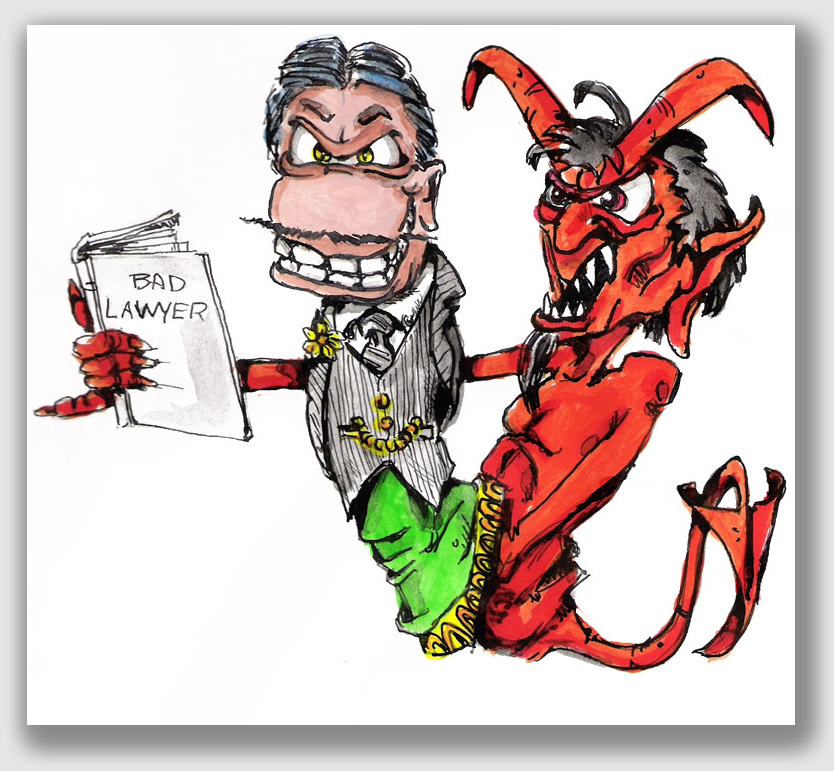
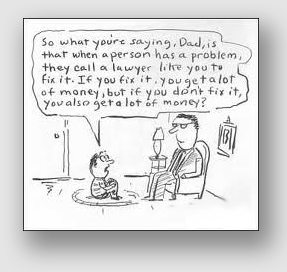
bad160311Every so often, a case comes along that so warms the cockles of our hearts that we just have to share it, despite the fact that it may not be terribly relevant to tree or neighbor law. But next week is Christmas Week. Under normal circumstances, no work gets done during Christmas week because of the annual office party, shopping, wassailing, general merriment, and decompressing after a Christmas Day blowout.

We are no exception. Instead of working today, I’m are kicking back with some eggnog, enjoying today’s wonderful tale from Delaware.

The case began as a rather prosaic trespass. The homeowners, part of what is essentially a condo association, put their kids’ swingset and play gear on common land. Even after a demand was made, the family refused to remove it, so the homeowners association —a nonprofit corporation — sued the family for trespass.

Luckily for the homeowners (and we say that with a bit of irony), one of the couple was a lawyer, in a law partnership with his father. The two attorneys proceeded to turn a simple trespass case — in fact, a case which shouldn’t have happened at all, because the trespass was as plain as the nose on your face — into a legal circus, with multiple affirmative defenses and counterclaims. Perhaps the most creative defense: the homeowners claimed that the association was engaged in age discrimination, because the case dealt with a child’s playset, and children are… well, you get it, they’re young.

"But, Your Honor," the defendant's lawyer argued, "it was just a tiny little swingset!"

“But, Your Honor,” the defendant’s lawyer argued, “it was just a tiny little swingset!”

We were a bit in awe at lawyer Ramunno’s creativity and legal legerdemain, but the trial court wasn’t. Believe it or not, there are rules against too much creativity and vituperativeness — embodied in Delaware and many other states, as well as the federal system (see Fed.R.Civ.P. 11) — and here, the Chancery Court held that the Ramunnos and their attorney paterfamilias had crossed the line. What started out as a simple request to “move the playset” ended up being a judicial order to “move the playset” … and to pay over $11,000 in the plaintiff’s legal fees.

We love a happy ending.

Fairthorne Maintenance Corp. v. Ramunno,  2007 Del. Ch. LEXIS 107, 2007 WL 2214318 (Del.Ch., Jul. 20, 2007).  This started out to be a simple case. Louis and Melanie Ramunno own a residence in the Fairthorne development of Wilmington, Delaware. To the rear of their residence is a portion of the 34 acres of private “open space” that is collectively owned and maintained by all of the homeowners in the Fairthorne development through a non-profit corporation known as Fairthorne Maintenance Corporation. By placing a playset, a park bench and other items on about 150 feet of the open space, the Ramunnos trespassed on common association property controlled by FMC. They resisted all demands that they remove it.

fix160311FMC sued for trespass. So far, so good. But Mr. Ramunno was a lawyer, and his partner was his father, who, according to the account by the court, was a zealous — perhaps over-zealous — advocate. The Ramunnos raised nine affirmative defenses and five counterclaims in their answer, which, they claimed, excused their conduct or required judgment in their favor. The trial court was so taken by the “apparent frivolity” of the answers and counterclaims (for example, the Ramunnos demanded that FMC pay for their playset because it didn’t provide any itself) that it threatened lawyer Ramunno with sanctions).

The Ramunnos backed off from seven of their nine defenses and all but one counterclaim. They then agreed to remove the personal property from the open space, but the parties couldn’t settle because the Ramunnos refused to pay FMC’s legal fees.

Held:   The trial court found that the “simple reality of this case is that the Ramunnos have been trespassing on FMC’s land since December 2005 and have been using this litigation to stall FMC’s landscaping and other projects in order to continue to enjoy the fruits of their trespass.”

You want a lawyer who won't clown around ...

You want a lawyer who won’t clown around …

The Ramunnos argued that as homeowners in Fairthorne, they were privileged to use the open space for recreational purposes and, therefore, were permitted to place their play set there because it occupied little space and could be removed. But the Court held that the playset was large, designed to be permanent, not easily moved, and, in fact, it was never removed from the open space once placed there. Even if the Ramunnos had had some license to use the open space along with Fairthorne’s other residents, the Court said, they impermissibly exceeded that authority.

Trespass can occur despite “authority under [a] license to enter the property” because the actions taken exceed the permission given. It was no defense that the play set only occupied 150 square feet of the 34 acres of open space because there is no de minimis exception to trespass liability.

The court found that the Ramunnos had argued tangential issues designed solely to help them delay the legal consequences of the trespass. The arguments had unduly burdened the court, intentionally delayed the resolution of the underlying dispute, and purposefully wasted FMC’s resources. Thus, under Chancery Rule 11, the Court found that the Ramunnos and their counsel, Attorney Ramunno, had acted in bad faith, and the Court ordered a shift of responsibility for fees under the “bad faith” exception to the traditional American Rule. The Court specifically “address[ed] a troubling pattern of conduct engaged in by Attorney Ramunno that does not befit an officer of this court. That conduct began with an adolescent letter-writing campaign during discovery, continued with a procedurally improper and substantively baseless letter seeking the court’s recusal from this action, and culminated in the filing of a host of frivolous arguments that were made without sufficient grounding in law and fact.

The Court explained that “the attorney’s duty is one of reasonableness under the circumstances; a subjective good faith belief in the legitimacy of a claim does not alone satisfy the requirements of Rule 11. Where that obligation is not upheld, sanctions, including the imposition of the opponent’s costs, may be imposed. This is so even when frivolous claims are withdrawn.”

Based on a persistent abuse of the litigation process, the Court found that sanctions under Rule 11 were appropriate, and ordered the Ramunnos and their lawyer to pay FMC legal fees of $11,355.93.

– Tom Root

TNLBGray

Case of the Day – Monday, June 24, 2024

UNDER A SPREADING CHESTNUT TREE

newspaper140421You think you got it bad, 2024ers? You dumped your Nvidia stock to invest in Fisker? You went long on Trump Media & Technology stock figuring he’d get acquitted in New York? Nest egg starting to smell a little rotten?

The year 1929 was bad for a lot of people, too, with the stock market crash wiping out millions. It started just as badly for one Lou Cotillo (not to be confused with Lou Costello) when a chestnut tree on suburban land being developed by a real estate firm crashed onto the road. Under the spreading chestnut tree was Mr. Cotillo’s car, which, unfortunately enough, contained him and a passenger.

It turned out the chestnut in question, a rather big specimen, had been dead for a few years. However, the Court noted, “beyond its deadness, [it] bore no exterior evidence of decay.”

Deadness? Is that even a word?

Maybe not, but the jury had little trouble determining that the tree’s obvious “deadness” made the real estate developer liable for the accident. Brandywine appealed, arguing that the trial court should have taken the case away from the jury and thrown it out. It argued that, as a matter of law, it wasn’t liable for the results of a tree’s natural condition (that is, it’s “deadness”).

Applying what little Delaware law the United States Court of Appeals for the Third Circuit could find, the appellate panel upheld the jury verdict. The Court held that responsibility for an owner’s property is one of the burdens of ownership, and, as a landowner has the right to enjoy his property unhampered by the actions of his neighbor, his neighbor – ­whether a landowner or a highway traveler ­– is similarly entitled. The trial court told the jury that Brandywine had a duty to keep its property from being a source of danger to the travelers on the highway “to the extent that reasonable care can guard against” the danger. The jury decided that Brandywine had breached its duty. Game, set and match.

This case was an early decision in the general trend of imposing a duty of reasonable care on non-rural landowners. The issue in negligence cases such as this one is always the nature of the duty owed by the defendant. Defendants such as Brandywine Hundred Realty (in this case) want the duty to be as minimal as possible, while plaintiffs want the jury charge to describe a duty of the first water. From the “trees will be trees” laissez-faire approach of the 19th century, where owners generally had no duty whatsoever to protect passers-by from hazardous trees to a modern view that while not guarantors of their trees, property owners had a duty to correct problems of which they had actual or constructive knowledge.

chestnutdown140421

Brandywine Hundred Realty v. Cotillo, 55 F.2d 231 (3rd Cir. 1931). On a dark winter night in January 1929, Mr. Cotillo and a passenger were driving forested suburban land owned by Brandywine Hundred Realty, Inc. A chestnut tree, standing about 10 feet from the road, fell suddenly, crushing Mr. Cotillo’s car and killing his passenger. The tree had been dead for four years, but “beyond its deadness, bore no exterior evidence of decay.”

Cotillo sued, and the case went to trial. The real estate company asked the judge to take the case from the jury and find in its favor as a matter of law, because the natural condition of the tree caused the accident, and it had no duty to Mr. Cotillo. The judge disagreed and instead told the jury that Brandywine had a duty to exercise reasonable care in the use of its property, so as not to harm neighboring landowners or motorists. The jury found for Mr. Cotillo.

Brandywine appealed, arguing that the trial court had misdefined its duty.

Held: The trial court was correct in its definition of Brandywine’s duty. The appellate court said that “[a]fter all is said and done, this case turns on the application of the time-honored principle of law, ‘sic utere tuo ut alienum non laedas’–so use your own as not to injure another.” It held that Mr. Cotillo had a right to use the highway and that Brandywine had the duty “to so use his property on his own land that it shall not cumber the highway and endanger the safety of those using it …” It agreed with the trial court’s charge to the jury that “ the owner of property abutting on a public highway is under a duty to keep it from being a source of danger to the public or to the travelers on such highway to the extent that reasonable care on his part can guard against.”

‘Cumber’? Is that even a word?

Negligencedef140421The Court of Appeals also concurred that the fact the tree had died of natural causes, rather than because of Brandywine’s conduct, had no effect on the realty company’s duty. Regardless of how the tree ended up in a condition of “deadness,” if its deadness was known by Brandywine or could have been known “by the exercise of ordinary case … then it became the duty of the defendant to exercise reasonable care and diligence to prevent the tree from falling and injuring those who might have occasion to use the public highway.”

Thus, the question of Brandywine’s alleged negligence was for the jury to pass upon. It did so, and found negligence. The Court found no basis for disturbing that finding.

As for “deadness” and “cumber” being actual words – the dictionaries give the Court a pass on both of them (although it admits “cumber” is obsolete). But as far as I’m concerned, the jury’s still out on those two…

The dismissal of this ridiculous suit was upheld.

– Tom Root

TNLBGray140407

Case of the Day – Tuesday, April 23, 2024

DOG BITES MAN

A little neighbor law today: Dog bites are big business in the United States. They happen all the time, which is why “Dog Bites Man” and its obverse are the archetypical predictable or unpredictable newspaper headlines. Man’s best friend sinks canine fretwork into a human over 3.5 million times a year. Insurance payouts for dog bites exceed $1 billion a year (or, by comparison, 10 million barrels of oil at $100 a barrel).  Some dog attacks can be fatal. Many more are just plain ugly.
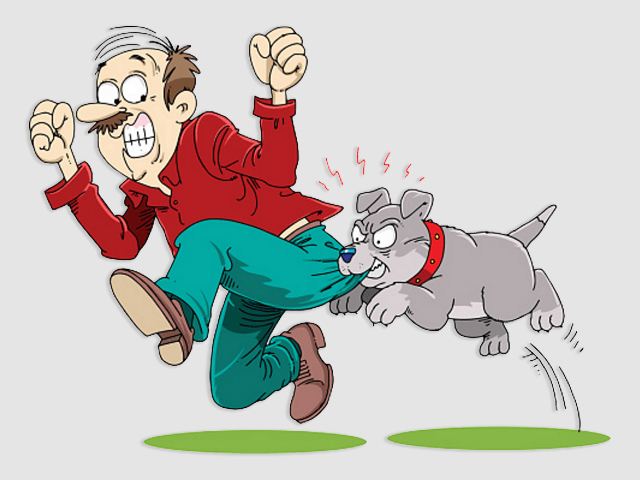
Today’s case is one of those ugly ones, a sweet little 3-year-old girl attacked without provocation by her cousin’s pit bull.   Our focus today is on the denouement, as the Delaware court apportions the financial blame for the accident.  Not that it much matters – the defendants didn’t bother to put on a case, which suggests that neither little Destiny nor her mother will ever collect a dime. 

Still, it’s a reminder that (1) just about every state regulates the liability a dog owner has for the bites inflicted by Fido, and most of those statutes impose liability without any proof of negligence; (2) permitting a default judgment to be entered against you is a very bad idea; and (3) the concept of “joint and several” liability means that a plaintiff can collect it equally from several defendants, or all from one and none from the other. 

Campbell v. Robinson, 2007 Del. Super. LEXIS 563, 2007 WL 1765558 (Del.Super.Ct., June 19, 2007). Young Destiny Campbell was attacked by a dog kept by Frances and Turquoise Robinson. The attack caused severe injuries, including the removal of Destiny’s right ear and a significant portion of her scalp, and created long-term physical and mental health consequences. Her mother, Alicia Campbell experienced emotional distress after witnessing the attack. 

Alicia sued on behalf of her daughter, complaining that as the owner of the dog, Turquoise was liable under Del. Code Ann. Title 16, § 3053F, which imposes liability upon owners for injuries caused by their dogs. Additionally, she claimed that Turquoise was negligent in maintaining a dog she knew to be vicious and in failing to warn those on the premises of the dog’s vicious nature and that Frances Robinson was liable for housing and maintaining a dog known to be vicious and dangerous, for failure to warn, and for failure to protect those who entered the premises.

The Robinsons apparently decided to let sleeping dogs lie, and failed to answer the complaint.  The trial court granted default judgment against both defendants and set a hearing to consider damages.  The Robinsons showed up for that one but did not testify.  That probably wasn’t such a good idea, because the trial court entered a judgment of $750,000 for compensatory damages against Turquoise Robinson, an award that no doubt left Turquoise feeling blue.

Based on the fact that the plaintiff alleged violation of the dog bite statute, the trial court reasoned that Frances Robinson could not be liable to Destiny Campbell because she didn’t own the dog.  The trial court apportioned $20,000 damages apiece against Turquoise and Frances for emotional distress caused to Alicia Campbell. 

Alicia appealed, complaining that the trial court should have made Frances liable for the $750,000 as well.

Held:   The Court agreed that the $750,000 must be apportioned equally between the Robinsons.  Delaware has long recognized that “when the negligent acts of two or more persons concur in producing a single indivisible injury, such persons are jointly and severally liable, though there was no common duty, common design, or concerted action.”  The joint and several liability of two codefendants, the Court said, entitled a plaintiff to seek recovery from either or both of the defendants, provided that total recovery does not exceed the full amount of damages. At the election of the plaintiff, either defendant may be held individually liable for the entire judgment. 

A default judgment constitutes a final judgment that provides a determination of the merits of a case, and — the Court noted — a defaulting party admits all of the allegations contained in a complaint.  Here, the Court said, its entry of default judgment established that both Robinsons were joint tortfeasors and were jointly and severally liable for all damages arising from both of the claims contained in the Plaintiffs’ complaint.  The allegations in the complaint supported joint and several liability, charging wanton and negligent acts by the Robinsons, which combined to proximately cause harm to Destiny and her mother in a manner not “divisible” or separately attributable to either defendant. 

The Court held that the fact that Count I of the complaint was labeled “Count I-Violation of 16 Del.C. §3053F” does not permit Frances to evade joint and several liability to Destiny Campbell.  While she was not the dog’s owner and was not liable under the dog bite statute, Count I nevertheless established negligent and wanton conduct unrelated to the dog bite statute and made Frances equally liable.

– Tom Root

TNLBGray140407