Case of the Day – Wednesday, October 29, 2025

SWEET BAMBOO

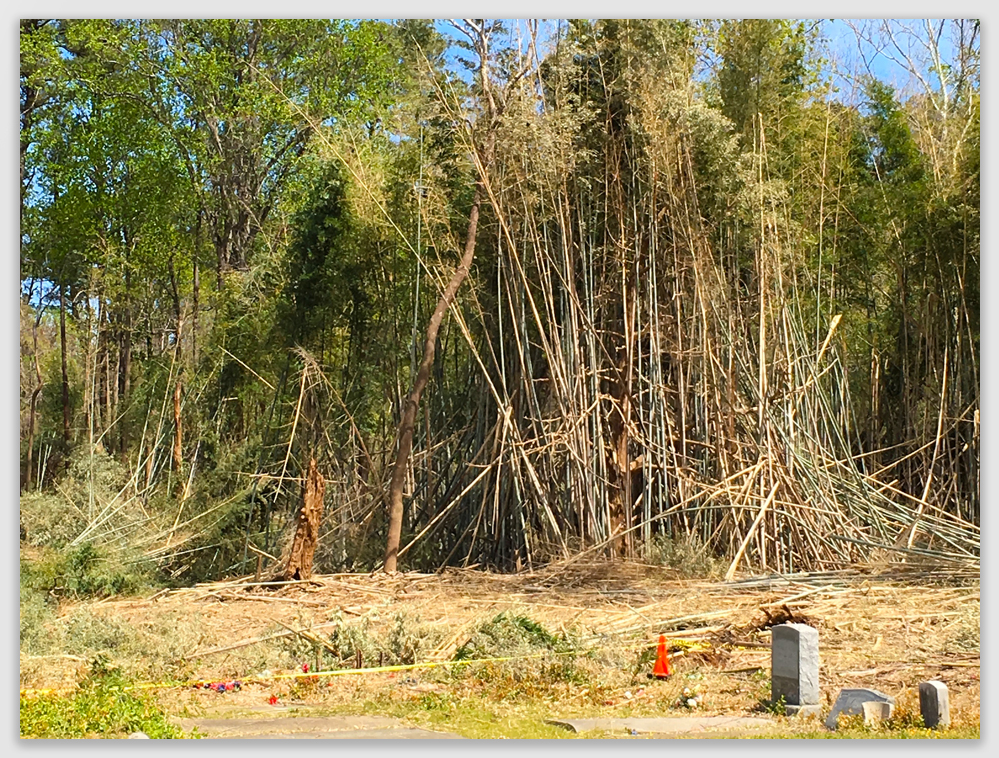
Bamboo – essentially kudzu with cellulose stalks. A report on pandas I saw on some forgettable channel last week reported, among other things, that the anthropomorphic beasts have been eating bamboo for 6 million years.

If that’s so, they certainly have done a lousy job of it.

Bamboo grows at two rates, fast and faster. It invades like the Germans into Russia, a plant so aggressive that landscapers recommend installing a concrete tank in the ground to ensure that its roots don’t go deep and spread into the neighbor’s land. It grows dense and tall, and takes no prisoners.

Florida Power & Light, the defendant in today’s case, considered bamboo a “critical removal” species. When found under FLP lines, bamboo was not to be trimmed. It was to be removed, killed dead, dead, dead.

That didn’t happen in today’s case, and the invasive plant was so high and thick that a teenager climbed it and died when the bamboo bent over and contacted a live power line.

That’s where the personal injury lawyer came in. PI attorneys are their own type of invasive species. The complaints they file spread far and wide, like bamboo, and can be as aggressive as Bambusoideae of the grass family Poaceae itself. 

A personal injury case, if successful, results in an award of damages to the plaintiff intended to make him or her whole. You would think that would be straightforward, but the amount is computed by juries, and juries can be fickle. A crying mother who lost her son versus a faceless, soulless electric utility owned by a faceless, soulless holding company sporting a made-up name, Nextera Energy, Inc. That holding company, stock symbol NEE, had net income of $6.9 billion (with a “b”) last year, on total revenues of $24.7 billion.

That’s a lot of money, and it spawns plaintiffs’ attorneys’ arguments I’ve heard many times before: Corporate greed killed the boy, and don’t you think this poor woman deserves at least one-half of one percent of FP&L’s obscene profits for her suffering? You, Mr. and Ms. Juror, need to send the defendant a message, and put the other corporate giants like it on notice that they cannot treat people this way.

In today’s case, the jury thought the loss of plaintiff Tricia Dominguez’s son was worth $12.5 million. It seems like a lot to me, but it is not my son who died. The tougher part is that the jury awarded Tricia another $15 million in punitive damages, damages awarded to punish FPL for its greedy and reckless decision to not cut the bamboo.

Punitive damages never made a lot of sense to me. Why should the plaintiff get them? If the object is to be like a fine in a criminal case, shouldn’t the punitive damages be paid to the state? And too often, the punitive damages seem to be as much a penalty imposed on a company for its size or profits as they are for truly abhorrent conduct.

Tricia’s PI attorney used a Florida doctrine known as direct liability, in which a corporation is punished for gross negligence if “there [is] willful and malicious action on the part of a managing agent of the corporation.” It worked, and FPL was socked with $15 million in punitives, despite the fact that the guy who was pilloried for gross negligence was a minor supervisor in a regional office, and despite the fact that there was no evidence he even knew about the bamboo stand where the accident occurred.

However, a court of appeals threw a healthy dose of reality on the case and undid the punitive damages.

Florida Power & Light Co. v. Dominguez, 295 So.3d 1202 (2019). In December 2011, 15-year-old Justin Dominguez was climbing a tall stalk of bamboo in his neighbor’s backyard. The stalk bent into a power line, resulting in Justin’s electrocution and death. The boy’s mother, Tricia Dominguez, filed a wrongful death action against Florida Power & Light, arguing that FPL was negligent because it ignored its own maintenance and safety standards when it failed to remove the bamboo, a fast-growing and uncontrollable plant, from the area near the line. She further alleged that FPL had been warned about the bamboo at the accident site but still failed to remove it. As a result of this negligence, she argued that FPL created a dangerous safety hazard that claimed her son’s life.

Tricia asked for punitive damages as well as compensation for her loss, complaining that the accident scene was so overgrown with trees that the power lines were not easily visible around the bamboo. She showed that FPL’s vegetation maintenance procedures explicitly recognized the risk of electrocution posed by foliage encroaching upon powerlines, including the danger to children who climb trees.

Bamboo in particular is a problem because of its aggressive growth rate. Thus, FPL designated it as a “critical removal” species that should be removed outright instead of merely trimmed in the vicinity of power lines. Tricia argued that FPL had been informed about the bamboo at the accident site by one of its contractors, who recommended it be removed. Despite the recommendation, Tricia alleged, FPL violated industry standards and its own vegetation maintenance policy by failing to do so. Tricia asserted that this failure warranted punitive damages because it was the direct result of a corporate policy that prioritized cutting costs and corporate greed over the lives and safety of the general public.

Tricia argued that due to direct liability, FPL – through the behavior of Barry Grubb, the head of vegetation management for the region in which the accident occurred and the person identified by FPL as being its vegetation management program expert – was financially responsible for the bamboo hazard. Tricia ran with that, arguing that Barry was willfully ignorant about the circumstances and hazards surrounding Justin’s death. When answering interrogatories, he claimed that no trimming or other maintenance was necessary at the accident site even though he had never visited the scene himself. At the time of his deposition years later, Grubb had still not visited the site and had no opinion on the adequacy of the maintenance there. He also testified that he was not familiar with the language in FPL’s vegetation maintenance rules about the danger of electrocution from foliage near power lines. In sum, Tricia argued, regional vegetation manager Grubb had taken a see-nothing, know-nothing approach. The jury agreed with this assessment and awarded her $15 million in punitive damages.

FPL appealed.

Held: The Court of Appeals upheld the wrongful death judgment and the $12.5 million in compensatory damages. It reversed, however, on the punitive damages.

Direct liability is one of two theories recognized in Florida through which a corporation may be liable for punitive damages. Under the direct theory, liability for gross negligence is established if the corporation itself engaged in conduct that was “so reckless or wanting in care that it constituted a conscious disregard or indifference to the life, safety, or rights of persons exposed to such conduct,” and its conduct contributed to the loss of the injured party. Because a corporation cannot act on its own, “there must be a showing of willful and malicious action on the part of a managing agent of the corporation” to establish direct punitive liability.

A “managing agent” is more than just a manager or midlevel employee. Instead, the Court held, a managing agent is an individual like a “president [or] primary owner” who holds a position with the corporation, which might result in his acts being deemed the acts of the corporation.
Here, Tricia sought punitive damages under the direct liability theory through the alleged gross negligence of a regional supervisor in FPL’s vegetation management program. At trial, supervisor Grubb was identified as the FPL employee who knew the most about this program, but he was only in charge of the program for a limited geographical area. He also testified that he has a manager himself, and thus he alone does not make policy decisions relating to the program. While his position certainly comes with significant managerial power, Grubb does not qualify as a managing agent of FPL. Overseeing only a portion of FPL’s arborist program, which is itself ancillary to FPL’s primary function of providing electric power, Grubb is at best a midlevel employee more akin to a bank vice president or hotel manager than to a corporate officer or official who could represent FPL as a whole. Because Grubb is not a managing agent for purposes of direct punitive liability, the Court said, the award of punitive damages in this case had to be reversed.

 Even if Grubb were a managing agent, punitive damages are only warranted if there is evidence he was negligent “equivalent to the conduct involved in criminal manslaughter.” To be punished by punitive damages, the Court observed, the conduct must be “so reckless or wanting in care that it constitutes a conscious disregard or indifference to the life, safety, or rights of persons exposed to such conduct.

But in this case, trial testimony established that Grubb was not directly involved with the accident and did not know about the details of Justin’s death until years after the fact. Grubb also seemed unaware of specific FPL safety standards cited by Tricia, despite being identified as the person most knowledgeable about FPL’s vegetation program. Whatever negligence a jury may infer from this evidence, the appellate panel ruled, “It certainly does not rise to the level of ‘reckless disregard of human life’ or an ‘entire want of care, which would raise the presumption of a conscious indifference to consequences’.”

– Tom Root

TNLBGray140407

Case of the Day – Monday, December 2, 2024

STAYIN’ ALIVE

Last Friday, pro se plaintiff Caryn Rickel survived the arguments advanced by the slick lawyers representing her bamboo-lovin’ neighbors, the Komaromis. The trial court held that her complaint about the Komaromis’ invading bamboo was a claim on which she could get relief.

But subsequently, the trial court bought the Komaromis’ argument that because Caryn admitted that they planted the bamboo in 1997 and Caryn sustained damage in 2005, she had at most until 2008 to sue for trespass and nuisance.

The reason, of course, is the statute setting limitations, that is, deadlines by which certain legal complaints have to be brought. The Komaromis’ lawyer probably shouted “a-ha!” when he found that Caryn had admitted she was damaged five years before she sued. Certainly, the trial court shouted it when it agreed with the Komaromis and dismissed Caryn’s lawsuit as untimely.

But for a novice, Caryn was pretty sharp. She took an appeal, arguing that every day the kudzu-like bamboo grew was a whole new affront to her property, and thus the trespass was continuing. The appeals court agreed, although not without a lot of confusing differentiation between continuing trespasses and continuing nuisances, on the one hand, and permanent trespasses and permanent nuisances on the other.

I’m not sure I see the distinction myself. It may be that the confusing definitions won’t help, leaving it like obscenity: we can’t describe it, but we know it when we see it.

For now, Caryn survives a second near-dismissal experience, and she stays alive to fight the bamboo fight.

Rickel v. Komaromi, 144 Conn. App. 775, 73 A.3d 851 (Ct.App. Conn. 2013). After plaintiff Caryn Rickel won the right to go forward on her claim that the Komaromis’ bamboo had invaded her property, the Komaromis won summary judgment against her in the trial court. Caryn claimed nuisance and trespass. The trial court ruled that because the bamboo began its inexorable crawl across Caryn’s backyard in 2005, her suit filed in 2010 was well beyond the three-year statute of limitations for such actions.

Caryn appealed, arguing that the repeated bamboo encroachment from the Komaromis’ property to her property constituted a continuing nuisance and a continuing trespass, and thus the statute of limitations did not start running.

The Komaromis lived next to Caryn Rickel. In July 1997, the Komaromis planted phyllostachys aureosulcata, a type of invasive running bamboo, along their corner property line, but they did not put up any barrier to contain it. The bamboo encroached upon Caryn’s property. In 2005, during the installation of a patio at the corner of Caryn’s property, a landscaper used a backhoe and dump truck in order to eradicate the bamboo, and then installed steel sheathing along this corner property line in order to protect the patio. Despite the steel sheathing, the bamboo had reentered the area by July 2010.

Caryn sued the Komaromis four months later, bringing claims of nuisance, trespass and negligence. She alleged in her complaint that the bamboo “further and repeatedly encroached” on her property and continued to do so. The Komaromis raised a statute of limitations defense on all of the claims against them.

The trial court granted the Komaromis’ motion, concluding that the applicable statutes of limitations had provided Caryn with a maximum of three years from “the date of the act or omission complained of” to bring suit. Because there was no dispute that the Komaromis planted the bamboo in 1997 or that Caryn “discovered the actionable harm in 2005…” Because Caryn did not commence her action against the Komaromis until 2010, the court held that each count of the action was time-barred as a matter of law.

On appeal, Caryn claimed that the trial court failed to address the factual question of whether a nuisance or trespass is continuing or permanent requires the denial of a summary judgment motion made solely on statute of limitations grounds. She claims that this is because, for statute of limitations purposes, each instance of nuisance or trespass in a continuing nuisance or trespass creates a new cause of action, while a permanent nuisance or trespass involves a discrete occurrence of nuisance or trespass from which the applicable statute of limitations begins to run.

Held: The Komaromis’ bamboo was engaged in a continuing trespass, and thus Caryn’s lawsuit was timely.

Caryn’s complaint alleged that the Komaromis’ bamboo repeatedly has encroached on her property, resulting in a continuing nuisance and a continuing trespass. For example, in her nuisance count, she alleged the Komaromis “have planted this nonnative invasive bamboo with no containment of any kind. They have continued to cultivate it and freely allow it to aggressively spread to… adjacent properties… This has been continual nuisance to my use and enjoyment of my land.”

Similarly, Caryn complained the Komaromis “have allowed this nonnative invasive bamboo to aggressively spread from their original planting which was directly on my property line to all three of the [neighboring] properties. The infestation is massive… and has continuously been aggressively invading my land.” Caryn’s continuing nuisance and trespass allegations, the Court said, therefore factor into the question of whether the court correctly concluded that the defendants met their summary judgment burden with respect to the plaintiff’s nuisance and trespass claims, as framed by her complaint.

The Court noted that recent cases treat trespass as involving acts that interfere with a plaintiff’s exclusive possession of real property and nuisance cases as involving acts interfering with a plaintiff’s use and enjoyment of real property. The essentials of an action for trespass are (1) ownership or possessory interest in land by the plaintiff; (2) invasion, intrusion or entry by the defendant affecting the plaintiff’s exclusive possessory interest; (3) done intentionally; and (4) causing direct injury…” Because it is the right of the owner to exclusive possession that is protected by an action for trespass, usually the intrusion of the property must be physical. Thus, the Court said, in order to be liable for trespass, one must intentionally cause some substance or thing to enter upon another’s land.”

The statute of limitations for trespass actions in Connecticut is General Statutes § 52-577, which provides: “No action founded upon a tort shall be brought but within three years from the date of the act or omission complained of.” The only facts material to the trial court’s decision on a motion for summary judgment must be the date of the wrongful conduct alleged in the complaint and the date the action was filed.

A “private nuisance,” on the other hand, “is a nontrespassory invasion of another’s interest in the private use and enjoyment of land… The law of private nuisance springs from the general principle that it is the duty of every person to make reasonable use of his own property so as to occasion no unnecessary damage or annoyance to his neighbor… In order to recover damages in a common-law private nuisance cause of action, a plaintiff must show that the defendant’s conduct was the proximate cause of an unreasonable interference with the plaintiff’s use and enjoyment of his or her property. The interference may be either intentional… or the result of the defendant’s negligence.” A permanent nuisance is one that inflicts a permanent injury upon real estate, while a temporary nuisance is one where there is but temporary interference with the use and enjoyment of property. Whether a nuisance is temporary or permanent is ordinarily a question of fact.”

The statute of limitations for a nuisance claim based on alleged negligent conduct is General Statutes § 52-584: “No action to recover damages for injury to real property, caused by negligence, or by reckless or wanton misconduct shall be brought but within two years from the date when the injury is first sustained or discovered or in the exercise of reasonable care should have been discovered, and except that no such action may be brought more than three years from the date of the act or omission complained of…” An injury occurs when a party suffers some form of actionable harm.

Nuisance and negligence may share the same statute of limitations, depending on the factual basis for the nuisance claim, but otherwise, they are completely distinct torts, different in their nature and in their consequences. A claim for nuisance is more than a claim of negligence, and negligent acts do not, in themselves, constitute a nuisance; rather, negligence is merely one type of conduct upon which liability for nuisance may be based. “Nuisance,” the Court said, “is a word often very loosely used; it has been not inaptly described as a catch-all of ill-defined rights. There is perhaps no more impenetrable jungle in the entire law than that which surrounds the word nuisance… There is general agreement that it is incapable of any exact or comprehensive definition.”

In applying these principles to the plaintiff’s claims, the Court said, “summary judgment may be granted where the claim is barred by the statute of limitations… as long as there are no material facts concerning the statute of limitations in dispute.” But here, the date of the act or omission and the date when Caryn first sustained or discovered injury depend on whether the alleged nuisance and trespass are continuing or permanent. Caryn argued that this is because, for statute of limitations purposes, each instance of nuisance or trespass in a continuing nuisance or trespass situation creates a new cause of action, whereas a permanent nuisance or trespass situation involves a discrete occurrence of nuisance or trespass from which the applicable statute of limitations begins to run.

The applicable statute of limitations runs differently for a continuing nuisance or trespass than it does for a permanent nuisance or trespass. For limitations purposes, the Court ruled, a permanent nuisance claim accrues when the injury first occurs or is discovered while a temporary nuisance claim accrues anew upon each injury. Therefore, in the case of a continuing trespass, the statute of limitations does not begin to run from the date of the original wrong but rather gives rise to successive causes of action each time there is an interference with a person’s property. If there are multiple acts of trespass, then there are multiple causes of action, and the statute of limitations begins to run anew with each act.

On the other hand, the Court said, if a trespass is characterized as permanent, the statute of limitations begins to run from the time the trespass is created, and the trespass may not be challenged once the limitation period has run.” Whether a nuisance is deemed to be continuing or permanent in nature determines the manner in which the statute of limitations will be applied. If a nuisance is not able to be abated, it is permanent, and a plaintiff is allowed only one cause of action to recover damages for past and future harm. A nuisance is deemed not abatable, even if possible to abate, if it is one whose character is such that, from its nature and under the circumstances of its existence, it will probably continue indefinitely.

A nuisance is not considered permanent if it is one that can and should be abated. In this situation, every continuance of the nuisance is a fresh nuisance for which a fresh action will lie, and the statute of limitation will begin to run at the time of each continuance of the harm.

Similarly, with trespass, the typical trespass is complete when it is committed; the cause of action accrues, and the statute of limitations begins to run at that time. However, when the defendant erects a structure or places something on or underneath a plaintiff’s land, the invasion continues if the defendant fails to remove the harmful condition. In such a case, there is a continuing tort so long as the offending object remains and continues to cause the plaintiff harm. Each day a trespass of this type continues, a new cause of action arises.”

Here, Caryn alleged facts to support her claims that the Komaromis’ conduct in planting the bamboo and then failing to control its growth resulted in a continuing nuisance and a continuing trespass. In seeking summary judgment, however, the Komaromis referred only to three dates to establish the untimeliness of Caryn’s claims — the 1997 planting of the bamboo, the 2005 installation of the patio, and the 2010 commencement of the action – ignoring Caryn’s other allegations.

By conducting its summary judgment analysis only on the basis of the 1997, 2005 and 2010 dates, the trial court did not address the allegations of the Komaromis’ failure to control the underground spread of the bamboo rhizomes and the above-ground spread of the bamboo on Caryn’s property. This continuing underground and above-ground activity on Caryn’s property created a genuine issue of material fact about whether the statutes of limitations were a bar to all of her claims encompassed in her trespass and nuisance counts.

Whether the alleged nuisance and trespass by the rhizomes and bamboo were continuing or permanent presents a genuine issue of material fact with respect to the plaintiff’s trespass and nuisance counts. The trial court erred in rendering summary judgment without addressing the plaintiff’s continuing nuisance and continuing trespass allegations, because, by doing so, the court overlooked genuine issues of material fact about whether the alleged nuisance and trespass were continuing or permanent, and thus whether the applicable statutes of limitations had run on the plaintiff’s nuisance and trespass claims.

– Tom Root

TNLBGray140407

Case of the Day – Friday, November 29, 2024

BEHIND THE BAMBOO CURTAIN

I admit to being old enough to remember the Bamboo Curtain, the Cold War political demarcation between the Communist states of East Asia – particularly the People’s Republic of China – and the capitalist and non-Communist states of East, South and Southeast Asia.

It seemed for a while that the Iron Curtain, Cactus Curtain, Bamboo Curtain and others of that ilk were now relics of unpleasant history. But we still have nine-dash lines, 38th parallels, Crimea, the Donbas, and other examples of countries acting badly, so we’re hardly out of the woods yet. Let’s not get started on Russia and Ukraine

But “bamboo curtains,” literally enough, are still with us. Every so often, I am reminded of that when I come across a case involving a stand of bamboo, encroachment that usually started when some well-meaning homeowner (who maybe anticipates an attack of hungry pandas) plants a little stand of bamboo in his backyard.

The problem is that the owner has a “little stand of bamboo” only for a minute or so. The stuff is pernicious and fecund. Bamboo, which is a giant grass and not a tree, has fairly been called one of the world’s most invasive plants. Once established, it is next to impossible to control. The sprouts that shoot up from the ground each spring can grow 12 inches a day. The underground roots of common running “fishpole” bamboo, which can easily reach 15 feet tall, can travel as far as 20 feet or more from the original clump. The experts suggest you control it by digging a two-foot deep trench and lining it with aluminum. Or lead. Or titanium. Or concrete. But whatever you use, leave a portion of it sticking up above ground, because bamboo roots can jump barriers like Superman leaps buildings.

Bamboo: the Asian carp of grasses. As one homeowner site puts it: When you need a concrete bunker to contain a plant, you know you’re in trouble.

Bamboo is not a very good idea. Unless, of course, you’re like Mike and Roberta Komaromi, who simply did not give a rip that their bamboo stand was galloping across neighbor Caryn Rickel’s lot. Usually, we complain about people foolish enough to represent themselves, but here, we grudgingly admit that pro se litigant Caryn was holding her own.

The Komaromis were smug, arguing that they had no duty to corral the bamboo. Well, as is usually the case when hard facts collide with justice, courts find a way to recompense the victim. So it did here, ruling (and right on the Bay State’s south border, too) that the Massachusetts Rule cut no ice in Connecticut.

Rickel v. Komaromi, 2011 Conn. Super. LEXIS 5254 (Superior Ct. Conn., July 13, 2011): Caryn Rickel, bringing her case without a lawyer, complained that her neighbors Mike and Roberta Komaromi planted bamboo in their yard without any plan for containment. As a result, her backyard has been overrun by invasive bamboo.

Mike and Bobbi, who did hire a lawyer, filed a motion to strike the complaint as legally insufficient. That is to say, they claimed that if everything Caryn said in the complaint was true, she still was entitled to no relief.

Mike and Bobbi complained that Caryn had not alleged they had any legal duty to her.

Held: Connecticut would follow the Hawaii Rule, and under that Rule, Caryn had adequately claimed her neighbors had a duty to her which they violated with the bamboo. “The essential elements of a cause of action in negligence are well established,” the Court said, “duty; breach of that duty; causation; and actual injury.” There can be no negligence without there first being a cognizable duty of care.

The test for the existence of a legal duty of care, the Court said, entails (1) a determination of whether an ordinary person in the defendant’s position, knowing what the defendant knew or should have known, would anticipate that harm of the general nature of that suffered was likely to result, and (2) a determination, on the basis of public policy analysis, of whether the defendant’s responsibility for its negligent conduct should extend to the particular consequences or particular plaintiff in the case.” (Internal quotation marks omitted.

So, how did Caryn do? First, she alleged the Komaromis planted bamboo without any plan for containment and watched while the non-native plant fully invaded Caryn’s backyard. She also alleged the Komaromis failed to take action to alleviate the situation even though the bamboo growth was readily visible. This, the Court ruled, sufficiently alleged that the damage to Caryn’s property was reasonably foreseeable to the Komaromis.

Second, the Court held, the Komaromis’ responsibility for their negligent conduct should extend to Caryn on public policy grounds. The Court looked at (1) the normal expectations of the participants in the activity under review; (2) the public policy of encouraging participation in the activity, while weighing the safety of the participants; (3) the avoidance of increased litigation; and (4) the decisions of other jurisdictions. Considering these four factors, the Court said, “supports the conclusion that the court should impose a duty on a property owner to refrain from planting bamboo without a containment plan in order to avoid harming an adjacent property.”

First, property owners are normally expected to refrain from engaging in conduct that would cause damage to an adjacent property. Although landowners may reasonably expect some level of discomfort from having adjacent property owners, it does not mean that property owners should reasonably expect bamboo belonging to an adjacent landowner to fully invade their property.

For the second factor, as a matter of public policy, it is desirable to promote property ownership, and the ability to live free of the concern of encroaching vegetation from adjacent properties directly impacts this goal. Allowing a landowner to cultivate his or her land “should be fairly balanced against the rights of adjacent landowners, and imposing a duty on the cultivating landowner whose vegetation harmfully invades another’s property would be in accord with public policy.”

Turning to the third factor, it is true that imposing a duty like this one could encourage other property owners suffering from the same problem to bring similar actions. On the other hand, however, establishing such an affirmative duty may deter potential defendants from engaging in this type of activity.

Finally, the Court rejected the Massachusetts Rule. That rule provides that a defendant has no duty to prevent his trees from causing damage to his or her neighbor’s property and that “a landowner’s right to protect his property from the encroaching boughs and roots of a neighbor’s tree is limited to self-help, i.e., cutting off the branches and roots at the point they invade his property.” The Hawaii Rule, by contrast, grants the landowner a remedy for damages caused by the encroaching vegetation of an adjacent property owner.

The Court adopted the Hawaii Rule, it said, for two main reasons. First, the Rule serves as a gatekeeping mechanism in that it imposes a requirement of actual harm to the property, discouraging trivial suits while simultaneously providing a cause of action for deserving plaintiffs. The Massachusetts Rule, by comparison, “deprives deserving plaintiffs of any meaningful redress when their property is damaged.” Second, the Massachusetts Rule is not “realistic and fair… Because the owner of the tree’s trunk is the owner of the tree,” the Court opined, “we think he bears some responsibility for the rest of the tree. It has long been the rule in Hawaii that if the owner knows or should know that his tree constitutes a danger, he is liable if it causes personal injury or property damage on or off of his property… Such being the case, we think he is duty bound to take action to remove the danger before damage or further damage occurs.”

In addition, the Court said, Caryn had linked the breach of the Komaromis’ duty, the damages she suffered and the causation between the breach and the damages suffered. She alleged that the Komaromis planted the bamboo and that their subsequent inaction as to the bamboo growth “directly caused the harmful condition and continual damage” to her property. Accordingly, the Court said, Caryn has successfully set forth a cause of action in negligence.

So does Caryn win an injunction to get the bamboo eradicated? Stay tuned Monday…

– Tom Root

TNLBGray140407

Case of the Day – Wednesday, May 8, 2024

BAMBOO-ZLED

The common-law rules governing rules on matters like encroachment can, of course, be modified by meddling legislatures. For example, we all know that if your neighbor’s tree encroaches above or below the soil onto your yard, you have the right of self-help and no more. You do not have the right to force your neighbor to correct things unless the encroachment causes “sensible harm,” and indeed becomes a nuisance.

The law recognizes negligence per se, which is essentially presumed negligence because you broke the law. Likewise, the law can declare that some things constitute nuisances for no better reason than the law says they are.

In Connecticut, where the state has yet to meet a tax or regulation it doesn’t like, there is a statute that declares running bamboo a nuisance. It falls on the homeowner to prevent his or her running bamboo from running into someone else’s yard, whether the encroachment causes harm or not. If you fail to control your running bamboo according to statute, you are negligent per se, and the bamboo is a statutory nuisance.

Who ever imagined that running bamboo was such a problem in temperate Connecticut? Well, the legislature for one. Generally, it seems to be a common enough problem, with running bamboo making kudzu propagation look like a bonsai tree by comparison.

Whatever the reason Connecticut may have had for enacting a law directed specifically at running bamboo, it seemed to come in handy for Jean Walden, when a neighbor’s running bamboo ran into her backyard. She sued, wanting an order that her neighbor remove it.

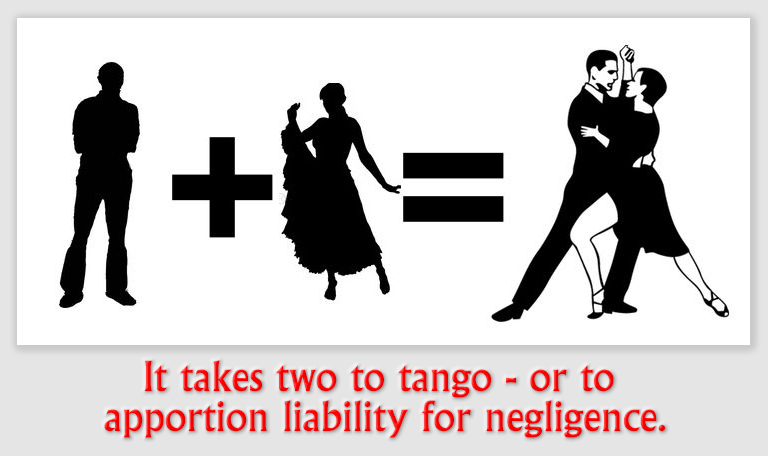
The neighbor Nationstar, a mortgage company, filed a motion that the amount of damages be apportioned between it and Jean. Jean was not much interested in talking about whether she was negligent: as far as the statute and Jean were both concerned, Nationstar let the bamboo encroach, and it was solely liable. Apportionment is premised on the notion that it takes two to tango, an approach Jean – who considered herself blameless – was not interested in at all.

What ensued was an “angels-on-the-head-of-a-pin” kind of thing, where the court wrestled with whether a negligence action could be found anywhere within Jean’s complex complaint. A negligence claim would justify apportionment. A claim that did not sound in negligence would not.

Walden v. Nationstar Mortgage, LLC, Case No. KNLCV176030465S (Superior Ct. Connecticut, November 27, 2017) 2017 Conn. Super. LEXIS 4963. Nationstar controlled property which contained a colony of running bamboo that had grown beyond the property line into the Walden Property. Jean Waldon had warned Nationstar on a number of occasions to control the bamboo colony so that it would not invade her yard. Nevertheless, Nationstar’s uncontrolled colony of bamboo has crossed onto the Walden Property and started to take over the yard.

Jean hired a lawyer who knew how to plead a complaint. Her suit claimed Nationstar was negligent because it had a duty not to allow the bamboo to encroach onto Jean’s land, but failed to control the bamboo. She also claimed the bamboo colony physically invaded her property without her permission, she had asked Nationstar to do something, but it had not. She complained its failure to act was intentional. Jean also included two counts claiming Nationstar violated Connecticut General Statutes § 22a-16 and § 22a-381e (part of the “Connecticut Environmental Policy Act,” or “CEPA”), creating “an unreasonable harm and future threat of harm to the public trust in the natural resources of the state.” Finally, she alleged that the migration of the bamboo colony unreasonably interfered with the peaceable use and enjoyment of her property.

Nationstar filed a complaint for apportionment, asking that responsibility for the negligence be apportioned between itself and Jean. as the parties responsible for negligence, under General Statutes § 52-572h. Jean quickly amended any mention of “negligence” out of the complaint, and then opposed the apportionment request on the grounds that Nationstar was maintaining a nuisance, she should not share in any blame for it, and apportionment was improper.

Held: Nationstar is entitled to its claim for apportionment, to have responsibility for the damage apportioned between itself and Jean.

Jean argued that General Statutes § 52-572h – the apportionment statute – does not apply to a violation of the CEPA because such a violation is not based on negligence, and the apportionment complaint cannot rest on any basis other than negligence. The statutory cause of action of the running bamboo, Jean said, is based on nuisance and not negligence. Nationstar retorted that a defendant found liable under CEPA will be deemed to have been negligent by virtue of violating the statute because such a violation is negligence per se.

General Statutes § 22a-16 provides that “any person… may maintain an action in the superior court… for declaratory and equitable relief against… any person, partnership, corporation, association, organization or other legal entity, acting alone, or in combination with others, for the protection of the public trust in the air, water and other natural resources of the state from unreasonable pollution, impairment or destruction…”

That is what Jean is doing, the Court said. She was enforcing General Statute § 22a-381e(b), which provides in relevant part that “[n]o person who… allows running bamboo to be planted on his or her property shall permit such bamboo to grow beyond the boundaries of his or her property.” General Statutes § 22a-381e(c) provides in relevant part that “no person shall… allow running bamboo to be planted on his or her property at a location that is forty feet or less from any abutting property…”

Negligence per se, the Court said, “serves to superimpose a legislatively prescribed standard of care on the general standard of care… A violation of the statute or regulation thus establishes a breach of duty when (1) the plaintiff is within the class of persons intended to be protected by the statute, and (2) the injury is the type of harm that the statute was intended to prevent.” Connecticut courts treat a statutory violation as negligence per se in situations in which the statutes… at issue have been enacted for the purpose of ensuring the health and safety of members of the general public.”

The CEPA was enacted to enable people to seek redress in the court when someone is polluting the environment, the Court said. Plus, the Appellate Court has held that “§ 22a-16 imposes on the defendants a standard of care, the violation of which constitutes negligence per se.” The two-pronged test applied to establish negligence per se is: (1) that the plaintiff was within the class of persons protected by the statute; and (2) that the injury suffered is of the type that the statute was intended to prevent.”

Here, Jean alleges damage to her property caused by bamboo. She is within the class of persons protected by the anti-bamboo statute. Furthermore, the Court said, the alleged injury suffered by the plaintiff is of the type that CEPA intended to prevent – in this case, the continued violations of the running bamboo going beyond Nationstar’s property and onto Jean’s abutting property.

Jean also argued that the apportionment statute, General Statutes § 52-572h, applies exclusively in negligence cases. Her claim, she said, for nuisance, alleging common-law nuisance and statutory nuisance under General Statutes § 22a-318e(f). Nationstar said that a cause of action for nuisance may be based upon a defendant’s negligent misconduct, and thus, apportionment was permissible.

The Court disagreed with Jean’s alleged statutory nuisance. General Statutes § 22a-318e(f) provides that allowing running bamboo to grow beyond the boundaries of a parcel of property “shall be deemed to be a nuisance,” but Jean just argued in the complaint that the bamboo colony “unreasonably interferes with the peaceable use and enjoyment by the plaintiff of the Walden Property.” That, the Court said, sounds like common law nuisance.

A common-law nuisance claim has four elements: (1) the condition complained of had a natural tendency to create danger and inflict injury upon person or property; (2) the danger created was a continuing one; (3) the use of the land was unreasonable or unlawful; [and] (4) the existence of the nuisance was the proximate cause of the [plaintiff’s] injuries and damages. While there are some similarities between a public and a private nuisance, the two causes of action are distinct. Public nuisance law relates to the interference with a public right such as public health and safety. Private nuisance law, on the other hand, concerns conduct that interferes with an individual’s private right to the use and enjoyment of his or her land.

Jean was alleging that the bamboo colony unreasonably interfered with the peaceable use and enjoyment of her land; she does not allege interference with a public right. Therefore, the Court said, the nuisance she alleged is a common-law private nuisance. A common-law private nuisance cause of action must show that the defendant’s conduct was the proximate cause of an unreasonable interference with the plaintiff’s use and enjoyment of his or her property. The interference may be either intentional or the result of the defendant’s negligence.

Thus, a common-law private nuisance can be based on negligence, and Nationstar’s complaint to apportion the liability can go forward.

– Tom Root

TNLBGray