UNCOMMONLY COMMON

It’s good to be the king
Suing the government is a daunting task. Besides the fact that the government has more lawyers than you do (about 32,000, plus or minus), the government makes the rules about when you can sue and when you’re out of luck. Never bet against the house.
The doctrine that lets Uncle Sugar rig the game is called “sovereign immunity,” and holds, simply enough, that you can’t sue the king. Dating from medieval times, when there actually was a king not to sue, that particular kind of immunity has spilled over to present-day America. You cannot sue the government – federal, state or local – without the government’s permission to do so.
Who’s crazy enough to give you permission to sue them? The government, of course. In federal law, permission to sue for a tort (such as negligence) is enshrined in the Federal Tort Claims Act. The FTCA grants the district courts jurisdiction to hear negligence and some other tort cases against government agencies and officials.
Some but not all. What we are particularly interested in today is the intersection between the FTCA and state recreational use statutes. Recreational use statutes, of course, are laws passed in virtually every state that afford landowners protection from liability when they make their property available without charge to the general public for recreational activity.
Even if you successfully bring an FTCA action, you still have to hold the government to the negligence law of the state in which the act occurred. Today’s case, just handed down by the U.S. Court of Appeals for the 8th Circuit, is in all likelihood the final act of a tragedy that began with a slow-moving summer storm in 2010 that caused unprecedented flooding at a U.S. Forest Service campground in the Ouachita National Forest of Arkansas. Twenty campers were killed, and in subsequent litigation, it developed that the forest ranger in charge had exerted his influence to ram through construction of an improved campground in a floodplain, contrary to the advice of one expert.
Even that was not enough to hold the government liable, because the Arkansas Recreational Use Statute contained enough of a loophole to get Uncle Sam off the hook. The question was whether the activity – which initially seemed like simple camping – was common or uncommon. The Court narrowed the definition of the activity but still found that it was common enough that the Forest Service’s failings were merely negligent (against which it was immune) rather than ultra-hazardous.
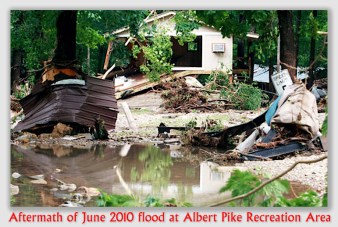
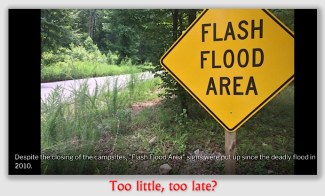
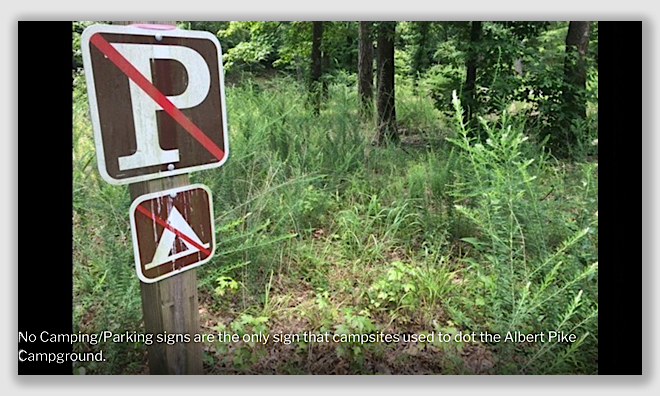
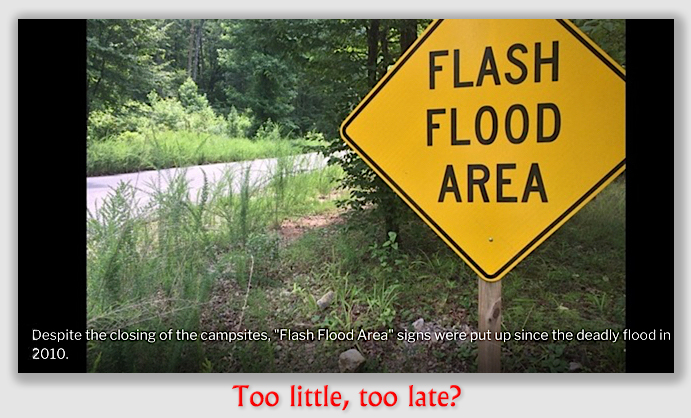
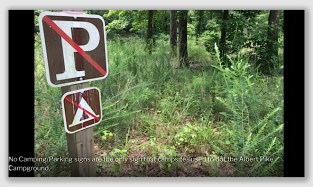 That did not save the campgrounds, however. The tragedy’s aftermath (and the lawsuits it spawned) left the campgrounds closed and in ruins. While the Albert Pike Recreation Area itself remains open, the campgrounds are still abandoned. Ironically, flood warnings—which the experts had recommended but the Forest Service failed to post before the flood—are prominent now.
Moss v. United States, 895 F.3d 1091 (8th Circuit U.S. Ct.App., July 20, 2018): Albert Pike Recreation Area is a large outdoor camping and recreation site. Winding through the site is the Little Missouri River, which gives visitors the opportunity to engage in popular recreational activities including fishing, canoeing, and swimming. The site also contains 54 campsites placed over four loops, Loops A, B, C, and D. In 2010, campers paid $10.00 for an overnight campsite in Loops A, B, or C, and $16.00 for a site in Loop D. Loop D’s higher cost was due to its campsites including electrical and water hookups for RVs.
The Loop D campsites were constructed as part of a renovation and expansion project for Albert Pike launched in 2001, which spent over $600,000 to renovate sites in Loop C and to build Loop D campsites. The redevelopment project was headed by District Ranger James Watson.
As part of the environmental assessment, Ranger Watson hired two “watershed specialists,” soil scientist Ken Luckow and hydrologist Alan Clingenpeel.
Luckow prepared an initial report that concluded that “most of the area where the new campsites are proposed… should be considered as being within the 100-year floodplain.” He recommended that any campsite in Loop D should not include electrical or water hookups and that signs warning of a flooding hazard be posted.
But Ranger Watson wanted to build developed campsites within Loop D, because that was what had been promised to get the funding, and thus was expected by the public due to the marketing campaign that had gone on. The Ranger, therefore, took hydrologist Clingenpeel to the planned site for Loop D and asked him whether he believed the proposed campsite would fall within the 100-year floodplain. Clingenpeel visually estimated the floodplain using the “double bankfull” method (which he himself described as only a “quick estimate” of the floodplain), and told Ranger Watson it was unlikely there would be flooding issues if all renovations took place above the sighted floodplain.
 The environmental assessment partially included Luckow’s floodplain analysis, but ultimately contradicted Luckow with Clingenpeel’s conclusion that the proposed Loop D campsites would not fall within the 100-year floodplain. Despite the conclusion, the environmental assessment still recommended posting signs to warn of flash floods. The Forest Service approved the project, including building developed campsites within Loop D. The decision notice made no reference to the floodplain or the need to place signs.
Loop D opened for campers in 2004, experiencing occasional minor flooding concerns for different campsites. Of ten flooding events in Albert Pike between 1940 and 2010, none inflicted any reported injuries and only one occurred near Loop D.
That changed on June 11, 2010. A strong storm system moved slowly toward Albert Pike Recreation Area, resulting in flash flood conditions on the Little Missouri River. By the time flooding was apparent, many campers were asleep at their campsites. Many of those who were awake decided to wait out the storm out in their vehicles. As the water continued to rise, some campers realized that their vehicles might be at risk from the flood and attempted to move to higher ground. Several families sought refuge in nearby trees.
Over the course of the next several hours, catastrophic flooding claimed the lives of 20 campers. Seventeen of the campers who died were camping in Loop D, with the other three just upstream. A U.S. Geological Survey expert described the flood’s intensity as exceeding a “500-year flood event.”
The plaintiffs in this case filed claims under the Federal Tort Claims Act, claiming negligence in the development and maintenance of the Loop D campsites. The government moved to dismiss, claiming the Forest Service was entitled to immunity under the Arkansas Recreational Use Statute, thus depriving the district court of jurisdiction under the terms of the FTCA.
The plaintiffs appealed.
Held: Because the Forest Service was not liable under ARUS, the district court had no jurisdiction to hear the case.
The FTCA prohibits suing the government except in limited circumstances. Unless the suit falls within one of the exceptions, the Federal district court lacks the jurisdiction to even hear the case. Among other provisions, the FTCA provides that the government is entitled to the benefit of the state recreational use statute in the state where the lawsuit arose, if there is such a statute on the books.
 The FTCA confers subject matter jurisdiction on federal courts for suits against the government in “circumstances where the United States, if a private person, would be liable to the claimant in accordance with the law of the place where the act or omission occurred.” Because the FTCA removes immunity from the United States only in such circumstances, the Court said, the issue became whether a private landowner who had designed and built Loop D would be immune from suit under the ARUS.
The purpose of the ARUS is “to encourage owners of land to make land and water areas available to the public for recreational purposes by limiting their liability toward persons entering thereon for such purposes.” Ark. Code. Ann. § 18-11-301 (2016). Generally, the ARUS provides immunity from liability to landowners who make their property available for the recreational use of others, with two exceptions: (1) when the landowner charges the person entering the land for recreational use; and (2) “when the landowner maliciously fails to guard or warn against an ultra-hazardous condition, structure, use, or activity actually known to the landowner to be dangerous.”
The ARUS generally does not provide immunity for injury suffered in any case in which the landowner charges admission to people who go on the land for recreational use. The statute defines a “charge” as an “admission fee for permission to go upon or use the land.” Ark. Code Ann. § 18-11-302(2) (2016). The parties disputed whether the $16.00 fee to secure a campsite in Loop D is an “admission fee” that “charged” the plaintiffs for their recreational use of Loop D, with the government arguing that other states usually interpreted their recreational use statutes to exclude campsite rental fees from qualifying as “admission” fees.
The Court cautioned that “the interpretation of the various recreational use statutes is controlled by the precise language of each statute,” and observed that the Arkansas Supreme Court has suggested that the ARUS should be construed strictly to avoid an overbroad grant of immunity. Nevertheless, the Court of Appeals said, “even construing the ARUS strictly, however, the Loop D campsite fee does not qualify as an ‘admission fee’ under the statute. The plaintiffs argued they were injured while camping — the exact activity for which they paid the use fee. But the ARUS, by its plain terms, removes immunity only when a fee 1s charged to enter a particular area.” The $16.00 overnight campsite fee was charged solely for access to particular campsite services. Campers who didn’t pay the fee could still access Loop D. Thus, the Court held, “under the plain language of the statute, the charge exception does not apply to the Loop D fees.”
The ARUS’s other exception denies immunity “for malicious, but not mere negligent, failure to guard or warn against an ultra-hazardous condition, structure, personal property, use, or activity actually known to the owner to be dangerous.” Ark. Code Ann. § 18-11-307(1). An activity is ultra-hazardous if it “necessarily involves a risk of serious harm to the person or [property] of others that cannot be eliminated by the exercise of the utmost care” and “is not a matter of common usage.”
 The trick, the Court said, was to properly define the activity. On the one hand, describing the activity as merely “camping” would make it a “matter of common usage” but would not take into account relevant distinguishing characteristics. On the other hand, describing an activity as “camping on June 11, 2010, at a particular time and location in Ouachita National Forest,” would make the activity “uncommon” simply because it “is not precisely the same as its close relatives.” The Court observed that Arkansas law indicated the appropriate level of generality should take into account “some particularizing factors, such as distinct and appreciable risks that might arise from engaging in an activity in a specific area.” Thus, the Court concluded the activity at issue here was “camping in a 100-year floodplain.” This description appropriately pegs the definition to the knowledge that plaintiffs suggest the government should have had regarding “the danger posed by a 100-year floodplain without including non-salient attributes of the tragedy.”
Camping within a 100-year floodplain is not an uncommon recreational activity in Arkansas. Camping near water poses some risks, but campers, fishermen, and other outdoorsmen frequently do so, even when it places them within 100-year floodplains. Because the activity is a “matter of common usage,” the Court said, “ARUS’s immunity would extend to a private landowner facing this claim.” And because a private landowner would be immune under the ARUS, there is no jurisdiction under the FTCA for plaintiffs’ claims against the United States.”
– Tom Root



 Jackson v. Pitts, 93 Ark.App. 466, 220 S.W.3d 265 (Ct.App. Ark. 2005). Richard Jackson owns land just north of Nora Pitts’s property. Pitts claimed that Jackson or people acting for him bulldozed trees on her land where it borders Jackson’s.







 Our topic today is an institution built on second chances – bankruptcy. It’s about to become very popular, with a lot of tight-margin businesses –
  The difference is important. A debtor who injured someone else because he or she negligently ran into that someone’s tree with a car could have the debt discharged. But if he or she deliberately came on someone else’s land, for example, to cut down a Christmas tree and carry it home, the debt that misconduct represented would not be forgiven.
 As for the maliciousness of the injury, the Bankruptcy Court found that it was enough that the state court jury had assessed punitive damages against Harper. The jury couldn’t have done that, the Bankruptcy Court said, unless it was clear that Harper knew his conduct was likely to cause harm. And as for the treble damages, the Court said, those are part of the judgment, and those aren’t dischargeable either.
 Held: The judgment could not be discharged in bankruptcy. Quadrangle argued that the judgment obtained against Harper was nondischargeable under
  Tree and Neighbor Law For Homeowners and Professionals