TREE GONNA DO WHAT A TREE GONNA DO
When I was a kid, we had a cottonwood in the far backyard that my father christened “The Mess Tree.” It was not a sobriquet of affection.
 The Mess Tree seemed to shed leaves and twigs all 12 months of the year. It was stubbornly marcescent, slow rolling its autumnal leaf drop from late August through February. Its twig production was prodigious: we all knew never to walk barefooted anywhere near the drip line. And when it released its seeds in June, the backyard looked as though it had been dusted with an early November snow.
Until I became responsible for my own yard, I could not understand my father’s disgust at The Mess Tree. But I am now responsible for a pair of cottonwoods in my own side yard, and I have empathy – a little late in coming, I admit – for Dad’s frustration.
For that matter, like many people, I understand Helena and Joe Ponte’s vexation at Silverio DaSilva’s weeping willow. As unhappy as Dad was at his cottonwood, it was his cottonwood: he could remedy the problem with a single call to our neighborhood tree service. But when Silverio’s tree rained its ration of sap, twigs and other debris onto the Pontes’ lawn and driveway, all they could do is demand that Silverio cut it down.
He would not.
Finally, when Helena slipped on some wet leaves and twigs, breaking her ankle, the Pontes brought in their lawyer.
Satisfaction did not follow. Silverio’s weeping willow was a fine, healthy tree. It was just doing what trees do. And that, the Court said, was fine. A tree gonna do what a tree gonna do, and the law won’t get in its way.
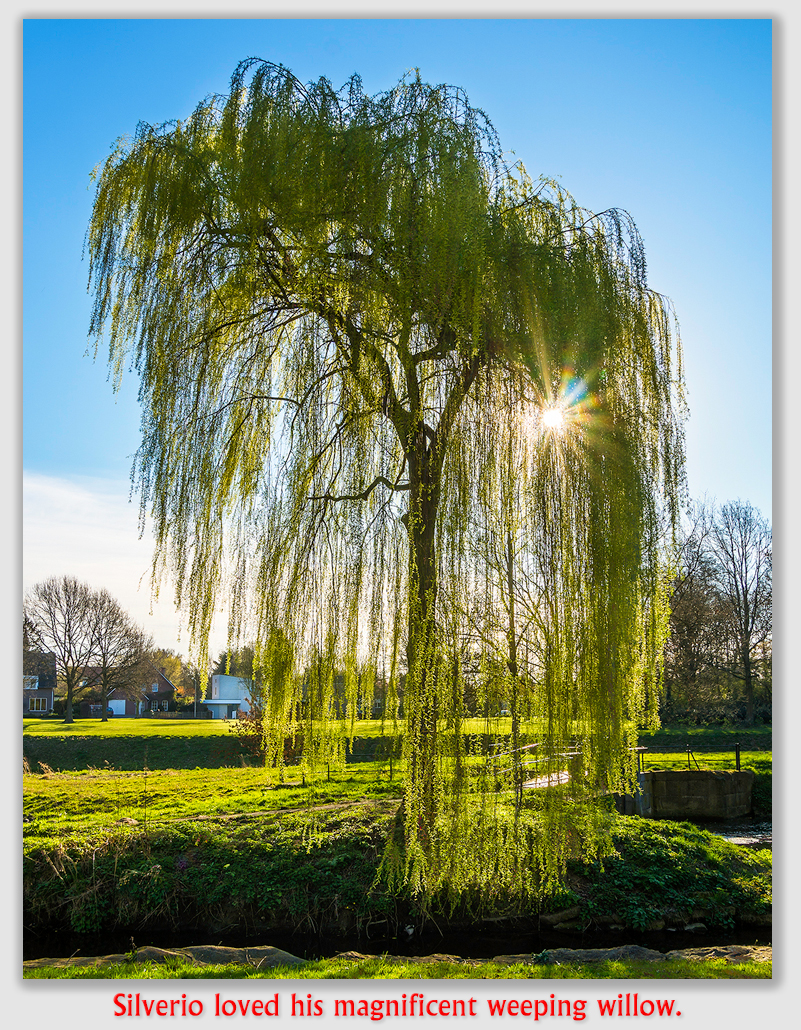 Ponte v. DaSilva, 1982 Mass.App.Div. 6 (1982). Helena Ponte lived next to Silverio DaSilva and his magnificent weeping willow tree. The tree, standing about four feet from Silverio’s boundary with Helena, overhung the picket fence and Helena’s driveway.
Helena began noticing all of the leaves, sap and branches that fell from the tree onto her driveway about two years before the accident. She complained to Silverio, demanding he cut down the tree. Leaves and debris were clogging Helena’s gutters and swimming pool filter. Sap and tree debris (leaves and twigs, no doubt, inasmuch as willows don’t have much fruit) fell on Helena’s Studebaker. And of course, Helena darkly foretold, there was the ever-present slip-and-fall risk.
Helena’s attorney then wrote to Silverio, complaining that Helen’s husband had already fallen on the leaves and debris. The letter portended similar incidents unless the tree was removed.
Sure enough, about 10 days later, Helena fell due to the leaves and sap, breaking her ankle. She sued.
The trial court found that the tree was not diseased and that the leaves, sap and debris which fell were due to the natural characteristics of weeping willow trees. They do, after all, “weep.” Nevertheless, the trial court awarded Helena $15,000 and her husband another $3,000 for loss of consortium (which we will not endeavor to describe here).
Silverio appealed.
Held: Helena and Joseph got nothing, and the tree kept on being a tree.
The crucial issue, the Court of Appeals said, was whether under the circumstances Silverio owed a legal duty to Helena and Joseph to remove the tree. If so, then he would be liable for the damages caused by a breach of that duty.
 The Pontes claimed essentially that the weeping willow was a nuisance because it bothered them. But the test for nuisance, the Court held, was not whether the conduct or activity would be objectionable to a hypersensitive person, but rather whether a normal person in the community would find the conduct at issue clearly offensive and annoying.
The Court observed that the tree had been there for some time, and it was obviously quite alive. No evidence in the record showed the tree to be a hazard (beyond Helena’s ankle, of course) to life or property. Trees “whose roots or branches extend beyond the boundary line,” the Court said, “have been held not to constitute a nuisance in themselves.” In fact, the Court noted, “the Restatement of Torts suggests that where the tree is a part of the natural condition of the land, there is no liability for private nuisance.”
The Court characterized Michalson v. Nutting (the case that was the origin of the Massachusetts Rule) as addressing the notion, albeit obliquely, of a tree as a nuisance. There, the Court said, “the Supreme Judicial Court held that the natural and reasonable extension of the roots and boughs of trees into adjoining property was damnum absque injuria.” The rationale given for this approach “is that to allow recovery in such situations would inundate the courts with frivolous and vexatious suits.”
 But Helena argued that the underpinnings of the Michalson case had eroded to the point that a new theory of liability would and should make the defendant legally responsible in a case such as this. The Court dismissed her argument for a change in the law, noting that the line of cases she relied on to make her point all involved trees that were diseased, decayed or dead. Silverio’s weeping willow, on the other hand, was very healthy.
The right of a landowner to use and enjoy it for lawful purposes, the Court said, must be weighed against the likelihood of substantial harm to a neighboring landowner in cases of private nuisance. A dead, diseased or decayed tree has little or no utility to its owner and poses a foreseeable threat to adjoining landowners from falling limbs. A live tree, on the other hand, provides shade and will generally enhance the landowners’ property. The fact that leaves or other debris will naturally fall from live and healthy trees that are harmless in and of themselves and that such falling leaves and twigs might cause some inconvenience or annoyance to neighbors does not render the tree’s owner liable for damages.
– Tom Root