Case of the Day – Tuesday, March 26, 2024

THE CURE IS TOO MUCH BETTER THAN THE DISEASE

I had a call recently from a North Dakota lawyer, who was involved in a tree case where the standard for measuring damages being considered was the “cost to cure.” He wondered whether I was familiar with the concept.

In losses due to wrongful cutting of trees, we traditionally see damages being applied as diminution of value of the property (noncommercial trespass), the value of the timber (in commercial trespass cases), and, occasionally, restoration value (the cost to restore that which was lost). The ultimate goal, as we once noted, “is compensation for the harm or damage done. Thus, a court may apply whatever method is most appropriate to compensate a plaintiff for his or her loss.”

The question posed by our attorney friend from the Flickertail State left me scratching my head, (not a good idea, because it dislodged some of the little hair I have remaining): it sounded to me that “cost-to-cure” was being used in the case as a fancier name for restoration costs (sometimes called replacement costs). The only place I had seen the term “cost to cure” used was in condemnation cases. A Texas appellate decision in such a case defined the “cost-to-cure” approach as “an appraisal technique used to arrive at the taken property’s market value and the diminished market value of the remainder, which included the cost to replace improvements taken, damaged, or destroyed after they have been appropriately depreciated.

The attorney asked me whether I could verify “that the Cost of Cure Method has been accepted by the Courts.” Not really. My problem is that “cost of cure” has been accepted by the courts in condemnation cases, where the government decides to take your property for some more-or-less debatable public “good.” But I have never seen it called “cost of cure” in a tree damage case, where “cost of restoration” is the term applied when that measure of damage is called for.

Nevertheless, I found a condemnation case from Michigan, which tangentially involves trees (and thus, meets my exacting standards for this blog). So, as a consolation prize, let’s see how a fruit farmer tried to jack up the value of the loss of 20% of his acreage with a “cost to cure” analysis, and how the Court – quite appropriately channeling Publilius Syrus in a time of viral pandemic – told him the cure couldn’t be better than the disease.

Dept. of Transportation v. Sherburn, 196 Mich.App. 301, 492 N.W.2d 517 (Mich.App. 1992). Loris Sherburn was a fruit farmer along Lake Michigan. When the Michigan Dept. of Transportation decided to extend U.S. 31 in Berrien County, it took 28 acres of Loris’ 124-acre farm. A court battle ensued, as it often does, over the value of the property taken. The State argued the value of the 28 acres was $47,200. Farmer Sherburn argued the property carved off his farm was worth closer to $183,000, claiming that this was the cost to cure the loss caused by the loss of the acreage.

The trial court found Loris was entitled to $56,600 for the condemnation of 28 acres of the farm.

Loris appealed.

Held: Loris was only entitled to $56,600. The Court of Appeals acknowledged that in a condemnation case like this one when only part of a larger parcel is taken, the owner is entitled to recover not only for the property taken but also for any loss in the value to his or her remaining property. The measure of compensation is the difference between the market value of the entire parcel before taking and the market value of what is left of the parcel after the taking.

Loris’ expert witness used the “cost to cure” method of calculating damages. The appellate court agreed that the cost-to-cure method is a measure of damages that may be considered by the jury, provided the cost to cure does not exceed that difference between the market value of the entire parcel before the taking and the market value of what is left of the parcel after the taking.

MDOT’s expert witness, an independent real estate appraiser, calculated the value per acre of the farm, which made the place worth $122,800 for all 124 acres. Using the same method, he found the 96-acre parcel remaining after condemnation to be worth $75,600. Thus, he concluded that Loris Sherburn’s damages were $47,200, the difference between the value of the entire parcel and the value of the remaining parcel after condemnation.

Farmer Sherburn had different ideas. His first expert witness, a real estate appraiser, using a comparable sales method testified that the market value of the farm before condemnation was $215,000. He also estimated it would cost the farmer about $183,000 to replace the mature vineyards, peach and apple trees, and buildings lost in the condemnation. The witness contended that Loris, in addition to retaining possession of the remaining 96 acres, should recover the $183,000 cost-to-cure damages.

Loris’ second witness, an independent fee appraiser, testified that using the market data approach, the market value of the defendants’ farm before the taking was $345,000, while the market value of the remaining 96-acre parcel after the taking was $139,000, leaving a difference of $206,000.

The Court of Appeals agreed with Loris that where a partial taking occurs, it is possible for the property not taken to suffer damages attributable to the taking. “These damages have been described as ‘severance damages’,” the Court held, “which may be measured by calculating the difference between the market value of the property not taken before and after the taking. Where severance damages have occurred, it may be possible for the property owner to take steps to rectify the injuries in whole or in part, thus decreasing the amount of severance damages and correspondingly increasing the parcel’s market value.” These actions constitute a “curing” of the defects, according to the Court of Appeals, and the financial expenditures necessary to do so constitute the condemnee’s cost to cure.

However, the Court held, the cost-to-cure damages in a given case are not unlimited. Where the market value of the property taken, the value of the property remaining, and cost-to-cure expenses exceed the market value of the land before condemnation, cost-to-cure damages will not be awarded. “An owner is not to be enriched because of the condemnation,” the Court said.

This leaves “cost-to-cure” damages as a valid measure of damages “only when it is no greater in amount than the decrease in the market value of the [remainder] property if left as it stood.” Thus, the Court concluded, “where there is no claim of severance damages, the maximum damages recoverable equal (the market value of the entire parcel before the taking) minus (the market value of the remainder after the taking). Where severance damages are claimed, the maximum damages recoverable equal (the market value of the parcel taken) plus (the market value of the remainder after the taking) plus (the cost-to-cure expenses); however, the total damages awarded may not exceed the fair market value of the whole parcel before the taking.”

For Farmer Sherburn, the trial court correctly concluded that cost-to-cure damages are not recoverable to the extent that they exceed the market value of the entire property before the taking.

– Tom Root

TNLBGray140407

Case of the Day – Monday, March 25, 2024

CECIDERIT LIGNUM IDEO DEBITUM

Emily Bernges, my sainted high school Latin teacher, would have been proud. We all recall René Descartes and his famous “Cogito ergo sum,” the philosophical proposition “I think, therefore I am.” For today’s case, I have coined a new maxim: “Ceciderit lignum ideo debitum.”

Today’s case, a fairly pedestrian fallen-tree situation, features a plaintiff that everyone will love to hate, an insurance company. When a tree fell on the neighbor’s garage, the victims, alliteratively named Robert and Roberta, called their local insurance agent. The insurance company paid off. Under the agreement (hidden in everyone’s policy) that gives the insurer the right to step into the insured’s shoes – called subrogation – the insurance company sued the neighbor whose tree fell.

One has to wonder why the insurance company even bothered. It agreed before trial that the neighbor had no idea – nor should he have had – that there was anything wrong with the hackberry tree.

Descartes was arguably right when he said, “Cogito ergo sum.” ‘I think, therefore I am.’ But the Latin maxim, “Ceciderit lignum ideo debitum,” which Mrs. Bernges would have translated, “A tree falls, therefore, I pay?” That’s not so catchy, and, as we will see, it’s just plain wrong.

Not so, but sometimes they’re rather obtuse…

American Family Insurance v. Anderson, 107 P.3d 1262 (Kan.App. 2005). Dean Anderson owned property next door to a place belonging to Robert and Roberta Stenfors. One summer evening, a hackberry tree on Dean’s property blew over onto Bob and Bobette’s garage. The Bobs called their insurance carrier, American Family Insurance, which paid to remove the tree and fix the garage, at a cost of $24,837.47.

American Family then sued Dean, claiming he had been negligent in letting the tree fall on the Bobs’ garage. Bob moved to have the claim thrown out, and the trial court obliged.

American appealed.

Held: Dean owed nothing for the fallen hackberry. A directed verdict is appropriate where no evidence is presented on an issue or where the evidence is undisputed and is such that the minds of reasonable persons may not draw differing inferences or arrive at opposing conclusions.

In this case, American Family had to establish that Dean had a duty to the Bobs, that he breached the duty, and that the breach caused the damage to the garage. The Court said that in order for Dean to have had a duty to remove the hackberry tree before it fell, he first had to have actual knowledge that the tree was defective, or there had to be evidence that any reasonable person would have understood meant the tree was defective (which is known as “constructive knowledge”).

Before the trial ever began, American Family stipulated that Dean lacked actual or constructive knowledge the tree was defective. But American Family urged the appeals court to look at the evidence presented at trial. Bob and Bobette, joined by Roy, the guy they hired to remove the fallen hackberry, recalled an incident a decade before in which Roy told Dean he should remove the hackberry along with an adjacent rotten tree. Roy admitted, however, that the hackberry seemed to have gotten healthier in the ensuing 10 years. Roy testified he saw no outward signs of disease or decay on the tree and did not believe the average non-tree person could have seen any indications of internal rotting. The appeals court concluded that based on this record, the testimony presented at trial also failed to establish that Dean had actual or constructive knowledge of the tree’s defects.

American Family also argued the tree was a nuisance. Under Kansas law, “[a] person is liable in damages for the creation or maintenance of anything that unreasonably interferes with the rights of another, whether in person, or property, and thereby causes [him or her] harm, inconvenience, or damage.” The court of appeals said a nuisance is not a separate type of tortious conduct. Rather, in this case, American Family’s nuisance claim was a “sub-variant” of its negligence claim.

A hackberry tree.

The trial court threw out American Family’s nuisance claim because the insurance carrier did not prove Dean had knowledge of the tree’s defective nature. The tree appeared healthy and contained no outwardly visible signs of decay or disease. Further, the trial court noted the tree has withstood 90-mile per hour wind gusts two months before it fell. A reasonable person, the trial court concluded, would not, under these circumstances, have removed the tree.

The appellate court held that American Family’s failure to prevail on its negligence claim doomed its ability to establish that the tree was a nuisance. Knowledge that the tree presented a danger to Bob and Bobette’s property was crucial, and American Family did not show that Dean knew or should have known of the tree’s defective condition.

American Family’s ‘Hail Mary’ argument was that the fallen tree presented a strict liability situation. The appellate court made short work of the claim, noting that the insurance company never raised strict liability at trial, and it could not do so for the first time on appeal.

– Tom Root


TNLBGray140407

Case of the Day – Friday, March 22, 2024

THOSE OLDIES BUT GOODIES

Anglo-American jurisprudence is built on stare decisis, the notion that a decision, once rendered, may be relied upon by future generations to be a correct and reliable explanation of the law.

It does not always work this way. Some decisions are sufficiently wrong-headed (take, for example, Plessy v. Ferguson) that reversal is both legally and morally right. But as the row over Roe v. Wade illustrates, reversal of precedent is never undertaken lightly.

That’s how a Pennsylvania decision that’s almost 80 years old can make its way into our lineup. Dare v. City of Harrisburg is old, but it’s still good law. As an application of the law of nuisance, as well as an explanation of the police power of a municipality to regulate nuisances for the commonweal, this case is fresh enough to have been tweeted just yesterday. It’s an old case, but a good one.

Mr. Dare clearly was a guy who loved his Carolina poplar. The tree is vigorous and rapidly growing, and – at least by the account in the case – can sniff out a water source like a bloodhound working a spoor. When it finds a water source – especially one as nutrient-rich as a sewer, it pries the source open like a squirrel cracking a nut.

Great for the tree. Not so great for the sewer. Or the city that has to maintain it, or the poor homeowner who watches unspeakable things backflow into his or her basement.

Carolina poplar – a cottonwood-family tree

Dare v. City of Harrisburg, 16 Pa. D. & C. 22 (Pa. Common Pleas 1930). In August 1925, the City of Harrisburg established a Shade Tree Commission under an Act providing for the planting and care of shade trees. A few short years later, the Commission ran headlong into Mr. Dare, who had a healthy, full-grown 35-year-old Carolina poplar shade tree in front of his property, one of nine such trees along the street.

In the fall of 1929, the Shade Tree Commission ordered the Carolina poplar removed to be replaced with a Norway maple tree.

The Norway maple was well suited to the Harrisburg climate and soil. The Carolina poplar, on the other hand, grows rapidly, is short-lived and has fibrous roots which can extend up to 100 feet in search of water. The roots have a tendency to penetrate the smallest crevices, and particularly enter sewers seeking moisture and food.

The City had a sewer about 38 feet from the tree, which was clogged twice, backing up into nearby homes, during the summer of 1929. Each time, crews pulled bushels of small matted Carolina poplar roots from the sewer. The Shade Tree Commission found that Mr. Dare’s Carolina poplar tree was likely to continue to clog the sewer, costing the City money and causing sewer backups that damaged other homes.

Mr. Dare argued that the Commission’s proposal to remove the tree was arbitrary, unreasonable, and an abuse of any discretion that the statute may have vested in the Commission. He said the problem was a shoddily built sewer, and that removing the tree constituted an unconstitutional taking of his property without compensation.

Held: The tree was a nuisance, and the Shade Tree Commission could order its removal without paying compensation to Mr. Dare. The evidence showed that the tree grew out to the sewer and stopped it, different from a case where the growth of the city around the tree was what created the condition now being called a nuisance.

The Court admitted that “it is a serious matter to destroy a beautiful shade tree and thus somewhat diminish both the market value and the advantages of one’s home. But when the tree has become a nuisance and the municipal authorities have upon proper evidence so determined, the court cannot say that a determination to remove such tree is either arbitrary or unreasonable.”

The Shade Tree Commission Act of 1907 gave the Commission the “exclusive and absolute custody and control of and power to plant, set out, remove, maintain, protect and care for shade trees.” This language, the Court said, gives the commission the exclusive power to remove. A municipality has a right to control trees and to remove them, and courts will not interfere unless there is an abuse of discretion or the power is exercised willfully, wantonly and unnecessarily. Where trees become a nuisance, the municipality does not act in the exercise of eminent domain but under the police power and needs no permissive statute.

Nor must the City pay compensation to the tree’s owner. The Court agreed with the principle from a Municipal Corporations treatise that “without regard to who owns trees in the street, the municipality has the right to control them, and it may in proper cases in the interest of public safety, convenience or health, cut them down. It is well settled that a municipality, even in the absence of a permissive statute, may remove trees, when necessary as against the objection of the abutting owner, without compensation, in connection with making improvements on the street, or where they are an obstruction to travel. For example, to improve and render a highway safe and convenient for travelers, to carry out a plan or system of street improvements, or to prevent the roots of trees from clogging a city sewer.”

Mr. Dare cited Bushong v. Wyomissing Borough, a prior case, in which municipal authorities were denied the right to remove a private landowner’s tree. But there, the Court said the City attempted to remove Norway maple trees (which is the species intended to be substituted in the instant case), which were well adapted to the conditions in the borough, and to plant in its place a Crimean linden, which had not been planted in the borough before and was not an established shade tree. In that case, the Court said, “it was very properly held that shade trees were not nuisances per se, and that the removal of beautiful and ornamental trees which add to the desirability and the value of properties, merely for the sake of uniformity, would be exercising an unreasonable and arbitrary power. But in the case of Mr. Dare’s Carolina poplar, there was “no question of the removal of the tree for the purpose of making municipal improvements, thus exercising the power of eminent domain or merely removing the tree to plant a tree of another kind, which may not be any better adapted to the soil and environment. The question is whether the city has the right, in the exercise of its police power, to direct the removal of a tree which has become a nuisance. We base our decision on that proposition alone.”

– Tom Root

TNLBGray140407

Case of the Day – Thursday, March 21, 2024

ANGELS WITH DIRTY WINGS

Filthy_animal140324Any fan of the Christmas comedy hit of the 1990s, Home Alone, remembers Angels with Dirty Wings. It was the fictional film noir movie that the kid protagonist played repeatedly. The mobster’s taunt –“Keep the change, ya filthy animal,” punctuated with a spray of .45 cal. bullets from a Model 1928 Thompson submachine gun – was used as a sound effect, part of the boy’s plot to keep the bad guys at bay.

In today’s case, the angel is Angel’s Path, a developer, and the dirt on its wings slid off a big mound the company put right on its property line as it built houses. The neighbors didn’t much like the dirt sliding into their back yard, and weren’t big fans of the stagnant water that collected after every rainstorm. But when Angel’s Path asked for summary judgment on the trespass and nuisance claims the Peters brought, for some reason the couple opposed it on the cheap, with an affidavit from Mr. Peters and a bare letter from their engineer.

It’s seldom a good idea to save money at the most crucial moment in the litigation. Better to adhere to the old law school maxim, “too much is not enough.” You have affidavits from five experts? Use ’em all. You have five boxes of documents? Attach ’em. Opposing a motion for summary judgment is no time to spare the horses. Here, Mr. Peters should have had an affidavit from his engineer, his own survey done by a registered surveyor and recorded down at the county building, and enough pictures of shifting dirt piles and standing water to start his own Instagram site.

angelsfight140324But he didn’t. The trial court granted summary judgment to Angel’s Path, finding the survey of property lines — showing the dirt piles on its own land — more persuasive than Mr. Peters’ affidavit claim that the dirt had sloughed over the line. Peters’ affidavit was “self-serving,” the trial judge complained.

The Court of Appeals reversed. Sure the affidavit may be a little self-serving, the Court said, but for purposes of summary judgment — a fairly high bar for a defendant to leap — the Court had little problem believing that a property owner knew where his own boundary lay. The summary judgment test, after all, is whether the evidence, taken in the light most favorable to the party against whom summary judgment is sought, shows there’s no material question of fact.

This standard required that the trial court assume that any reasonably detailed facts Mr. Peters raised in his affidavit were true. If after doing this, the court still believes that Peters was not entitled to a judgment, then summary judgment could go for Angel’s Path. It was pretty clear that Mr. Peters was going to need a whole lot more persuasion at trial to pull the halo off Angel’s Path, but for now – at the summary judgment stage– his showing was enough to stay in the hunt. Just barely.

Incidentally, this case was brought with a companion case from the Kramers, who sued Angel’s Path, too. That decision is an interesting study in nuisance and trespass. We’ll consider that decision tomorrow.

angelspath140324Peters v. Angel’s Path, L.L.C., 2007-Ohio-7103, 2007 Ohio App. LEXIS 6211, 2007 WL 4563472 (Ct. App. Ohio, 2007). Clarence and Nanette Peters complained that Angel’s Path, LLC, a developer, damaged their two residential properties. As a result of residential property development by Angel’s Path, dirt mounds at the edge of the development property caused water run-off and flooding on their adjacent land. They sought restraining orders to prevent Angel’s Path from trespassing on their properties or continuing to alter the natural flow of water, as well as damages.

Angel’s Path filed a motion for summary judgment, arguing (1) that the earth mounds did not cause run-off to the Peters property or any sinkhole conditions and, therefore, were not a nuisance and (2) that their surveyor said that the mounds did not encroach upon appellants’ property, so no trespass had occurred. The trial court also granted summary judgment against the Peterses on both their nuisance and trespass claims. The Peterses appealed.

Held: Summary judgment was reversed. A “nuisance” is the wrongful invasion of a legal right or interest. A private nuisance is a nontrespassory invasion of another’s interest in the private use and enjoyment of land. In order for a private nuisance to be actionable, the invasion must be either intentional and unreasonable, or unintentional but caused by negligent, reckless, or abnormally dangerous conduct.

If the private nuisance is absolute, strict liability will be applied. By contrast, a qualified nuisance is premised upon negligence, essentially a negligent maintenance of a condition that creates an unreasonable risk of harm. To recover damages for a qualified nuisance, negligence must be averred and proven. A qualified nuisance is a lawful act so negligently or carelessly done as to create a potential and unreasonable risk of harm, which in due course results in injury to another.

Where damage to one property by water run-off from an adjacent property is alleged, Ohio has adopted a reasonable-use rule. A landowner isn’t allowed to deal with surface water as he or she pleases, nor is the owner absolutely prohibited from interfering with the natural flow of surface waters to the detriment of others. Instead, each landowner over whose property water flows is allowed to make a reasonable use of the land, even though the flow of surface waters is altered thereby and causes some harm to others. He or she incurs liability only when the harmful interference with the flow of surface water is unreasonable.

nuisance151019In answer to Angel’s Path’s motion for summary judgment, Mr. Peters provided an affidavit along with photos that claimed the mounds created by Angel’s Path had slid across the common property onto his property. His affidavit also said that Angel’s Path workers entered his property to cut the weeds because the slope of the mounds didn’t allow appropriate maintenance without entering his land. Finally, the Peters’ affidavit stated that the back portion of his property was now flooding and would not dry out, preventing his use of the land for a rental or for farming. Peters also included as a letter from his expert stating the mounds blocked the natural flow of the water, creating a “permanent pond,” and suggesting possible ways to eliminate the problem.

The Court said that Mr. Peters’ testimony about the location of his property lines, although perhaps not the best evidence to rebut a commercially prepared survey, was something presumably within the property owner’s personal knowledge. Therefore, despite the fact that he had not yet had a separate survey done, the Court would not disregard the affidavit. At the same time, the Court criticized the trial judge for placing too much weight on the fact that Angel’s Path plans had been approved by the local county engineers. The Court of Appeals said that while the county engineer and other agencies approved the Angel’s Path development plans, including the projected effects that it might have on surrounding properties, “such facts are of little consequence and comfort when examining the real-world results of the construction…”

Here, for the purposes of summary judgment, the Court concluded that the Peterses had presented prima facie evidence to establish causes of action for private nuisance and trespass. Whether Angel’s Path’s actions were reasonable, intentional, or negligent, the Court said, are decisions to be made in a trial, not on summary judgment.

– Tom Root

TNLBGray140407

Case of the Day – Wednesday, March 20, 2024

CRY ME A RIVER

leakybucket151016Law students learn in first-year civil procedure that it’s entirely proper to file utterly inconsistent pleadings. For example, if a complaint is that the defendant borrowed plaintiff’s bucket and broke it, the defendant can answer that (1) he never borrowed it; (2) when he returned it, it wasn’t broken; and (3) it was broken when he borrowed it. And lawyers wonder why there are so many attorney jokes

But there are limits, and complaints in civil actions should not be completely mindless in their allegations. In today’s case, landowner Fischer changed the slope of his land, rebuilt a driveway and installed a retaining wall. His neighbor Christiana complained that the effect of his neighbor’s construction project was to send unwanted drainage onto his property. Fischer was unimpressed. “Cry me a river,” you can imagine him saying. Christiana’s lawyer – who perhaps was charging his client by the word – obliged, tearfully filing a four-count complaint claiming negligence, recklessness, nuisance and trespass.

crymeariver140326Fischer filed a motion to strike the recklessness and trespass counts. He argued that the complaint — even assuming everything Christiana has alleged was true — simply didn’t state a claim. Christiana depended on pretty much the same facts for recklessness as he did for negligence, except in the recklessness count, he charged that on top of everything else, Fischer hadn’t gotten permits from the town for the project. Well, maybe that was a little sloppy, at least as far as paperwork goes, but the Court held that Fischer’s lack of a few permits didn’t constitute recklessness towards Christiana. The recklessness count was bounced.

Fischer argued that the trespass count should be dismissed because there was no allegation that he intended for the water to flow onto Christiana’s land. The Court disagreed with Fisher’s novel interpretation of trespass, holding that Fischer didn’t have to intend that the water trespass on Fischer’s land, just intend the act – that is, the diversion of the water – that resulted in the trespass. The distinction is subtle but crucial.

Thus, the trespass count remained, an important holding: the Court said, in essence, that without ever stepping foot on Christiana’s property, Fischer could have trespassed just by being negligent in the way he altered water flow.

Christiana was upset because Fischer's retaining wall left his place a little soggier than it had been before ,,,

Christiana was upset because Fischer’s retaining wall left his place a little soggier than it had been before …

Christiana v. Fischer, 2007 Conn. Super. LEXIS 2660, 2007 WL 3173949 (Conn. Super.Ct., Oct. 17, 2007). Christiana sued Fischer after Fischer altered the slope of his land and built a retaining wall. Christiana sued for negligence, recklessness, nuisance, and trespass. Fischer moved to strike the recklessness and trespass counts as insufficient to state a cause of action.

Held: The court split its holding, striking the count for recklessness but not the trespass count. Recklessness is a state of consciousness with reference to the consequences of someone’s acts, more than negligence, more than gross negligence. While the actor’s state of mind amounting to recklessness may be inferred from conduct, there must be something more than a failure to exercise a reasonable degree of watchfulness to avoid danger to others or to take reasonable precautions to avoid injury to them. Reckless conduct tends to take on the aspect of highly unreasonable conduct, involving an extreme departure from ordinary care, in a situation where a high degree of danger is apparent.

In Count 2, Christiana repeated his allegations of negligence and additionally alleged that Fischer rebuilt a driveway without a building permit and in violation of the town’s zoning regulations. Christiana, however, made no allegation that Fischer was made aware prior to completion of the alteration and construction work of any problems that he was causing that would drain water onto Christiana’s property. The Court found that the allegations failed to support a cause of action for recklessness.

As for the trespass count, Fischer argued that Christiana failed to allege any intentional conduct essential to state a cause of action for trespass, pointing out that there was no allegation that the defendants intended to direct water or other debris onto the plaintiffs’ property or that they acted knowing to a substantial certainty that the water or other debris would enter the plaintiffs’ property. But the Court held that to make out a trespass, a plaintiff had to have ownership or possessory interest in the land; there had to be an invasion, intrusion or entry by the defendant affecting the plaintiff’s exclusive possessory interest; the act had to be done intentionally; and the act had to cause direct injury.

In his complaint, Christiana alleged that he had notified Fischer that he was having severe drainage problems as a result of the land alteration and construction on several occasions and that Fischer failed to take corrective action. The Court found that Christiana’s allegations were sufficient to establish a cause of action for trespass.

– Tom Root
TNLBGray140407

Case of the Day – Tuesday, March 19, 2024

THE MASSACHUSETTS RULE GETS FLUSHED

Greed may be good ... but it doesn't get a lot of love from the court.

Greed may be good … but it doesn’t get a lot of love from the court.

Gloria Lane was a down-on-her-luck middle-aged woman who managed to just eke out an existence with her disabled brother in an old house. Their place was next to a rental property, a house equally as old, but owned by a corporate slumlord, W.J. Curry & Sons.

Do you see where this one is going? Hard cases can make bad law. Even where the result isn’t necessarily wrong — and we’re not hard-hearted enough to criticize people who were too poor to afford to fix the bathroom — cases are fact-driven.

We can imagine the scenario: a faceless corporation rolling in dough, too chary to keep up its properties and too avaricious to pay damages inflicted on the impoverished neighbors. That, at least, is the innuendo.

The Curry property included three large, healthy oak trees near the boundary with the Lane homestead. The trees are much taller than either of the houses, and those towering oaks featured limbs that protruded over Gloria Lane’s house and caused manifold problems. First, the court said, she had to replace her roof 15 years before the lawsuit “because the overhanging branches did not allow the roof to ever dry, causing it to rot.” She complained that prior to replacing the roof, “[e]very roof and wall in [her] house had turned brown and the ceiling was just falling down. We would be in bed at nighttime and the ceiling would just fall down and hit the floor.”

In 1997, one of the oaks shed a large limb, which fell through the Lanes’ roof, attic, and kitchen ceiling. Rain then ruined her ceilings, floor, and the stove in her kitchen. The Lanes were physically unable to cut the limbs back that were hanging over the house, and they couldn’t afford to hire it done. For that matter, Gloria couldn’t even afford to fix the hole in her roof.

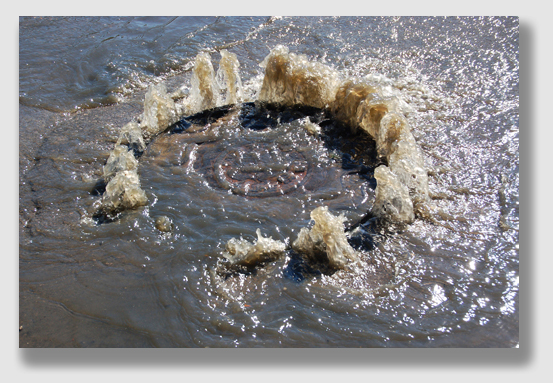
flush151015If that weren’t enough, the oaks’ roots clogged the Lane’s sewer line, causing severe plumbing problems. Gloria tried to chop the encroaching roots away from the sewer over the years, but they kept growing back and causing more plumbing problems. At the time of the lawsuit, she hadn’t been able to use her toilet, bathtub, or sink in two years because of the clogs. Instead, she went to the neighbors’ house (presumably not the Curry rental) to use the toilet. Meanwhile, raw sewage was bubbling into her bathtub, and the bathroom floor had to be replaced because of toilet back-ups and water spills onto the floor.

Gloria told the trial court that “everything is all messed up. I can’t bathe. I can’t cook. I don’t want people coming to my house because it has odors in it, fleas, flies, bugs. It’s just been awful for me.” Ms. Lane, already under a psychiatrist’s care, said she “just can’t take too much more.”

After the branch punched a hole in her roof, Gloria asked the owner of W.J. Curry – one Judith Harris, a corporate minion who was neither W.J. nor any of his sons – to do something. She had a tree service trim the lower branches, but not the ones that would have been more expensive to reach. This didn’t solve the problems. When Gloria complained again, Ms. Harris told Gloria that she was on her own.

Now, boys and girls, these are hard facts. We aren’t dealing with the Schwalbachs, who were perfectly fit and reasonably flush, complaining about a few twigs and leaves to an underfunded cemetery association. Here, we have a dramatis personae that includes – as protagonist – a pathos-inducing poor woman caring for an invalid sibling, and – as antagonist – a soulless corporation destroying her happy home, one dropped limb by one dropped limb by one rotten roof by one clogged sewer at a time. And we’ve got some real damages, too. You try knocking on the neighbor’s door eight times a day and night to use the ‘loo, and see how you feel. Did the Massachusetts Rule have any chance of survival in the face of this heart-wrenching tale?

punch151015Of course not. The evil slumlord defendant (and we don’t know that he was evil or even a slumlord, but the story has a life of its own) argued that Tennessee followed the Massachusetts Rule. After all, it pointed out, Gloria was free to fire up her Husqvarna and clamber out onto her roof herself to cut down the offending limbs. Tennessee law firmly established that her remedies were limited to Massachusetts-style “self-help.” That means Gloria should get nothing for the hole in her roof, nothing for her falling plaster, nothing for her waterlogged stove, and nothing for the sewage bubbling in her bathtub.

The trial court agreed with W.J. Curry. It held that while it was “certainly a serious situation that the plaintiff has not been able to use her bathroom for two years … these three trees are alive and living and they do what trees normally do. They produce branches and grow and they produce a root system. And even though you trim the branches back or you trim the roots back, they are going to produce more branches and more roots.”

Spoken like a judge whose own toilet flushes just fine. The three-judge appellate panel – a trio of jurists who also were not worrying about the efficacy of their respective commodes – agreed. They observed that, after all, the trees were not “noxious” (which was a quaint notion championed by Smith v. Holt but since abandoned in Fancher v. Fagella).

The Tennessee Supreme Court reversed, adopting the Hawaii Rule, holding that living trees and plants are ordinarily not nuisances, but can become so when they cause actual harm or pose an imminent danger of actual harm to adjoining property. When that happens, the Court said, the owner of the tree had some responsibility to clean up the mess. No doubt swayed by the extensive record of travail propounded by Ms. Lane, the Court held that W.J. Curry’s trees clearly satisfied the definition of a “private nuisance.” It sent the case back to the trial court for a remedy to be crafted, one that no doubt included money damages and probably an order that the landlord cut down the oversized trees.

Sure, Gloria ... get up there and trim those branches yourself.

Sure, Gloria … get up there and trim those branches yourself.

Lane v. W.J. Curry & Sons, 92 S.W.3d 355 (Tenn. 2002). The long-suffering Gloria Lane sued W.J. Curry and Sons, Inc. a landlord owning a rental property next to her house. Over the years, her roof was damaged by branches overhanging from oaks growing on the Curry property, a branch fell, smashing into the home and causing extensive damage, and the root system substantially damaged her sewer system, rendering her home almost uninhabitable.

Gloria sued, asserting that encroaching branches and roots from the Curry trees constituted a nuisance for which she was entitled to seek damages. W.J. Curry responded that Ms. Lane’s sole remedy was Massachusetts Rule-style self-help, and she could not recover for any harm caused by the trees.

The trial court and Court of Appeals agreed with W.J. Curry and Sons, holding that an adjoining landowner’s only remedy in a case like this one was self help, and that a nuisance action could not be brought to recover for harm caused by encroaching tree branches and roots.

Ms. Lane appealed to the Tennessee Supreme Court.

Held: Self-help is not an adjoining landowner’s sole remedy when tree branches and roots encroach. A nuisance action may be brought when the encroaching branches and roots damage the neighboring landowner’s property.

The Supreme Court held that although encroaching trees and plants are not nuisances merely because they cast shade, drop leaves, flowers, or fruit, or just because they encroach upon adjoining property either above or below the ground, they may be regarded as a nuisance when they cause actual harm or pose an imminent danger of actual harm to adjoining property. If so, the owner of the tree or plant may be held responsible for harm caused by it and may also be required to cut back the encroaching branches or roots, assuming the encroaching vegetation constitutes a nuisance.

Thumb's down to the Massachusetts Rule.

Thumb’s down to the Massachusetts Rule.

The Court engaged in a lengthy discussion of the various theories of liability adopted in various states, including the Massachusetts Rule, the Hawaii Rule, and the old, pre-Fancher Virginia Rule. The Court decided that the Hawaii Rule should be followed, because it “voices a rational and fair solution, permitting a landowner to grow and nurture trees and other plants on his land, balanced against the correlative duty of a landowner to ensure that the use of his property does not materially harm his neighbor,” while being “stringent enough to discourage trivial suits, but not so restrictive that it precludes a recovery where one is warranted.” The Court criticized the Massachusetts Rule, agreeing with the notion that limiting a plaintiff’s remedy to self-help encourages a “law of the jungle” mentality by replacing the law of orderly judicial process with the doctrine of “self-help.” Yet, the Court said, the Hawaii Rule was consistent with the principle of self-help Tennessee courts had previously enunciated.

The Court was careful to note that it was not altering existing Tennessee law that the adjoining landowner may, at his own expense, cut away the encroaching vegetation to the property line – whether or not the encroaching vegetation constitutes a nuisance or is otherwise causing harm or potential harm to the adjoining property.

– Tom Root

TNLBGray140407

Case of the Day – Monday, March 18, 2024

MY DAD’S GONNA SUE YOUR DAD

We had some great trees in our back yard when I was a kid. My parents let each of the four of us children “claim” one of the trees as our own, although I must now confess that the utility of doing so is no longer obvious to me. My sister staked out the sugar maple on the north side of the house, my brothers had a box elder and a red maple, respectively, and I got a magnolia that stood outside the kitchen window.

It’s not like we children had any responsibilities for our trees, either trimming them or raking up their leaves or even pulling suckers off their trunks. We had ownership but no responsibility, which is a great segue into today’s classic case from New Jersey.

I bring up our “claimed” trees because of the young rascal Rick, an ornery kid who lived next door. One warm rainy day in the spring, when intelligent people were inside to avoid getting wet (and you can see what that implies), young Rick was outside playing in the downpour. He somehow decided that conditions were perfect for climbing my magnolia. However, when his foot slipped on a wet branch, gravity ensued. Rick was treated to what would have been a jarring but harmless fall, except for his chin making rather sharp contact with the branch on the way down.

We were blissfully unaware of the life-and-death drama occurring beyond our kitchen window until the next day when Rick – with his chin stitched and bandaged – told my siblings and me what had happened. He matter-of-factly announced that because of the accident, “My Dad’s gonna sue your Dad!”

I recall being shocked that an injury so directly resulting from Rick’s own knuckleheadedness could somehow strip us of all possessions and leave us living in a cardboard refrigerator carton in the back lot of Brown & Miller’s Hardware. Of course, Rick’s appreciation for the finer points of tort law matched his understanding of gravity, and no suit ever resulted. But I found the idea alarming that merely owning a tree (and letting it be a tree) could make us liable for injury to others.

But the notion is not so ridiculous that people aren’t still trying to sell it to trial courts. Today’s case resulted from a perfectly healthy tree falling from one property onto a garage on another property. The aggrieved property owner argued that the tree was a nuisance because it fell – for whatever reason – and because it was a nuisance, the tree’s owner was liable. When I read the case, I felt that same alarm young Rick engendered in me all over again. Fortunately, the appellate court was not so cowed by the premise that it could not make short work of such a foolish claim.

So what is the standard to be applied to determine the liability of a landowner for a tree that falls from his property onto his neighbor’s property for no apparent reason?

Burke v. Briggs, 571 A2d 296 (N.J. Super.Ct. 1990). Robert Briggs and the Burkes owned adjoining properties. One June evening, a large white oak tree growing on Bob’s property suddenly fell over onto the Burkes’ property, crushing their garage. The tree appeared to be perfectly healthy, and no one could assign a reason for its falling.

That hardly stopped the Burkes, who sued Bob for negligence but later added a count citing the elements of a nuisance. The Burkes argued Bob was “strictly liable” for the damages caused by the fallen tree because it amounted to a nuisance. Bob countered that liability should be determined on the basis of traditional negligence principles of tort liability. The trial judge agreed with the Burkes that reasoned the fallen tree constituted a “nuisance” because Bob had failed to use his property in a manner that did “not damage or unreasonably interfere with the use of an adjacent land owner’s property.” The judge said that a private nuisance “imposes a strict liability” on the responsible party, and summarily found for the Burkes without the need for a trial.

Bob appealed.

Held: A nuisance can only be created by unreasonable use of land, meaning that the trial court must look at the circumstances of the case to decide whether Bob was unreasonable in permitting the tree to grow as it did. Thus, the lower court was wrong to decide the matter without a trial.

The appellate court noted the distinction that had arisen in tree law over the years between conditions of land artificially created as opposed to those that come into existence naturally. Historically, if Bob’s tree had been growing there on its own, he would not have been liable for any damage it caused, but if he had planted it or nurtured it, he would be accountable. The appellate panel concluded that the natural-artificial distinction makes little sense in modern life.

The appellate court admitted that “there is perhaps no more impenetrable jungle in the entire law than that which surrounds the word ‘nuisance’,” but it nonetheless held that the law was clear enough that a private nuisance must be based on the defendant’s interference with another’s use and enjoyment of his or her own land. The superior court fell back on the Restatement, Torts 2d for the general rule that

One is subject to liability for a private nuisance if, but only if, his conduct is a legal cause of an invasion of another’s interest in the private use and enjoyment of land, and the invasion is either

(a) intentional and unreasonable, or

(b) unintentional and otherwise actionable under the rules controlling liability for negligent or reckless conduct, or for abnormally dangerous conditions or activities.

The appellate court held that liability without fault should not be imposed “whether that activity be classified as a nuisance or a trespass, absent intentional or hazardous activity requiring a higher standard of care or, as a result of some compelling policy reason.”

In other words, the appellate court said, regardless of whether the falling tree was a nuisance, trespass or negligence, “the issue here should logically depend on whether the offending landowner somehow has made a negligent or unreasonable use of his land when compared with the rights of the party injured on the adjoining lands.”

So, the court concluded that the focus of the case should be on whether Bob was negligent in some way. To figure this out, the trial court should have considered the nature of the incident, the danger presented by the presence of the tree, whether Bob could or should have known of the tree’s condition by making inspections, and what steps Bob could have taken to prevent it from falling onto the Burkes’ garage.

Tom Root

TNLBGray140407