Case of the Day – Tuesday, December 31, 2024

SAUCE FOR THE GANDER

I confess that I have always been a little uneasy at the cases that balance the Massachusetts Rule against harm – even inevitable harm – to a neighbor’s tree. If the Massachusetts Rule says that a landowner suffering harm from a neighbor’s tree has no recourse but to trim branches and roots back to the property line, it seemed like holding that the tree owner had no recourse if the trimming harmed the tree was just a practical application of the commonsense notion that what is sauce for the goose is as well sauce for the gander.

The property line limitation of the Massachusetts Rule is quite necessary. You cannot have the neighbor wandering into your yard, hacking the tree branch back to the trunk. But at the same time, standards of careful tree maintenance (think ANSI Standard A300) would suggest that cutting a limb halfway back to the trunk is negligence. Inasmuch as the afflicted neighbor cannot trim the tree beyond the property line to acceptable standards without the tree owner’s permission, the neighbor would be sandbagged if she were liable for not trimming it in a way that did not damage it.

Likewise, if a neighbor can save her foundation only by severing so many roots on her property that the tree’s health and safety is jeopardized, why should she be liable for what happens to the tree? It’s not as though she could have sued to have the tree removed: that’s the whole point of the Massachusetts Rule.

And yet, cases like Brewer v. Dick Lavy Farms, LLC, Fliegman v. Rubin, and Booska v. Patel lead the march toward limiting the Massachusetts Rule with the rule that a landowner had a duty to act reasonably when exercising self-help rights. Such a limitation on the Massachusetts Rule almost guarantees that the Rule will be further watered down by permitting suits against tree owners for encroachment. And when that happens, the Massachusetts Rule will be indistinguishable from the Hawaii Rule.

My worry that what some may be progress is just needless change is why was so cheered by a 2018 year-end decision from Florida that so succinctly expressed my own feeling that the Massachusetts Rule requires that the prohibition on bringing suit apply as much to the goose as it does to the gander.

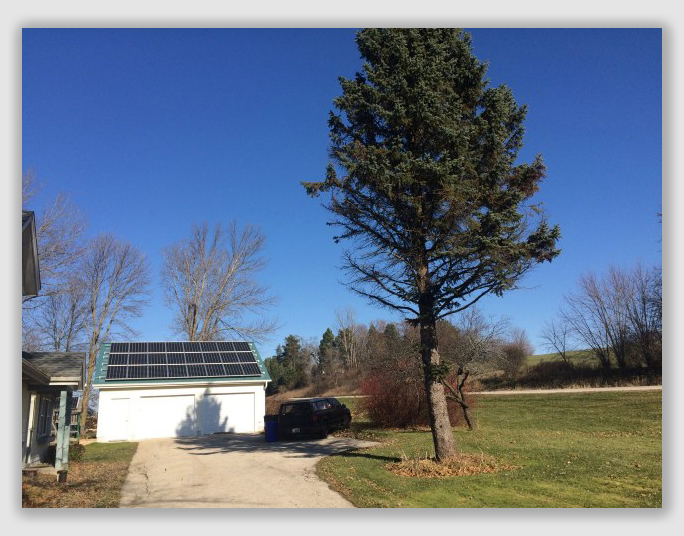
Balzer v. Maxwell263 So. 3d 189 (Ct.App. 1st Dist., 2018). A large pine tree stood on Barbara Balzer’s property near her boundary with a parcel owned by Cindy Ryan. The tree’s roots encroached onto Cindy’s property, damaging the sewer line that ran under their driveway. To fix the sewer line, Cindy hired Hoyt Maxwell to remove her driveway and replace the line. While removing the driveway, Hoyt cut some of the encroaching tree roots. Although he did not kill the tree, Hoyt undermined the tree’s structural integrity and increased the risk that it might someday fall on Barbara’s house. To be prudent, Barbara paid to have the tree removed.

Afterward, she sued Cindy to recover the costs of removing the tree. After a nonjury trial, the court awarded Barbara only a portion of her costs to remove the tree. Barbara appealed, arguing that the county court erred by not awarding all of her costs. Cindy and Hoyt cross-appealed, arguing that the county court erred in finding them liable for damaging the tree because Cindy had the right to cut the encroaching tree roots. The circuit court reversed, reasoning that because Barbara could not be compelled to pay for Cindy’s damaged sewer line, she likewise had no cause of action against Cindy and Hoyt if the tree was damaged when Cindy exercised her privilege to cut the roots encroaching onto her property.

Barbara sought review of the circuit court appellate decision.

Held: Because the circuit court’s decision did not violate any clearly established principle of law, its decision holding that Cindy and Hoyt were not liable was upheld.

The holding in this decision, known as a second-tier certiorari proceeding, was limited to deciding whether the lower court’s decision departed from a “clearly established principle of law” resulting in a miscarriage of justice. If there is no controlling precedent, certiorari relief cannot be granted because without such precedent, the reviewing court “cannot conclude that a circuit court violated a clearly established principle of law.”

Under Florida law, the Court observed, it is well-established that an owner of a healthy tree is not liable to an adjoining property owner for damage caused by encroaching tree branches or roots, but the adjoining property owner “is privileged to trim back, at his own expense, any encroaching tree roots or branches… which has grown onto his property.”

The issue in this case, however, was slightly different, whether an adjoining property owner is liable to the tree owner when the self-help remedy damages the tree. The Court held that while there are conflicting decisions on the issue in other states, no Florida court has weighed in on the issue. For that reason, the Court said, “it follows that the circuit court did not violate clearly established law in ruling the way that it did.”

Barbara argued that McCain v. Florida Power Corp. established that negligence principles extended to suits against landowners in circumstances like this case. The Court disagreed because Barbara did not allege and the evidence did not show that Cindy damaged anything other than the tree whose encroaching roots Cindy “undisputedly had a right to cut.” The Court concluded that a “rule imposing liability for causing any damage to the tree in these circumstances would effectively eviscerate that right.”

– Tom Root

TNLBGray140407

Case of the Day – Monday, December 30, 2024

PINKY SWEAR

pinkyswear150204Hey, kids! Remember “cross my heart and hope to die?” How “swear on a stack of Bibles?” Even if you’re too young for those old chestnuts, you all know what a “pinky swear” is.

Sadly, Robert Grey Johnson, Jr., does not. Mr. Grey Johnson lived in tony Monarch Bay Terrace, on the Pacific Ocean between Long Beach and San Diego. The community is governed by the Monarch Bay Terrace Property Owners Association, a type of local quasi-governmental regulatory body that gives despotism a bad name.

A few years ago, Monarch Bay POA and Grey Johnson became embroiled in a dispute concerning his alleged installation of various “unapproved” trees on his property, and his failure to properly trim and maintain all of his trees so they didn’t impede either use of the sidewalks adjacent to his property or – more important when the “starter houses” in your neighborhood sell for over a million bucks – the ocean views of his neighbors.

To settle that earlier case, Grey Johnson promised to abide by a settlement that spanned more than 20 pages. He said he would abide by Monarch Bay’s “Covenants, Conditions and Restrictions” and seek prior approval of any trees planted on his property. He conceded that Monarch Bay POA’s board of directors would have “sole discretion” to determine the proper height of any tree, or whether any new or existing planting constitutes a view impediment or a nuisance – and that its decisions would be “final.” Finally, Grey Johnson promised to remove certain trees, trim or top other trees, as necessary, to maintain them at rooftop level; and pay a fine of $250.00 plus $500.00 in attorney fees to Monarch Bay.

crossedfingers150206No one looked behind Grey Johnson’s back while he signed off on the deal, or they might have seen his crossed fingers. A few years later, after Grey Johnson had failed to trim his trees as he promised, the parties were back in court. The POA wanted the trial judge to enforce the deal. Grey Johnson, who channeled Joyce Kilmer, argued that he should not be required to “top” the tree that some of his neighbors characterize as an impediment to their ocean views, even though he earlier agreed to do that very thing.

The court was unimpressed. Kilmer, the judge pointed out, didn’t say that trees were lovelier than ocean views – just poems. Grey Johnson offered fifty shades of justification for not honoring the deal, but the court saw through them. After the trial court upheld the deal, he took his plea to the Court of Appeals, which wisely observed that “this case is not about whether Johnson should be required to top his tree – or whether Kilmer would have approved of his doing so. It’s about whether Johnson’s voluntary agreement to do it is legally enforceable, even though he doesn’t want to do it anymore. It is.”

My hat is off in homage to the salesmanship of the lawyer who convinced Grey Johnson that he ought to bankroll this turkey. Had Grey Johnson come to me, I probably would have uncreatively told him to “keep your word… you signed the deal, now live with it.” Which, come to think of it, is exactly what the Court of Appeals told him.

The moral? Lawyers often say that a “bad settlement is better than a good lawsuit.” True, but that settlement is more than a technicality on the road to ending some pesky litigation. Courts presume the parties understand what they’re signing and won’t later entertain deviceful arguments for ignoring the plain terms of the deal.

It's a pretty fine view - what you'd expect for ocean vistas that start round $2.5 million.

It’s a pretty fine view – what you’d expect for ocean vistas that start around $2.5 million.

Monarch Bay Property Owners Ass’n v. Johnson, Case No. G043518 (Ct.App. 4th Div. Cal., Oct. 19, 2011), 2011 Cal. LEXIS 13258. Bob Johnson, a homeowner in Monarch Bay, became embroiled in a dispute with the Monarch Bay Property Owners Association over his installation of various “unapproved” trees on his property, and his failure to properly trim and maintain other trees to ensure they were not impeding the use of the sidewalks adjacent to his property or the ocean views of his neighbors.

In 2008, the parties settled the dispute with a lengthy settlement agreement, in which Johnson promised to abide by the community’s Covenants, Conditions and Restrictions, and would seek prior approval of any plantings on his property. He also agreed that the POA’s board of directors would have sole discretion to determine the proper height of any trees, or whether new or existing trees constitute a view impediment or a nuisance. Johnson promised to remove some trees and trim others as necessary to maintain them at roof level and to pay a modest fine. The parties agreed that a particular Canary pine “will be inspected” nine months after the date of settlement to determine whether it creates any view impediments. If it does, it would be further trimmed – but only if a “neutral arborist” (paid by Monarch Bay) determines that doing so would not permanently injure the tree. The settlement specified that the POA could enter a judgment against Johnson if he didn’t comply.

Right after signing the settlement agreement, Johnson removed and trimmed trees as he had promised to do. However, when Monarch Bay inspected his property nine months after the settlement, it determined that he had failed to properly maintain the trimming of his existing trees, and also that the Canary pine appeared to be impeding the views of his neighbors. The POA concluded that Johnson was in breach of the settlement agreement, and sought entry of judgment against him.

Monarch Bay’s motion for entry of judgment was filed just over one year after the settlement date. Johnson opposed the motion, arguing that he was in compliance with the terms of the settlement agreement but that Monarch Bay had breached it by “fail[ing] to inspect the Canary pine within the nine-month period of the agreement.” Johnson also argued that Monarch Bay had provided no evidence that further trimming of the Canary pine would not endanger it and that the stipulated judgment was too “vague” and lacking in objective standards to be enforceable.

The court denied the POA’s motion without prejudice because it lacked sufficient supporting evidence to establish Johnson’s breach of the agreement. The POA refiled its motion for entry of judgment five months later, supported by additional evidence, including the declaration of a neutral arborist, and declarations of neighbors attesting to view impairment. Also included with the moving papers was a copy of the stipulated judgment that the court was being asked to enter. Johnson again filed an opposition. The trial court entered judgment for the POA on December 29, 2009.

Johnson appealed.

Held: The POA was entitled to its judgment. Johnson asserted two primary bases for challenging the stipulated judgment which arose out of the prior settlement. First, he claims the court was without jurisdiction to enter an order enforcing the parties’ settlement pursuant to Code of Civil Procedure section 664, because Monarch Bay’s motion was brought more than one year after the date of the settlement in violation of a provision requiring that the case be dismissed no later than one year after the settlement date. Second, Johnson claimed that the terms of the judgment as entered were materially different from those to which he stipulated.

Neither argument persuaded the Court.

stackofbibles150204Instead, the Court ruled that the settlement agreement did not actually require that the case be dismissed within a year after the settlement date – or at all. Instead, what the provision Johnson relied upon did was prohibit dismissal of the case for a period of time. But even if the settlement had imposed a deadline or dismissal of the case, Johnson would have waived any right to rely upon it by failing to enforce it prior to entry of judgment. Until the case was actually dismissed – which this one never was – the Court retained jurisdiction to enter judgment.

The Court also held that Johnson’s argument concerning the specific terms of the judgment ignored the plain fact that, as part of the settlement agreement, he had expressly stipulated to the exact terms of the judgment to be entered against him if he failed to comply with his obligations under the settlement agreement. While Johnson might be unhappy with its terms, the Court held, it was much too late for him to raise that issue now.

Finally, Johnson challenged the trial court’s award of about $60,000 in attorney fees incurred by the POA in enforcing the settlement agreement. The Court of Appeals upheld the award, holding that “the parties specifically provided in their stipulated judgment for an additional award of attorney fees incurred by Monarch Bay ‘in enforcement of the stipulation,’ which would equate to the fees expended to obtain entry of the stipulated judgment. Nor did the court err by including in its award the fees Monarch Bay incurred in its first motion to obtain entry of judgment. The court explicitly denied the first motion “without prejudice, ” thus signaling that the issue of whether Monarch Bay was entitled to such a judgment was yet to be determined – in other words, that neither party had yet won nor lost the fight. The court’s fee award, entered after Monarch Bay ultimately prevailed, was consistent with that approach: One fight, one victor – and to the victor went the spoils.

– Tom Root

TNLBGray140407

Case of the Day – Friday, December 27, 2024

RUNAWAY TRAIN NEVER GOING BACK …

crash150303Mr. Elder drove his dump truck onto the Union Pacific tracks in Nephi, Utah — a town, not a soft drink — where he was promptly hit by what the Utah Supreme Court described as a “ninety-one car train.” It’s unlikely 78 cars or 23 cars or even just a set of GE diesel-electric locomotives would have caused a less deadly result.

Mr. Elder was killed, and his widow set off trying to find someone to pay for it. She sued Union Pacific and the City, suggesting that someone should have trimmed the trees near the tracks so her husband could have seen the train. The UP, which was quite adept in its own right in blaming others for grade-crossing mishaps, had a great excuse: the railroad didn’t own the offending trees to begin with.

It seems that no one ever remembered to give the Union Pacific title to its right-of-way, due to — what else? — a federal government screw-up back in the 19th century. It almost makes you wish Uncle Sam had shut down again However, the ever-resourceful Mrs. Elder argued, the Railroad had acquired all of the land under and around the tracks by prescriptive easement. She was thus in the unusual position of arguing in the lawsuit that UP was entitled to own a big piece of land on which it had been squatting for a hundred years — and was therefore liable for not keeping up the land it had never claimed to own — all at the same time.

Pretty creative lawyering! But the Utah Supreme Court held Mrs. Elder had no standing to claim the UP’s prescriptive easement on its behalf, probably because the Court suspected she didn’t have the Railroad’s best interests at heart. Imagine! As for the City, the Court agreed it had no duty under any statute to trim the trees, but it did observe the City did have a common law duty to Mr. Elder. The case was sent back to figure out whether that duty required it to trim the trees obscuring the crossing.

Elder v. Nephi City ex rel. Brough, 164 P.3d 1238 (S.Ct. Utah, 2007). Shelley Elder was killed on a Union Pacific Railroad railway track in Nephi City, Utah when the dump truck he was driving was struck by a freight train. His widow sued, contending that her husband’s death was caused by the negligence of Union Pacific Railroad and the City of Nephi.

The tracks may have been a little obscured by trees, but not quite like this.

The tracks may have been a little obscured by trees, but not quite like this.

According to Mrs. Elder, her husband would not have lost his life had a line of trees located parallel to the railroad tracks not obscured his vision of the train. The trees were situated on land owned by the City of Nephi, but Union Pacific owned the tracks and operated the train. The Railroad had no recorded property interest in the ground where the trees were located. The trial court summarily dismissed Mrs. Elder’s wrongful death claim, ruling as a matter of law that neither Nephi nor the Railroad owed a duty to Mr. Elder to ensure that the trees did not impair motorists’ ability to observe approaching trains. She appealed.

Held: The Railroad had no property interest in the trees and was under no duty to remove them. While the City of Nephi owed no statutory duty to Mr. Elder, it did owe a common-law duty to him, and the case had to be reversed on that point.

As for the Railroad’s right-of-way through Nephi, the UP route was acquired by prescriptive easement rather than by statute, and thus did not extend to land bordering tracks, including the land on which the offending trees stood. Under the Federal Townsite Act of 1867, the United States conveyed by patent to a probate judge the land within the city limits, including the railroad crossing area. Because this conveyance occurred before Congress passed the Railroad Rights of Way Acts granting railways rights-of-way through public lands, the statute could not have conveyed the right-of-way through Nephi.

Mrs. Elder claimed that the Railroad’s prescriptive easement extended not only to the railbed, however, but also to the land on which the trees stood. The Court ruled that while it wouldn’t rule that out, Mrs. Elder lacked standing to make a prescriptive easement claim on behalf of the Railroad. Standing to bring a quiet title action to perfect title is limited to parties who could acquire an interest in the property created by the court’s judgment or decree. What Mrs. Elder sought to do was to stick Union Pacific with the prescriptive easement as a way-station on the road to making the Railroad liable for her husband’s death.

As for the City of Nephi, the Court said, municipalities owe a duty of reasonable care to ordinary people, and this duty extends to travelers on their highways. The scope of a governmental entity’s common-law duty to persons using roadways under its control extends beyond the boundaries of the thoroughfare. A governmental entity does not undertake a duty to remove vegetation from private land that may obstruct the vision of motorists utilizing its roadways; nor does a private party bear a common-law duty to keep roadways free of visual obstructions caused by vegetation growing on his land.

Crossing 150303The Court ruled that the Utah statute requiring landowners to remove vegetation “which, by obstructing the view of any operator, constitutes a traffic hazard,” did not impose a duty on the City to monitor railroad crossings for visual obstructions. U.C.A. § 41-6-19.  Rather, the City’s statutory obligation to remove the trees would have been triggered by receipt of notice from the department of transportation or a local authority that an investigation had deemed the trees to be a traffic hazard. The City did not undertake any such investigation itself.

Nevertheless, the Court said, a genuine issue of material fact remained as to the allocation of duties between the City — which owned land near railroad tracks that contained irrigation ditch and trees which sprouted from the ditch embankment — and the irrigation company, which maintained irrigation ditch along the land pursuant to an irrigation easement. The common-law duty of a governmental entity to safeguard those who travel its roads may extend to visual hazards located on its land outside the bounds of the roadway itself, and the mere fact that an easement existed did not automatically assign that common-law duty to the servient estate. The issue of whether the City or the irrigation company was responsible for tree trimming, and whether the City breached its duty to the late Mr. Elder, precluded summary judgment.

– Tom Root

TNLBGray140407

Case of the Day – Thursday, December 26, 2024

IT WAS SMALL WHEN I PLANTED IT

       It was such a safe vehicle … so it must have been the tree’s fault.

Times change and trees grow. That’s the lesson in today’s case.

Mr. Paredes was driving along I-805 in the driving rain, transporting his daughters in a superannuated Volkswagen with bald tires. He lost control of the VW and it slid down a bank, colliding with a eucalyptus tree located about 25 feet from an on-ramp. His 6- and 9-year-old daughters died in the accident, and he was badly hurt.

Normally, one would shake his or her head and observe that Mr. Paredes maybe was going too fast, or driving a junker in weather that was too bad, or perhaps engaging in risky conduct by relying on bald tires. But this being America, it had to be someone else’s fault.

Mr. Paredes blamed Caltrans, the California Department of Transportation. It was the agency’s fault because the trees were closer to the on-ramp than should be permitted by Caltrans standards, and in fact, shouldn’t have been there at all. Only problem was when the trees were planted, they complied with all standards. Even today, they were more than 30 feet from the road and 25 feet from the on-ramp. In other words, Caltrans may have set in motion the factors that caused the damage, but it didn’t create it negligently: the construction complied with all standards when built.

Under the law, the agency had to have actual or constructive knowledge of the dangerous condition. Splitting hairs, the Court found that Caltrans knew that the trees were planted where they were planted: after all, Caltrans had planted them. But, the Court said, Caltrans didn’t have knowledge that the trees, located as they were, were dangerous.

It strikes me as maybe parsing things a little too finely. But as has been said before, hard cases make bad law. Here, the jury may have gone off on a frolic, and — notwithstanding all of the expert testimony — figured that Mr. Paredes was a little too much at fault to be entitled to much. The Court of Appeals, which is legally disposed to defend a jury verdict anyway, may have agreed.

Driving 60 mph in a beater of a car with bald tires through heavy rain? So exactly who was negligent here? Some workers who planted a tree 15 years ago or the idiot who jeopardized his most precious possession — two little girls — in his haste to get somewhere?

Mr. Paredes claimed the trees were too close to the road ...

Mr. Paredes claimed the trees were too close to the road …

Paredes v. State, 2008 WL 384636, 2008 Cal. App. Unpub. LEXIS 1262 (Cal.App. Feb. 14, 2008). Marco Paredes was injured and his two daughters killed when Paredes lost control of his vehicle in heavy rain, after which the vehicle slid down an embankment and struck a eucalyptus tree. Paredes claimed that California Department of Transportation (Caltrans) employees created the dangerous condition by creating the slope and planting eucalyptus trees within 30 feet of the on-ramp without protecting them with guardrails, demonstrating negligence per se as well as placing Caldrons on notice of the defect.

The jury disagreed. It found that the property was in a dangerous condition at the time of the accident and was a substantial cause of Paredes’s injury and the death of his children, but it nonetheless concluded that the State did not have actual or constructive notice of the condition in sufficient time before the incident to protect against it. The jury also found the dangerous condition was not caused by a negligent or wrongful act or omission of a State employee acting within the scope of employment.

Paredes appealed.

Held: The verdict against Paredes was upheld. The Court of Appeals observed that California law held that except as provided by statute, a public entity is liable for injury caused by a dangerous condition of its property if the plaintiff establishes that the property was in a dangerous condition at the time of the injury, that the injury was proximately caused by the dangerous condition, that the dangerous condition created a reasonably foreseeable risk of the kind of injury which was incurred, and either a negligent or wrongful act or omission of an employee of the public entity within the scope of his employment created the dangerous condition, or the public entity had actual or constructive notice of the dangerous condition a sufficient time prior to the injury to have taken measures to protect against the dangerous condition.

The law, the Court said, plainly requires a finding that a public entity’s negligent or wrongful acts created a dangerous condition. It does not impose liability for the mere creation of a dangerous condition. In this case, the jury was instructed that the plaintiffs had to establish that negligent or wrongful conduct by a State employee acting within the scope of employment created the dangerous condition. The Court concluded that substantial evidence from State’s expert, as well as Paredes’ own experts, supported the jury’s finding that State did not act negligently or wrongfully in planting the accident trees on the slope along the accident site.

The State’s expert explained that the standard applicable at the time of the planting was Caltrans’s “clear zone principle,” which required only that trees be planted 30 feet beyond the traveled way of the I-805 mainline and 20 feet from the on-ramp. For that matter, Paredes’ expert agreed the accident tree was over 31 feet from the edge of the traveled way of the I-805, and 25 feet from the edge of the traveled way of the nearby on-ramp. Another expert explained that a fixed immovable object under the Caltrans clear zone standard was a tree having a trunk with eight-inch diameters or greater. The State’s expert testified that a guardrail would not have been required at the site of the accident tree applying standards prevalent at the time of trial.

The testimony of a single witness may be sufficient to establish substantial evidence, the Court said, and here, the jury as the exclusive judge of credibility was entitled to believe the defendant’s witnesses.

Someone should have told Mr. Paredes this ...

Someone should have told Mr. Paredes this …

The Court also concluded that substantial evidence supported the jury’s finding that the State did not have actual or constructive notice of the dangerous condition. A public entity has actual notice of a dangerous condition if it had actual knowledge of the existence of the condition and knew or should have known of its dangerous character. A public entity has constructive notice of a dangerous condition only if the plaintiff establishes that the condition had existed for such a period of time and was of such an obvious nature that the public entity, in the exercise of due care, should have discovered the condition and its dangerous character.

Here, State employees planted the accident tree as well as other trees on the embankment. But the Court refused to fault the jury’s finding that the public property was in a dangerous condition at the time of the accident required it to also find the State had notice of that condition. On the evidence here, the jury could have concluded that the planting of the young eucalyptus tree on the embankment was not dangerous in 1979 or 1980 when that project was completed but became dangerous only when its trunk grew to a larger diameter. Thus, while State may have had notice of the physical condition it had created — the presence of trees on the slope — the jury was entitled to conclude it did not have notice that the condition was dangerous. Substantial evidence supported such a conclusion, the Court held.

– Tom Root

TNLBGray140407

Case of the Day – Monday, December 23, 2024

EVERYONE KNOWS IT’S WINDY


We’re heading into the teeth of the winter storm season, with The Weather Channel continuing its silly practice of naming foul weather systems: we “experienced” Winter Storm Anya way back on November 9th. But so far, we’re only through “Blair.”

Blair was accompanied by a lot of wind, which reminds us of the case we’re writing about today. We’re not suggesting that the case has an Association to the 1960’s hit. But it was windy one night near the musical instrument capital of the world, and many trees in Elkhart County were blown over. The county crews worked diligently through the night cleaning up the mess, but Marvin Hochstetler rode his motorcycle down a dark county road in the predawn hours, he found a tree the county hadn’t gotten to — and he found it the hard way.

As he recuperated from his injuries, Mr. Hochstetler hired a canny personal injury attorney. The problem was that the Indiana Tort Claims Act had an exemption carved out for conditions arising from inclement weather. Our intrepid cyclist’s response was two-fold: (1) this was so long after the storm (a whopping four hours) that it no longer qualified as storm damages; and (2) if the County hadn’t been negligent in maintaining roads and trees prior to the storm, the limb he hit wouldn’t have been there. He lost in the trial court, but the Court of Appeals agreed with Hochstetler.

The Indiana Supreme Court wasn’t buying, however. It upheld the trial court, finding that the unrebutted evidence told of widespread damage and hard-working repair crews through the nighttime hours. To agree with Mr. Hochstetler that the limb with which he had become intimately familiar should have been removed prior to 5 a.m. was to hold the County to too high a standard.

mccrash150227Hochstetler v. Elkhart County Highway Dept., 868 N.E.2d 425 (Sup.Ct. Ind., June 20, 2007). At around 1 a.m. on June 12, 2001, Elkhart County was hit by a strong storm that produced many fallen trees and limbs. The county started dispatching crews at about 1:30 as calls began coming into the highway garage. There were eventually 56 reports of fallen trees on county roads as a result of the storm.

Among these reports, received about 2 a.m., was a call about a tree down on County Road Four, north of State Road 120. It turns out that County Road Four is some seven miles long, and State Road 120 does not intersect with it. Riding his motorcycle sometime very early that morning, Marvin Hochstetler struck a tree that had fallen across County Road 4.

Hochstetler contended the erroneous report was about the tree he hit. Hochstetler sued the highway department, the county commissioners, and the county sheriff, alleging that they were negligent and careless in maintaining the county road. The county defendants moved for summary judgment on the basis of immunity under the Indiana Tort Claims Act. The trial court granted them judgment.

The Court of Appeals reversed.

The Indiana Supreme Court then heard the case.

association150227Held: The county defendants prevailed. A provision of the Indiana Tort Claims Act provides immunity for losses resulting from temporary conditions of public thoroughfare that result from the weather. The Supreme Court held that the provision applied to county highway, sheriff’s departments and county commissioners insofar as the personal injuries went that Mr. Hochstetler claimed to have sustained when he hit a tree that had fallen on a county road.

The unrebutted evidence showed that the storm produced scores of trees and limbs down on roads, county highway crews were on the job almost immediately, and highway crews were still at work hours after the storm had passed in the middle of the night. The Court agreed that state and local governments may have tort responsibility for damages flowing from negligence, but the Tort Claims Act grants immunity for that negligence under certain specified circumstances. This was one such circumstance, the majority held.

The plaintiff tried to get around the weather exception by arguing that the weather-related hazard went on too long after the storm and that there was an issue of fact whether poor design and maintenance — not the storm — was responsible. One judge thought the plaintiff had enough of a point so as to survive summary judgment, but the majority of the five judges prevailed.

– Tom Root

TNLBGray140407

Case of the Day – Friday, December 20, 2024

YOU’RE A LOUSY LAWYER, DAD

bad160311Every so often, a case comes along that so warms the cockles of our hearts that we just have to share it, despite the fact that it may not be terribly relevant to tree or neighbor law. But next week is Christmas Week. Under normal circumstances, no work gets done during Christmas week because of the annual office party, shopping, wassailing, general merriment, and decompressing after a Christmas Day blowout.

We are no exception. Instead of working today, I’m are kicking back with some eggnog, enjoying today’s wonderful tale from Delaware.

The case began as a rather prosaic trespass. The homeowners, part of what is essentially a condo association, put their kids’ swingset and play gear on common land. Even after a demand was made, the family refused to remove it, so the homeowners association —a nonprofit corporation — sued the family for trespass.

Luckily for the homeowners (and we say that with a bit of irony), one of the couple was a lawyer, in a law partnership with his father. The two attorneys proceeded to turn a simple trespass case — in fact, a case which shouldn’t have happened at all, because the trespass was as plain as the nose on your face — into a legal circus, with multiple affirmative defenses and counterclaims. Perhaps the most creative defense: the homeowners claimed that the association was engaged in age discrimination, because the case dealt with a child’s playset, and children are… well, you get it, they’re young.

"But, Your Honor," the defendant's lawyer argued, "it was just a tiny little swingset!"

“But, Your Honor,” the defendant’s lawyer argued, “it was just a tiny little swingset!”

We were a bit in awe at lawyer Ramunno’s creativity and legal legerdemain, but the trial court wasn’t. Believe it or not, there are rules against too much creativity and vituperativeness — embodied in Delaware and many other states, as well as the federal system (see Fed.R.Civ.P. 11) — and here, the Chancery Court held that the Ramunnos and their attorney paterfamilias had crossed the line. What started out as a simple request to “move the playset” ended up being a judicial order to “move the playset” … and to pay over $11,000 in the plaintiff’s legal fees.

We love a happy ending.

Fairthorne Maintenance Corp. v. Ramunno,  2007 Del. Ch. LEXIS 107, 2007 WL 2214318 (Del.Ch., Jul. 20, 2007).  This started out to be a simple case. Louis and Melanie Ramunno own a residence in the Fairthorne development of Wilmington, Delaware. To the rear of their residence is a portion of the 34 acres of private “open space” that is collectively owned and maintained by all of the homeowners in the Fairthorne development through a non-profit corporation known as Fairthorne Maintenance Corporation. By placing a playset, a park bench and other items on about 150 feet of the open space, the Ramunnos trespassed on common association property controlled by FMC. They resisted all demands that they remove it.

fix160311FMC sued for trespass. So far, so good. But Mr. Ramunno was a lawyer, and his partner was his father, who, according to the account by the court, was a zealous — perhaps over-zealous — advocate. The Ramunnos raised nine affirmative defenses and five counterclaims in their answer, which, they claimed, excused their conduct or required judgment in their favor. The trial court was so taken by the “apparent frivolity” of the answers and counterclaims (for example, the Ramunnos demanded that FMC pay for their playset because it didn’t provide any itself) that it threatened lawyer Ramunno with sanctions).

The Ramunnos backed off from seven of their nine defenses and all but one counterclaim. They then agreed to remove the personal property from the open space, but the parties couldn’t settle because the Ramunnos refused to pay FMC’s legal fees.

Held:   The trial court found that the “simple reality of this case is that the Ramunnos have been trespassing on FMC’s land since December 2005 and have been using this litigation to stall FMC’s landscaping and other projects in order to continue to enjoy the fruits of their trespass.”

You want a lawyer who won't clown around ...

You want a lawyer who won’t clown around …

The Ramunnos argued that as homeowners in Fairthorne, they were privileged to use the open space for recreational purposes and, therefore, were permitted to place their play set there because it occupied little space and could be removed. But the Court held that the playset was large, designed to be permanent, not easily moved, and, in fact, it was never removed from the open space once placed there. Even if the Ramunnos had had some license to use the open space along with Fairthorne’s other residents, the Court said, they impermissibly exceeded that authority.

Trespass can occur despite “authority under [a] license to enter the property” because the actions taken exceed the permission given. It was no defense that the play set only occupied 150 square feet of the 34 acres of open space because there is no de minimis exception to trespass liability.

The court found that the Ramunnos had argued tangential issues designed solely to help them delay the legal consequences of the trespass. The arguments had unduly burdened the court, intentionally delayed the resolution of the underlying dispute, and purposefully wasted FMC’s resources. Thus, under Chancery Rule 11, the Court found that the Ramunnos and their counsel, Attorney Ramunno, had acted in bad faith, and the Court ordered a shift of responsibility for fees under the “bad faith” exception to the traditional American Rule. The Court specifically “address[ed] a troubling pattern of conduct engaged in by Attorney Ramunno that does not befit an officer of this court. That conduct began with an adolescent letter-writing campaign during discovery, continued with a procedurally improper and substantively baseless letter seeking the court’s recusal from this action, and culminated in the filing of a host of frivolous arguments that were made without sufficient grounding in law and fact.

The Court explained that “the attorney’s duty is one of reasonableness under the circumstances; a subjective good faith belief in the legitimacy of a claim does not alone satisfy the requirements of Rule 11. Where that obligation is not upheld, sanctions, including the imposition of the opponent’s costs, may be imposed. This is so even when frivolous claims are withdrawn.”

Based on a persistent abuse of the litigation process, the Court found that sanctions under Rule 11 were appropriate, and ordered the Ramunnos and their lawyer to pay FMC legal fees of $11,355.93.

– Tom Root

TNLBGray

Case of the Day – Thursday, December 19, 2024

WHATCHA GONNA DO WHEN THEY COME FOR YOU?

cops150225Many people find it hard to believe that until about 50 years ago or so, a citizen was largely without remedy when federal employees violated his or her Constitutional rights. Oh, sure, if the feds beat a confession out of you or take your stash of B.C. Bud without a warrant, you might get the confession suppressed or the fruits of the illegal search excluded from your trial. But this pretty much meant that only the guilty could get their Constitutional rights vindicated. For the truly innocent – like the readers of this blog – suppression seems like a pretty pale palliative.

What if you were like Webster Bivens, whose door was kicked in by drug agents who had the wrong house? In Bivens v. Six Unknown Named Agents of the Federal Bureau of Narcotics, 403 U.S. 388 (1971), the Supreme Court said that when the government, its agents, its employees, or even its minions, breach a person’s Constitutional rights, a remedy must exist. (For a state/local version of this, look at Anjanette Young, the naked, frightened social worker whose door was kicked in (mistakenly it turned out) by Chicago police).

Badboys150226Since that time, Bivens actions have been employed (mostly without marked success) by citizens whose rights have been allegedly trampled by federal agents and employees. A lot of those citizens are not in very good positions to begin with (as you can see here at our sister blog). [And, practically speaking, Bivens is dead and buried].

But a citizen can still sue for non-monetary remedies (like injunctions). So it’s worth looking at what kind of mountain an average Joe, like rancher Charlie Robbins, has to scale to stop the Feds from running roughshod over him.

Charlie bought a ranch whose predecessor had given the federal Bureau of Land Management an easement. But the BLM knuckleheads never recorded it, so when Robbins bought the place, he took the ranch free of the easement. BLM demanded that he sign another one. He refused.

What followed was a disgraceful reign of harassment which caused one BLM official to resign, saying “[i]t has been my experience that people given authority and not being held in check and not having solid convictions will run amuck [sic] and that [is] what I saw happening.” But the BLM’s war of attrition was one of a thousand petty slights — trespasses, spurious administrative sanctions, even videotaping of his guests — and Mr. Robbins didn’t have the money or energy to litigate every one of them.

Too bad for him. The Supreme Court held that there was no Constitutional remedy for the non-stop harassment by government employees. Instead, the victim must bankrupt himself or herself by litigating the slights as they occur. It’s like suggesting that the best remedy for death by a thousand cuts is a thousand Band-Aids. To add insult to injury, the Court held that what would be extortion if inflicted on an East Side shopkeeper by the Mob is perfectly lawful if practiced by a government employee to gain an advantage for the government.

"Nice place," BLM told Rancher Wilkie. "Can we harass you out of it, maybe?"

“Nice place,” BLM told Rancher Wilkie. “Can we harass you out of it, maybe?”

Wilkie v. Robbins, 551 U.S. 537 (2007). Robbins’s Wyoming guest ranch was a patchwork of land parcels intermingled with tracts belonging to other private owners, the State of Wyoming, and the federal government. The previous owner granted the United States an easement to use and maintain a road running through the ranch to federal land in return for a right-of-way to maintain a section of road running across federal land to otherwise isolated parts of the ranch. When Robbins bought the ranch, he took title free of the easement, which the Bureau had not recorded.

Robbins continued to graze cattle and run guest cattle drives under grazing permits and a Special Recreation Use Permit (SRUP) issued by the Bureau of Land Management. Upon learning that the easement was never recorded, a BLM official demanded that Robbins re-grant it, but Robbins declined. Robbins claims that after negotiations broke down, BLM employees began years of low-level harassment of him in order to force him to re-grant the BLM easement. This harassment included an unauthorized survey of the desired easement’s terrain and an illegal entry into Robbins’s lodge. In each instance, Robbins had a civil damages remedy for trespass, but he did not pursue it because the isolated trespass had caused inconsequential damages. At the same time, BLM began vigorous — perhaps unduly vigorous — enforcement actions against Robbins, including administrative claims for trespass and other land-use violations, a fine for an unauthorized road repair, and two criminal charges.

Robbins had the opportunity to contest all of the administrative charges. He fought some of the land-use and trespass citations and challenged the road repair fine as far as the Interior Board of Land Appeals, but did not seek judicial review after losing there. He exercised his right to a jury trial on the criminal complaints, and the jury acquitted him after only 30 minutes of deliberation. Although the quick verdict tended to support Robbins’ baseless-prosecution charge, the federal trial judge did not find the Government’s case thin enough to justify attorney’s fees, and Robbins appealed that ruling too late.

Extortion is ugly, no matter whether the Mob or Uncle Sam is behind it.

Extortion is ugly, no matter whether the Mob or Uncle Sam is behind it.

BLM also canceled a right-of-way given to Robbins’s predecessor in return for the Government’s unrecorded easement, a 1995 decision to reduce the Robbins’ special recreational use permit duration from five years to one, and termination of the SRUP and a grazing permit in 1999. Robbins also alleged BLM employees videotaped his ranch guests during a cattle drive, and they attempted unsuccessfully to pressure a Bureau of Indian Affairs employee to impound Robbins’s cattle. Robbins has an administrative, and ultimately a judicial, process for vindicating virtually all of these complaints. Instead, he filed a claim against the BLM employees he alleged had orchestrated and carried out the low-intensity warfare against him to pressure him into granting BLM an easement, claiming that they had violated his due process rights under color of their office, relying on Bivens v Six Unknown Named Agents of the Federal Bureau of Narcotics, a Supreme Court case from the 1970s that permitted citizens to sue federal employees who had violated their constitutional rights. Robbins also claimed the employees had engaged in RICO (Racketeer-Influenced and Corrupt Organizations Act) conduct by blackmail and extortion (a so-called Hobbs Act violation) in order to obtain a new easement. The trial court threw out the suit, but the 9th Circuit Court of Appeals reinstated it. The BLM sought review from the U.S. Supreme Court.

Held: The Supreme Court dismissed the case against the BLM employees. The Court held that a landowner did not have a private action against BLM’s employees for damages of the sort recognized under Bivens, and the alleged violations of the Hobbs Act and state blackmail statutes by BLM employees in their efforts to obtain an easement over landowner’s property for the exclusive benefit of the Government did not qualify as a predicate RICO offense.

The Court said that trying to induce someone to grant an easement for public use was a perfectly legitimate purpose, and, as a landowner, the Government had a valid interest in getting access to neighboring lands. To permit a lawsuit to redress retaliation against those who resist Government impositions on their property rights would invite claims in every sphere of legitimate governmental action affecting property interests, from negotiating tax claim settlements to enforcing OSHA regulations. The Court observed that Congress is in a far better position than a court to evaluate the impact of a new species of litigation against those who act on the public’s behalf (like Congress is going to do anything about it). At any rate, the Court said, the Hobbs Act does not apply when the federal government is the intended beneficiary of extortionate acts by government employees. given that the alleged conduct did not fit the traditional definition of extortion.

The Court found it noteworthy that Robbins had judicial and administrative remedies for all of the minor annoyances, harassments and inconveniences that he, in the aggregate, claimed merited a Constitutional rights lawsuit. However, he did not pursue many of these remedies, and those he did pursue, he often did not pursue to the end. Given that the wrongs he complained of were not without remedy, the Court was uncomfortable with trying to create a new one, especially one that it feared would spawn so much litigation.

Two justices dissented in part from the decision.

– Tom Root

TNLBGray