Case of the Day – Wednesday, December 24, 2025

Missed you

We’re out until Friday, December 26th, watching early and inconsequential bowl games.

tag

turkey161223

Our turkey, covered with bacon, is being cooked on the grill again this year. Tradition tastes so good…

No heavy lifting for today (unless perhaps a really big present, maybe a new chainsaw or something). We’re being overrun by our three grandsons (ages 7, 3 and a year old). Our two granddaughters are wisely staying in sunny and warm Minnesota. Meanwhile, we’re hunkered down awaiting the jolly old Elf. I’ll see you back on Frieday, December 26th. 

For now, I have an arboriculture law present for you from me.

I really do, a little literary gem, a simple case from That State Up North (Michigan, for you non-Ohioans out there) in which the property owner sued a driver who careered off the road and ran into the landowner’s beloved oak tree. The tree was badly damaged, the plaintiff said, and would need special care for the remainder of its days.

The driver defended on jurisdictional grounds, arguing that Michigan’s “no-fault” insurance law meant that the court could not assess property damages against him for the mishap.

The Court denied the landowner’s case, but it did so in verse (with apologies owed to Joyce Kilmer):

We thought that we would never see
A suit to compensate a tree…
A suit whose claim in tort is prest
Upon a mangled tree’s behest;
A tree whose battered trunk was prest
Against a Chevy’s crumpled crest;
A tree that faces each new day
With bark and limb in disarray;
A tree that may forever bear
A lasting need for tender care.
Flora lovers though we three,
We must uphold the court’s decree.

Doggerel? I don’t think so. Perhaps “poetic justice” instead. Whatever it might be, it makes for more interesting reading, and no doubt amused everyone except the plaintiff, who was left uncompensated for the damage to the oak tree.

May your trees remain healthy, happy, properly trimmed by a professional arborist, and clear of easements, rights-of-way, neighbors, and passers-by for this season and all of 2026.

Merry Christmas to all!

Buffer

Fisher v. Lowe, 333 N.W.2d 67, 122 Mich.App. 418 (Ct.App. Mich., 1983).

The facts:

“A wayward Chevy struck a tree,
Whose owner sued defendants three.
He sued car’s owner, driver too,
And insurer for what was due
For his oak tree that now may bear
A lasting need for tender care.
The Oakland County Circuit Court,
John N. O’Brien, J., set forth
The judgment that defendants sought
And quickly an appeal was brought.”

Held:

“Court of Appeals, J.H. Gillis, J.,
Gave thought and then had this to say:
(1) There is no liability
Since No-Fault grants immunity;
2) No jurisdiction can be found
Where process service is unsound;
And thus the judgment, as it’s termed,
Is due to be, and is,
Affirmed.”

– Tom Root


TNLBGray

Case of the Day – Tuesday, December 23, 2025

IMPEACHMENT IN WASHINGTON, D.C.

Just for something different, I thought I’d write about impeachment and Washington, D.C. You know, of course, what I mean, and her name doesn’t rhyme with Epstein… but some intend that it will.

The District of Columbia – the motto of which is “taxation without representation” – argues that it should have voting representation in Congress like the rest of us. As a voter, I would just as soon not be held responsible for the cretins who cast ballots on Capitol Hill. Being responsible for one level of incompetent boobs managing the city I lived in seems to be plenty.

Am I unfair to D.C. municipal employees? Not according to John Katkish, who accused the Dept. of Public Works Tree and Land Division (“TLD”) of incompetence. He said that when he noticed a tree leaning in on his house, he called the TLD. Nothing happened, and a week later, the tree fell on his residence.

John’s lawyer got flummoxed by the rules of negligence, which require, right out of the gate, you show that there is a recognized standard of care and that the defendant failed to meet it. John’s two experts did not testify as to what the national standard of care might be when a resident calls to say a tree is suddenly leaning toward his house and looking like it’s going to fall. (If you figure that the standard is pretty obvious, you can be forgiven for that burst of common sense… but you’ll never be a lawyer).

John’s second problem was that he insisted he had accurately conveyed the emergent nature of the situation to the TLD guy he talked to on the phone. But when the trial dust settled, the TLD had not put the man – whose name was Alvin – on the stand.

There is a great evidentiary claymore a party can wield on its foes in such instances, called themissing witness instruction.” Where a witness is peculiarly within the control of one party, has particularly first-hand evidence on some element of the case, and yet is not called by the controlling party, the other party is entitled to have the judge tell the jury members that they may infer from the witness’s non-production that had he appeared to testify, his testimony would have been harmful to – that is, would have impeached – the controlling party’s case. Here, had the instruction been given, the jury could have surmised that Alvin would have testified that John screamed into the phone, “The tree is falling! The tree is falling!,” and thus made the emergency nature of the situation clear.

Alas, John missed out on getting a missing witness instruction, because although Alvin worked for TLD, there was no evidence that John’s lawyer could not have called him for a deposition, an interview, or even a cup of coffee.

In the final analysis, it seemed John called the TLD once and then figured that a single call should be enough. As it turns out, “one swallow does not a summer make,” nor does one call define an emergency.

Katkish v. District of Columbia, 763 A.2d 703 (Ct.App.D.C. 2000). When John Katkish, a resident of our nation’s capital, noticed a large tree leaning toward his house, he did what anyone would do in such circumstances: He called the District of Columbia Dept. of Public Works, Tree and Land Division (“TLD”), to complain.

Fat lot of good that did. A week later, the leaning tree fell on his house. That’s when John did a second thing that anyone would have done in such circumstances.  He sued the District of Columbia for negligence.

At trial, John called two expert witnesses. The first, arborist James Biller testified that a 60-foot tall oak tree leaning toward a house with a lifting curb would warrant immediate inspection and possible abatement. The trial court rejected Arborist Biller’s opinion because he failed to define a national standard of care for the maintenance of leaning trees or the response time to notification of that condition. In addition, the trial court complained, Mr. Biller based his opinion on what Virginia municipalities do and lacked familiarity with the District of Columbia’s horticultural situation and how it compared to that in Virginia.

John also called Thomas Mayer, an expert in utility arboriculture. The trial court rejected Mr. Mayer’s testimony because he also did not specify a national standard or one relating to comparable municipalities.

On the first day of trial, Sandra Hill, a TLD employee, testified that Alvin Baltimore was the clerk who took John’s call on May 20. After the close of the evidence, John asked the trial court for an adverse inference against the District under the missing-witness presumption, because the District had offered no explanation as to why it had not called Alvin to testify. The trial court questioned whether Alvin was available to the District but not to John, and ultimately refused to draw an adverse inference from the District’s failure to call Alvin as a witness.

Unsurprisingly, the trial court found that John did not convey the emergency nature of the situation to the TLD when he called on May 20th, and thus held that the government was not negligent.

Equally unsurprisingly, John appealed.

Held: The trial court’s decision was upheld because John failed to present sufficient expert testimony to establish the standard of care the TLD needed to meet in order for it to avoid being found negligent. As for the missing witness Alvin, the trial court did not abuse its discretion by declining to draw an adverse inference regarding the worker who took the report of the leaning tree that the appellant phoned in.

While expert testimony regarding the appropriate standard of care isn’t necessary for acts within the realm of common knowledge and everyday experience, the appellate court ruled, a plaintiff must put on expert testimony to establish the standard of care when the issue in question is so distinctly related to some science, profession or occupation as to be beyond the ken of the average layperson. The expert’s testimony must clearly relate the standard of care to the practices in fact generally followed by other comparable governmental units, or to some standard nationally recognized by such units.

In this case, the Court found, “an average lay person is not capable of discerning when a leaning tree may create a dangerous situation requiring an emergency response and whether the likelihood of the tree falling is related to the condition of the tree, the street, or other circumstances.” Thus, the trial court was not wrong to rule that the standard of reasonable care and maintenance of a dead and leaning tree by a municipality – at least in the non-emergency situation presented in this case – was “beyond the ken of the average person.”

Based on the trial court’s finding that John told the District only that there was a “dead” and “leaning” tree in front of his house, the appellate court agreed that expert testimony was needed to determine the standard of care the District of Columbia had to meet to abate the situation.

The requirements for a missing witness inference are that the party proposing such inference must show the missing witness is (a) able to testify about the transaction such that he might be expected to be called as a witness, and (b) is peculiarly available to the party against whom the inference of unfavorable testimony is made. A trial court must exercise discretion in making its decision whether to give an instruction on the missing witness inference and be “constantly mindful of the dangers inherent in creating evidence from nonevidence.”

Here, John did not show that the trial court abused its discretion in refusing to draw a missing witness inference. John had plenty of chance to take Alvin’s deposition, meaning that Alvin was hardly just available to the Dept. of Public Works. Given the principle that the missing witness inference “need not be applied broadly or rigidly,” the court of appeals wrote, “we cannot conclude that the trial court erred as fact finder in refusing to draw the inference.”

Thus, John could not use Alvin’s absence to ask the jury to infer that he would have impeached D.C.’s defense.

The Court noted that there was plenty of evidence to support the trial court’s conclusions in the case. The record showed John made no follow-up contacts by phone or in writing to anyone in the D.C. government after the May 20th call, despite the fact he testified that he believed the tree was going to fall. In fact, John saw a TLD crew outside his house after he had noticed the leaning tree but before it fell, yet did not contact the crew to have them look at the tree. Therefore, the trial court’s ruling was supported by the evidence.

– Tom Root

TNLBGray140407

And Now The News …

Larchmont, California, Larchmont Buzz, December 22, 2025: Christmas Tree Lot – Sold Out!

The Wilshire Rotary Christmas tree lot has sold out all its trees. “Thank you to our community for their support over the years,” Wendy Clifford, Wilshire Rotarian and longtime volunteer manager of the Christmas tree lot, told the Buzz. “We had record-breaking sales, which helps us support many local organizations with the funds we raised. This year, we donated trees to veterans and for veterans graves, victims of domestic violence, and other worthy organizations.” The Wilshire Rotary also provided the trees decorated by local businesses in the planting bed by the Larchmont City parking lot. If you shopped at the lot, we hope you are enjoying our tree and the knowledge that proceeds from the sale support local charities through donations from the Wilshire Rotary Foundation. Clifford and her husband Scot started the lot in 2007 with a simple goal to provide a community service that would raise funds for the local Rotary chapter. Scot was inspired by a fellow parent at his daughter’s school who successfully operates Tina’s Trees, a Christmas tree lot in the San Fernando Valley for many years, and who agreed to mentor Clifford to get him started. Fellow Rotarian Bill Ahmanson provided the space, and the Cliffords opened that fall with a pumpkin patch to promote the soon-to-follow Christmas Tree lot. Over the years, their daughter Kari, now a teacher at Lycee Francais, has volunteered at the lot on weekends and evenings…

Skowhegan, Maine, Maine Public Radio, December 22, 2025: “It’s tradition” — Maine Christmas tree farmers say sales are up, and so is demand for real trees

Maine’s small Christmas Tree growers say their sales are up this season, despite an exceptionally wet spring, a severe drought, and tariffs that have made it a tough year for many farmers. Nora Saks visited a tree grower near Skowhegan, who has been trying to keep up with demand. It’s about a week before Christmas, and Paul and Stephanie Lizotte have come to Quinn’s Tree Farm in Cornville, just north of Skowhegan. But it’s a Tuesday, and it’s closed. “We weren’t sure if anyone was around,” said Paul Lizotte. “Well, we’re not technically open today,” said Matt Quinn, “but if you’re here and you want to go cut one, we can do it.” Rather than turn them away, tree farmer Matt Quinn hands them a handsaw, and sends them out into the snowy field full of fragrant balsam and Fraser fir trees. “Run on out there, drag it in, we’ll shake it for you, bale it for you, and then get you on your way, okay guys?” Quinn said…

Phys.org, December 22, 2025: Leaves’ pores explain longstanding mystery of uneven tree growth in a carbon-enriched world

The basics of photosynthesis are something that every student learns in school: carbon dioxide, water and light in; oxygen and sugar for growth out. In a world where atmospheric carbon dioxide levels are rising, it is plausible to think that trees and other plant life growth will rise in lockstep. But that is not what observations have borne out. As global levels of carbon dioxide have risen, measurements of tree growth—and how much carbon they are storing for the long-term—have varied greatly. How much of that variance can be attributed to carbon dioxide levels has long been unknown. In a paper published online on December 1 in the journal Nature Climate Change, researchers led by Duke University and Wuhan University describe a model that answers many of these questions. By looking at the trade-offs between taking in more carbon dioxide to grow and losing water to evaporation, they show how an engineer’s view of this delicate balance in the pores of a tree’s leaves can explain and predict its growth over decades and centuries. “There used to be a common assumption that higher levels of carbon dioxide will cause trees to grow more and store more carbon,” said Gaby Katul, the George Pearsall Distinguished Professor of Civil and Environmental Engineering at Duke. “But benchmark experiments showed that while this may be true in isolation, other environmental factors also play a large role…

New York City, WCBS-TV, December 22, 2025: Bargain hunting for a Christmas tree? It’s time to play “Let’s Make a Deal,” experts say.

Last-minute Christmas tree shoppers can always expect a better deal as sellers look to unload them right before the holiday. Research shows final sales for the season could be more modest than expected, or even flat. Some New York City street corners were loaded with Christmas trees on Monday, three days before the big day. CBS News New York’s Dave Carlin found one cost-conscious neighbor browsing but not yet buying. “No, no, I’m just looking,” the person said. In order to get more trees sold, lugged home and decorated, sellers say they strike more bargains with each passing day. On a stretch of the Upper West Side, Carlin learned that a 9-footer that would have sold for $400 a few days ago can now be had for half that. In another example, a 6-footer that was $250, and more earlier, was down to around $150…

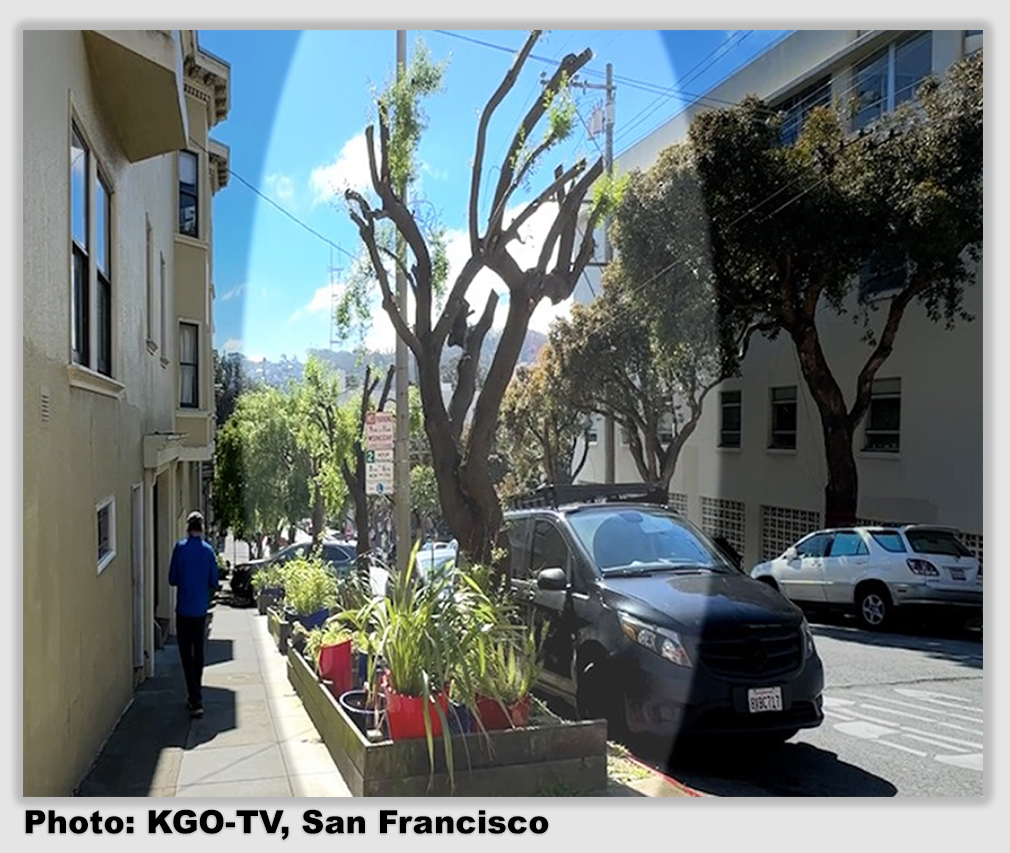
San Francisco, California, Chronicle, December 21, 2025: Property owner on leafy Claremont Avenue faces nearly $1M fine for ‘most egregious’ tree removal

In February 2021, Oakland city arborists responded to a report of an illegal tree removal on leafy Claremont Avenue. When they got there, they saw eight mature trees on the ground. In the middle of the property was a man holding a chainsaw. Three years later, city arborist Tod Lawson said that moment marked the beginning of what he called “the most egregious illegal tree removal case” he’d seen in his 34 years with the City of Oakland. City staff allege that the property’s owner, Matthew Bernard, and crews he hired cut down 38 mature trees without permits in 2021 and 2022 across his land, on an adjacent city property and on his neighbors’ lots. Bernard could face fines of nearly $1 million — one of the highest fees for tree removal in the city’s history. Barnard also is engaged in a bitter legal battle with his neighbors over the tree-cutting. Aerial images show the undeveloped lot completely covered by trees as of 2020. Today, there are none left on the property — the steep slope is bald, save for a few stumps clustered along the eastern edge. A neighbor’s house, once hidden by trees, can now be seen through the hole in the treeline Bernard created. Bernard told the Chronicle Friday that he was acting on advice of his own arborist, trying to make a hazardous property safe, and that the city’s response only escalated after a bitter dispute with neighbors who, he said, have harassed him for years…

A Way To Garden, December 22, 2025: Tree care’s history and how-to, with nybg’s melissa finley

The earliest references to humans cultivating trees date back to maybe 6000 BC, and there are records of tree-care tactics in the Bible, too, and from ancient Egypt. These person-to-tree interventions were the start of the science and art of arboriculture, and our best practices of pruning and other how-to have evolved in each successive era to the methods we know today. I took a look backward in history, and also explored some current recommendations, with Melissa Finley, New York Botanical Garden’s Thain Curator of Woody Plants, and also curator of NYBG’s Peggy Rockefeller Rose Garden. Woody plants are Melissa’s passion; she is a certified arborist, and was a forester with the New York City Department of Parks and Recreation before joining NYBG four years ago. Read along as you listen to the Dec. 22, 2025 edition of my public-radio show and podcast using the player

New York City, The New York Times, December 19, 2025: Real or Fake? There’s a War Over Christmas … Trees.

Milk had “Got Milk?” Beef had “Beef: It’s what’s for dinner.” But Christmas trees don’t have anything, and, “Uh, please don’t buy a fake tree?” is a bit choppy. “All these fake trees coming from out of the country have really taken a bite out of our industry,” said Ben Stone, one of three brothers who own BTN of Oregon, a Christmas tree farm. “Buy America, support America,” his brother, Tyler Stone, chimed in, from their farm in Salem. “That is the message we need to get out, but our budget is low.” Advertising is difficult for agricultural products, even those in high demand. Consumers might know a few brands, at best, but not the thousands of farmers who produce for them. So for almost every fruit, vegetable or animal, there is an organization dedicated to marketing it, funded by small fees paid by producers…

Paris, Texas, MyParisTexas.com, December 21, 2025: Tree care in the cold and ice damage: A guide

Though Texas is not known for harsh winters, the winter season can still be tough on trees as evidenced by Winter Storm Uri in February 2021. Harsh conditions like cold winds, bright sun, bitter ice, snow and frost can be damaging and add stress to trees. Newly planted trees don’t have extensive, well-established root systems, meaning they are usually shallower and not able to use soil moisture as effectively as more mature, healthy trees. Water helps insulate both the tree and the soil. Moist soil will be warmer, and a well-watered tree will be less susceptible to freeze damage. If a hard freeze is forecasted and soil moisture is low, it is best to water the tree before freezing temperatures occur. Recommended watering schedules vary by region but, in general, should be followed through October and early November. For hardwood species that go dormant, watering can be reduced to once or twice per month, depending on rainfall, in winter months. Watering should be done early in the day, so the tree has time to absorb it before the drop in nighttime temperature…

New York City, The Wall Street Journal, December 17, 2025: America’s Largest Landowner Bets It Can Replace Met Coal With Pine Trees

Weyerhaeuser, America’s largest private landowner, said it has launched a venture to turn runty trees and sawdust from its fleet of mills into a replacement for metallurgical coal used in steel making. The forest-products company said it expects production to begin in 2027 at a facility being built next to its sawmill in McComb, Miss.—the first of several biocarbon plants planned by Weyerhaeuser and partner Aymium. It is the latest effort to find a market for the trees too small or otherwise unsuitable for making lumber. Such wood has typically been sent to pulp and paper mills, but U.S. wood-pulp consumption capacity has plunged due to waning paper demand. This year alone, the U.S. has shed roughly 10% of its capacity to produce containerboard, the thick paper used to make corrugated boxes. The closures have walloped timber growers, especially in the South, where landowners ranging from Weyerhaeuser, with its vast loblolly plantations, to families with 40-acre woodlots…

Salt Lake City, Utah, Tribune, December 18, 2025: Logan mayor-elect apologizes after taking down yard signs protesting the removal of century-old trees

Nearly a month after crews began cutting down century-old ash trees along Canyon Road to make way for a controversial waterline project, neighbors’ protest signs still peppered the street, staked in front yards and beside the trunks of felled trees. On Friday, Logan mayor-elect Mark Anderson and his wife removed many of those signs, pulling some directly from neighbors’ yards, according to residents who witnessed the removal. Erika Hansen, who lives along Canyon Road, said she watched the mayor-elect’s wife, dressed in black, carry signs opposing the tree removal from neighbors’ yards and load them into the Andersons’ truck. “The signs were placed on private property, and while many trees have been removed, the project is just getting underway,” Hansen said, “and undoubtedly more damage will be done.” The signs, she said, were one of the few ways residents felt they could continue to voice their support for the trees as construction on the project moves forward. “Keeping the signs up is just part of our way to communicate our love for those trees,” Hansen said, “even though they are gone.” Anderson issued a lengthy apology on his campaign’s Facebook page Sunday, adding that he woke up early Saturday morning to return the signs…

New York City, The Gothamist, December 17, 2025: We asked New Yorkers what they paid for a Christmas tree. These prices don’t exactly ‘sleigh.’

We asked, and you delivered: More than 400 readers sent us their Christmas tree prices — and among reader submissions and data collected by our staff, we found that the average price for a Christmas tree in New York City is $116. The cheapest was a fun-sized, 1-foot-tall tree from Trader Joe’s for $10. The priciest was a 9-foot-tall Fraser on the Upper West Side for $633. And while the prices in between are all over the map, Gothamist readers seem to agree that prices are way too high. “Ten years ago, we were shocked that trees were $100,” said Adam Benn, an East Harlem resident. “Now we’re shocked that they’re double the price.” If prices keep rising, Benn said, his family might go “Charlie Brown” and opt for a smaller tree. But Benn, a parent of a 12-year-old, said he can’t imagine not getting a tree. Other parents said Christmas isn’t Christmas without one. And while Benn remains loyal to his neighborhood vendor, other New Yorkers are more willing to forgo their local stands for better deals…

Madison, Wisconsin, WMTV, December 18, 2025: Wisconsin man’s life saved by helmet after tree falls on head while cutting wood

A 39-year-old man who was hit in the head by a falling tree while cutting wood last week is expected to make a full recovery, and nurses said a helmet saved his life. Aaron Feigl was chopping wood with a friend last Wednesday when a tree fell the wrong way, landing directly on his head. His friend called 911 immediately. Feigl was dragged out of the woods and airlifted to the hospital with severe damage to his face, jaw and neck. “We were at the ER room at that point our son was unrecognizable, his clothes were in a pile and this was on top of it and I picked it up and the nurse said ‘yea that is what saved his life,’” said Terri Feigl, Aaron’s mother. The cracked and broken helmet now sits under the Feigl family’s Christmas tree. “He has two beautiful girls, a beautiful wife and I can’t imagine this Christmas without this helmet,” Terri Feigl said. “So this sits under our Christmas tree as the best blessing we could have asked for this Christmas…”

NJ.com, December 17, 2025: Fallen trees were an issue on RiverLine for 18 months before train operator was killed, report says

The National Transportation Safety Board recently issued its report on the crash that killed a NJ Transit train operator last year in Burlington County and found what was obvious, that the light rail train struck a downed tree on the tracks. However, the report says River Line light rail cars struck trees four times in the 18 months prior to the early-morning Oct. 14, 2024, crash that killed Jessica Haley in Mansfield, and the investigation found six cases of downed trees being reported on or near River Line tracks in that period…

Starkville, Mississippi, Mississippi State University, December 17, 2025: MSU scientists cast light on Christmas tree research

From the Griswolds to the Grinch, just about every holiday movie features characters cutting, decorating or stealing the perfect Christmas tree. But most people—including moviegoers—don’t consider that Christmas trees take work to cultivate. Like all trees, they are subject to the threats of disease, insects, fungi and other menaces. This is why scientists in Mississippi State’s Forest and Wildlife Research Center have been studying some of the most popular tree species that decorate homes for the holidays. Forestry Associate Professor Joshua Granger explained why Christmas trees often get overlooked in forestry programs. Christmas trees are considered a gray area in the forestry industry. Is it horticulture? Is it landscaping? Or is it forestry?” Granger said. “When I came to MSU, we didn’t have any research with these trees, but I’ve begun working with the Southern Christmas Tree Association to develop some studies to help our growers out.” Last year, Granger began research on behalf of a partnership established between MSU and Shady Pond Tree Farm in St. Tammany Parish, Louisiana. Former owner Clark Gernon had discovered a novel variety of Leyland cypress, a popular, fast-growing species, on his farm. The single tree was unique in its apparent resistance to Passalora sequoia—a fast-spreading foliar pathogen attacking his other trees…

Earth.com, December 17, 2025: Little-known tree has enormous potential as both food and medicine

Few trees in food science work harder than Hymenaea courbaril, a towering tropical species whose fruit, sap, bark, and seeds all matter. One mature tree can hang roughly a hundred pods in a good year, and entire forests across Latin America are full of them. Inside the hard brown pods sits a pale floury pulp rich in fiber and antioxidant molecules, wrapped around large seeds loaded with natural gum. Researchers in Colombia and Brazil are now mapping each part so food makers can use it without putting human health at risk. The work was led by Luz María Alzate Tamayo, a food scientist at the Lasallian University Corporation in Colombia. Her research focuses on how this carob-like tree can supply safe natural ingredients for the food industry. Hymenaea courbaril is native to tropical forests from southern Mexico through the Amazon basin and into parts of the Caribbean. Local people know it by many names, including algarrobo, guapinol, and jatobá, and value it both as shade and as food…

San Luis Obispo, California, KSBY-TV, $80,000 worth of equipment stolen from San Luis Obispo tree-cutting business

A local tree-cutting business is reeling after burglars made off with roughly $80,000 worth of equipment last week. Bunyon Brothers Tree Service, which has been serving San Luis Obispo County since 1999, lost 54 chainsaws during an early-morning break-in at its facility. Owner Ron Rinell says the theft has put a major strain on his crew of 40 employees. “These saws are our livelihood. In order to make a living, we have to have a saw. We can’t create tree work without saws,” Rinnell said. The break-in occurred around 4:45 a.m. on Dec. 11. Rinell says one of his employees called to deliver the bad news: thieves had cut through locks with bolt cutters and taken every saw on site, each valued at $1,000-$2,000. While Rinell says this is the first theft of this magnitude his business has experienced, other tree service owners have faced similar crimes…

Buffalo, New York, WKBW-TV, December 15, 2025: Niagara Falls resident raises concerns after tree from condemned home damaged his deck

Randy Dullen and his wife have lived on Welch Avenue in Niagara Falls since 2001, but now they’re afraid to sleep in their own bedroom because of the tree next door. The tree stands in the backyard of a home that was condemned in July. The backyard is full of tangled branches and weeds, and the tree itself has branches that hang over their home. Dullen said he’s been calling the City of Niagara Falls for more than two years about this tree, foreshadowing the potential danger. “I’ve gone to city hall several times over the past two to three years,” explained Dullen, but he said nothing has been done. Then a few months ago, large branches fell off, piercing the roof of his garage. Dullen had to pay for the damage. Then last month, these massive branches crushed his deck…

Hamilton, Victoria, Australia, Australian Broadcasting Corporation, December 16, 2025: London plane trees to be removed in Hamilton following infrastructure concern

London plane trees will be removed from a south-west Victorian city, as a growing number of councils across the country try to phase out the species. Southern Grampians Shire Council has confirmed 25 plane trees are in line for removal in Hamilton, and the future of another 75 trees will be considered. The issue came under the spotlight in April, when the council was told older people with mobility issues avoided the town centre because of the trees. The council organised an advisory committee to help determine the future of the trees. Group member Sarah Hope joined after she created a petition to save the trees. Ms Hope said the trees added “charm” to the city, and had a positive impact on local climate, biodiversity and mental health…

IFL Science, December 15, 2025: A 4,900-Year-Old Tree Called Prometheus Was Once The World’s Oldest. Then, A Scientist Cut It Down

Everyone’s made some decisions that they later regret – going crazy with the hair dye, microwaving an egg, finding out how snails have sex… But what about inadvertently chopping down what would later turn out to be the oldest tree ever dated? That’s exactly what happened to an unfortunate graduate student named Donald R. Currey back in the summer of 1964, who ended up responsible for the demise of Prometheus, a bristlecone pine that stood in what is now Great Basin National Park, Nevada. Bristlecone pines are some of the hardiest trees out there; they’re slow growing, with dense wood keeping them resistant to the effects of weather, insects, and fungi, and have a characteristically twisted appearance. One species in particular, the Great Basin bristlecone pine (Pinus longaeva) is capable of living for thousands of years. After never having heard of bristlecone pines before graduate school, Currey took an interest in them after his mother sent him a National Geographic article written by Edmund Schulman, the researcher who famously sampled bristlecone pine Methuselah – which may now be the oldest known non-clonal tree in the world…

Blue Dot Living, December 15, 2025: How Can I Plant a Tree from Seed?

Q: Can you recommend a good book with some information about growing trees from seed?
A: What a delightful question! As that old chestnut goes, “the best time to plant a tree was 30 years ago. The next best time is now.” And “now” really means now. As I write this from my home in the North, the snow is piling up outside, but we needn’t wait til the weather warms to begin the process of planting a tree under whose shade we hope eventually to sit. A few years ago, Dot planted four paw paw trees, thanks to a local environmentalist who, keen to restore populations of these formerly ubiquitous and beloved trees, offered up seeds to anyone interested. Just one of those trees survived. Clearly, I’m no expert at nurturing tree growth, but I found someone who is. So we will not only offer up a selection of books that will tell you how to grow a tree, but also some straightforward instructions, courtesy of Jordan Jones, a regenerative tree farmer in Kansas…

The Cool Down, December 9, 2025: Scientists issue warning as dangerous tree fueling rare condition spreads across US region: ‘There is certainly evidence now’

A tree rapidly spreading across Oklahoma is causing problems — from helping disease-carrying ticks thrive to increasing wildfire risks. Oklahoma State University has suggested that eastern redcedar, a fast-growing, drought- and climate-tolerant species, is reshaping grasslands in ways that put people, livestock, and local ecosystems at risk. Researchers have confirmed that the expansion of eastern redcedar across Oklahoma is boosting populations of the lone star tick, as reported by KOKH. This species is the primary carrier of alpha-gal syndrome, a rare condition that can trigger allergic reactions to meat. It also commonly spreads Southern tick-associated rash illness, which is similar to Lyme disease, and other illnesses. As OSU entomology professor Dr. Bruce Noden documented the species’ spread over the years, ranchers kept pointing to the same culprit, per KOKH: “Everybody knows they’re down in the cedars.” Research from Noden and graduate student Jozlyn Propst shows why. Redcedar stands create dense, humid pockets of shade, which provide an ideal habitat for ticks. OSU ecology professor Dr. Scott Loss explained how. “There is certainly evidence now that areas with eastern redcedar retain moisture more consistently and return it to the atmosphere as water vapor, which is creating the new microclimates,” he said, per KOKH…

New York City, The New York Times, December 13, 2025: Up All Night in New York, Selling Christmas Trees

For the last several years, Kyle Dalton has taken unpaid time off from his job as a sales rep in Canada to live in a trailer without running water so he can sell Christmas trees to New Yorkers. “The first year when I told my friends back home what I was doing, they were like, ‘Must be nice to live in New York City for a month,’” said Mr. Dalton, who works for a beverage company in Newfoundland. “Then I told them about my living arrangement.” Mr. Dalton, 28, and his friend Charlie May, a 31-year-old Salt Lake City ski instructor and river guide, share an 7-foot-by-20-foot trailer parked on South Fourth Street in Williamsburg, Brooklyn. They hang their clothes on wall hooks above their cots. A power box from nearby Domino Park powers the trailer’s mini refrigerator, space heater, microwave, hot plate and toaster oven…

Portland, Oregon, KOIN-TV, December 14, 2025: Despite climate change, Oregon retains top Christmas tree producer title

Christmas trees are big business in Oregon. In 2023 alone, the industry contributed $118 million to the state economy. Researchers at Oregon State University are working develop resilience strategies to help the state’s Christmas tree growers. “If you’re sick you call a doctor. If you’re a Christmas tree grower who has a sick tree, you call me,” said Priya Rajarapu, a tree specialist for Oregon State University’s Extension Service. Events like the 2020 wildfires and the 2021 heat dome have made things more challenging for Christmas tree farmers and Oregon’s forests in general. To combat this, Rajarapu and her team are working to develop new resilience strategies. Those efforts include testing different mulch alternatives to see if they can help, or studying different tree species that may be better suited to the changing climate. “Oregon is a perfect place to grow evergreens because of the climate,” she said. “Our mild summers and wet winters are ideal for native species like noble and Douglas-fir that are traditionally among the most popular Christmas trees in the Western United States.” But new species are starting to grow in popularity. The Nordemann and Turkish fir species, for example, are new to Oregon but native to Georgia. They hold their needles longer compared to the noble fir trees native to Oregon. They’re also drought and pest-tolerant…

New York City, Post, December 14, 2025: Christmas tree-seller explains why it’s such a cutthroat business

So I interviewed tree-seller George Smith. I asked why this is such a cutthroat business. Smith: Cutthroats years ago thought they owned those locations, so you now can’t put one stand near another. I’m from Brooklyn. Learned the old-fashioned way. At 12, I was a tie boy. Tying trees onto cars. Now I’m in the fields, pick my own trees, watch them grow. I shear them in Canada and North Carolina. “Saying ‘a tree is a tree’ is like saying ‘sneakers are sneakers.’ There are different types, grades. Frasers last longer. Some customers leave theirs up till Valentine’s Day and put hearts on it. They’re cheapos. Also, make sure your tree guy cuts the stump, put it on your radiator so your house smells of Christmas. You know, there’s nothing like Christmas, especially in New York.” Me: “What’s the best sort of Christmas tree?” “I prefer a Fraser, but I used to like the balsam. They drop their needles more. That’s why I say you should get a Fraser. Fraser needles shed less. Last longer in the house. A tree doesn’t start dying until it hits the heat in your house…

TNLBGray

Case of the Day – Monday, December 22, 2025

WHEN THE GAS COMPANY COMES A CUTTIN’

I’ve told you before to beware of what lurks in the dark and malevolent corners of your deed. Today, we’re going to look at a cautionary tale.

No one really thinks about the wording of easements when the power company or the gas folks come by with some standard form clipped to a dollar bill. The utility reps tell you that it’s no big deal because the language is standard, no one can change it, and anyway, all your neighbors have signed off on the same form, so what’s the big deal?

I’m not a public utility, so I’ll tell you what the big deal is. Or, better yet, show you.

Consider New Jersey. Please. Just for right now. In East Brunswick, New Jersey (city motto: “We’re located at Turnpike Exit 9″), a gas transmission company had acquired an easement for a 3-1/2 foot wide natural gas transmission pipe through some unimproved land back in 1967. The property – once used only for mob hits and toxic waste dumping (just kidding) – was sold sometime after the easement was granted. At some point, a housing development was over a 42” high-pressure gas line the company had buried inside the easement.

The utility had always patrolled its pipeline and was well aware of the 19 oak trees growing along the street, 40 inches above the pipe. But when new evidence showed that tree roots could cause catastrophic pipeline failures, the gas utility announced it intended to cut down the trees.

newjersey150908

The property owners, who probably had never bothered to read all of the boring stuff in their deeds that followed the “Know all Men by These Presents …” part, were outraged. They complained that the gas utility shouldn’t be allowed to cut the trees now because it hadn’t ever bothered to before. This argument is called “laches,” based on the old legal maxim that “equity aids the vigilant.” Or, as some like to say, “Don’t sit on your rights.” The owners argued that the gas company had never tried to remove the trees before, and – 40 years after obtaining the easement – it should not be allowed to do so now.

What’s more, the owners contended, the gas company couldn’t really prove the 19 trees were hurting anything.

Horrors! Imagine buying land subject to an easement, only to have the easement holder actually try to exercise the easement rights! As they say in New Jersey, “Oh, the humanity!” The gas utility carefully showed how new techniques had determined that tree roots could weaken high-pressure supply lines and, in fact, had caused some spectacular failures. The property owners could only muster an expert who opined that the tree roots in question probably wouldn’t grow that deep.

The Court of Appeals agreed with the trial judge. The gas company didn’t have to show that the tree roots were damaging the line, only that it had a reasonable basis for keeping roots away from its pipe. The evidence easily did that. As for the laches argument, the Court agreed that the nonuse of an easement in New Jersey didn’t result in the loss of the right. Plus, the Court said, the gas company had a good reason for not seeking to remove the trees until it did, as science had only recently determined that tree roots and gas pipelines didn’t mix.

Township of East Brunswick v. Transcontinental Gas Pipeline Corp., 2008 N.J. Super. Unpub. LEXIS 27, 2008 WL 2627688 (N.J.Super.A.D., July 7, 2008). Transcontinental (“Transco”) operates an interstate natural gas transmission system that runs from the southern Atlantic seaboard to New York City. One of its main lines, the Lower Bay Line, runs across East Brunswick and along Timber Road. This 42″ high-pressure gas line was built in 1967.

When trees fall on power lines, the lights go off for a few hours. When gas transmission lines are breached by tree roots, the misadventure that follows is usually much more energetic.

When trees fall on power lines, the lights go off for a few hours. When gas transmission lines are breached by tree roots, the ensuing misadventure is usually much more energetic.

Transco held a 100′ wide easement for the pipeline under a right-of-way agreement “for the purposes of laying, constructing, maintaining, operating, repairing, altering, replacing and removing from time to time one or more pipelines … together with such other rights as may be necessary or convenient for the full enjoyment or use of the rights herein granted [including] the right to enter upon the right of way and easement … at such times as Grantee may elect … and the right from time to time to keep said right of way free from trees, undergrowth and all other obstructions that may endanger or interfere with the construction, operation and maintenance of Grantee’s pipe lines[.]”

The owner sold the property subject to the easement, and in the 1980s, it was developed into a residential community of single-family homes. The easement covered the width of Timber Road, the sidewalks, and portions of residents’ front yards. The pipeline was buried 40″ deep and runs along one side of the street in the public space between the sidewalk and the curb.

Nineteen shade trees were planted sometime in the 1980s between the sidewalk and the curb, so they were growing directly above the pipeline. Transco knew of these shade trees because it regularly inspected and monitored the pipeline.

Natural gas pipelines must be properly maintained and monitored because any rupture can cause severe damage. Transco monitored the pipeline and conducted an extensive on-site inspection program of the Lower Bay Line pipeline right-of-way. An inspector walked directly over the pipeline at least once a year to perform ground tests to determine if natural gas was leaking. The right-of-way was patrolled almost daily by vehicle. It was inspected weekly by air to determine if any unauthorized excavation occurred in the area and to detect early signs of leakage.

Concerned about damage to the pipeline’s protective coating by tree roots, maintaining a clear line of sight along the pipeline, and preventing any delays in reaching the pipeline in an emergency, Transco tried to remove the 19 trees above the pipeline as part of a larger effort to remove trees above all of its pipelines in the area. The residents sued for a temporary restraining order enjoining Transco from removing the trees. Transco argued it had an absolute legal right to remove the trees under the right-of-way easement. Plaintiffs argued there was a genuine issue of material fact whether the trees endangered the pipeline and whether their removal was reasonably necessary for Transco’s enjoyment of its easement right. No evidence was adduced that the tree roots were currently damaging the pipeline, but there was evidence of potential harm.

A 2004 investigation revealed metal losses in the pipe walls ranging from 6% to 15% at various locations along Timber Road. Additional testing in 2005 uncovered pipeline coating defects or interruptions at some of the same places where the metal anomalies were discovered, but neither inspection definitively determined that tree roots caused the damage. Finding that Transco need not wait for actual damage to its pipeline before exercising its express easement rights, the judge concluded, “the record indicates that tree roots may damage the protective coating of the pipeline …. [and][f]urther, efforts to keep the protective coating of the pipe intact [are] part of the necessary maintenance program for a pipeline.” The judge also reasoned that while the pipeline’s path was marked with yellow markers, the trees detracted from the area’s appearance as a right-of-way and may lead to third-party interference with the pipeline, a major cause of pipeline accidents. The Court granted summary judgment for Transco.

The plaintiffs appealed.

easement150908Held: Transco had the right to remove the trees. The Court said the primary rule of construction is that the intent of the conveyor is normally determined by the language of the conveyance read as an entirety and in the light of the surrounding circumstances. Here, the easement plainly and expressly gave Transco the right to remove trees when they may endanger or interfere with the construction, operation or maintenance of the pipeline. The language specifically stated the grantee had “the right from time to time to keep said right of way free from trees, undergrowth and all other obstructions that may endanger or interfere with the construction, operation, and maintenance of Grantee’s pipelines….” The easement also clearly gave Transco the right to remove trees if they interfered with Transco’s immediate access to the right-of-way. The plain language of the easement gave Transco the express right to remove trees and did not require actual damage to or interference with pipeline operations before the trees were cut. The easement permitted preventive action to avoid potential harm, disruption, or interference with the operator’s pipeline.

The uncontroverted evidence showed that the pipeline and its coating along Timber Road had been damaged. Although there was no proof that the damage was caused by tree roots, other sections of Transco pipelines and their coatings in New Jersey had been damaged by tree roots. The Plaintiff had no proof to the contrary, but instead, their expert only posited that “the roots are not likely to interfere in any way with the pipeline;” the root systems are “generally non-invasive;” and root growth is “typically” confined to the upper two to two-and-one-half feet beneath the ground surface. The proof didn’t foreclose the possibility that the tree roots may grow deep enough to interfere with the pipeline, as they had in other sections of Transco’s pipeline.

Plaintiffs also contended Transco was barred from taking affirmative action by the equitable doctrine of laches because it waited so long to exercise its easement rights. But the mere nonuse of an easement cannot destroy the rights granted by it. Rather, clear and convincing evidence of the intent to abandon the easement rights must be shown. In this case, there was no evidence that Transco intended to abandon its easement rights; therefore, any reliance placed by plaintiffs on Transco’s inaction was unreasonable. Also, there was reasonable justification for Transco’s inaction over the years, as it was unaware of the potential danger posed by the tree roots at the time the trees were planted.

The evidence showed that since the trees were planted, there have been three accidents nationwide involving natural gas pipeline ruptures and three incidents in New Jersey in which Transco has discovered that tree roots have damaged pipelines. The Court said that the fact that action had not been taken earlier did not preclude preventive action now, nor did it require waiting for actual damage to occur.

The Plaintiffs did not demonstrate how their interest in preventing the removal of the trees outweighed Transco’s taking preventive measures in the public interest.

– Tom Root

TNLBGray140407

Case of the Day – Friday, December 19, 2025

RECREATIONAL USE STATUTE AND NATURAL DEFECTS

It's hard to enjoy an idyllic sunset when you can't get to the lakeshore.

It’s hard to enjoy an idyllic sunset when you can’t get to the lakeshore. Recreational use statutes make it easier.

A landowner has little natural incentive to let people freely enjoy her land. You have a nice pond and woods, and, being as you’re a nice person, you let the birdwatchers’ society wander around looking for the white-throated needletail. Next thing you know, one of them steps into a prairie dog hole, and you’re being sued.

But public policy is firmly in favor of getting people out to enjoy nature’s bounty (and to exercise, a good idea what with all of the helpings of Christmas goose and figgy pudding we’ll be consuming next week). For that reason, virtually all states have passed some version of a recreational use statute. These RUSs generally state that a landowner only has a duty to avoid being grossly negligent to people using unimproved land without charge for recreational activities. The statutes are intended to encourage the opening of private land – unspoiled natural areas – for free recreational use by shielding landowners from liability for the most common forms of negligence.

Today’s case raises an interesting question under the Texas recreational use statute. In this case, the City of Waco had a park that included limestone cliffs. A boy was sitting on the cliffs when a portion collapsed, causing him to fall to his death.

A user might anticipate he could fall off a cliff – but not that it would give way.

A user might anticipate he could fall off a cliff – but not that it would give way.

The City argued it couldn’t be held liable under the statute because it did nothing to cause the defect in the cliffs. However, the Court of Appeals agreed with the boy’s mother that the landowner didn’t need to cause the defect if the fault was so latent, that is, hidden, that the recreational user would not reasonably be aware of it. That one might accidentally fall off a cliff was foreseeable, the court admitted. But it wasn’t open and obvious that the cliff one was sitting on would suddenly give way.

Because the defect wasn’t obvious, all the boy’s mother had to do was advance in her pleading some allegation of gross negligence. In her complaint, she argued that the City was aware that others had been injured by falling rocks and that it had reports warning of the danger posed by collapsing cliffs. Those reports recommended the City post warning signs, but it didn’t. The court said that the mom’s allegations were good enough to make out a claim under the recreational use statute.

Kirwan v. City of Waco, 249 S.W.3d 544 (Tex.App 2008). Debra Kirwan’s son, Brad McGehee, was sitting on the edge of Circle Point Cliff in Cameron Park, a park owned and operated by the City of Waco, when the ground beneath him gave way, and he fell about 60 feet to his death. Kirwan brought a wrongful death suit against the City, alleging a premises defect.

A firefighter who responded to the scene of Brad’s fall testified that an average person would “probably not understand that the ground could give way underneath them.” The trial court threw out the suit, holding that Debra had not: (1) “alleged that the Defendant was grossly negligent in creating a condition that a recreational user would not reasonably expect to encounter in Cameron Park in the course of permitted use;” or (2) “raised a genuine issue of material fact.”

Debra appealed.

Held: The suit was reinstated and sent back for trial. Deb challenged whether Texas Civil Practice & Remedies Code § 75.002(c)the state recreational use statute – requires that all premises defect claims be based on a condition created by the defendant, thereby precluding any claim based on the existence of a natural condition that the defendant knew about. Under the recreational use statute – intended to encourage landowners to open their property to the public for recreational purposes – a landowner’s duty to a user is no greater than that owed to a trespasser, the minimal duty to not injure anyone willfully, wantonly, or through gross negligence.

A few signs like this one might have saved the City of Waco a lawsuit – and spared a boy's life.

A few signs like this one might have saved the City of Waco a lawsuit – and spared a boy’s life.

The law is clear that a landowner has no duty to warn or protect trespassers from obvious defects or conditions. Thus, an owner may assume that a recreational user requires no warning to appreciate the dangers posed by natural conditions, such as a sheer cliff, a rushing river, or even a concealed rattlesnake. But the appeals court held that the recreational use statute permits claims based on natural conditions, provided the condition is not open and obvious and the plaintiff furnishes evidence of the defendant’s alleged gross negligence. Here, the court said, the crumbling rocks and cracks on the cliff that gave way did not conclusively prove that the danger of the unstable cliff rock was open and obvious. Crumbling rock may alert the average person to the risk of slipping and falling, but certainly not that the ground will simply fall apart beneath him. The court ruled that unstable cliff rock is not necessarily an open and obvious condition that a person might reasonably expect to encounter.

To state a claim under the Texas recreational use statute, Deb had to allege sufficient facts to show that the City of Waco was grossly negligent. The pleadings need only provide a plain and concise statement of the cause of action sufficient to give the defendant fair notice of the claim involved. In her pleading, Debra alleged that the City was actually aware of the dangerous condition on the cliff, that other park patrons had died or been seriously injured by the condition of the cliffs, that the City received a report from its own expert warning of dangerous rock falls and advising the City to post signs warning of potentially fatal rock falls, and that the City had failed to do so, in fact, to warn or guard against this danger at all amounted to gross negligence.

The court agreed that Deb plainly alleged the City’s conduct amounted to gross negligence. The City’s complaint that the pleading didn’t allege that the City had created the condition was meritless. Where a claim is based on hidden natural conditions, such as the structurally unstable cliff rock in this case, Debra need not plead that the City was grossly negligent in creating a condition to make her case.

– Tom Root

TNLBGray140407

Case of the Day – Thursday, December 18, 2025

VIVE LA DIFFERENCE

The general rule in this country as to boundary trees – those trees located partly on parcels belonging to more than one owner – is that the landowners have rights to the tree as tenants in common. This means that no owner can do anything to the tree without permission of the other.

There’s a good reason I suggest that owners get good advice from a local attorney. This blog is not legal advice. You pay for legal advice. What I write here is free. You get what you pay for.

What’s more, there are nearly always variations, however slight, among the states. Today’s case is a perfect example. The tree was clearly a boundary tree, but one of the owners, who did not believe he was an owner, had a tree-trimming service sever some roots and branches on his side of the property line. He sued the other owner for the cost of the tree service, alleging that the other guy owned the tree.

Of course, the other guy only owned it to the same extent the aggrieved owner did.  But in New York –unlike elsewhere – a tenant-in-common may trim on his or her side of the property line, a form of self-help that is consistent with the Massachusetts Rule but inconsistent with what everyone else says a tenant-in-common may do.

Vive la difference!

Ahmed v Zoghby, 63 Misc. 3d 866, 98 N.Y.S.3d 391 (City Ct. Middletown, NY, 2019). A large tree straddled the property line separating Shafi Ahmed’s property from that of Allen Zoghby. Allen complained that the tree’s roots were extending under and pushing through a portion of his driveway. Additionally, branches of the tree overhung his property and dropped leaves and other debris onto his roof.

Shafi produced evidence that the tree straddled the property line, that his insurance company had ordered him to fix the heaved concrete, and that leaves and twigs fell on his roof. He also produced estimates from two companies to repave the driveway, including severing the tree’s roots. Shafi eventually hired a third contractor, Max Landscape LLC, for $2,950.00 to do the work.

Allen testified that he had the entire tree (including the overhanging branches) trimmed 8-10 years before. He did not know if the tree was on his property or Shafi’s property, but he believed it straddled the property line between the two properties. Allen showed that he, too, had cracked driveway pavement.

Shafi bought his residence in December 2004. Allen bought his place in October 2002 and sold it in 2018.

Shafi sued Allen for maintaining a private nuisance, seeking damages and an order that the tree be removed.

Held: It is the long-standing rule in New York that a tree is wholly the property of him upon whose land the trunk stands. However, if a tree straddles the line between two properties, the owners of each property own the tree as tenants in common. Accordingly, the Court held that Shafi could not sue Allen for a private nuisance. Even if he could, Shafi had not proven any real, sensible damage; his action in removing the branches was a self-help action as a co-owner of the tree and was not subject to reimbursement by his neighbor. Finally, a property owner who owned a tree as a tenant in common with his neighbor could not recover damages resulting from the tree’s root system because both parties would be liable for the damage.

The Court noted that a tree is the property of the person upon whose land the trunk stands. But if the tree straddles the boundary line between two properties, the owners of each property own the tree as tenants in common. Where damages are caused by roots from a tree owned by neighbors as tenants in common, neither owner may recover from the other property owner. Rather, each is limited to self-help remedies to cure any such damage on that owner’s property caused by the tree’s roots, so long as that action does not injure the main trunk of the tree.

Overhanging branches, accumulated fallen leaves, branches, and or buds, or cosmetic damage to a garage, or branches and leaves blocking the sun, without proof of actual injury to a person or that person’s property (injury known as “sensible damage”) is not enough to sustain a claim of private nuisance. In a private nuisance context, just as it has been established that a property owner may resort to self-help in the first instance to remove tree roots adversely affecting his land, so it has been held with the removal of overhanging tree branches. Where the parties own as tenants in common, each party is entitled to conduct ordinary clipping or pruning, so long as this does not injure the tree’s main trunk.

Even if this were not so, under CPLR 214(4), actions to recover damages for injury to property must be commenced within three years of the property damage. Shafi paid a contractor to trim the tree in 2013, but did not sue until 2018. Therefore, even if he were entitled to sue, he would be too late.

Beyond that, the Court said, “overhanging branches, accumulated fallen leaves, branches, and or buds, or cosmetic damage to a garage, or branches and leaves blocking the sun, without proof of actual injury to a person or that person’s property is not enough to sustain a claim of private nuisance.” The remedy in such a case, the Court said, is self-help: “Summary abatement by self-help under these circumstances is a sufficient remedy. Just as it has been established that a property owner may resort to self-help in the first instance to remove tree roots adversely affecting his land, so it has been held with the removal of overhanging tree branches… Shafi, in essence, resorted to self-help in 2013 by hiring a contractor to remove the branches and leaves, and that self-help was appropriate in this case because of the lack of “sensible damage” from the falling and accumulating leaves.”

Third, even if the branches and leaves caused “sensible damage,” Shafi would not have a right to require Allen to reimburse him for $1,000.00 of expense, because Shafi owned the tree as a tenant in common with Allen. Shafi’s remedy, as a co-owner of the tree as a tenant in common with Allen, would be self-help by trimming the branches, so long as that action does not injure the main trunk of the tree.

– Tom Root

TNLBGray140407