

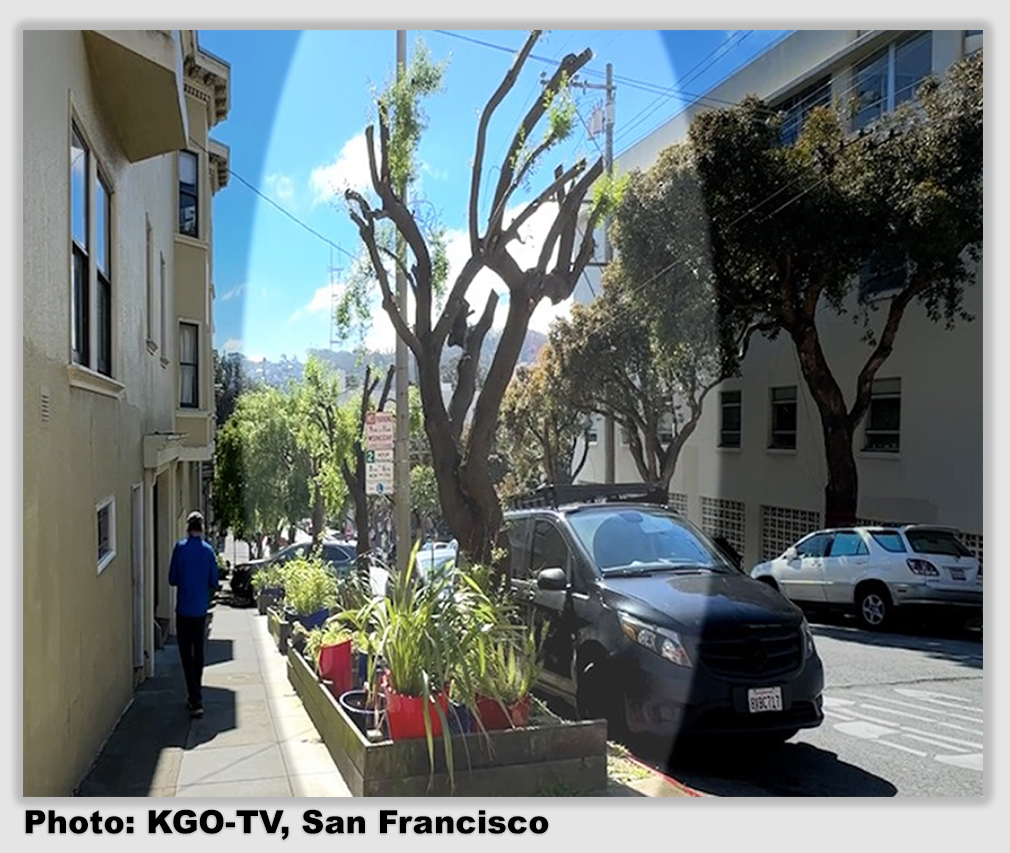
A San Francisco homeowner is facing a series of fines totaling $50,000 for illegally trimming five trees believed to be on his property. Trees located right outside his home. But as the city explains, they’re not his, and he wasn’t authorized to do it. Paul Dennes was trying to get his property in San Francisco’s Panhandle neighborhood insured. “I got an email from my broker saying in order for you to qualify for insurance you need to trim the trees so many feet from the property,” Dennes said. “You thought, OK?” Stephanie Sierra asked. “Yeah! I’ll just take care of that,” Dennes said. So Dennes trimmed down five trees in front of his unit that he says were touching the building and, in some cases, even power lines. “You see that? I wanted to get them out of the power lines. I didn’t want to be responsible for that,” Dennes said. Three trees in front… “And on the other side,” Dennes said, there were two more. His family has owned the home since 1988. Since then, Dennes always thought it was the property owner’s responsibility to trim. “I’ve never seen the city trim these trees, never!” Dennes said. Well, he learned the hard way, not in his case. The trees aren’t his…
Kalamazoo, Michigan, Gazette, April 2, 2026: Several walnut trees cut down and stolen in Southwest Michigan
Several walnut trees were cut down and stolen while a property owner was out of town, police said. A white truck was seen in the area around the time of the crime. This isn’t the first walnut tree theft in the area. The theft happened at a home in Hartford Township, the Van Buren County Sheriff’s Office said in a Wednesday, April 2, news release. In an unrelated 2024 incident, Trever Wallace was arrested and later sentenced for a walnut tree theft on Oct. 10, to three years and two months up to 10 years in prison…
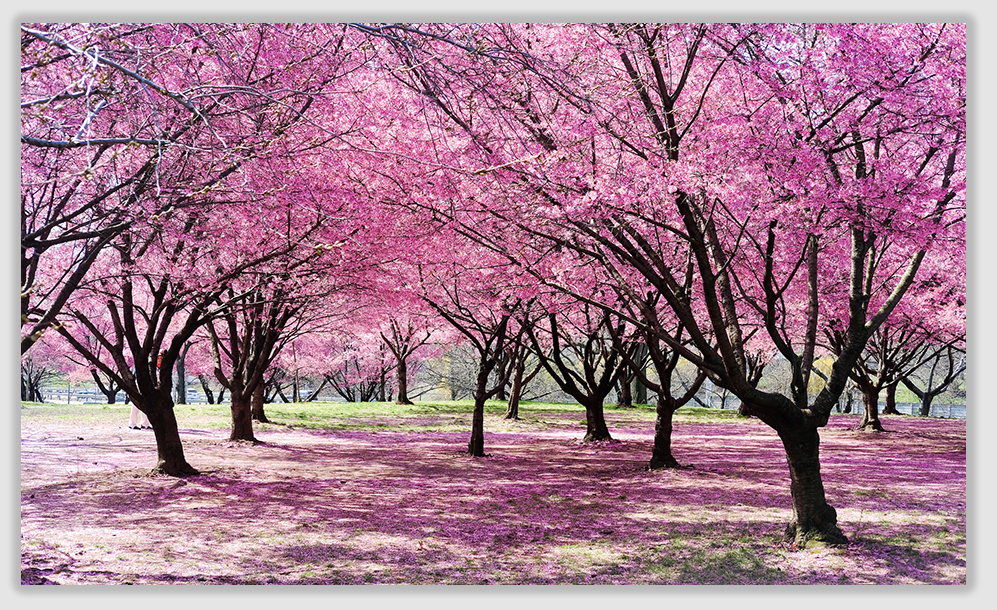
After a long winter, spring is in full swing, and with it the cherry blossom season in New York City. Tens of thousands of ornamental cherry trees around the city have started bursting with white and pink petals in a display that lasts about a month. Here’s an overview of what kind of cherry blossoms are in New York City, when they’ll bloom and where to find them. Most of New York’s cherry trees bloom by mid-April, though some types bloom earlier or later. A blooming tree holds its blossoms for about 10 days. When exactly each tree begins to flower is hard to predict and can depend on the temperature and the amount of daylight it receives. As winters in New York have become shorter and more mild, the city’s cherry trees are blooming earlier than they did a decade ago, said Shauna Moore, the director of horticulture at the Brooklyn Botanic Garden. Blossom lovers can check the garden’s CherryWatch tracker, updated daily with information on whether each cherry tree is in pre-bloom, first bloom, peak bloom or post-peak bloom. By April 1, the garden’s early-season cherries, including the fuchsia-flowered Okame, were already in full bloom…
Charleston, West Virginia, WCHS-TV, April 2, 2026: Tree canopy clearing put on hold until November due to bats
March 31 was the last day to clear tree canopy overhanging West Virginia roadways until mid-November because of bats. The restriction comes because of tree-clearing rules tied to bats in West Virginia under the Endangered Species Act. A deal with the federal government cuts red tape and protects bats but limits when work happens. “We’ve got a programmatic agreement with Fish and Wildlife Services to be able to cut during those times without going through all of the processes that you would have to do in other projects,” West Virginia state highway engineer Jacob Bumgarner said. The work is limited from Nov. 15 to March 31. The Division of Highways can still remove brush anytime, but canopy clearing along roads that often involves removing limbs or entire trees is on hold. Disturbing edge forest habitat – a prime bat roosting area – is a no-no now until Nov. 15. The overhanging trees can create shadows that let water build up and ice that can damage roadways. Trees can fall on block the road, and in rare cases, fall on a car and injure or even kill someone…
 Wisconsin DNR Forestry, April 1, 2026: ‘Exploding Trees’ Face Long-term Impacts
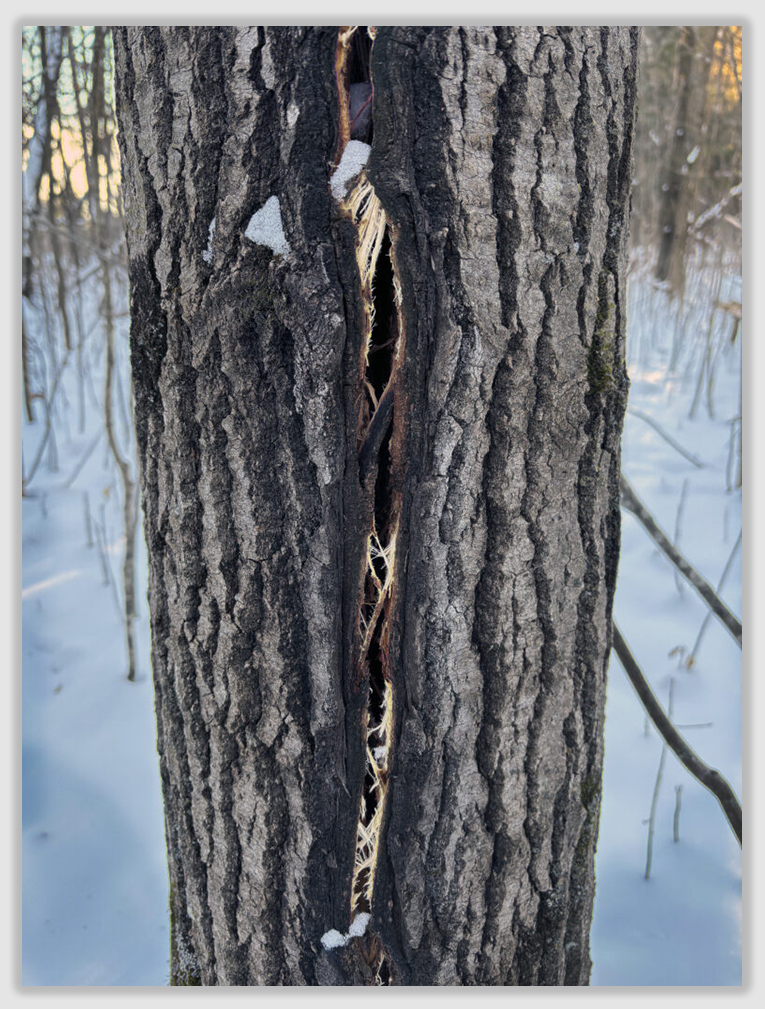
This past winter, “exploding trees” went viral on social media. Many news outlets followed up with a more realistic explanation of the dramatically named phenomenon, pointing out that while the bitter cold can cause sudden cracks to form on trees, the trees don’t truly explode. But what happens to those damaged trees as we warm up and move into the growing season? Trees don’t heal wounds the same way that people heal wounds. Instead of repairing the damaged cells, trees compartmentalize the damaged area, serving to limit the ability of bacteria and fungi to invade. Trees then begin growing callus tissue over or around the wounded area. How trees respond to wounds can vary based on the species of tree, its health, the location and extent of the wound and any further stress the tree might face during the upcoming growing season…
RJ Laverne’s childhood home in Detroit had a big elm out front. In fact, the whole neighborhood was lined with them: great, graceful trees whose branches spread across the street to create a shady canopy. Elms were so widely planted in cities and suburbs in the 19th and 20th centuries that they became known as the “Main Street tree.” Then, in the 1930s, Dutch elm disease began to ravage them, and by 1989, most of America’s 77 million mature elms were dead. Laverne’s elm and its demise remain seared into his memory decades later. “I was maybe 8,” he says, “and I remember standing at the front door next to my sister when the trucks came down the street and cut down the elm trees one by one. When they cut ours, it felt similar to losing a pet. I imagine I was not the only person who grieved to see our neighborhood transformed from this beautiful cathedral of trees to clear cut…”
 Needham, Massachusetts, Observer, April 1, 2026: Draft tree bylaw presented
In a little more than a year, less time than it takes a sapling to fully take root, the Tree Preservation Planning Committee has agreed on most of the specifics of a draft bylaw. The details were presented on March 25. Fourteen people attended the session in person and seven joined online. Almost all of the public comments supported the committee’s efforts to slow down the rate of deforestation, and many thought that the committee’s proposed restrictions were too lax. The proposed bylaw is triggered only by construction and is applied only to trees along the property line within current setbacks, usually an unbuildable area the Tree Preservation Committee calls the “tree yard.” It requires the input of a certified arborist who, among other determinations, will assess how to protect the critical root zone, an area which may extend inside the tree yard. The bylaw also applies only to overstory trees, or trees that have reached or will reach a height of 40 feet at maturity. “If the tree is in the buildable area of the lot, you can take it down with no penalty,” said Heidi Frail, committee chair and Select Board member. She told the Observer the draft gives homeowners a variety of options to help them reduce or eliminate any potential fees…
Orion Magazine, April 1, 2026: A Tulip Tree in Winter
I have come to the tree again, with a data sheet and an offering. That stately tulip tree above the creek in the woods behind our Catskills home, the one I lean my forehead against to speak to someone no longer here, and to give thanks for someone who is. I press my palms to the deeply furrowed bark and say what I came to say. Then I pour a little honey onto the ground beside her roots. I marked her with a yellow ribbon more than a decade ago, the first tree on what would become my phenology trail—a way to track seasonal timing in the living landscape, year after year. A flicker of sound breaks through the quiet ritual: the faint creak of a leafless branch shifting its burden, the tiny crackle of ice falling from bark. High in the canopy, a male cardinal, backlit by a web of sky, forages among the highest branches, prying seeds from last year’s fruits. If I tilt my head just so, I can take in the whole of him: obsidian eye mask, scandalously scarlet wings and crest, a sturdy flame-colored beak working carefully at dried husks. I could stop here with the pleasure of him…
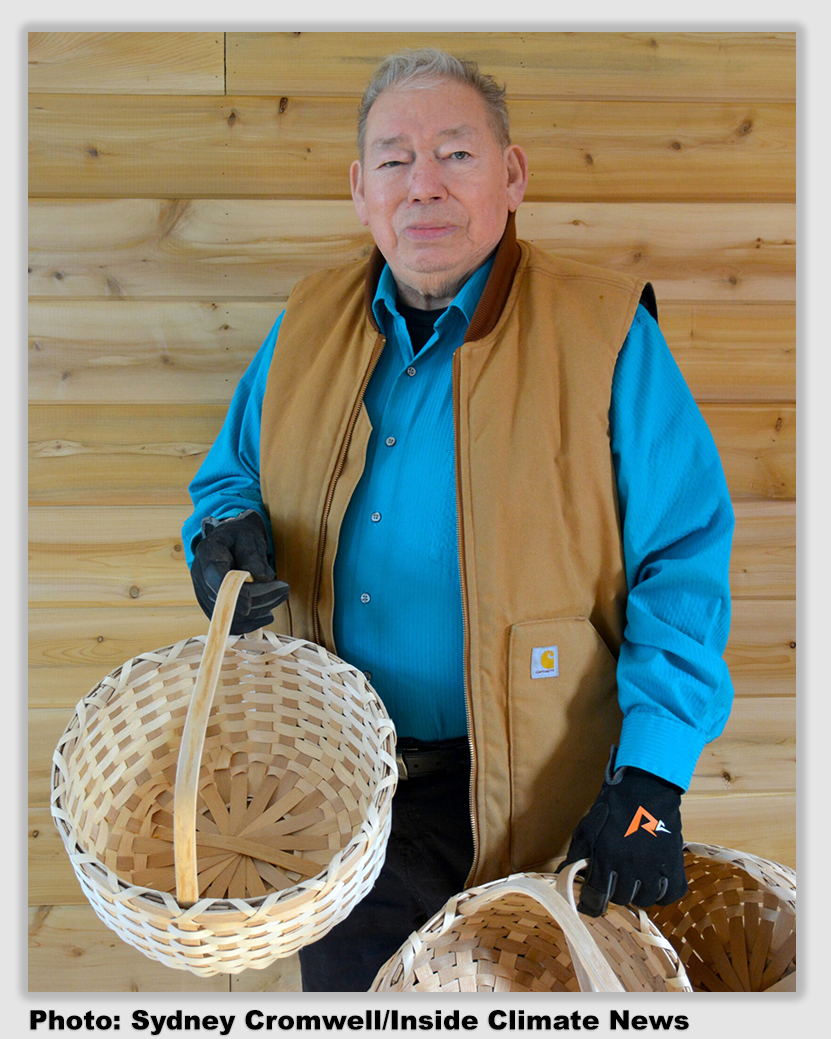 Inside Climate News, March 30, 2026: The Wabanaki Basketmakers’ Plans to Save Maine’s Ash Trees
Each strip of wood in Richard Silliboy’s hands started as a year of an ash tree’s life. Silliboy, 79, is a member of the Mi’kmaq tribe and a master basketmaker. His blue eyes are kind and frequently crinkle into a smile, and his hands are constantly busy as he talks. In his workshop in Littleton, Maine, surrounded by logs, splints and the sound of country music, Silliboy says making ash baskets is “so peaceful and spiritual.” His baskets are bound up in the past: the history of his tribe, his family and the trees themselves. But lately, Silliboy is thinking more about the ash tree’s future. The emerald ash borer, an invasive species of beetle, is creeping across Maine, bringing the possibility of near-total extinction for the state’s ash species, and a potentially devastating loss to what Silliboy calls “the oldest art in the Northeast.” But so far, a majority of Maine’s trees are alive and healthy, and tribe members, scientists and government officials are trying to keep it that way…
Nashville, Tennessee, WKRN-TV, March 30, 2026: Restoring West Nashville’s tree canopy
Ahead of Arbor Day, District 20 Metro Council member Rollin Horton is drafting a proclamation to mark the progress West Nashville has made in restoring its tree canopy. According to Horton, new development has taken out many mature trees that previously existed in and around The Nations. However, new rules in the district took effect last August to help restore some of the trees that have been lost. “A lot of times when developments come to our neighborhoods, they will scrape the entire lot, cut down four or five healthy, mature trees, and until recently only planted one in its place. And it’s really [led to] a significant loss of our tree canopy over the last 10 and a half years,” Horton said. “The tree canopy brings a lot of benefits to our neighborhood,” he continued. “It provides shade and privacy, helps combat the urban heat island effect, trees soak up a lot of storm water and combat the flooding problem that we have in our neighborhood. It also functions as natural traffic calming; it forces people to drive slower and more cautiously when there’s a lot of trees in the neighborhood…”
Cats are carnivores, but I can never turn down a juicy apple. I asked my friend Kate Evans about apple trees. She’s a plant biologist and apple breeder at Washington State University. She told me that how many apples appear on a tree starts with the blossoms. Every apple tree makes blossoms. Tucked inside the flower is the pollen-making part called the stamen. When a bee visits the apple blossom to slurp up nectar, it picks up some pollen there. Then the bee zooms to another apple tree. Some pollen falls off. It lands in the sticky center of the flower—on the pollen-catching part called the pistil. The pollen forms a tube that grows down to the bottom of the pistil. There, it fuses with an ovule. That makes an embryo inside a cute little package—an apple seed…
Spring tree pruning is often done to shape branches and encourage new growth. But DIY pruning can sometimes cause problems, especially if proper techniques or timing aren’t observed. Arborists are good resources for this kind of work, so we asked them about the most common spring pruning mistakes people make in their yards—and how to avoid them for peak tree health. Tree pruning can be relatively straightforward, or specialized and complex. Pruning for good tree health requires appropriate tools, proper methods and techniques, good timing, and knowledge of individual trees and their needs. Below are some common tree pruning mistakes observed by tree care professionals…

Washington state tree lovers were in shock last month when they found out that a forestry program that helps plant and sustain trees in urban areas was about to be eliminated. The Department of Natural Resources (DNR) was informed in February that the state House appropriations committee had a budget proposal that included the elimination of its urban forestry program. Urban forestry programs across Washington help communities sustain urban tree canopies, promote tree equity and plant and maintain vegetation in metropolitan environments. The News Tribune originally covered the House’s budget proposal on March 1. On March 11, Mike Carey, Tacoma’s urban forest program manager, received word that the proposal had been axed. The community showed up when there was the potential for taking out urban forestry funding,” Carey told The News Tribune. “The urban forestry council got all of their networks involved, and local officials who were concerned about losing potential grants that their communities had been awarded made themselves heard as well…”
Adirondack Explorer, March 29, 2026: A ‘three-legged stool’ of hemlock conservation

 Tree and Neighbor Law For Homeowners and Professionals