


Across the calm waters behind a pumping station near Lake Borgne, hundreds of saplings stand out in the mist, wrapped in white plastic cylinders. To get there and to other sites like it, organizers have ferried dozens of volunteers week after week in airboats. They have a trailer equipped with supplies. Rubber boots in all different sizes. Bins full of snacks for the end of a hard day’s work. One day, they hope to see 30,000 fully grown trees like bald cypress and water tupelo at this and other sites that restore the natural barrier of wetlands into the protective forest it once was. The goal is for the roots of these native trees to hold the earth around New Orleans in place as it slips further below sea level, create habitat for wildlife and help shield the city from storms. Much of that natural barrier was lost after Hurricane Katrina, which killed over 1,000 people and caused over $100 billion in damage in 2005. But many have been working since then to restore the land, and near the end of a long effort run by local environmental groups, organizers are reflecting on the roots they’ve helped put down — a more solid ecosystem, so different from the degraded marsh they started with…
A recent graduate of San José State University who went skiing at a California resort in Lake Tahoe was found dead along a trail, days after eight skiers were killed in a large avalanche in the region. Colin Kang, 21, the student, was found on a black diamond run, a challenging type of trail for expert skiers, by the Tahoe Nordic Search & Rescue Team on Thursday morning, the Placer County Sheriff’s Office said in a statement posted on social media. Elise Soviar, a spokesperson with the sheriff’s office, confirmed Mr. Kang’s identity on Friday. It appeared that Mr. Kang “fell into a tree well,” Ms. Soviar said, but his cause of death remained under investigation. A tree well is a hidden hollow that forms when snow piles up around the outside of trees, leaving an area under the tree that remains untouched and poses a risk to skiers, Ms. Soviar said. When skiers fall into deep tree wells, they can get stuck, she said, and there’s a chance that snow could collapse around them…
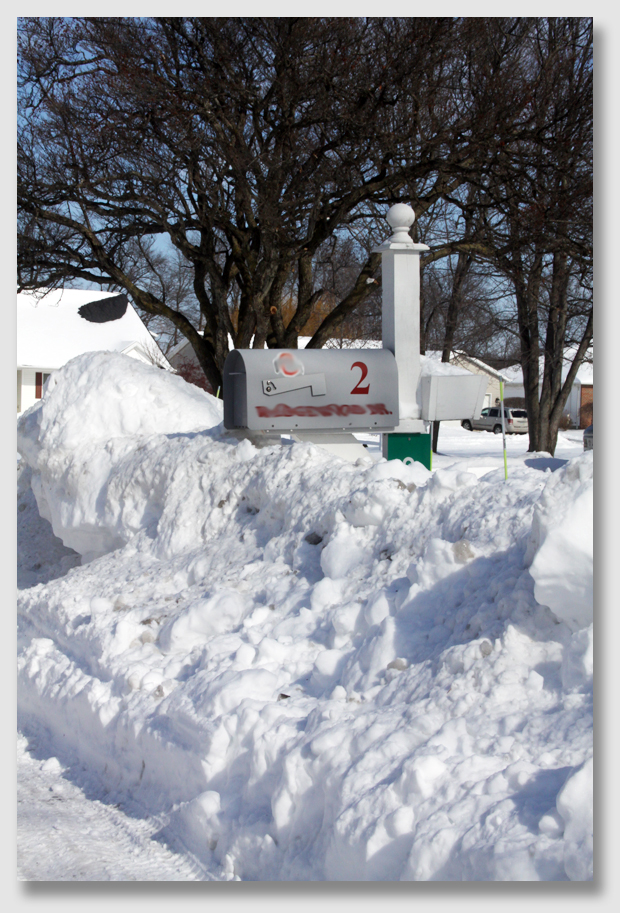
Residents are preparing to respond to downed trees and potential property damage, as a potential blizzard works its way through the Commonwealth. Locals are fixing their snowblowers, bucket trucks, cranes, and chainsaws for a winter storm that’s expected to encompass Massachusetts, with trees taking some of the punishment. “You know, once it’s fallen, that’s when you need a professional. The most dangerous form of tree work is storm damage,” said Arborist John Quinn. Quinn is with Hartney Graymont, a professional tree care service. He says the most dangerous and unpredictable form of tree work is storm damage, so it might be best to call an expert if a tree or two falls in your neighborhood. “We make sure major roadways are open, hospitals, all the most important stuff gets the first priority, but really it’s just you keep going until you’re done…”
Brentwood residents who lost trees in January’s winter storm have more than 100 different species to choose from when it comes to replacing theirs. The Brentwood Tree Board’s approved tree list contains 110 different species of trees — from maples, oaks, pines and spruces to hickories and fruit trees — should homeowners look to replace any trees they lost during the storm. The winter storm last month brought significant devastation to much of Middle Tennessee, downing trees across the Volunteer State, wrecking power lines and destroying forested areas. Cheekwood Estate & Gardens has been closed for weeks as staff assessed the devastation to the flora on the grounds. One of the 100-year-old oak trees that stood outside Cheekwood mansion did not survive the storm and had to be cut down, Cheekwood said earlier this month. The popular attraction announced this week it will reopen for Cheekwood in Bloom on March 7. According to Brentwood Parks Maintenance Supervisor Connor Schutzman, who is also on the Brentwood Tree Board, the city’s tree canopy “took a pretty big hit” in the winter storm. “We were hit pretty hard,” Schutzman said. “We’re obviously in the process of debris removal trying to get everything back to normal as quick as we can…”
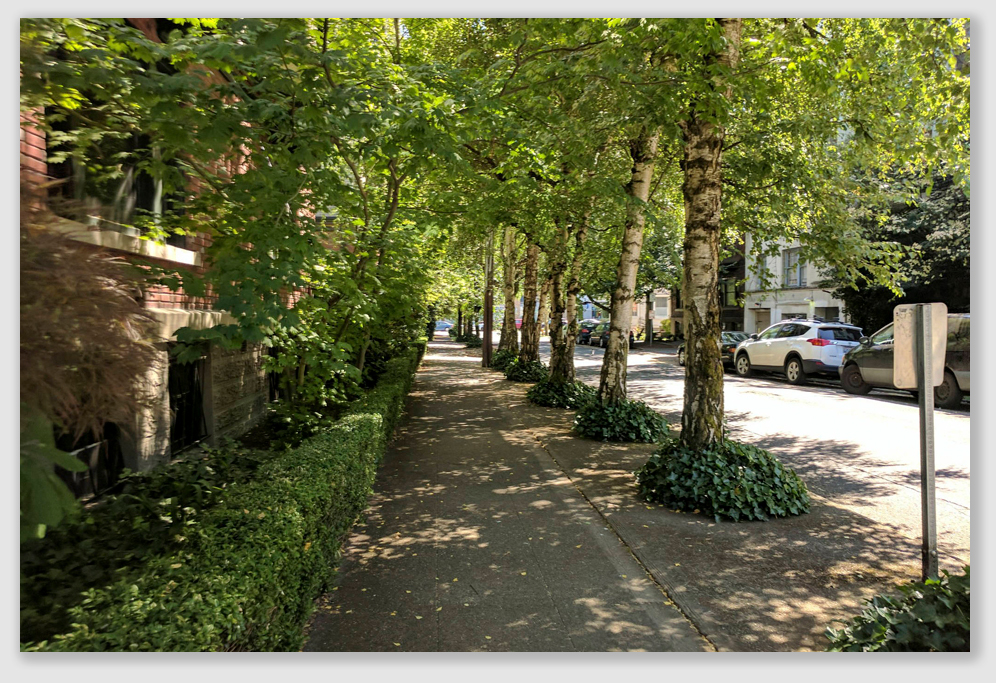 Brooklyn, New York, February 19, 2026: Brooklyn Heights to fill every empty tree bed with a new tree
Brooklyn Heights will become greener and shadier in 2026, with a plan to plant a new tree in every empty, viable tree bed, the Brooklyn Heights Association announced in their newsletter Thursday. All of the neighborhood’s street tree beds will be inspected by the BHA’s volunteer Brooklyn Heights Tree Team this spring, and, in partnership with the New York City Parks Department, planting will begin in the fall. For more information, email trees@thebha.org. The ambitious effort is in collaboration with Councilmember Lincoln Restler’s District 33 Street Tree Plan, which aims to fill every viable street tree bed from Greenpoint to Boerum Hill. Restler says his office has invested over $1.5 million in trees through capital allocations and donations to the District 33 Street Tree Fund. The goal is to plant more than 1,000 trees districtwide by the end of the year…
The City of South Portland, the Portland International Jetport and the Roman Catholic Diocese of Portland have reached a settlement agreement in a dispute over tree clearing in a South Portland neighborhood last year. In January 2025, the Portland Jetport began clearing trees on two plots of land owned by the Roman Catholic Bishop of Portland. The Jetport is required by federal regulations to maintain the airspace surrounding the airport for runway approach. But according to the City of South Portland, the tree cutting happened without site plan or tree protection plan approval from the city. The Jetport disturbed protected wetlands and removed more trees than had previous been agreed upon in a 2019 plan. Now, after months of litigation, the three parties have settled. The Jetport has agreed to pay $125,000 in restitution for cutting down trees and disturbing the adjacent wetlands and has committed to replanting at least 75 mature trees in the affected area, according to the settlement agreement…
Despite decades of industrial deposition, nitrogen availability in the boreal forest is steadily declining. In a new study published in Nature, researchers from the Swedish University of Agricultural Sciences using decades of unique, stored data have found that atmospheric CO₂ is the main driver. Studies from North America and global meta-analyses have in recent years shown declining nitrogen stable isotope values in tree rings, which serve as an indicator that nitrogen availability is decreasing over time. Why this happens is the key question. Two alternative theories have been proposed, either falling atmospheric N deposition rates since the 1990s, or rising CO₂ levels in the atmosphere. And that is what the new study from SLU by lead author Kelley Bassett, Ph.D. student at the Department of Forest Ecology and Management, has been able to answer, using 60 years’ worth of archived tree cores. The unique material works like a time machine, where the nitrogen isotope values of spruce and pine can be traced back decade by decade…
The owner of a Happy Valley-based company that did tree removal and landscaping was sentenced Wednesday to a year and three months in federal prison for failing to pay more than $3.5 million in taxes over seven years ending in 2024. Leard withheld taxes from her employees’ wages from 2017 to 2024 but did not pay the money to the Internal Revenue Service as required or file quarterly payroll tax returns, prosecutors said. She instead used the money to buy about $3.5 million in real estate in her name, according to Megan E. Wessel, a U.S. Department of Justice lawyer. She also failed to file personal income tax returns from 2017 through 2023, Wessel said. Wessel urged the judge to sentence Leard to two and a half years in prison and order her to pay $2.9 million in restitution, representing the amount of federal tax due minus payments already received from Leard. Leard failed to “fulfill serious legal obligations for many years and it should carry serious consequences,” Wessel said…
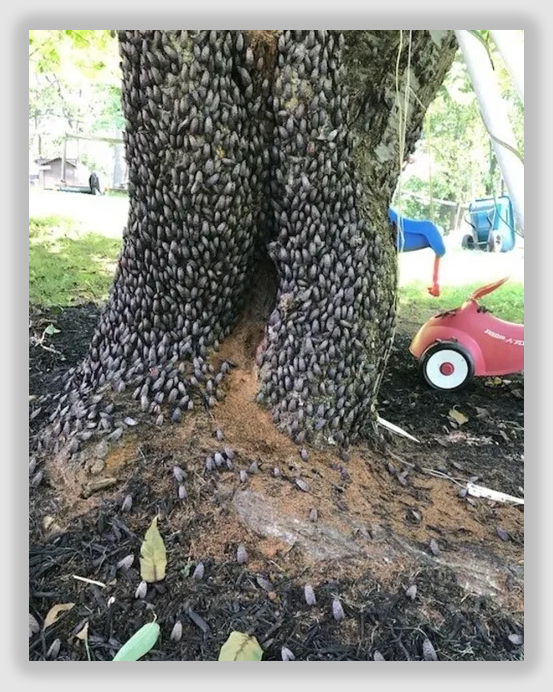
Under the quarantine, products such as trees and nursery stock may not be moved out of Ohio without a compliance agreement, permit or inspection certificate, according to ODA’s release. Producers who ship these products to non-regulated areas must have their stock inspected and each load must be accompanied by a certificate which confirms their product is free of SLF. The spotted lanternfly, native to Asia, was first spotted in North America in 2016, in Pennsylvania, according to the Ohio Department of Natural Resources. It was first identified in Ohio in 2020, per the Ohio Department of Agriculture. The insects feed on a variety of plants, causing them to wilt and die back, making them susceptible to damage from outside factors, such as mold. They’re particularly fond of the tree of heaven, also an invasive species, as well as grapes and hops, according to ODNR. The spotted lanternfly lays eggs from October through December, per the ODA. The egg masses — which are small and gray, and protected by a waxy coating — are placed in sheltered areas of trees, buildings, firewood, outdoor furniture, lawn equipment and rocks…
While plant life can be negatively impacted by extreme cold temperatures, Fort Worth’s tree canopy did not see “significant damage” during Winter Storm Fern, city officials say. The winter is an ideal time for Fort Worth’s urban forestry management team to prune trees, said city forester Hannah Johnson. Cold snaps typically prompt the city’s hazard abatement team to closely monitor reports and clear high-traffic roads of downed limbs or damaged trees, if any, to ensure conditions are safe for first responders. Forestry staff check young trees, either those just planted or growing at the city’s tree farm, are properly watered ahead of freezes. Moist soil helps insulate roots and reduces stress stemming from weather conditions on young trees, Johnson said…

With the ground saturated and more wind and rain on the way, tree experts say downed trees may be a common sight over the coming days. Janet Emmons and her family have lived on their property just off Squire Canyon Road in San Luis Obispo since 1995. Emmons says they are no strangers to tree problems, including the tree that fell overnight on their property. “We had a tree go down on the house about 15 years ago, so since then we’ve been very careful to make sure we monitor and trim limbs as much as we can,” Emmons said. That’s where Ron Rinell and his team at Bunyon Brothers come in. Emmons says she has him out about once a year to inspect things, or in cases like this, to do tree removal. “When the soil becomes saturated, it’s less for the tree roots to hold on to, so then you throw in the winds and we have a higher chance of leverage of trees to fall over,” said Bill VanHorbek, Master Arborist with Bunyon Brothers…
A Nevada couple visiting Disneyland were hit by a large tree just off Main Street U.S.A. that snapped and fell on top of them during a “crazy windy” night at the Anaheim theme park, according to social media reports. “My husband and I were the ones hit,” LeWanda Joseph of Las Vegas wrote on the Disneyland Magic Keyholders Facebook group. “The tree fell directly on top of us.” A ficus tree fell on Tuesday around 11:40 p.m. on the Plaza Inn patio that was unoccupied due to the rain, according to Disneyland officials. Two Disneyland guests in the area were treated by Disneyland First Aid for minor grazes and released, according to Disneyland officials. The Disney Fire Department worked with multiple Disneyland teams to clear the tree overnight, according to Disneyland officials. LeWanda and Mark Joseph were not seriously injured by the tree that fell near the Little Red Wagon corn dog cart between the Plaza Point shop and Plaza Inn restaurant…
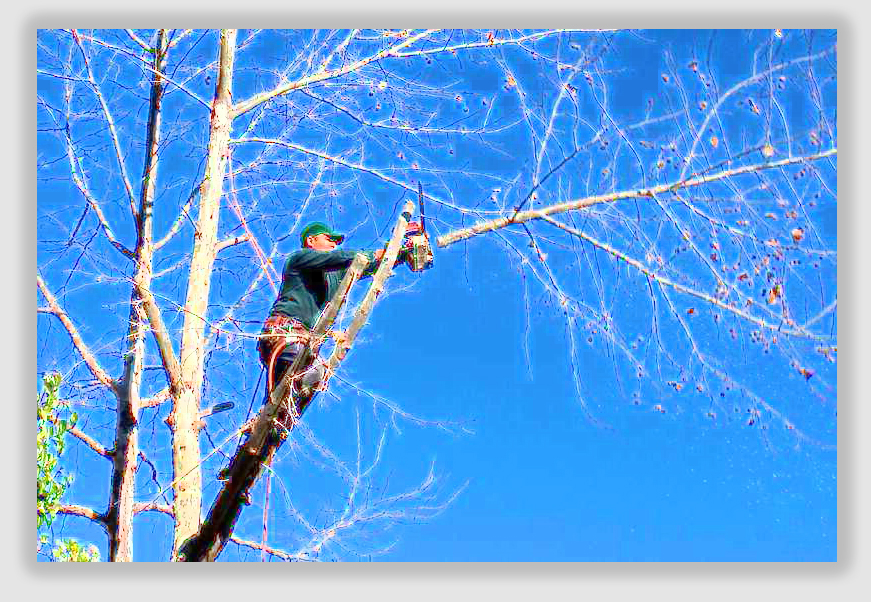
It’s a familiar experience: You step outside to find your yard covered with tree limbs and leaves. Washington residents may wonder what happens when it’s not your landscaping that is making a mess, but your neighbors’. Are you allowed to cut your neighbor’s tree if it’s across your property line? Who’s required to clean up leaves, twigs and broken branches that fall over the fence? Here’s what Washington state law says: In Washington state, who owns a tree “depends on the location of the tree’s trunk at ground level,” according to Sound Tree Care, a SeaTac company that provides arborist services throughout the Puget Sound. “If the entire trunk is located on one property, that tree is typically owned by that property owner,” Sound Tree Care said. If that trunk sits directly on the boundary between two properties, it belongs to both neighbors under Washington state law. “Ownership affects who can legally prune, remove or alter the tree,” Sound Tree Care says…
London, UK, BBC, February 15, 2026: Does a tree know it’s being eaten?
From roots to canopy, many trees can indeed tell if they are being eaten – and by whom. They have evolved extraordinary abilities to discern chewing by beetles and caterpillars, piercing and sucking by bugs, acoustic vibrations from grasshoppers, deer saliva, microbes left by various animals, even the stress signals released by nearby trees being browsed by giraffes. Many trees respond by making more unpalatable chemicals or growing tougher leaves. Oaks, for example, produce more tannins and phenol compounds after heavy grazing by caterpillars. Pines, elms, acacias and many others release alarm gases that attract predators, such as parasitic wasps, to attack their enemies. Lodgepole pines share information about mountain pine beetle infestations with neighbouring pines, and those trees react by boosting their own chemical defences. Climate stress may weaken such resilience, though. Research shows that Aleppo pines are up to 75 per cent less able to respond to a pine weevil attack during drought…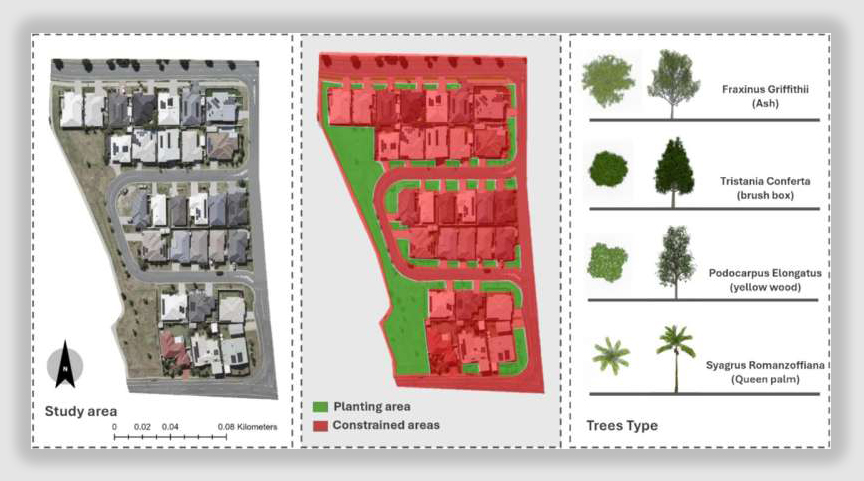 Phys.org, February 16, 2026: AI tool suggests tree species and placement to cool urban streets by 3.5 C
Urban landscapes could be cooled by up to 3.5 degrees using a QUT-developed AI-based tool that optimizes where trees and which species are planted to make cities cooler, greener and more resilient in the face of climate change. The study, Algorithmic urban greening for thermal resilience: AI-optimised tree placement and species selection, was published in Cities. First author Queensland University of Technology Ph.D. researcher Abdul Shaamala from its School of Architecture and Built Environment said city planners could use the tool to prioritize species and location of tree plantings in urban areas at risk of overheating during extreme heat. “The urban heat island effect—where built-up areas experience higher temperatures than surrounding areas—increases heat discomfort, energy consumption, and public health risks, especially for the elderly, children and low-income communities,” Mr. Shaamala said. “The strategic placement of urban trees chosen for their shade and cooling capacities is a promising way to harness their capacity to moderate microclimatic extremes…
Question: I am curious who is responsible for the cleanup of tree trimming by Duke power in an easement. They have destroyed a good portion of our (easement) property with radical tree trimming and tree felling. The debris — in some cases wrapped in old steel leader lines from the power lines — still remains on the hillside from three-plus months ago. Although I have called and emailed their sites/customer service, we are still left with much tree debris, pieces too big to move, and it is still there. The last tree that fell from the storm still remains in the middle of our parking lot of our business — in several large pieces. I was just given a “work order number” from the tree trimming (not debris cleanup) department and was told we would hear from someone in 10 business days. Who is responsible for this mess? This property is on Clarks Chapel Road in Weaverville.
My answer: Hmmm…gonna make a wild guess here and say, “Not Duke?”
Real answer: Duke Energy spokesperson Logan Stewart first noted that “trees and vegetation are the No. 1 leading cause of outages system wide. “This is especially true in western North Carolina where we have a large tree canopy,” Stewart said. “While our vegetation management program helps lessen storm damage and power outages, we do not clean up tree debris that results from severe weather.” Duke Energy says its top priority after a storm is to clear trees and restore power as soon as possible. The company is not responsible for removing tree debris, a spokesperson said. // Watchdog photo by John Boyle I drove by the area in question Tuesday, and you can see where the crews have cut around the power lines. There was one sizable log lying in the ditch that was wrapped up in the aforementioned leader cables, so that would be a difficult removal…

 Tree and Neighbor Law For Homeowners and Professionals