

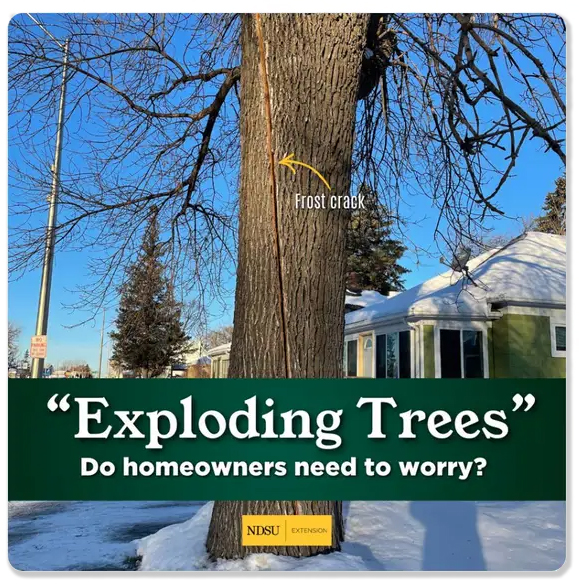
As Wisconsin and much of the upper Midwest prepare for rapidly dropping subzero temperatures, some viral social media posts warn people to watch out for “exploding trees.” The phenomenon, while bizarre-sounding, is real – kind of. Bill McNee, a forest health specialist with the Wisconsin Department of Natural Resources, said it’s not uncommon for a sudden drop in temperature to cause “frost cracks” in trees. These longitudinal cracks can run the full length of a tree and are accompanied by a loud “bang,” according to the DNR. McNee said frost cracks occur because the thick sap inside a tree freezes at a colder temperature than water, and usually stays liquid even when temperatures are well below freezing – a state known as “supercooling…”
Next City, January 20, 2026: How Stockholm Is Sprouting Healthy Trees From Concrete
When Stockholm’s Traffic Office conducted a general assessment of street traffic in the Swedish capital in 2001, it came to the shocking conclusion that two-thirds of all trees in the city center were dead or dying. City authorities agreed that an urgent response was needed to nurse these leafy urban ecosystem pillars back to health. Enter Björn Embrén, Stockholm’s first “tree officer.” Under his leadership, various technologies and materials were tested in an attempt to create a more suitable living space for trees in the urban environment. “I knew that they could grow if the circumstances were right,” says Embrén, a former professional gardener. The root of the problem was the fact that many trees in Stockholm were planted in the 19th century. Back then, the streets were comparatively underdeveloped, so the trees could grow relatively freely in the space underground. But as Stockholm has developed over the decades, like many cities across the world, its streets have been increasingly paved over with concrete, and more pipes — for plumbing, electricity, internet and beyond — have been laid underneath them. As a consequence, the roots of the trees have often been damaged through disruptive building works and, due to the lack of space and impermeable concrete, they have also been starved of oxygen and water…
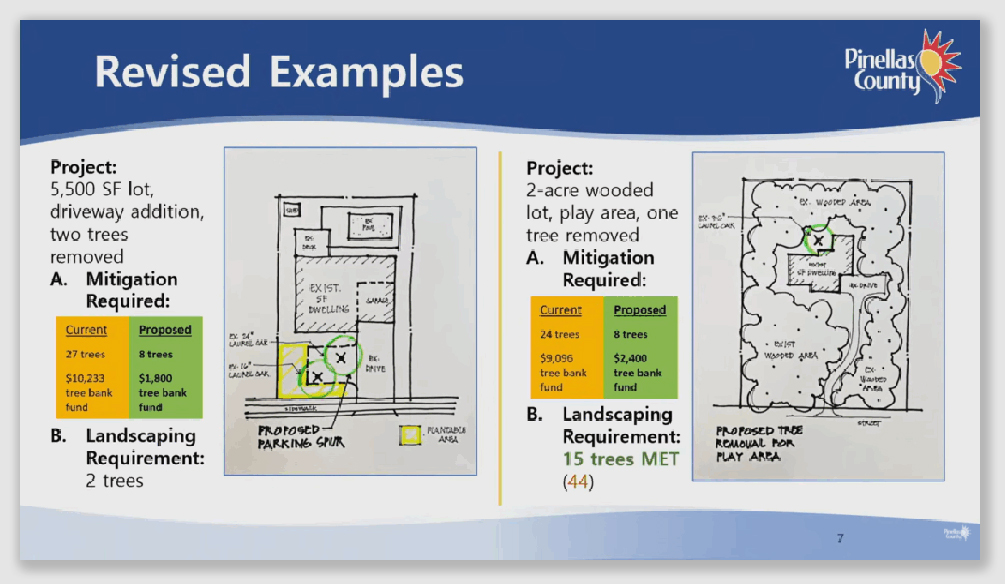
Pinellas County residents who remove an average-sized tree from their yard must no longer plant 15 others or pay over $7,000, solving what some commissioners believe is a “property rights issue.” County commissioners unanimously passed several ordinance amendments related to tree removal, protection and planting Tuesday. The goal was to mitigate overly burdensome regulations and simplify a complex – and costly – process that often resulted in disputes or unpermitted home improvements. Pinellas administrators initially proposed requiring residents who remove a tree with a diameter between 14 and 24 inches to plant four others or contribute $1,200 to a related fund. Commissioner Chris Scherer led the charge to remove those regulations. “There are lots of reasons for a homeowner to want to take the tree out of their front or back yard,” Scherer said. “Philosophically, I have a difficulty accepting the premise that I should have to go to the government to receive a permit to remove a tree that’s on my property. He also believes that residents should not have to hire an arborist, “argue with the county” and prove that a tree is dying. Scherer worked with administrators on a compromise for that “property rights issue…”
As North Texans brace for the incoming winter storm, preparing homes, vehicles, plants and beloved is top of mind. When it comes to preparing your room, experts say failing to check on your trees can be a costly mistake. In Texas, evergreen trees like Live Oaks and Magnolias are popular because they keep their green leaves year-round. However, when winter weather brings precipitation that turns to ice, that ice gets packed into those trees and weighs them down. Amy Langbein Heath, owner of Texas Tree Surgeons and a board-certified master arborist, said that ice can begin to stress tree branches and limbs if it sits for too long or strong winds start to blow. She and her crews were out across North Texas on Thursday afternoon securing and trimming tree limbs for customers before the storms moves in on Friday…
 Berkeley, California, The Daily Californian, January 21, 2026: Not every tree deserves a hug
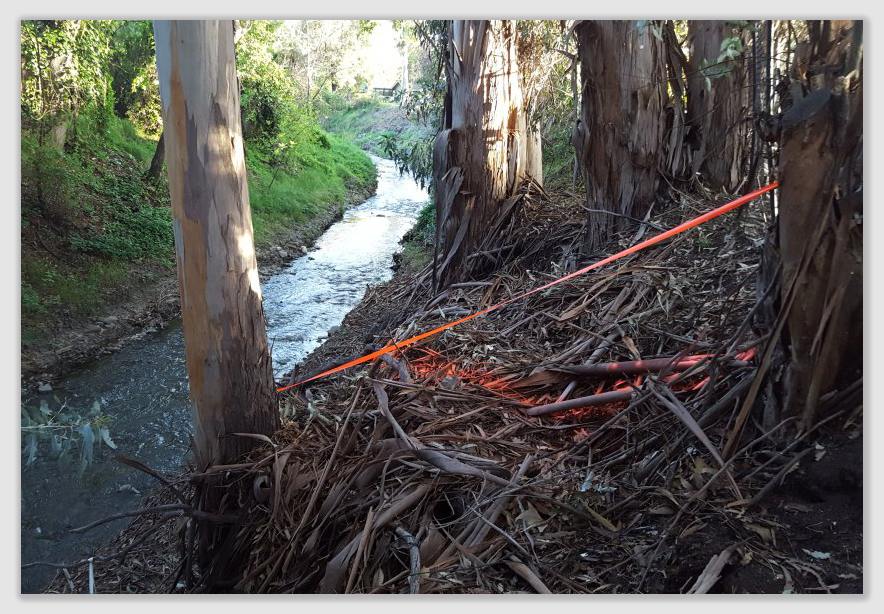
When walking by the Valley Life Sciences Building, you will be met with the aromatic smell of the tall eucalyptus trees. Native to Australia, these sweet-scented trees are well-known for their usage in essential oils and as food for koalas. Though the shaggy leaves and tall trunks of the eucalyptus are easy on the eye, a smoky reality lies behind its beauty. Naturally, eucalyptus is both dry and oil-rich, making the tree extremely flammable. These trees along the northern boundaries of the Lawrence National Berkeley Laboratory and UC Berkeley groves create a “line of fire,” potentially fueling a catastrophic fire that could ignite the eucalyptus groves on campus, along with hundreds of houses that stretch all the way down to the bay. Eucalyptus trees were introduced from Australia in the mid 1800s due to their rapid growth to meet the rising demand for wood. However, Americans soon realized the trees’ tendency to warp and break when dry, abandoning efforts to use eucalyptus as lumber. Yet the trees themselves remained…
Minneapolis, Minnesota, KARE-TV, January 21, 2026: Can trees ‘explode’ during winter weather?
Hazardous conditions are expected throughout much of the nation as a major winter storm continues to take shape this week. Days ahead of the storm’s expected arrival, there were some eye-popping claims getting attention online, including the risk of “exploding trees.” A social media post shared Tuesday warned about the possibility of “exploding trees” in the Midwest and Northern Plains on Friday, and it racked up thousands of likes on X. The extremely cold airmass is forecast to drop heavy snow, ice, and freezing rain from Texas to the Carolinas, creating hazardous travel conditions, power outages, and could burst pipes, according to the National Weather Service. Some forecasters have even warned that the drastic drop in temperatures could cause some trees to explode, but it’s not the type of explosion that might first come to mind. Trees have evolved amazing strategies to withstand extreme cold, but sometimes sudden temperature changes still prove to be too much for them to handle, according to the National Forest Foundation…
New Mexico’s Forestry Division is concerned after thousands of trees died last year due to warm temperatures, drought conditions, and native insects. Victor Lucero, the forest health program coordinator, said in 2024, about 67,000 acres of trees died. Last year, that jumped to about 209,000 acres. Most of the damage is south of I-40, including parts of the Lincoln National Forest near Ruidoso and areas west of Socorro in the Gila National Forest. The main culprit is native bark beetles. Lucero explained that when it’s warm and dry, trees get stressed and weakened, giving off chemicals that attract the beetles. Once the beetles get under the bark, they tunnel in, cut off the tree’s ability to move water and nutrients, and bring in fungi, leading to the tree’s death over time. Lucero also highlighted the broader implications, saying, “Not only, you know, are the trees killed by insects, but then it poses, you know, the potential for wildfire activity to be increased because now we have more fuel on the ground as a result of these die-offs…”
My thumb may be far from green, but for many Bozeman gardeners, that’s not the case. Still, with this unusual winter, some might start to worry. Jerry Cashman knows gardening well — he’s been in the nursery business off Springhill Road for more than 51 years, helping locals plant trees, grow perennials and tend their gardens. “We’ve been at this location for 51 years, and we’ve seen a lot of winters come and go,” Cashman said. Given his experience, I asked Cashman if this year’s winter weather was abnormal. He said it was — but it’s not the first time. “The winter of 1986 was the one I remember when Bridger Bowl didn’t open until about the 25th of January. There was no snow at all,” he said.
Walking through his nursery, Cashman explained how mild winters can hurt plants. “Well, the negative effects include the freezing and thawing of the bark,” he said. Particularly at risk, he noted, are deciduous trees — those that shed their leaves seasonally — such as maple, birch, chokecherry and lilac…

 Tree and Neighbor Law For Homeowners and Professionals